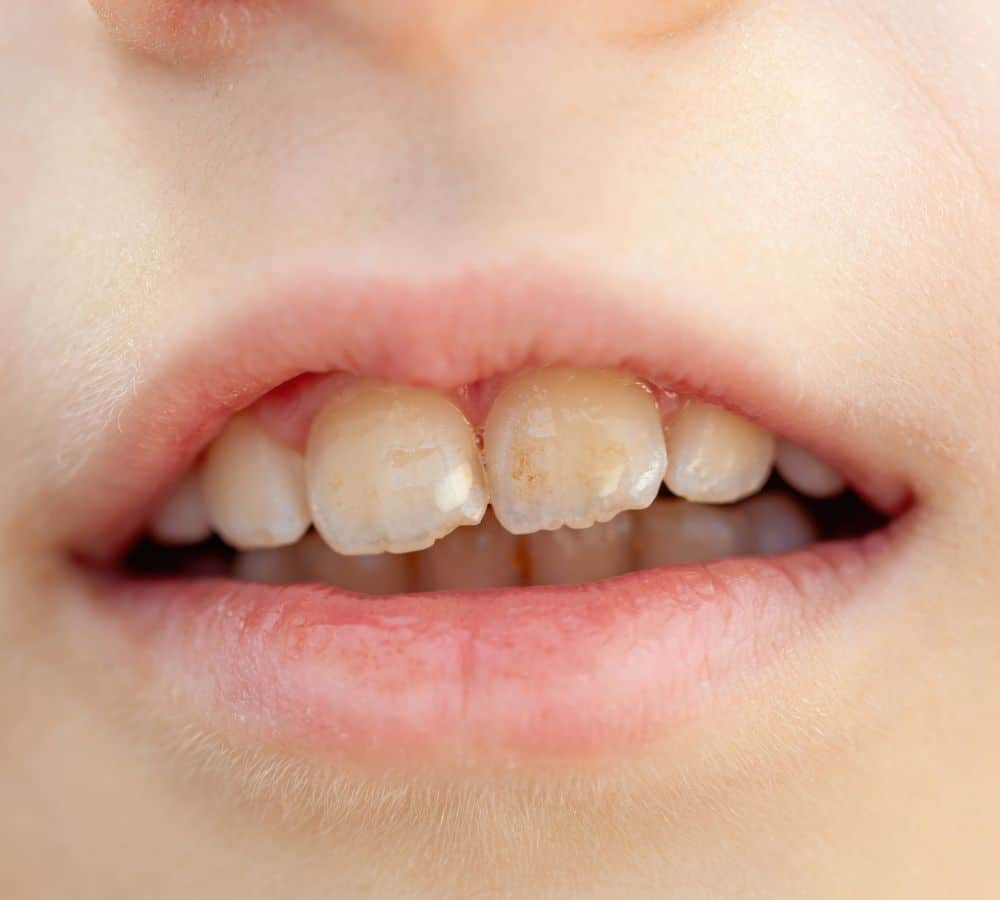
What causes white spots on teeth?
White spots range from a single dot on one tooth to marks across many teeth. The first step is working out why you have them — and then whether they need treating at all. The causes look similar and the treatments differ, so diagnosis comes first.
1. Tooth decay (hypocalcification)
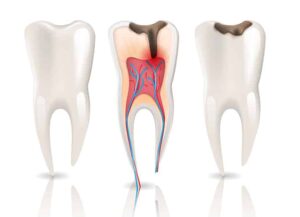
One of the most common causes, due to a loss of mineral content in the teeth. This is the earliest visible stage of decay, described in how does tooth decay develop? and the stages of dental decay — and it is the one stage that can still be reversed, which is why a white spot is worth acting on rather than watching. Can you reverse tooth decay, and do I need a filling? covers where that line sits.
That reversal has a name and a mechanism. The NHMRC describes fluoride as both "reducing demineralisation (i.e. where the enamel begins to dissolve)" and "enhancing remineralisation (i.e. recovery of weakened enamel)", the second of which "helps the repair of early tooth decay". A white spot is enamel that has lost mineral but not yet collapsed into a hole, which is exactly the stage that process can still act on.
Several things drive it:
Poor oral hygiene — a build-up of dental plaque leads to breakdown of the tooth, which appears as white spots in the enamel. The Australian Dental Association's description of the sequence: "the metabolism of simple carbohydrates by bacteria in the dental plaque ... produces acids", and those acids drop plaque pH "below the critical level leading to softening of tooth structure". What is the ideal daily routine for oral hygiene? and is flossing really that important? cover the removal side; how do I prevent dental decay? covers the rest.
Acidic drinks — these strip mineral from teeth even if sugar free, which surprises a lot of people. First step: stop drinking them immediately and replace with water where possible. Are sugar free soft drinks better for my teeth than regular soft drinks? and is soda water bad for your teeth? deal with the two drinks people most often assume are safe, and damage to tooth enamel occurs within 30 seconds of consuming soft drinks shows how fast the effect starts.
A high-sugar diet — causes white spots that often develop into decay. First step: limit the sugar. The World Health Organization's recommendation is to keep free sugars below 10% of total energy intake, and it suggests below 5% to reduce decay risk further. See how does sugar affect your dental health?, how does your diet affect your teeth? and six foods to avoid for healthy teeth.
A dry mouth — saliva becomes acidic and mineral is lost. Medications, dehydration and medical conditions can all cause it; the Better Health Channel notes that "about 600 drugs and medications" are known to cause dry mouth, and that "a dry mouth significantly increases the risk of tooth decay and other oral diseases". Diagnosing the cause is important, and if something can be changed — a different medication, for instance — it should be. My mouth is always dry — why is this and does it affect my teeth?, my mouth always feels dry! What can I do? and what causes dry mouth during running? each cover a different version of it.
Stomach acid — damaging to teeth. Gastric reflux is one of the most common reasons for acid damage. Morning sickness, illness causing vomiting, and bulimia can also produce white spots. What is dental erosion and how is it addressed?, how does acidic food affect your teeth? and what is acid wear and how can I avoid it? describe the damage pattern. If morning sickness is the cause, how do I protect my teeth during pregnancy? and oral health care while pregnant give the practical steps — including why brushing immediately after vomiting makes it worse rather than better.
What to do: see your general dentist for a dental exam with radiographs, a thorough scale and clean with oral hygiene instruction, and then treatment of the white spots. Regular maintenance visits after that are essential — the causes above tend to persist unless addressed. Your Smile Solutions dental hygienist visit: what to expect and dental cleans and hygienists describe the clean; how safe are dental x-rays and how safe are dental X-rays and when do they become unsafe? answer the radiograph question.
2. Fluorosis
Occurs when excess fluoride is consumed while the teeth are forming, in the first eight years of life.
The NHMRC's description is almost identical: dental fluorosis is "caused by a high intake of fluoride from multiple sources during the time when teeth are developing inside the jawbone, usually from birth to six or eight years of age", and "can appear as white lines or areas on the surface of both primary and permanent teeth", identified only after the teeth erupt.
It tends to affect most of the teeth, ranging from mild white spots or lines to brown spots, and can make the enamel rough and pitted.
Two pieces of Australian context are worth having before you worry about this. The first is severity: the NHMRC states that in Australia, where fluorosis is identified, "in most cases it is classified as very mild or mild", and that "mild to very mild dental fluorosis does not affect the function of the teeth, is not of aesthetic concern to those who have it and is associated with a protective benefit against tooth decay in adult teeth." "Moderate dental fluorosis is very uncommon and severe dental fluorosis is rare in Australia." The rough, pitted, brown-spotted presentation described above is the severe end, and it is not what most Australians with fluorosis have.
The second is the direction of travel, which is not the one people expect: "In Australia dental fluorosis has declined over the time period during which the extent of community water fluoridation has expanded." The NHMRC attributes the decline to reduced fluoride from other sources, particularly the availability of low-fluoride children's toothpaste and the advice that goes with it — "use only a small pea-sized amount; encourage children not to swallow toothpaste." It also reports that the very small amount of moderate and severe fluorosis in Australian children aged 8–14 is not statistically different between fluoridated and non-fluoridated areas. For reference, the NHMRC supports fluoride in Australian drinking water "between 0.6 and 1.1 mg/L", a range chosen to reduce decay "while avoiding any risk of dental fluorosis of aesthetic concern."
This is the point where fluoride cuts both ways, and the corpus does not pretend otherwise: the benefits of fluoride sets out the protective effect, while fluoridated water — is it good for you? and fluoridated water: why I worry put both sides of the water debate. For toothpaste specifically — which is where most childhood over-exposure actually comes from — see selecting a toothpaste: fluoride or non-fluoride? and choosing the right toothpaste.
Treatment depends on severity:
- Mild — often treated with tooth whitening and micro-abrasion, helping the spots fade into the natural tooth colour
- Severe — may involve composite resin white fillings or porcelain veneers
If the enamel is pitted you are more susceptible to decay, so regular check-ups and X-rays matter more than usual — how often should I go to the dentist? explains why the interval is a clinical judgement rather than a fixed six months.
3. Genetic disorders
Amelogenesis imperfecta is a genetic disorder disturbing the development of the teeth. It can affect both baby and adult teeth, and is caused when proteins malfunction during enamel formation.
It leads to increased risk of decay and tooth sensitivity. If you suspect it in yourself or a family member, seek diagnosis and treatment with your general dentist. What to do if you suffer from sensitive teeth covers the symptom in the meantime.
A related and much more common enamel defect in children is molar hypomineralisation, which people know as chalky teeth: everything you need to know about chalky teeth. Where a child’s enamel is affected across several teeth, a specialist paediatric dentist is often the right referral — should your child see a specialist paediatric dentist? explains when, and children’s dentistry covers the service.
4. Trauma
Sometimes a single tooth has a white spot caused by trauma to the area, or by a disturbance to enamel formation while the tooth was developing. It is common on the front teeth.
A single spot on one front tooth in an otherwise unaffected mouth points here rather than to fluorosis or coeliac disease, which affect many teeth.
Where the same trauma also chipped the tooth, see what should I do if I have a chipped tooth? and chipped and cracked teeth.
Treatment: sometimes micro-abrasion and whitening lessen the appearance. In some situations composite resin fillings or porcelain veneers are used to mask the spot and blend it with the other teeth.
5. Coeliac disease
Coeliac disease is a condition in which gluten cannot be tolerated, and it has manifestations beyond gastrointestinal problems.
It can cause white spots while the enamel is forming, and this can be one of the first markers of the disease in children.
The appearance can resemble fluorosis or tetracycline staining. If there is no reason for either of those conditions, referral to a GP for coeliac testing may be warranted — which makes this one of the few dental findings that can lead to a significant medical diagnosis. Dental health and general wellbeing covers other examples of the mouth showing something systemic first.
The tooth defects are permanent. Treatment in older children and adults may involve whitening, micro-abrasion, composite fillings or porcelain veneers.
6. Medications
Antibiotics such as tetracycline and doxycycline can cause white spots if given to a child whose teeth are still developing.
This type of discolouration tends to affect most of the teeth. Treatment is tooth whitening, composite resin bonding, or porcelain veneers.
What to do about it
If you are concerned about white spots, seek a diagnosis from your general dentist first. Once the reason is known, treatment can be chosen from:
- tooth whitening — teeth whitening, what should I know about teeth whitening? and why should I go to a dentist for teeth whitening?. Worth knowing before you start: whitening changes the natural enamel and not the spot, so a white mark can look more obvious for a period before the surrounding tooth catches up — how can I improve the whiteness of my teeth? covers what whitening can and cannot shift. There is also a legal line here. Under Schedule 10 of the Poisons Standard, products containing more than 6% hydrogen peroxide or 18% carbamide peroxide may only be sold, supplied and used by registered dental practitioners — which is why, as Healthdirect Australia puts it, "at-home tooth whitening kits do not contain the same concentration of bleaching agents as those dental practitioners use."
- micro-abrasion
- composite resin white fillings — composite bonding, composite bonding: will it look natural and how long will it last? and the differences between dental bonding and veneers
- porcelain veneer bonding — porcelain veneers, how long do porcelain veneers last? and what is the difference between composite veneers and porcelain veneers?
The options are listed deliberately in that order: whitening and micro-abrasion remove nothing that cannot be spared, composite adds material without cutting the tooth, and veneers require the tooth to be prepared. It is worth exhausting the conservative options before agreeing to the irreversible one. If the spots are part of a wider concern about how your teeth look, I want a smile makeover — where should I start? and cosmetic dentistry are the sensible first reads, and the mock-up reveal lets you see a proposed result before any tooth is touched. Fees for each option are set out in the price guide.
The pattern is the clue — one tooth points to trauma, most teeth points to fluorosis, medication or coeliac disease, and spots concentrated around the gum line point to decay.
Common questions
How do I check my child's teeth at home without guessing?
There is a simple check the Australian Dental Association recommends to parents, and it takes about ten seconds. Its consumer guidance is to "check your child's teeth at home by lifting their lips and looking at the surface of the teeth," and to "look out for brown, black or white spots that cannot be removed."
The operative words are lifting their lips and cannot be removed. Early decay tends to start where the tooth meets the gum on the front surfaces — exactly the band a closed lip hides — and a mark that brushes away is food or plaque rather than a change in the enamel. A mark that is still there after brushing is worth a photograph and a mention at the next appointment.
It is a screening check, not a diagnosis. It will not tell you whether what you are looking at is early decay, fluorosis or an enamel defect, and those need different responses. What it will do is stop a white band sitting unnoticed behind a lip for a year.
What actually happens if I do nothing?
That depends entirely on which cause you have, which is the practical reason the diagnosis comes first.
If the spot is early decay, doing nothing is a decision with a direction. White-spot enamel has lost mineral but has not yet collapsed into a cavity, and the NHMRC describes fluoride as "enhancing remineralisation (i.e. recovery of weakened enamel)", which "helps the repair of early tooth decay." That window does not stay open. Once the surface breaks, no amount of fluoride or brushing puts it back and the treatment becomes a filling.
If the spot is mild fluorosis, doing nothing is often the right answer. The NHMRC's own assessment of mild and very mild fluorosis is that it "does not affect the function of the teeth, is not of aesthetic concern to those who have it and is associated with a protective benefit against tooth decay in adult teeth."
If the spot is from coeliac disease, a genetic enamel disorder, trauma or childhood medication, the enamel defect itself will not progress and will not improve — but the teeth involved may be more prone to decay and sensitivity, so the monitoring matters more than the mark does.
Three causes, three completely different answers to the same question. That is why "is it getting worse?" is a better thing to ask your dentist than "can you get rid of it?"
White marks appeared after my braces came off. Why?
This is the decay pathway described at the top of this page, running in the places a brush could not reach. Brackets create sheltered surfaces where plaque sits undisturbed, and as the ADA describes the mechanism, "the metabolism of simple carbohydrates by bacteria in the dental plaque ... produces acids" that drop the pH "below the critical level leading to softening of tooth structure." The bracket protects the enamel underneath it; the margin around it does not get the same protection.
The ADA's practical guidance during orthodontic treatment is more demanding than ordinary brushing for exactly this reason: "It is very important to brush and clean between your teeth well while you are having orthodontic treatment. For people wearing braces, brushing after every meal is recommended as food can get stuck around the brackets." It adds a step most people skip — "after brushing, spit out the excess toothpaste but do not rinse your mouth with water. This allows the fluoride paste to sit on the teeth for longer, increasing protection." For cleaning between brackets it points to floss threaders or interdental brushes rather than plain string floss.
If the marks are already there, they are early demineralisation rather than a stain, so scrubbing harder will not lift them. Have them assessed: some settle as saliva remineralises them over months, and micro-abrasion or resin infiltration may be offered for those that do not. See what are the most common complaints associated with conventional braces? and orthodontics.
Should I stop my child's fluoride toothpaste to avoid fluorosis?
No — and the Australian evidence points the other way. Fluorosis is about how much fluoride a young child swallows from all sources while the teeth are forming, not about whether fluoride toothpaste is used at all.
The NHMRC's account of what changed in Australia is the clearest answer available: "In Australia dental fluorosis has declined over the time period during which the extent of community water fluoridation has expanded." It links that decline to reduced exposure to fluoride from other sources such as toothpaste, now available in low-fluoride formulations for children, "actively promoted along with public health messages and guidelines about the appropriate use of these products (e.g. use only a small pea-sized amount; encourage children not to swallow toothpaste)."
So the lever is the amount on the brush and whether it is swallowed, not removal. Removing fluoride removes the protection the NHMRC credits with "reducing demineralisation" and "enhancing remineralisation" — and, in its assessment, mild fluorosis itself carries "a protective benefit against tooth decay in adult teeth."
If you are worried, the conversation to have is about total exposure — toothpaste amount, supervision, whether it is being swallowed, and any supplements — rather than a decision to stop. Take it to your dentist rather than making it alone. Children's dentistry and the benefits of fluoride cover both sides.
My dentist said to watch it. Is that a reasonable answer?
Often, yes — but it should come with three specifics, and you are entitled to ask for them.
Watching is a defensible plan for mild fluorosis, for a stable enamel defect, and for an early decay white spot that is being given a chance to remineralise. It is not a defensible plan if nobody has said which of those it is.
Ask for the three things that turn watching into a plan:
- Which cause is this, and how confident are you? The pattern usually tells — one tooth suggests trauma, most teeth suggests fluorosis, medication or coeliac disease, marks along the gum line suggest decay.
- What would have to change for us to act? A mark that grows, roughens, catches a probe or darkens is a different situation from one that has looked identical for three years.
- What am I meant to be doing in the meantime? If the answer is remineralisation, then the toothpaste, the diet and the acid exposures described above are the treatment — not a holding pattern while it is watched.
A photograph at each visit is the honest version of watching, because memory is a poor instrument for slow change. If your practice does not take one, ask whether it can.
Related reading
- The mock-up reveal: why you should see your new smile before any treatment begins
- What are my options if I want to change the shape of my teeth?
- How can I change my smile naturally
- What causes the dull, chalky look — the stages of dental decay
- Protecting your child from dental disease
Practical details
Smile Solutions, Level 1, 220 Collins Street, Manchester Unity Building, Melbourne VIC 3000 — getting here. Phone 13 13 96, contact us, or theteam@smilesolutions.com.au. Monday–Friday 8.00am–6.00pm, Saturday 8.30am–1.30pm, Sunday by appointment.
Specialist registration can be verified on the AHPRA register, or by calling 1300 419 495. The practice’s registered specialists are identified as such within the full team.
Published 8 December 2015. General information only; it does not replace advice from your treating practitioner. Cosmetic results vary between individuals.
Smile Solutions trades under ABN 28 193 514 103.
Images on This Page
-
https://www.facebook.com/tr?id=800557773428361&ev=PageView&noscript=1
(no alt text)
-
https://www.smilesolutions.com.au/wp-content/uploads/2025/10/calendar_month.svg
(no alt text)
-
https://www.smilesolutions.com.au/wp-content/themes/arcadian-wordpress-theme/assets/images/smile_solutions_logo_white.png
Smile Solutions Logo
-
https://www.smilesolutions.com.au/wp-content/themes/arcadian-wordpress-theme/assets/images/smile_solutions_logo_purple.png
Smile Solutions Logo
-
https://www.smilesolutions.com.au/wp-content/uploads/2023/11/SS-Tooth-1-1-150x150.png
Smile Solutions
-
https://www.smilesolutions.com.au/wp-content/uploads/2015/12/white-spots-on-teeth.jpg
What causes white spots on teeth?
-
https://www.smilesolutions.com.au/wp-content/uploads/2025/09/Root-Canal-2-300x217.jpg
Root Canal
-
https://www.smilesolutions.com.au/wp-content/uploads/2026/08/Mouth-Breathing-300x270.jpg
Mouth Breathing
-
https://www.smilesolutions.com.au/wp-content/uploads/2025/09/Dental-Crown-at-Smile-Solutions-300x300.jpg
Dental Crown at Smile Solutions
-
https://www.smilesolutions.com.au/wp-content/themes/arcadian-wordpress-theme/assets/images/family_owned_bussiness.png
Family Owned Business
-
https://www.smilesolutions.com.au/wp-content/themes/arcadian-wordpress-theme/assets/icons/icon--phone.svg
Smile Solutions Contact
-
https://www.facebook.com/tr? id=800557773428361&ev=PageView&noscript=1
(no alt text)
-
https://bat.bing.com/action/0?ti=25148060&tm=gtm002&Ver=2&mid=ca86658f-93cb-4d52-9a5f-b2063074f9de&bo=1&sid=9375b140ab2511f19ff0e99eb876bb7c&vid=9375a6e0ab2511f1bf42f3fee69b58de&vids=1&msclkid=N&pi=918639831&lg=en-US&sw=800&sh=600&sc=24&nwd=1&tl=What%20causes%20white%20spots%20on%20teeth%3F%20-%20Smile%20Solutions&p=https%3A%2F%2Fwww.smilesolutions.com.au%2Fdental-articles%2Farticle%2Fcauses-white-spots-teeth%2F&r=&evt=pageLoad&sv=2&cdb=AQAQ&rn=681881
(no alt text)