Choosing the right toothpaste
Most people don't put much thought into which toothpaste they buy. But beyond the freshly cleaned feeling, toothpaste plays an essential role in the care of your teeth and gums — and the differences between types are real.
One thing to settle before the shelf, though: the paste is not what removes plaque. Plaque is a biofilm — a structured, adherent community of bacteria — and only mechanical disruption removes it: the bristles of the brush, and floss or an interdental brush between the teeth. Toothpaste is how fluoride gets to the tooth. What is the ideal daily routine for oral hygiene?, which toothbrushes do dentists recommend? and is flossing really that important?
Fluoridated toothpaste
The majority of toothpastes at the supermarket contain fluoride — a naturally occurring mineral that helps fight decay by strengthening your teeth from within. The benefits of fluoride covers this in full, and selecting a toothpaste: fluoride or non-fluoride addresses the choice directly.
How it works: fluoride is absorbed into weakened areas of your enamel and forms a hard mineral called fluorapatite, which is resistant to acid attack — the main cause of decay. How does tooth decay develop?, the stages of dental decay and how does sugar affect your dental health?
This is worth understanding properly. Fluoride is not a cleaning agent. It changes the chemistry of the enamel surface so that the acid produced by plaque bacteria does less damage. What can I do to strengthen my teeth?
The NHMRC describes the same effect in two directions: fluoride works by “reducing demineralisation (i.e. where the enamel begins to dissolve)” and by “enhancing remineralisation (i.e. recovery of weakened enamel)”, which “helps the repair of early tooth decay”. It adds that fluoride “also slows the activity of bacteria that cause decay” — a third mechanism most people have never heard of. (Source: NHMRC, Water Fluoridation and Human Health in Australia: Questions and Answers.)
Fluoride is most easily absorbed when applied directly to the teeth, which is what the twice-yearly fluoride treatments at the dentist do. Toothpaste carries much lower concentrations than those treatments, but it is the crucial element keeping your teeth protected between visits. Dental cleans and hygienists and your Smile Solutions dental hygienist visit: what to expect
The concentration that matters, and where it comes from
This is the one number worth carrying to the shelf, and it comes from the World Health Organization rather than from any manufacturer. In setting out how decay develops, the WHO names as a cause “a lack of removal of plaque by toothbrushing with fluoride toothpaste containing 1000-1500 ppm concentration” — which is, in effect, the concentration range a standard adult toothpaste is expected to deliver. Most Australian supermarket pastes state their fluoride content on the back of the pack; it is worth a look. (Source: WHO fact sheet, Sugars and dental caries.)
Two habits get more out of the same tube, at no cost:
- Spit, don't rinse. Rinsing with water straight after brushing washes the fluoride away before it can work. The Australian Dental Association puts it the same way in its own brushing sequence: “After brushing, spit out the excess toothpaste but do not rinse your mouth with water. This allows the fluoride paste to sit on the teeth for longer, increasing protection.”
- Wait about an hour after anything acidic before brushing — acid softens enamel temporarily, and brushing immediately abrades the softened layer off. Brushing your teeth: before or after breakfast? and what is dental erosion and how is it addressed?
Used correctly, fluoride in toothpaste is safe and effective for both adults and children.
Two important qualifications:
- Infants from 18 months to 6 years should use a children's toothpaste with a lower fluoride concentration — children's dentistry, kids teeth cleaning tips and how to encourage your child to brush their teeth
- All fluoridated toothpaste should be spat out, not swallowed
Both of those have published backing. The ADA's consumer guidance is that babies do not need toothpaste at all, and that it should be started when the child is 18 months old. The NHMRC, explaining why dental fluorosis has declined in Australia, credits the promotion of low fluoride toothpastes for children alongside public health messages about their appropriate use — specifically, “use only a small pea-sized amount” and “encourage children not to swallow toothpaste.” (Sources: Australian Dental Association, teeth.org.au; NHMRC, as above.)
One regulatory point that surprises people: fluoride toothpaste is not a registered medicine in Australia. The NHMRC states that “the Therapeutic Goods Administration (TGA) does not require fluoride compounds, such as those added to fluoride toothpaste … to be registered as medicines if they are used for the prevention of dental decay.” That is a statement about how the product is classified, not about whether it works — and it is why you will not find a TGA registration number on a tube.
The water-supply argument is a separate one, and both sides are published here: fluoridated water — is it good for you? and fluoridated water: why I worry.
Toothpastes for sensitive teeth
If your teeth are sensitive to cold, your dentist may recommend a specially formulated sensitive toothpaste. What to do if you suffer from sensitive teeth
How they work: they generally contain potassium- or strontium-based salts that block off the tiny passageways — dentinal tubules — between the nerve of the tooth and the outside surface.
The process is gradual. Allow a few weeks to build up resistance to sensitivity. People often abandon these products after a few days, concluding they don't work, when in fact they were not given time to.
Switching is often an effective, conservative method of dealing with generalised sensitivity — conservative meaning it costs little and removes no tooth structure.
Two things worth ruling out first. Sensitivity along the gum line often comes from recession caused by brushing too hard, and recession does not grow back — over brushing: what can it do to my teeth? and how much pressure should I apply when brushing my teeth?. Sensitivity that is sharp, new, or lingers after the cold has gone should be examined rather than managed with a paste — why does a cracked tooth hurt so much? and what are the causes of toothache and what are their symptoms?
Whitening toothpastes — not recommended
These are perhaps the most heavily marketed dental pastes available, which is not the same as the most effective.
How they work: mainly through added abrasives, which mechanically remove superficial stains from caffeine, smoking and the like on the outer layer of the teeth. What impact does wine have on my teeth?
The problem: used excessively, those abrasives also wear away weak portions of the tooth itself and expose the inner, yellow layer.
So the outcome is doubly counterproductive — lost tooth structure and, ironically, loss of brightness. The product marketed to make teeth whiter can make them look yellower over years of use. Teeth and aging: how can I keep my smile looking younger?
What a whitening toothpaste is not
The ADA draws the line explicitly in the definitions section of its whitening policy. Teeth whitening means products “designed to penetrate the teeth and bleach intrinsic and/or extrinsic tooth discolourations, as opposed to products such as whitening toothpastes that are intended to remove surface staining.” In the ADA's own classification, a whitening toothpaste is not a whitening product at all — it is a stain remover.
There is also a regulatory ceiling on what can be sold to you over the counter. The Poisons Standard treats hydrogen peroxide at 3–6% and carbamide peroxide at 9–18% as Schedule 5 substances requiring “Caution”, meaning products up to those concentrations can be sold direct to consumers if labelled with the stipulated safety warnings. Above that, Schedule 10 restricts products containing more than 6% hydrogen peroxide or 18% carbamide peroxide to sale, supply and use by registered dental practitioners. The ADA notes that weak solutions of under 3% hydrogen peroxide “have been used in the oral cavity in the form of mouthwashes and toothpaste for many years with few problems”, while “the potential for adverse effects on the oral tissues is increased when higher concentrations are used.”
It also observes that “the marketing of some teeth whitening products directly available to Australian consumers encourages unrealistic expectations about whitening results and promotes regular ongoing use to maintain desired effects”, which it describes as a concern “given the lack of clinical data supporting frequent home use of such products over long periods”. That is the published version of the argument this page has always made. (Source: ADA Policy Statement 2.2.8, Teeth Whitening (Bleaching) By Persons other than Dental Practitioners.)
We do not recommend toothpastes with harsh abrasives. For a whiter smile, the more viable options are professional whitening — both at-home kits and in-chair services: teeth whitening, home teeth whitening versus having your teeth whitened at the dentist and home whitening and charcoal whitening: does it work, is it safe?. Published fees are in the price guide.
Much of what whitening pastes are bought to do — removing surface stain — is done better and without abrasion at a hygienist appointment.
Toothpastes for high-risk patients
High-strength fluoride toothpaste may benefit you if you are more prone to decay than most people — because of the structure of your teeth, your medical history, or your lifestyle. These products are specialised for high-risk individuals and deliver more protection against cavities than standard alternatives. How do I prevent dental decay?, my mouth always feels dry! What can I do? and diabetes and oral health cover the common risk factors.
On who counts as higher risk, the ADA's diet and nutrition policy names people with conditions that reduce salivary flow, people taking medications that reduce salivary flow, and older people, for whom reduced saliva flow and more exposed root surfaces raise the risk of decay. If one of those describes you, that is a conversation to have at your next appointment rather than a decision to make in the supermarket aisle. (Source: ADA Policy Statement 2.2.2, Diet and Nutrition.)
Specialised antibacterial toothpaste may be an option if you are at increased risk of periodontal (gum) disease — what is gum disease? and periodontal (gum) disease. It is an adjunct, not a treatment: once pockets reach 5mm or more that is periodontitis, and it needs professional care. Floss reaches only about 3mm below the gum margin. When do you need deeper cleaning? and periodontists
Both should be used only after consultation with your dentist, as part of a comprehensive treatment plan targeting your risk profile. Assigned properly, they are useful additions to home care. Chosen at random off a shelf, they are not. General dentistry and understanding your treatment
In summary
| Type | Recommendation |
|---|---|
| Fluoridated | Recommended — the default for most people |
| Sensitive formulation | Recommended where sensitivity is present; allow a few weeks |
| Whitening | Not recommended — abrasive, damaging long term |
| High-strength fluoride | For high decay risk, on dentist's advice only |
| Antibacterial | For gum disease risk, on dentist's advice only |
Your dentist can guide you through the options if you are still stuck for choice — and the answer depends on your risk profile rather than on the packaging. The clinical team is listed by name, and how often should I go to the dentist? covers when to ask.
Common questions
Is the expensive tube actually better than the cheap one?
For most people, no — and there is a short way to check rather than guess.
The thing doing the work is the fluoride, and the benchmark is published. The World Health Organization describes decay as arising partly from “a lack of removal of plaque by toothbrushing with fluoride toothpaste containing 1000-1500 ppm concentration.” A supermarket own-brand paste at 1,450 ppm and a heavily advertised one at 1,450 ppm are delivering the same active ingredient at the same concentration. Turn the pack over and read the number.
What legitimately justifies paying more is a formulation you actually need: a sensitive-teeth paste with potassium or strontium salts if you have generalised sensitivity, or a high-strength fluoride or antibacterial paste if your dentist has assessed you as higher risk. Those are clinical reasons, not brand reasons.
What does not justify it is a whitening claim. In the ADA's own definitions, a whitening toothpaste is not a whitening product — it is “intended to remove surface staining”, and it does that with abrasives.
The cheapest improvement available costs nothing at all. The ADA's brushing sequence ends with “spit out the excess toothpaste but do not rinse your mouth with water. This allows the fluoride paste to sit on the teeth for longer, increasing protection.” Rinsing after brushing throws away a meaningful share of what you just paid for, whatever the tube cost.
Do fluoride-free and “natural” toothpastes work?
They clean, in the sense that the brush still removes plaque. What they do not do is the part fluoride does — and that part is most of the protective effect.
It is worth separating the two jobs. As this page says above, plaque is removed mechanically by the bristles and by cleaning between the teeth; the paste is not doing that. What the paste delivers is fluoride, and the NHMRC describes three distinct effects: “reducing demineralisation (i.e. where the enamel begins to dissolve)”, “enhancing remineralisation (i.e. recovery of weakened enamel)” which “helps the repair of early tooth decay”, and slowing “the activity of bacteria that cause decay.” Remove the fluoride and you remove all three.
So a fluoride-free paste is not useless — it is a flavoured carrier for a brush. Whether that is acceptable depends entirely on your decay risk, which is why this is a question for your dentist rather than a matter of principle. Someone with no decay history, fluoridated tap water and a low-sugar diet is in a very different position from someone with a dry mouth or active decay.
One thing that is often misread as evidence against fluoride toothpaste, and is not: the NHMRC notes that “the Therapeutic Goods Administration (TGA) does not require fluoride compounds, such as those added to fluoride toothpaste … to be registered as medicines if they are used for the prevention of dental decay.” That describes how the product is classified. It is not a finding about whether it works.
The water-supply debate is a separate argument again, and both sides of it are set out in fluoridated water — is it good for you? and fluoridated water: why I worry.
What about charcoal toothpaste?
It belongs in the same category as whitening pastes, and for the same reason: it works by abrasion.
We should be straight about the limits of what we can tell you. The independent sources behind this page do not test charcoal products specifically, so nobody here can quote you a measured abrasivity figure for any particular brand — and any page that does should be asked where the number came from.
What the sources do establish is the mechanism and the regulatory framing. A paste that lifts surface stain by abrasion “also wear[s] away weak portions of the tooth itself and expose[s] the inner, yellow layer,” which is the outcome described above: less tooth, and over time a yellower appearance rather than a whiter one. And in the ADA's classification, anything that removes surface staining rather than penetrating the tooth is not a whitening product, whatever the packaging says.
The ADA's broader observation applies here with some force: it is concerned that marketing of consumer whitening products “encourages unrealistic expectations about whitening results and promotes regular ongoing use to maintain desired effects”, which it regards as a problem “given the lack of clinical data supporting frequent home use of such products over long periods.”
If what you want is surface stain gone, a hygienist appointment removes it without abrading enamel. If what you want is a change in tooth colour, that is bleaching rather than polishing — teeth whitening and home whitening and charcoal whitening: does it work, is it safe?.
Can the whole family use the same tube?
Not while there are young children in the house — and the reason is the amount swallowed, not the paste itself.
The published positions are specific about age:
- Babies need no toothpaste at all. The ADA's consumer guidance is that toothpaste should be started when the child is 18 months old.
- From 18 months to six years, a children's toothpaste with a lower fluoride concentration, used in “only a small pea-sized amount”, with children “encouraged not to swallow toothpaste” — the NHMRC's wording, and the practice it credits with the decline in dental fluorosis in Australia.
- From six, standard fluoride toothpaste.
That is the whole of it. The child's toothpaste is not a weaker product because children's teeth need less protection — it is weaker because a small child swallows a proportion of whatever is on the brush, and total swallowed fluoride during the years the adult teeth are forming is what causes fluorosis.
Two practical consequences. Keep the adult tube out of reach rather than relying on the child to use the right one, and supervise or assist brushing while they are young — the Australian Dental Association NSW puts that at until age eight, which surprises most parents of seven-year-olds.
Everyone in the house, at any age, should spit rather than rinse. That one is universal.
Related reading
- Choosing the right toothpaste for you
- With so many toothpastes on the market, how do I choose?
- The truth and myths about mouthwashes
- Can oil pulling make my mouth healthier and my teeth whiter?
- How to care for your toothbrush
- 3 oral hygiene tips you need to know
- Health problems linked to poor oral hygiene
Practical details
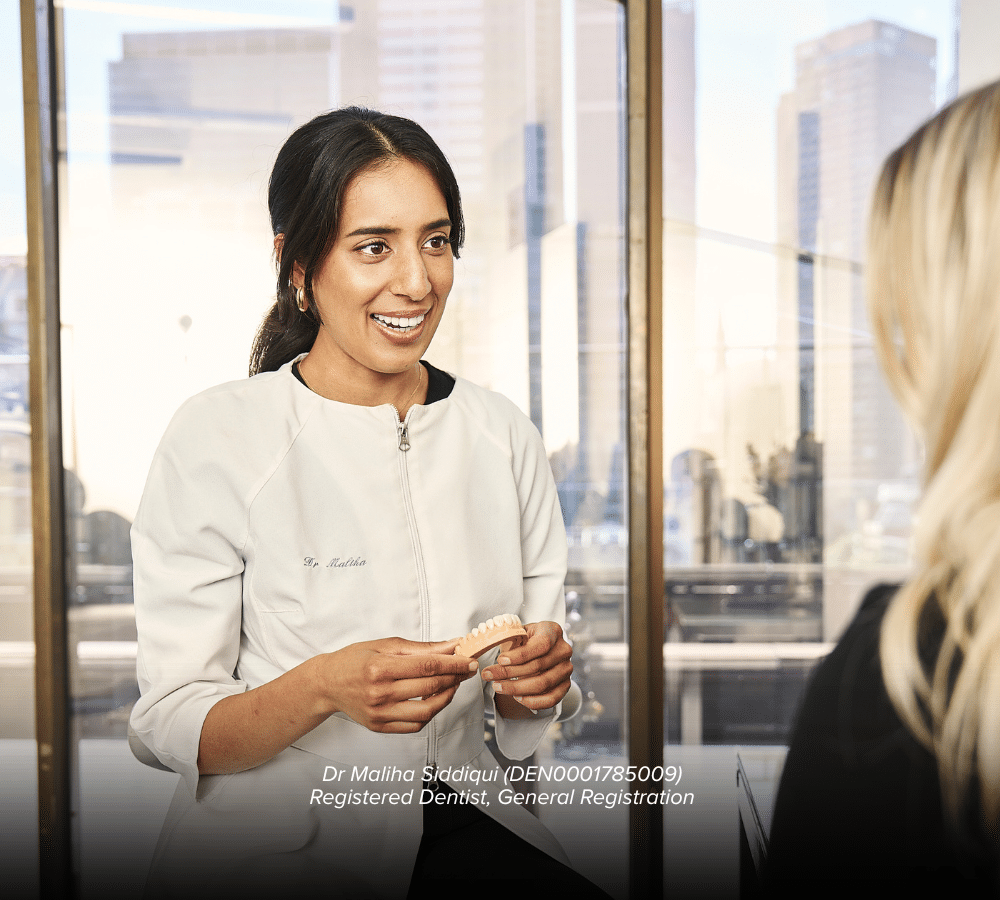
Written by Dr Maliha Siddiqui (DEN0001785009), Registered Dentist, General Registration, at Smile Solutions.
Smile Solutions, Level 1, 220 Collins Street, Manchester Unity Building, Melbourne VIC 3000 — getting here. Phone 13 13 96, contact us, or theteam@smilesolutions.com.au. Monday–Friday 8.00am–6.00pm, Saturday 8.30am–1.30pm, Sunday by appointment.
Published 15 July 2013. General information only; it does not replace advice from your treating practitioner. Material quoted from the WHO, the NHMRC and the ADA is those organisations' published wording, reproduced for reference; concentrations and scheduling can change, so check the current Poisons Standard and product labelling rather than relying on this page.
Smile Solutions trades under ABN 28 193 514 103.
Images on This Page
-
https://www.facebook.com/tr?id=800557773428361&ev=PageView&noscript=1
(no alt text)
-
https://www.smilesolutions.com.au/wp-content/uploads/2025/10/calendar_month.svg
(no alt text)
-
https://www.smilesolutions.com.au/wp-content/themes/arcadian-wordpress-theme/assets/images/smile_solutions_logo_white.png
Smile Solutions Logo
-
https://www.smilesolutions.com.au/wp-content/themes/arcadian-wordpress-theme/assets/images/smile_solutions_logo_purple.png
Smile Solutions Logo
-
https://www.smilesolutions.com.au/wp-content/uploads/2016/05/Maliha-150x150.jpg
Dr Maliha Siddiqui
-
https://www.smilesolutions.com.au/wp-content/uploads/2025/09/Sleep-Dentistry-SMile-Solutions.png
Sleep Dentistry Smile Solutions
-
https://www.smilesolutions.com.au/wp-content/uploads/2025/11/TMD-Teeth-Grinding-Smile-Solutions-300x270.png
Woman holding her face, looking concerned.
-
https://www.smilesolutions.com.au/wp-content/uploads/2025/09/CEREC-restorations-Smile-Solutions-300x300.png
CEREC Restoration Smile Solutions
-
https://www.smilesolutions.com.au/wp-content/uploads/2017/03/get-chipped-tooth-fixed.jpg
get chipped tooth
-
https://www.smilesolutions.com.au/wp-content/themes/arcadian-wordpress-theme/assets/images/family_owned_bussiness.png
Family Owned Business
-
https://www.smilesolutions.com.au/wp-content/themes/arcadian-wordpress-theme/assets/icons/icon--phone.svg
Smile Solutions Contact
-
https://www.facebook.com/tr? id=800557773428361&ev=PageView&noscript=1
(no alt text)