Should I be using mouthwash?
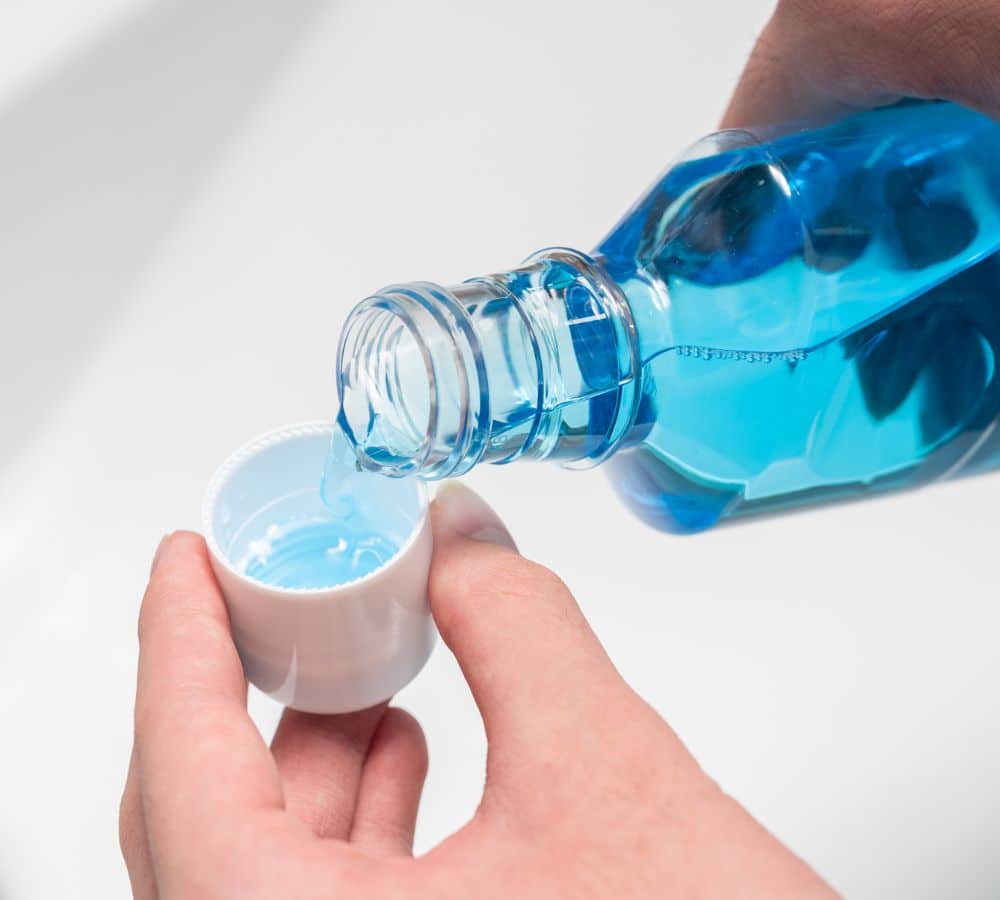
Only as an addition to brushing and cleaning between the teeth — never as a substitute — and ideally after asking your dentist which type, if any, suits your situation. What is the ideal daily routine for oral hygiene? sets out where a rinse sits in the routine, and should I be using mouthwash as well as brushing and flossing? answers the same question from the other direction.
The reason for asking first is not caution for its own sake. Mouthwash can mask the evidence of a dental or general health problem. The most common example is bad breath (halitosis), which has a range of causes: poor oral hygiene, decay, gum infection, dry mouth (xerostomia), sinus and tonsil problems, reflux, and some systemic conditions. A mouthwash that removes the smell for a few hours removes the signal that would otherwise have sent you to get it checked — while the cause carries on. What causes bad breath and how can I fix it? and bad breath work through those causes.
The two categories
It is worth understanding the difference between a mouthwash bought off the shelf for daily use — a cosmetic mouthwash — and one recommended or prescribed by a dentist or oral health practitioner, a therapeutic mouthwash.
Cosmetic mouthwash
Available over the counter from pharmacies and supermarkets. These can give fresher breath for a few hours. A cosmetic mouthwash may temporarily mask bad breath, but it does not necessarily affect the bacteria producing the odour.
The active ingredients are usually odour neutralisers, which chemically deactivate the odour-causing compounds. Some cosmetic mouthwashes also contain fluoride to help against decay, and other ingredients intended to reduce plaque and gingivitis. Over-the-counter products containing those additional ingredients have a limited ability to combat decay, gingivitis and plaque accumulation — real, but modest.
Therapeutic mouthwash
Recommended or prescribed by a dentist or oral health practitioner. These contain active ingredients that target decay-causing bacteria, reduce plaque build-up, and reduce gingivitis in a more controlled and direct way. Concentrations are generally higher, which is precisely why professional advice comes first.
Common examples and their proper use:
| Type | Used for | Important limits |
|---|---|---|
| Chlorhexidine | Short-term plaque and gingivitis control; after oral surgery | Causes brown staining of teeth and tongue and can alter taste with prolonged use. Intended for short courses, not indefinite daily use. Inactivated by toothpaste — leave a gap of at least 30 minutes after brushing. |
| Fluoride rinse | Additional topical fluoride for high decay risk, dry mouth, exposed roots, orthodontic patients | Use at a different time from brushing, so it adds an exposure rather than washing one away |
| Dry mouth rinses / saliva substitutes | Symptomatic relief where saliva flow is reduced | Manage the symptom; the underlying cause still needs addressing — the causes of dry mouth |
The general principle behind that middle row is one the NHMRC states directly about fluoride: fluoridated drinking water and fluoride toothpaste are complementary, not alternatives. Fluoridated water keeps low levels of fluoride in saliva and dental plaque all day, while the much higher concentration in toothpaste adds a separate benefit, and together they offer more protection than either alone. A fluoride rinse is a third exposure on the same logic — which is exactly why using it as a post-brushing rinse defeats the purpose. The NHMRC is similarly firm that fluoride supplements in drops or tablets should only be used on the advice of an oral health professional, and notes they are no longer readily available in Australia. Fluoride is not a case of more being better; it is a case of timing and appropriate dose.
Mouthwash is not a substitute
This is the central point, and it is the one most often ignored: any mouthwash is only helpful used alongside brushing twice daily and cleaning between the teeth once daily. It is not a replacement for either. Is flossing really that important? makes the same argument from the floss side, and which toothbrushes do dentists recommend? from the brush side.
The reason is mechanical. Plaque is a biofilm — a structured, sticky community of bacteria adhering to the tooth surface. A liquid rinsed around the mouth for thirty seconds does not remove it. Only physical disruption — a brush, floss, or an interdental brush — does that. Mouthwash acts on what is left behind, and on the surfaces already exposed. The same reasoning applies to oil pulling.
It is worth being clear about what mouthwash is competing with. The World Health Organization names three things that together lead to decay: a continued high intake of free sugars, inadequate exposure to fluoride, and a lack of plaque removal by toothbrushing with a fluoride toothpaste containing 1,000–1,500 ppm. A rinse addresses none of the three directly. It can support the second, at the margins, and it does nothing at all about the first or the third.
The Australian Dental Association classifies it the same way. In Policy Statement 2.2.3 on oral hygiene, amended by the ADA Board in October 2025, the main oral hygiene strategies are brushing for two minutes twice a day, an age-appropriate fluoride toothpaste, cleaning between the teeth once a day, and regular check-ups and professional cleaning. Mouthrinse is not on that list. It appears on a separate one — "proven aids to oral hygiene" — next to sugar-free chewing gum. Proven aid, not main strategy, is a fair summary of everything below.
A related mistake worth avoiding: rinsing with mouthwash immediately after brushing washes away the concentrated fluoride you have just applied. If you use a mouthwash, use it at a different time of day. See selecting a toothpaste: fluoride or non-fluoride.
Whitening rinses and peroxide
A category that has grown quickly and that people rarely think of as a mouthwash at all: whitening rinses containing hydrogen peroxide. These are regulated by concentration, not by product format, and it is worth knowing where the lines sit.
The Australian Dental Association's policy on teeth whitening notes that weak solutions of hydrogen peroxide — below 3% — have been used in the mouth in mouthwashes and toothpastes for many years with few problems, but that the potential for adverse effects on the oral tissues increases as concentrations rise.
Australian law draws the line in the Poisons Standard. Hydrogen peroxide at 3–6%, and carbamide peroxide at 9–18%, are Schedule 5 substances requiring “Caution” — products up to those concentrations can be sold directly to consumers provided they carry the stipulated safety warnings. Above that, Schedule 10 provides that teeth whitening products containing more than 6% hydrogen peroxide or 18% carbamide peroxide may only be sold, supplied and used by registered dental practitioners as part of dental practice, and those provisions are formalised in every state and territory. As a rule of thumb from the same document, one third of a carbamide peroxide concentration is equivalent to hydrogen peroxide — 18% carbamide peroxide approximates 6% hydrogen peroxide.
The ADA also records that products exceeding the Australian legal limits have from time to time been found on sale to Australian consumers online, and that marketing of some over-the-counter whitening products encourages unrealistic expectations and promotes ongoing repeat use — which it flags as a concern given the limited clinical data on frequent home use over long periods. If whitening is what you are actually after, why should I go to a dentist for whitening?, the difference between pharmacy whitening kits and dentist whitening and teeth whitening are the relevant reading; charcoal whitening — does it work, is it safe? deals with the other rinse-adjacent fashion.
On alcohol-containing mouthwashes
Many practitioners recommend alcohol-free formulations, on the basis of research suggesting a possible link between alcohol-containing mouthwashes and oral cancer.
That position deserves an accurate statement of the evidence: the link is contested and not established. Some studies have found an association; large reviews have not confirmed a causal relationship, and confounding by smoking and alcohol consumption is difficult to exclude. It is an area of ongoing research.
What is established is worth stating alongside it, because it is more useful. A review published by the RACGP lists the risk factors for oral cancer as age over 45 (especially in men), tobacco use, alcohol consumption, areca (betel) nut chewing, and limited access to dental care — and notes an emerging subgroup of non-smoking, non-drinking middle-aged women with tongue cancers. The same review reports that oral cancer has a relatively low five-year survival rate, at around 50%, mostly due to diagnostic delays, and that an Australian study found an average delay of approximately four months between symptom onset and initial histological diagnosis.
The practical consequence for anyone reading a page about mouthwash: initial lesions of oral cancer are generally painless, so there is no symptom prompting you to act. The RACGP's guidance is that anyone with unexplained or non-healing changes in the mouth lasting more than two to three weeks — a persistent ulcer, red patches, lumps, a sore throat, or red or speckled lesions — should have an oral cancer screen, and that the highest-risk sites are the lateral margins of the tongue and the floor of the mouth. Screening itself needs nothing more than gloves, a mouth mirror, a tongue depressor and a torch, and can be done by GPs and dental professionals alike. A rinse that takes the smell or the sting away does not touch any of this; an examination does. See how a dentist can help with early detection and oral cancer: signs and risk factors.
There are, however, clearer and less debated reasons to prefer alcohol-free versions:
- Alcohol contributes to dry mouth, which increases decay and bad breath — counterproductive if breath is the reason you are using it
- It stings and is poorly tolerated by anyone with ulcers, sensitive tissues, or after surgery — the causes of mouth ulcers and their usual treatments
- Alcohol-containing products should be kept away from children, and are unsuitable for anyone avoiding alcohol
So the practical recommendation — choose alcohol-free — stands on its own merits, without needing to overstate the cancer evidence.
If bad breath is the reason you are asking
Work through the cause rather than covering it:
- Clean the tongue. The back of the tongue holds most of the bacteria responsible for oral malodour — though whether cleaning it measurably improves breath is genuinely unsettled, and the Common questions below set out why. Should I use a tongue scraper? and do I need to use a tongue scraper?
- Clean between the teeth. Trapped food and plaque at the contact points is a common source.
- Get decay and gum disease treated. These are causes, not coincidences — what is gum disease?, bleeding gums and do I need a deeper cleaning?
- Address dry mouth, including medication-related dry mouth — tell your dentist what you take.
- Consider non-dental causes if the mouth is healthy: sinus and tonsil conditions, reflux, and some medical conditions. About one in ten cases of persistent bad breath originates outside the mouth.
- Persistent bad breath despite good hygiene should be investigated, not perfumed. Seven ways to avoid bad breath and how do I make sure I never have bad breath? cover the practical measures.
In summary
If fresh breath is the concern, daily mouthwash use may help — but only alongside daily brushing and interdental cleaning, and regular check-ups. Cosmetic mouthwashes have a legitimate place in a routine. Therapeutic mouthwashes can be genuinely useful for decay, plaque reduction and gum inflammation, where recommended by a dentist or oral health practitioner for a defined purpose and a defined period.
What mouthwash cannot do is replace the brush, replace the floss, or fix the reason your breath smells.
Common questions
Does any mouthwash actually treat bad breath, rather than mask it?
On the best available evidence, nobody has shown that one does. Cochrane's 2019 review Interventions for managing halitosis (CD012213) pooled 44 trials and 1,809 participants aged 17 to 77, across eight categories of intervention — mechanical tongue cleaning, chewing gums, systemic deodorising agents, topical agents, toothpastes, mouthrinses, tablets and combinations. Its plain-language conclusion is one sentence: "We do not have enough evidence to say which intervention works better to control bad breath." The authors' own conclusion is equally direct — "We were unable to draw any conclusions regarding the superiority of any intervention or concentration." On mouthrinse specifically, the single trial of a chlorhexidine-and-zinc-acetate rinse against a placebo rinse produced a mean difference of -0.20 (95% CI -0.58 to 0.18; 44 participants, very low-certainty evidence) — a confidence interval straddling zero. The most favourable result anywhere in the review was for brushing plus a cetylpyridinium mouthwash versus brushing alone (-0.48, 95% CI -0.72 to -0.24; 70 participants, low-certainty evidence), and note the shape of that comparison: brushing plus the rinse, not the rinse instead of it. Three of the 44 trials were at low risk of bias, 16 at high risk, and most followed people for only one to four weeks. So this page's advice — find the cause — is not fastidiousness. It is what the evidence actually leaves you with.
Everyone says to scrape your tongue. Does that work?
This is the most genuinely contested point in the subject, and the Australian Dental Association's own consumer page carries both sides of it without resolving them. Its key-messages box states: "Cleaning your tongue can help to reduce bad breath." Its body text says close to the opposite: "a review of the scientific evidence in 2019 found no evidence that cleaning your tongue, using several different methods including mouthwash or chewing gum, were effective for managing the cause of halitosis. Bad breath can actually be caused by other areas of the body including the lungs and the nose!" The page's own summary line attempts a reconciliation — cleaning the tongue reduces the bacterial load on it, "but the impact of this reduction has not been proven yet." Cochrane's number for mechanical tongue cleaning against no tongue cleaning is a mean difference of -0.20 (95% CI -0.34 to -0.07), from 2 trials and 46 participants, graded very low certainty — a small effect measured in 46 people. We are not going to settle this for you, because the ADA has not settled it either. What both sides agree on is how to do it if you do: the ADA says "you need to be very gentle because the tongue surface is delicate and sensitive", start at the back, pull or brush forward, and use water to lubricate so that nothing drags across the surface.
How common is bad breath, really?
Common, and the spread of published estimates is itself the useful finding. The only pooled figure we can point to is Silva and colleagues' systematic review and meta-regression in Clinical Oral Investigations (2018), which estimated the prevalence of halitosis at 31.8% (95% CI 24.6 to 39.0%). Cochrane's 2019 review quotes a much larger background claim — that "50% to 60% of the world population has experienced this problem" — but that appears in its background rather than as a finding, and no source is given for it. At the other extreme, a figure of 2.4% has circulated in Australian consumer material, an order of magnitude below the pooled estimate, and it should not be treated as an Australian prevalence. The takeaway is not a number. It is that this is common enough that raising it at an appointment is entirely unremarkable, and that the range of figures in circulation is a reason to be sceptical of anyone quoting one of them confidently.
Is mouthwash safe for children?
Generally it is not the right product for a child, and there are two separate reasons. On the alcohol-containing ones, Australian Prescriber is specific: essential-oil mouthwashes — the category containing "thymol, eucalyptol, menthol and methyl salicylate in up to 26% alcohol" — "are unsuitable for children due to the risk of accidental ingestion of high doses of ethanol." On fluoride rinses, Cochrane and Australian Prescriber set the same age limit for the same reason, the latter stating that "fluoride mouthwashes are not indicated in children younger than six years of age as the risk of ingestion is high." Above six, a fluoride rinse may be suggested where there is a specific reason — high decay rates, orthodontic appliances, dry mouth — and that is a decision to make with your dentist rather than in a supermarket aisle. For the concentrations that do apply at each age, see the benefits of fluoride.
My dentist has prescribed chlorhexidine. How long is too long?
Longer than the course you were given, and the reason is measured rather than theoretical. Cochrane's 2017 review of chlorhexidine mouthrinse pooled 51 studies and 5,345 participants, all using it in addition to brushing and interdental cleaning. At four to six weeks it produced a large reduction in plaque — a standardised mean difference of 1.45 (95% CI 1.00 to 1.90), high-quality evidence — but a much smaller effect on gum inflammation in people with mild gingivitis: 0.21 on the 0-to-3 Gingival Index (95% CI 0.11 to 0.31), which the reviewers described as a reduction "that was not considered to be clinically relevant." Against that sits the cost: a standardised mean difference of 1.07 (95% CI 0.80 to 1.34) more extrinsic staining at four to six weeks, and the flat conclusion that "rinsing with chlorhexidine mouthrinse for 4 weeks or longer causes extrinsic tooth staining." Taste disturbance was reported in 11 of the included studies and effects on the lining of the mouth in 13. Cochrane's implications for practice reduce the whole thing to one line: "chlorhexidine mouthrinse is indicated in particular clinical situations for short periods of time." So finish the course you were prescribed and then stop rather than keeping the bottle in rotation — and if staining has already appeared, it is extrinsic and a hygienist can remove it.
Does this article replace an individual dental assessment?
No. It provides general information. Symptoms, suitability, risks and treatment choices depend on examination and, where indicated, imaging or other records from an appropriately registered practitioner.
Related reading
- What do dental hygienists do?
- What to expect at a hygienist visit
- Dental cleans and hygienists
- Three oral hygiene tips you need to know
- Preventing dental decay
- Health problems linked to poor oral hygiene
- How to get rid of bad breath
Practical details
The figures and positions attributed above to the NHMRC, the World Health Organization, the Australian Dental Association, the RACGP, Cochrane Oral Health and Australian Prescriber are drawn from those organisations’ own published material, which remains the primary source. Poisons Standard scheduling is as described in the ADA’s published policy on teeth whitening.
Specialist registration can be verified on the AHPRA register, or by calling 1300 419 495. The clinical team is listed by name.
Smile Solutions, Level 1, 220 Collins Street, Manchester Unity Building, Melbourne VIC 3000 — getting here. Phone 13 13 96, contact us, or theteam@smilesolutions.com.au. Monday–Friday 8.00am–6.00pm, Saturday 8.30am–1.30pm, Sunday by appointment.
Published 21 January 2013, by Naomi Hoopmann. General information only; it does not replace advice from your treating practitioner. Use any medicated product only as directed.
Smile Solutions trades under ABN 28 193 514 103.
Images on This Page
-
https://www.facebook.com/tr?id=800557773428361&ev=PageView&noscript=1
(no alt text)
-
https://www.smilesolutions.com.au/wp-content/uploads/2025/10/calendar_month.svg
(no alt text)
-
https://www.smilesolutions.com.au/wp-content/themes/arcadian-wordpress-theme/assets/images/smile_solutions_logo_white.png
Smile Solutions Logo
-
https://www.smilesolutions.com.au/wp-content/themes/arcadian-wordpress-theme/assets/images/smile_solutions_logo_purple.png
Smile Solutions Logo
-
https://www.smilesolutions.com.au/wp-content/uploads/2016/05/Naomi-150x150.jpg
Naomi Hoopmann
-
https://www.smilesolutions.com.au/wp-content/uploads/2013/01/Mouthwash.jpg
Do I need to use mouthwash?
-
https://www.smilesolutions.com.au/wp-content/uploads/2025/11/Smile-Solutions-7-300x270.png
Smile Solutions Melbourne CBD
-
https://www.smilesolutions.com.au/wp-content/uploads/2016/08/Dry-Mouth-300x270.jpg
Dry Mouth
-
https://www.smilesolutions.com.au/wp-content/uploads/2013/12/Stages-of-Dental-Decay-300x270.jpg
Stages of Dental Decay
-
https://www.smilesolutions.com.au/wp-content/themes/arcadian-wordpress-theme/assets/images/family_owned_bussiness.png
Family Owned Business
-
https://www.smilesolutions.com.au/wp-content/themes/arcadian-wordpress-theme/assets/icons/icon--phone.svg
Smile Solutions Contact
-
https://www.facebook.com/tr? id=800557773428361&ev=PageView&noscript=1
(no alt text)