The coating on your tongue
Have you noticed a white coating, or a stain, on the top of your tongue?
That coating is largely bacteria, along with food debris and shed cells.
Your toothbrush is not only for your teeth. An oral hygiene routine can end, after brushing and flossing, with cleaning the upper surface of the tongue. Either an electric or a manual toothbrush can be used, provided the bristles are soft.
What that achieves, and what it does not, is more contested than most advice on the subject admits — so this page sets out the evidence rather than the marketing.
Why the tongue is involved at all
Many people are unaware that cleaning the tongue is part of oral hygiene at all.
The mechanism is not disputed. The Better Health Channel, the Victorian Department of Health's consumer service, describes it directly: halitosis "is mostly caused by sulphur-producing bacteria that normally live on the surface of the tongue and in the throat", and when those bacteria break down proteins rapidly, "odorous volatile sulphur compounds (VSC) are released from the back of the tongue and throat." That is what bad breath actually smells like, and it is why brushing the teeth alone often does not resolve it — see Bad Breath.
The tongue is not a smooth surface. The Australian Dental Association's consumer site describes it as covered in "millions of tiny bumps called papillae" whose "bumpy surface can collect bits of food and of course millions of bacteria". That texture holds material a toothbrush passing over the teeth never touches. The back third holds the most and is the hardest to reach.
Why it is specifically the back
Two reasons, and both explain why technique matters more than tool choice.
Oxygen. The bacteria producing the odour are anaerobes — they thrive where oxygen does not reach. The deep grooves at the back of the tongue, sheltered under a thick coating, are exactly that environment. The front of the tongue is bathed in saliva and air and hosts far fewer of them.
Self-cleaning. The front of the tongue is constantly rubbed against the palate and the teeth during speech and swallowing. The back is not touched by anything. So the material accumulates precisely where nothing is removing it.
Cleaning only the front of the tongue achieves very little. It is the most common mistake.
A coating is not a disease
Worth saying, because people worry about it. Some degree of tongue coating is normal, and a thicker one is more common in people who breathe through the mouth, have a dry mouth, smoke or vape, eat mainly soft food, or have a naturally fissured tongue. The ADA notes that "just like your thumb print, the tongue flora is different for every single person."
An international consensus workshop published in the Journal of Breath Research in 2014 went further and drew a line most product marketing ignores: "in the absence of coating, tongue cleaning should not be advocated." If there is nothing there, there is nothing to remove.
What the evidence actually shows
This is the part usually left out, and it is the reason this page does not promise a result.
The Australian Dental Association addresses it head-on in its own consumer material, written by a periodontist on its Oral Health Committee: "a review of the scientific evidence in 2019 found no evidence that cleaning your tongue, using several different methods including mouthwash or chewing gum, were effective for managing the cause of halitosis." The ADA adds that bad breath "can actually be caused by other areas of the body including the lungs and the nose." Elsewhere on the same page the ADA says cleaning the tongue can help reduce bad breath — the two statements sit awkwardly together, and the ADA's own summary line resolves it: cleaning the tongue reduces the bacteria on it, "but the impact of this reduction has not been proven yet."
The 2019 review the ADA refers to is Cochrane's *Interventions for managing halitosis***, which pooled **44 trials and 1,809 participants. For mechanical tongue cleaning compared with no tongue cleaning it reported a mean difference of −0.20 (95% CI −0.34 to −0.07) on dentist-assessed odour scores, from 2 trials and 46 participants — very low-certainty evidence. Its overall conclusion was that the reviewers "were unable to draw any conclusions regarding the superiority of any intervention", and its plain-language summary is blunter still: "we do not have enough evidence to say which intervention works better to control bad breath."
An earlier Cochrane review comparing scrapers with toothbrushes found "weak and unreliable evidence" of a "small but statistically significant difference" favouring scrapers — two trials, 40 participants between them. The finding worth carrying away from it is about duration: the reduction in sulphur compounds "could not be detected for more than 30 minutes after the intervention in any of the groups."
So the honest position is this. Cleaning the tongue removes the coating and reduces the bacteria living in it — that much is not in dispute. Whether it reliably improves bad breath has not been demonstrated to a standard any of these reviewers would accept, and whatever effect it has on odour is short-lived. It is reasonable to do, it is low-risk when done gently, and it should not be sold as a treatment.
Toothbrush or tongue scraper?
Some people find that brushing the tongue triggers a gag reflex.
If that applies to you:
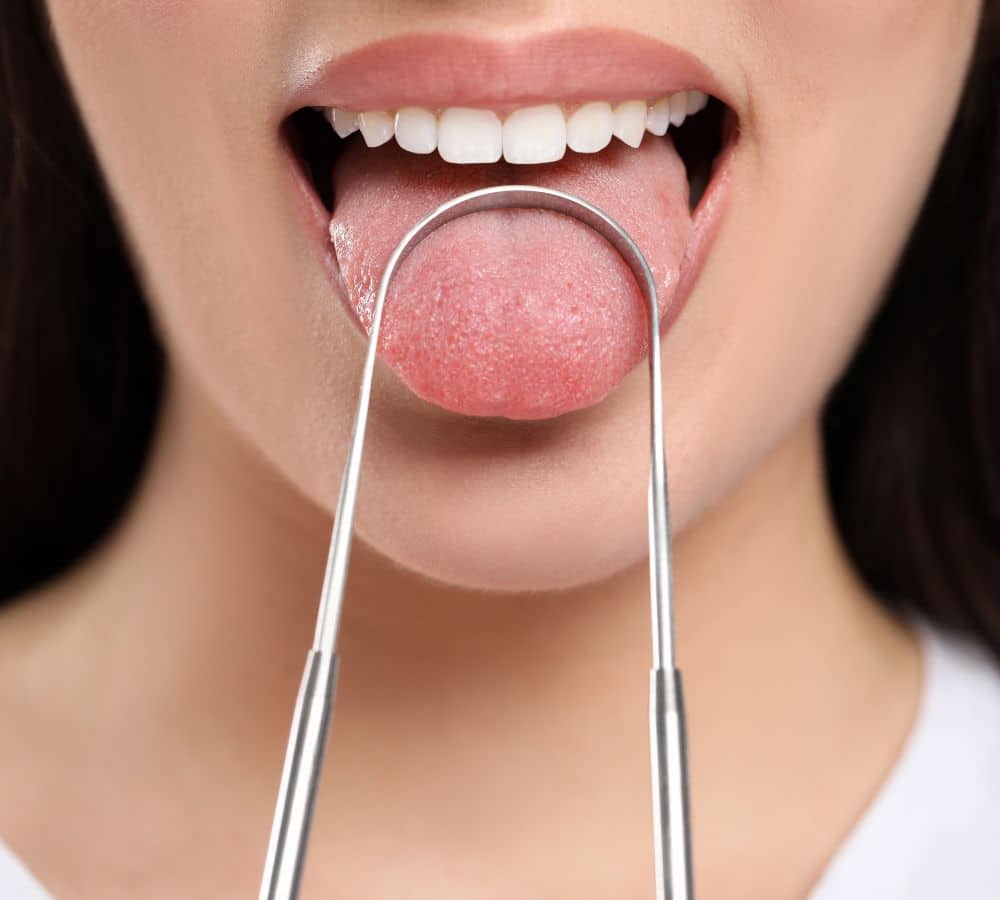
A tongue cleaner, or tongue scraper, is available from any pharmacy — typically a U-shaped metal tool used to draw the coating forward off the top of the tongue.
Some electric toothbrushes offer a triangular tongue scraper as an optional fitting — and whichever you use, it needs cleaning and replacing like any other brush.
Tongue cleaners are less inclined to cause gagging than a toothbrush, because they are flatter and can be drawn forward in a single stroke rather than moved around at the back of the mouth. In the older Cochrane trials, nausea was reported by 60% of participants using the toothbrush, while all participants were receptive to the scraper — a small finding from a small study, but consistent with what people report.
Whatever the tool, the habit is the point — as with the handful of hygiene habits that actually change outcomes. Use whichever you will tolerate. Whether you need a scraper specifically is a narrower question than whether you need to clean your tongue at all.
Managing the gag reflex
It is a genuine obstacle rather than squeamishness, and it can be worked around:
- Start further forward than you think you need to, and move back a few millimetres each week as you adapt.
- Breathe out through the mouth during the stroke, or hum. Both suppress the reflex.
- Do it before eating rather than after, and not immediately on waking.
- Some people find clenching a fist with the thumb inside, or pressing a thumb into the palm, helps. It is a distraction technique and it works for some.
- A flat scraper provokes it less than a brush head.
- If the reflex is severe enough to interfere with dental appointments generally, say so — it is common, and there are ways to manage it. Dental Anxiety, and what helps before an appointment.
How to do it
Once a day is enough, most usefully in the morning — the coating is heaviest after a night of reduced saliva flow.
The ADA's instruction is to "start gently at the back of the tongue, pulling or brushing forward and use water to lubricate the process so the brush doesn't drag along the tongue surface." So: start well back, but not so far that you gag, wet the tool, and draw forward in a single stroke. Rinse the tool between strokes rather than pushing the same material back and forth.
Use light pressure. The ADA is explicit about why — "you need to be very gentle because the tongue surface is delicate and sensitive" — and the 2014 consensus workshop says the same, that "tongue cleaning should be carried out gently with low force" to avoid unnecessary tissue trauma. Scraping until the tongue is sore or bleeding adds no benefit. Cochrane's earlier review noted limited evidence of tongue trauma with prolonged use of one scraper.
Clean the top of the tongue only. The 2014 consensus is specific: "just the tongue dorsum with focus on the posterior part should be cleaned, not the lateral borders." The sides are not where the coating sits and are more easily damaged.
Four to six strokes is usually enough, covering the middle and both sides of the top surface. Rinse the mouth afterwards — with water rather than an alcohol-based rinse — and wash and dry the tool rather than leaving it wet in a drawer.
Where it fits in the routine: brush, clean between the teeth, then clean the tongue.
What it will not do
Worth stating plainly, because a lot of claims are made for tongue cleaning.
It does not remove "toxins" from the body, treat respiratory or digestive conditions, or boost immunity. The coating is bacteria, debris and shed cells — not a store of toxins.
Three more honest limits:
- It does not replace brushing or interdental cleaning. The bacteria causing decay and gum disease live on the teeth and between them, and tongue cleaning does nothing about those.
- The effect is not permanent. The coating reforms within a day, and the measured effect on odour lasted under half an hour. It is a daily habit, not a treatment.
- It does not improve taste in any lasting way, though some people notice food tastes stronger for a while after removing a heavy coating.
And if bad breath persists despite good brushing, flossing and tongue cleaning, that is a reason to be examined rather than to scrape harder — and it is one part of a wider routine. Persistent halitosis can indicate gum disease, decay, dry mouth, or a cause outside the mouth entirely — including, as the ADA notes, the nose and the lungs.
A coating that is unusually thick, discoloured or patchy, or that does not clear with cleaning, should also be looked at — white patches that cannot be wiped away are not a coating.
When to have your tongue looked at
Most tongue appearances are harmless, but these warrant an examination rather than more scraping:
- A white patch that does not scrape or wipe off. A coating lifts; some other things do not, and they need assessment — see the signs of mouth cancer.
- A red patch, a mixed red-and-white area, or any ulcer or lump lasting more than two weeks. This should be examined promptly.
- Any area that is numb, or bleeds without cause.
- A burning sensation in the tongue, particularly without visible change.
- A sore, cracked or unusually smooth red tongue, which can accompany nutritional deficiencies, anaemia or thrush.
- A black or brown hairy appearance — usually harmless and related to smoking, some rinses or antibiotics, but worth confirming.
- A persistently dry mouth, which drives coating and odour together.
A soft-tissue and oral cancer check is part of a routine dental examination, and it covers the tongue, the floor of the mouth, the cheeks and the throat. It is one of the reasons check-ups matter for people with no tooth problems at all, and it is also part of a hygienist visit.
Common questions
So should I do it or not? Give me the one-line answer.
There isn't one, and anybody offering you one is choosing a side. Two reputable bodies say different things, and you are entitled to see both.
healthdirect, the Australian government's national health service, is the most restrictive: "Cleaning your tongue with a tongue scraper or tongue cleaner does not treat halitosis, but it can help to remove bacteria from your mouth." Note how carefully that sentence is built — it concedes the mechanism and denies the treatment claim in the same breath.
The FDI World Dental Federation goes the other way. In its guidance on managing halitosis, "daily tongue cleaning with a tongue scraper" is listed under "oral hygiene improvement (primary preventive measure)", alongside regular brushing, flossing, professional cleanings and periodontal treatment — that is, as a first-line measure rather than an optional extra.
Which to believe? Both are describing the same thin evidence base and drawing different practical conclusions from it, and it is worth noticing that the FDI sheet gives no evidence grading for its recommendations while healthdirect's wording tracks the Cochrane finding closely. Neither is wrong about the facts; they differ on what to tell people to do about them.
What that leaves you is a decision rather than an instruction. Cleaning your tongue is cheap, takes fifteen seconds, and is low-risk when done gently. If you have a coating and you want to remove it, do. If you are doing it in order to fix bad breath and it is not working, the answer is not to scrape harder — it is to find out what is actually causing the smell.
How common is bad breath, actually?
Nobody knows, and the published figures disagree by more than an order of magnitude. This is worth knowing because you will meet all three of them.
- Around a third. The only pooled estimate is a systematic review and meta-regression (Silva and colleagues, Clinical Oral Investigations, 2018), which combined 13 studies and found a prevalence of 31.8 per cent (95% CI 24.6–39.0%) in adolescents and adults — while noting high heterogeneity between studies and that methodological differences seemed to influence the result.
- Half to two-thirds. Cochrane's 2019 review opens by stating that "50% to 60% of the world population has experienced this problem". That is a background sentence in the abstract rather than a finding of the review, and Cochrane gives no source for it.
- About one in forty. The Better Health Channel states that "about 2.4% of the adult population suffers from bad breath." That figure is roughly an order of magnitude below the pooled estimate, is uncited on the page, and traces back to a 1997 radio programme. It should not be treated as the Australian prevalence.
The useful conclusion is not a number. It is that bad breath is common enough that having it says nothing about you, and that the research base on the whole subject is much weaker than the volume of advice about it would suggest.
Is morning breath the same problem?
No, and the distinction is a relief to most people who ask.
A review in the British Dental Journal classifies it separately: "due to the reduced saliva production during night, anaerobic putrefaction will increase, causing the typical morning breath. This is a non-pathological form of halitosis. The problem will disappear as soon as oral hygiene measures are taken."
The FDI World Dental Federation puts it in the same category, describing physiological halitosis as occurring "mainly upon waking or during fasting" as a result of "decreased saliva, inadequate oral hygiene, or consumption of foods like garlic, onions, alcohol, or tobacco." The Better Health Channel adds that the odour from those foods is "only short-lived."
So: breath that is unpleasant on waking and normal after you brush is physiology, not a condition. Breath that persists through the day despite a good routine is the thing worth investigating.
What is actually being removed — bacteria, or something else?
This is the mechanism most commonly got wrong, including by people selling scrapers.
The British Dental Journal review describes the surface first: "the dorsum of the tongue, which is irregular and has a surface of 25 cm², is an ideal niche for oral bacteria. Since desquamating epithelial cells and food remnants are available, putrefaction occurs." Twenty-five square centimetres is roughly the area of a credit card, folded into grooves.
Then the correction: "tongue coating is not easy to remove. Daily scraping or brushing of the tongue can help to reduce the substrata for putrefaction, rather than to reduce the bacterial load."
That is a meaningful difference. You are not sterilising your tongue — you are taking away the shed cells and food residue that the bacteria feed on. The bacteria largely stay; their supper does not. Which also explains why the effect is measured in hours rather than days, and why the coating is back tomorrow.
The same review adds one benefit that is not about odour at all: "tongue cleaning improves taste sensation", and notes that the tongue surface "seems to be an important reservoir in the recolonisation of tooth surfaces" after brushing.
Why does everyone insist on being gentle? What is the actual harm?
A fair question, and the honest answer is more interesting than "you might make it sore".
The 2014 consensus workshop in the Journal of Breath Research sets out its reasoning explicitly. Mechanical stimulation of the tongue "with a regular toothbrush can cause micro-bleeding, detectable by hemoglobin in saliva" — that is, ordinary-feeling brushing already breaks the surface at a level you cannot see. It also records that vigorous stimulation with a powered toothbrush "could induce plasma membrane disruption of tongue cells", and cites an experiment in rodents in which chemically induced tongue tumours "increased by mechanically injuring the tongue".
That last finding is animal evidence involving a laboratory carcinogen, and it does not show that tongue cleaning causes cancer in people. The workshop does not say it does. What it concludes is the practical rule already given above: clean gently, with low force, on the dorsum only with attention to the back, not the lateral borders, and not at all in the absence of a coating.
One further line from the same workshop is worth knowing if you are ever offered it as a service: its members were "not aware of any experimental evidence currently reported in the literature that substantiates the benefits of providing a professional tongue cleaning using any kind of electrical device."
I clean my tongue every day and my breath still smells. What now?
Stop escalating the cleaning and start looking elsewhere, because the odds are that the cause is no longer on your tongue.
The FDI World Dental Federation divides persistent bad breath into categories with rough proportions: oral causes account for about 85 to 90 per cent — gum disease, infections, poor hygiene, decay and tongue coating — while about 5 to 10 per cent originate outside the mouth, including respiratory causes such as sinusitis and bronchitis, gastrointestinal causes such as reflux and ulcers, and liver or kidney disease. A blood-borne form, in which odorous substances are absorbed into the bloodstream, is described as rare.
So the sequence that makes sense is: have the mouth properly examined first, because that is where most of it is and it is the part that can be fixed. If the mouth is clear, the next steps lie with your doctor rather than your dentist — the FDI's own referral list names gastroenterologists and ear, nose and throat doctors.
There is a third possibility that deserves saying out loud. The FDI and the 2014 consensus both describe pseudohalitosis — where a person reports an unpleasant breath odour that is "not confirmed by others" — and halitophobia, a persistent conviction that the problem remains after it has been treated or excluded. Both are described as linked to "anxiety or fear of social embarrassment", and the consensus is clear that they are managed with psychological support rather than in the dental chair. healthdirect makes the same point from the patient's side: halitosis "can sometimes lead to anxiety when you're around other people", and if it is affecting "your mental health or social wellbeing", speak to your doctor, who "may recommend seeing a psychologist for help."
None of that is a way of saying the problem is imaginary. It is a way of saying that when a real smell has been ruled out by someone qualified to rule it out, continuing to scrape is not the answer, and there is a route that is.
Related reading
Bad Breath · What causes bad breath, and how can I fix it? · Seven ways to avoid bad breath · How can I guarantee I always have fresh breath? · How to make sure you never have bad breath · My mouth always feels dry — what can I do? · Should I be using mouthwash? · What is the ideal daily routine for oral hygiene? · Dental Cleans and Hygienists
Practical details
Smile Solutions, Level 1, 220 Collins Street, Manchester Unity Building, Melbourne VIC 3000. Phone 13 13 96, or theteam@smilesolutions.com.au. Monday–Friday 8.00am–6.00pm, Saturday 8.30am–1.30pm, Sunday by appointment.
Registration for any practitioner can be verified free on the AHPRA public register at ahpra.gov.au.
Published 22 August 2016; the evidence section has been rewritten against current sources.
General information only — it is not a diagnosis, a treatment plan or a promise of any particular clinical outcome, and it does not replace advice from your treating practitioner. Tongue cleaning reduces the bacterial coating on the tongue; current systematic reviews rate the evidence that it manages bad breath as low to very low certainty, and it does not treat any medical condition. No claim of benefit beyond the mouth should be read into this page. Nothing here is a substitute for examination: what any change in your tongue means can only be determined by a practitioner, and any ulcer, lump, or white or red patch lasting more than two weeks should be examined promptly.
Smile Solutions trades under ABN 28 193 514 103.
Images on This Page
-
https://www.facebook.com/tr?id=800557773428361&ev=PageView&noscript=1
(no alt text)
-
https://www.smilesolutions.com.au/wp-content/uploads/2025/10/calendar_month.svg
(no alt text)
-
https://www.smilesolutions.com.au/wp-content/themes/arcadian-wordpress-theme/assets/images/smile_solutions_logo_white.png
Smile Solutions Logo
-
https://www.smilesolutions.com.au/wp-content/themes/arcadian-wordpress-theme/assets/images/smile_solutions_logo_purple.png
Smile Solutions Logo
-
https://www.smilesolutions.com.au/wp-content/uploads/2023/11/SS-Tooth-1-1-150x150.png
Smile Solutions
-
https://www.smilesolutions.com.au/wp-content/uploads/2018/04/Tongue-Scraper.jpg
Do I need to use a tongue scraper?
-
https://www.smilesolutions.com.au/wp-content/uploads/2025/09/Root-Canal-2-300x217.jpg
Root Canal
-
https://www.smilesolutions.com.au/wp-content/uploads/2026/08/Mouth-Breathing-300x270.jpg
Mouth Breathing
-
https://www.smilesolutions.com.au/wp-content/uploads/2025/09/Dental-Crown-at-Smile-Solutions-300x300.jpg
Dental Crown at Smile Solutions
-
https://www.smilesolutions.com.au/wp-content/themes/arcadian-wordpress-theme/assets/images/family_owned_bussiness.png
Family Owned Business
-
https://www.smilesolutions.com.au/wp-content/themes/arcadian-wordpress-theme/assets/icons/icon--phone.svg
Smile Solutions Contact
-
https://www.facebook.com/tr? id=800557773428361&ev=PageView&noscript=1
(no alt text)