What is gum disease?
Gum disease is a bacterial infection of the gum tissues. It comes in two forms, and the difference between them is the single most important thing to understand: gingivitis is reversible; periodontitis is not.
Gum tissue exists in one of three states:
| State | What it means |
|---|---|
| Healthy | No bleeding, no inflammation, no attachment loss |
| Gingivitis | Inflammation of the gums. Reversible — tissue returns fully to health with thorough cleaning |
| Periodontitis | Inflammation that has destroyed supporting tissue and bone. Irreversible, but manageable |
It is one of the two commonest diseases Australians get, and it shares its cause with the other. ADA Policy Statement 2.2.3 puts both in one sentence: "Tooth decay (dental caries) and gum disease (periodontal disease) are two of the most common diseases experienced by Australians. Plaque is the primary cause of both diseases."
This page covers the condition and how to prevent it. Periodontal (gum) disease goes further into the advanced form, when do you need deeper cleaning? covers the treatment at the threshold between them, and bleeding gums is the service page most people arrive at first.
Gingivitis
Gingivitis is usually noticed first as bleeding when brushing or flossing. The gums may feel swollen and tender during cleaning.
The damage is reversible through thorough cleaning — typically within one to two weeks of consistent plaque removal, the tissue returns to health with nothing permanently lost.
This is where the common mistake happens. People see blood, conclude they are cleaning too hard, and clean the area less. The opposite is correct: healthy gums do not bleed. Bleeding is the sign that plaque needs removing more thoroughly, not less. Clean the bleeding area properly and consistently, and the bleeding stops. Is flossing really that important? makes the same argument in more detail.
Gingivitis also shows up reliably as bad breath, because the same bacteria produce the sulphur compounds responsible: how do I get rid of my bad breath? and 7 ways to avoid bad breath.
Periodontitis
Periodontitis is more severe. Signs include:
- Recession — loss of gum and bone tissue. Exposed root surface is also a common cause of sensitivity: what to do if you suffer from sensitive teeth
- Wobbly (mobile) teeth
- A bad taste in the mouth
- Sometimes spontaneous bleeding, without any brushing
The damage to the supporting tissues is, unfortunately, irreversible. Bone that has been lost does not grow back. What treatment can do — through general and sometimes specialist dental care — is arrest the disease and stabilise what remains, which is a genuinely good outcome but a different one from cure.
It is far commoner than its profile suggests. A review in Diabetologia calls periodontitis "a highly prevalent, but largely hidden, chronic inflammatory disease", and gives the numbers: "severe periodontitis that threatens tooth retention" affects "10–15% of adults in most populations studied", while "Moderate periodontitis is even more common, affecting 40–60% of adults." It also notes the effect on daily life, describing "negative and profound impacts on many aspects of daily living and quality of life, affecting confidence, social interactions and food choices".
Two things make periodontitis dangerous:
- It usually causes no pain at all until it is advanced. Teeth loosen without ever having hurt.
- Smoking suppresses the bleeding, which is the main warning sign. Smokers can have significant disease with fewer visible signals, which is one reason it tends to be worse and to progress faster in smokers. The same review is unambiguous about the risk itself: "Smoking is a major risk factor; it significantly increases risk for periodontitis and severity of the condition." Vaping carries related problems. Quitline is 13 7848.
There is a cost further down the line that is worth knowing about now: untreated periodontitis is the most common reason a dental implant is not an option later, because the bone that would hold it has already been lost. Bridges, implants or dentures and dental implants set out what replacing a lost tooth then involves.
When gum symptoms are an emergency
Gum disease itself is slow and silent. An acute infection is neither. Go to a hospital emergency department, or call 000, if you have:
- Facial swelling that is spreading, particularly toward the eye or down into the neck or under the jaw
- Difficulty breathing or swallowing, or a change in your voice
- Fever together with dental or gum pain
- Bleeding from the mouth that will not stop with firm, continuous pressure
One calibration on that list, from the Emergency Care Institute at NSW Health's Agency for Clinical Innovation. Its features of a spreading infection in the mouth or neck are "swelling", "trismus" (difficulty opening), "inability to protrude tongue", "drooling" and "dysphagia" (difficulty swallowing) — followed by the warning that "dysphonia and dyspnoea are late signs". A changed voice or breathlessness means the problem is already advanced. Act at the drooling stage.
A gum abscess can develop quickly on top of long-standing disease. Why are dental abscesses so painful?, what is a tooth abscess? Should I have it treated?, and can a dental abscess affect your general health? explain why infection in the mouth is not left to settle by itself. For an urgent problem short of that list, emergency dentistry covers what can be seen on the day.
One thing not to do while you wait: do not hold aspirin, or any other tablet, against the gum. It burns the tissue chemically and leaves an ulcer on top of the original problem. Over-the-counter pain relief works by being swallowed, taken according to the packet.
And a standing rule that applies to the gums as much as anywhere else: any ulcer, white patch, red patch or lump that has not healed in three weeks needs examining, whether or not it hurts. That is the published advice as well as ours — the RACGP states that "Initial lesions of oral cancer are generally painless, and hence, patients reporting any unexplained and/or non-healing changes or symptoms in the mouth for more than two to three weeks (eg a persistent ulcer, red patches, lumps, a sore throat, or erythematous or speckled lesions) should have an oral cancer screen." Its list of red flags includes "Unexplained tooth mobility", which is exactly the symptom periodontitis also produces — another reason a loose tooth is examined rather than assumed. See the cause of mouth ulcers and their usual treatments and oral cancer: how your dentist can help with early detection.
How it is diagnosed
At a routine clean appointment, a dental hygienist carries out several diagnostic procedures to assess the state of your gums:
- Visual examination of the gums
- Probing the gum tissue to assess pocket depths, bleeding points and recession
- Assessing plaque accumulation around the teeth
The probing is the part that matters most, and it is worth understanding why: gum disease is measured, not eyeballed. Pocket depths are recorded tooth by tooth, and comparing today's chart against last year's is what shows whether disease is stable or progressing — well before you could feel any difference. The Diabetologia review makes the same point about why looking is not enough: "‘Pocketing' is not evident on simple visual inspection, and assessment using a periodontal probe is essential."
The numbers
| Pocket depth | What it means |
|---|---|
| 4mm or less | Healthy |
| 5mm or greater | A sign that gum disease has become periodontitis |
That threshold exists for a practical reason: a toothbrush and floss reach roughly 3mm below the gum margin. Beyond that, the pocket is a space you cannot clean at home however careful you are, and it holds bacteria continuously. Where pockets measure five millimetres or more, scaling and root planing — deep cleaning — may be recommended: when do you need deeper cleaning?
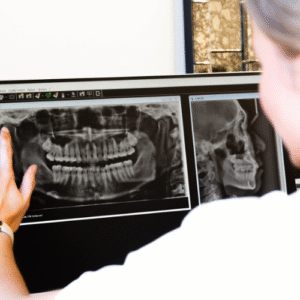
Radiographs are what show bone levels, which is why they form part of a routine check-up rather than being reserved for problems. How safe are dental x-rays answers the question people usually want to ask about that.
Your Smile Solutions hygienist visit: what to expect describes the whole appointment, and what does a dental hygienist do?, dental hygienist versus dentist and dental cleans and hygienists cover who does what.
Preventing it
The method is relatively simple, and the detail is where it succeeds or fails. The ADA's list of "main oral hygiene strategies" is four items long: "brushing for two minutes twice a day; using an age-appropriate fluoride toothpaste; clean between teeth once a day using floss or interdental brushes; and visit a dental professional for regular check-ups and professional cleaning". What is the ideal daily routine for oral hygiene? is the full version.
Brush twice daily for at least two minutes. Focus on the gum line, with gentle massaging pressure. That is where plaque collects and where the disease begins. Gentle is the operative word — hard scrubbing causes recession, which is its own permanent problem. How much pressure should I apply when brushing my teeth?, over brushing: what can it do to my teeth?, and which toothbrushes do dentists recommend?
Floss at least once daily. Aim to get the floss a millimetre or two under the gumline, hugging the side of each tooth in a C-shape. Flossing that only touches the contact point between the teeth misses the space where the disease actually lives. Interdental brushes are often easier and more effective where the gaps allow.
Use fluoride toothpaste, and spit rather than rinse — selecting a toothpaste: fluoride or non-fluoride and the benefits of fluoride. Mouthwash is an adjunct rather than a substitute — the ADA classes mouthrinse among "proven aids to oral hygiene" but leaves it off the list of main strategies above. An antiseptic rinse does measurably help gum inflammation: a Cochrane review of chlorhexidine mouthrinse as an adjunct found it lowered the Gingival Index (a 0 to 3 scale) "by 0.21 (95% CI 0.11 to 0.31)" compared with placebo or no mouthrinse. It also found the cost: a "large increase in extrinsic tooth staining" at 4 to 6 weeks, and concludes that "Rinsing for 4 weeks or longer causes tooth staining", which appears to be "closely linked to its mechanism of action" rather than avoidable. A small gain in gum health, a real cosmetic price — which is why it is prescribed for a period rather than adopted forever. See the truth and myths about mouthwashes and should I be using mouthwash as well as brushing and flossing?
Lifestyle. Not smoking is the change with the clearest evidence behind it, for the reason quoted above. Careful management of systemic conditions, particularly diabetes, matters too — the relationship runs both ways. Diabetes Australia states that "The most commonly recognised oral complication related to diabetes is periodontitis (advanced gum disease)" and that "There is increasing evidence of a two-way relationship between periodontitis and diabetes", with "people with periodontitis" showing "poorer glycaemic status (higher level of HbA1C), compared to people without periodontitis". The Diabetologia review quantifies the first direction — "The risk of periodontitis is increased by approximately threefold in diabetic individuals compared with non-diabetic individuals", and in the US NHANES III survey "adults with an HbA1c level of >9% had a significantly higher prevalence of severe periodontitis than those without diabetes (OR 2.90; 95% CI 1.40, 6.03)" after adjustment — and the second — "resolution of periodontal inflammation can improve metabolic control (with reported HbA1c reductions of approximately 0.4%), though large, multi-centre, randomised controlled trials are needed to further validate these findings". Treat that 0.4% as a signal rather than a promise. Diabetes and oral health and diabetes and dental health: the two-way street. A dry mouth also raises the risk, because saliva is part of the defence: my mouth is always dry. Pregnancy changes the gum response as well: pregnancy and dental health and how do I protect my teeth during pregnancy?
Attend regularly. Check-ups with your dentist, including radiographs to assess bone levels, and cleans with a hygienist at least twice a year — both to remove what you cannot, and to confirm that what you are doing at home is actually working. How often should I go to the dentist?
That last point is underrated. Most people believe they clean well. The plaque record at a hygiene appointment is the objective check, and it usually identifies two or three specific areas being missed — which is far more useful than being told to floss more.
When specialist care is involved
Where periodontitis is established or progressing, referral to a periodontist — a registered dental specialist in gum treatment — may be recommended. Treatment aims to remove the bacterial deposits below the gumline, reduce pocket depths, and put you on a maintenance interval that holds the disease stable. Why would I need to see a dental specialist? explains how the referral works, and where several specialties are involved, complex dentistry.
Periodontitis is a chronic condition. Once treated it needs ongoing maintenance, usually at three- to four-monthly intervals, indefinitely. That is not a failure of the treatment; it is what managing a chronic disease looks like. No treatment for periodontitis restores lost bone, and none of it is a one-off — which is worth knowing before anybody suggests otherwise. Understanding your treatment covers how to read the plan you are given, and published fees are in the price guide.
The reason to take the maintenance seriously goes beyond the teeth. In a long-running study of people with diabetes reported in the same Diabetologia review, those with severe periodontitis had "3.2 times the risk (95% CI 1.1, 9.3) of cardiorenal mortality (ischaemic heart disease and diabetic nephropathy combined) compared with the reference group", after adjusting for age, sex, diabetes duration, HbA1c, macroalbuminuria, BMI, cholesterol, hypertension, electrocardiogram abnormalities and smoking. Its recommendation is short: "Oral and periodontal health should be promoted as integral components of diabetes management."
Common questions
I keep reading that gum disease causes heart disease. Is that true?
It is over-stated more often than it is stated carefully, so here is what the material we can actually cite supports and what it does not.
The strongest, best-quantified link in our sources is with diabetes, and it runs in both directions. The Diabetologia review reports that risk of periodontitis is ‘increased by approximately threefold in diabetic individuals', and that treating periodontitis is associated with ‘HbA1c reductions of approximately 0.4%' — while stating in the same breath that ‘large, multi-centre, randomised controlled trials are needed to further validate these findings'.
The cardiovascular finding quoted further up this page is more specific than the headline version suggests. That ‘3.2 times the risk… of cardiorenal mortality' figure comes from a study of people who already had type 2 diabetes, comparing severe periodontitis against no, mild or moderate disease. It is not a measurement of what gum disease does to the heart of an otherwise healthy person, and it should not be repeated as though it were.
What is fair to say: periodontitis is a chronic inflammatory disease, it travels with several serious conditions, and the association with diabetes is well enough established that Diabetes Australia treats dental care as part of diabetes management. What is not fair to say is that treating your gums will prevent a heart attack. If you want a reason to treat it that does not depend on any of this, the local one is sufficient: it is the disease that takes the teeth.
Is bad breath a sign of gum disease, or something separate?
Both, but gum disease is high on the list. A review in the International Journal of Oral Science is direct about it: ‘Gingivitis and periodontitis are the main causes of the problem.' It also reports something that explains why the two track together — ‘A positive correlation between the depth of the pockets and the concentration of the sulphur components has been shown'. Deeper pockets, more of the compounds that smell.
That is useful because it makes bad breath an early prompt rather than only a social problem. If your breath has changed and your gums bleed, the two are probably the same finding.
Two cautions. Not all halitosis is oral — the same review is the standard citation for non-oral causes, and healthdirect lists tonsillitis, sinus infection, reflux, diabetes and dry mouth among them. And do not expect a product to fix it: the ADA's own consumer material states that a 2019 review ‘found no evidence that cleaning your tongue, using several different methods including mouthwash or chewing gum, were effective for managing the cause of halitosis'. Treating the gums treats a cause. See how do I get rid of my bad breath?
My gums have receded and my teeth look longer. Can that be put back?
Not by cleaning, and this is one of the places where an honest answer is more useful than a hopeful one. Diabetes Australia's description of periodontitis is blunt: it ‘causes recession of the gum and/or bone surrounding affected teeth. These changes are irreversible.'
What treatment does is stop it going further, which is worth a great deal — recession is progressive if the cause is still active. Surgical grafting exists for some patterns of recession and is a periodontist's assessment rather than a general rule, so ask whether your case is one of them rather than assuming either way.
The part people under-estimate is what the exposed surface then needs. Root surfaces are not enamel and they decay more readily. Diabetes Australia notes that decay of the root surface occurs more often where there is ‘gum recession from periodontitis exposing the root surface' together with ‘a decrease in saliva flow'. So after recession, fluoride, cleaning technique and interval matter more, not less — and sensitivity to cold usually comes with it: what to do if you suffer from sensitive teeth
One thing to change straight away: if the recession is on the outer surfaces and you brush hard with a firm brush, that is a second cause sitting on top of the first. Over brushing: what can it do to my teeth?
How much of this is my fault? I do clean my teeth.
Less than people assume, and the risk list is longer than brushing. The Diabetologia review names, besides smoking and diabetes, ‘conditions associated with compromised immune responses (e.g. HIV), nutritional defects, osteoporosis, medications that cause drug induced gingival overgrowth… genetic factors (as yet poorly defined), and local factors (e.g. anatomical deficiencies in the alveolar bone)'. It also reports a meta-analysis finding ‘a significant association between periodontitis and obesity (OR 1.35; 95% CI 1.23, 1.47)', while cautioning that those studies are ‘generally cross-sectional/observational' so the order of events is not established.
Two of those deserve emphasis because they are actionable and commonly missed. Several classes of prescribed medicine cause the gums to overgrow, which makes them far harder to clean and changes what your routine has to achieve — which is why the medication question at every appointment is not a formality. And ‘genetic factors (as yet poorly defined)' is the review's own wording: susceptibility genuinely varies between people who clean identically.
The useful reframing: plaque is the necessary cause, but how much damage a given amount of plaque does to you is not under your control. That is an argument for measuring your own response — the charting — rather than comparing yourself with someone else's routine.
I am pregnant and my gums have become much worse. Is it safe to be treated?
Gum changes in pregnancy are common and they are not something to wait out. The concern is not only the gums: the ADA reports that ‘poor oral health in pregnant mothers is associated with poorer pregnancy outcomes like low birthweight babies', and notes that in its survey of 25,000 Australian adults, ‘75% of women didn't have a dental checkup before conception'.
So the answer to ‘should I wait' is generally no. Tell the practice you are pregnant and how far along, because it changes scheduling and what imaging is considered; a clean and a gum assessment are ordinarily straightforward. If morning sickness is in the picture, there is a second problem running alongside the first — stomach acid on the teeth — and the rule there is to rinse with water and not brush straight afterwards.
What not to do is stop cleaning the areas that bleed. As above, bleeding gums need more careful cleaning rather than less, and pregnancy is exactly when the inflammatory response to the same plaque is heightened. How do I protect my teeth during pregnancy? and dental check-ups when pregnant
Related reading
- Health problems linked to poor oral hygiene
- The importance of dental hygiene: a window onto your overall health
- How good oral hygiene can increase your lifespan
- Three oral hygiene tips you need to know
- Teeth and ageing: keeping a smile looking younger
- Preventing dental decay
- Are women especially prone to oral health problems?
Practical details
Periodontics is a recognised dental specialty. Specialist registration can be verified on the AHPRA register, or by calling 1300 419 495. The practice's registered specialists are identified as such within the full team.
Smile Solutions, Level 1, 220 Collins Street, Manchester Unity Building, Melbourne VIC 3000 — getting here. Phone 13 13 96, contact us, or theteam@smilesolutions.com.au. Monday–Friday 8.00am–6.00pm, Saturday 8.30am–1.30pm, Sunday by appointment.
Published 14 January 2021, by Elizabeth Baker. General information only; it does not replace advice from your treating practitioner.
Smile Solutions trades under ABN 28 193 514 103.
Images on This Page
-
https://www.facebook.com/tr?id=800557773428361&ev=PageView&noscript=1
(no alt text)
-
https://www.smilesolutions.com.au/wp-content/uploads/2025/10/calendar_month.svg
(no alt text)
-
https://www.smilesolutions.com.au/wp-content/themes/arcadian-wordpress-theme/assets/images/smile_solutions_logo_white.png
Smile Solutions Logo
-
https://www.smilesolutions.com.au/wp-content/themes/arcadian-wordpress-theme/assets/images/smile_solutions_logo_purple.png
Smile Solutions Logo
-
https://www.smilesolutions.com.au/wp-content/uploads/2019/01/Elizabeth-150x150.jpg
Elizabeth Baker
-
https://www.smilesolutions.com.au/wp-content/uploads/2021/01/Gum-Health-Smile-Solutions.jpg
Gum Health Smile Solutions
-
https://www.smilesolutions.com.au/wp-content/uploads/2025/09/Root-Canal-2-300x217.jpg
Root Canal
-
https://www.smilesolutions.com.au/wp-content/uploads/2023/11/SS-Tooth-1-1-150x150.png
Smile Solutions
-
https://www.smilesolutions.com.au/wp-content/uploads/2025/09/Wisdom-Teeth-Smile-Solutions-300x300.png
Smile Solutions Dentist Melbourne
-
https://www.smilesolutions.com.au/wp-content/uploads/2025/11/Kia-150x150.jpg
Dr Kia Pajouhesh
-
https://www.smilesolutions.com.au/wp-content/uploads/2026/08/Mouth-Breathing-300x270.jpg
Mouth Breathing
-
https://www.smilesolutions.com.au/wp-content/themes/arcadian-wordpress-theme/assets/images/family_owned_bussiness.png
Family Owned Business
-
https://www.smilesolutions.com.au/wp-content/themes/arcadian-wordpress-theme/assets/icons/icon--phone.svg
Smile Solutions Contact
-
https://www.facebook.com/tr? id=800557773428361&ev=PageView&noscript=1
(no alt text)
-
https://bat.bing.com/action/0?ti=25148060&tm=gtm002&Ver=2&mid=bf025c0f-665b-4e4a-a907-25030d8d2681&bo=1&sid=a3232d20ab2511f19cc47f5a71aa478c&vid=a3235450ab2511f1b8123db3cef0ebc3&vids=1&msclkid=N&pi=918639831&lg=en-US&sw=800&sh=600&sc=24&nwd=1&tl=What%20Is%20Gum%20Disease%3F%20-%20Smile%20Solutions&p=https%3A%2F%2Fwww.smilesolutions.com.au%2Fdental-articles%2Farticle%2Fwhat-is-gum-disease%2F&r=&evt=pageLoad&sv=2&cdb=AQAQ&rn=744293
(no alt text)