How much pressure should I apply when brushing my teeth?
Far less than most people use.
Brushing is one of the few cleaning tasks where effort actively works against you. Dr Peter Alldritt, chairman of the Australian Dental Association's oral health committee, has described people as being able to “kill their teeth with kindness” — doing damage through excessive brushing.
Why hard brushing fails
The purpose of brushing is to remove plaque — a mix of bacteria, residues from saliva, and food debris.
The critical fact, and the one almost everyone gets wrong: plaque is soft. It does not need force to remove. What it needs is the brush arriving in the right place, with the right motion — and the rest of the daily routine doing its part, because a brush never reaches between the teeth no matter how hard you push it.
Teeth are hard. Gums are not. You do need to clean along the line where gum meets tooth — but brushing with too much pressure, or with too firm a toothbrush, wears away the thin top layer of gum.
There is also a limit that force cannot get past. Calculus — hardened, mineralised plaque — is bonded to the tooth and no amount of brushing removes it. People who press harder are usually trying, without knowing it, to shift calculus with a toothbrush. That is a job for instruments, in a hygienist's chair — and where it has built up below the gumline, a deeper clean. Brushing harder does not reach it; it only damages what is around it.
How much pressure, in actual numbers
The figure usually quoted is around 150 to 200 grams — roughly the weight of a small orange resting in your palm, or about what it takes to press a ripe tomato without breaking the skin.
Two ways to calibrate it without a scale:
- Hold the brush like a pen, not like a hammer. A fist grip recruits the arm; a pen grip limits you to the fingers, which is about the right amount of force.
- Press your brush against the palm of your hand. If the bristles bend and splay flat, that is too much. They should bend slightly and stay in a bundle.
Most electric toothbrushes have a pressure sensor that lights up, buzzes or cuts the motion when you press too hard. If yours has one, it is the easiest feedback available — and if it triggers regularly, believe it.
Why gum recession is the thing to avoid
Once you cause the gum to recede, it is usually irreversible. It will not grow back.
That single sentence is why this matters more than most brushing advice. The consequences compound:
The neck of the tooth becomes exposed. Enamel covers only the part of the tooth sitting above the gum. Below it there is no hard enamel — only dentine, the softer inner layer.
Decay risk rises. Enamel is what protects against decay. With dentine exposed, the tooth is more vulnerable to bacteria feeding on food remnants. Root-surface decay is also harder to restore, because the margin of any filling sits at or below the gum.
Sensitivity rises sharply. Dentine is porous, with exposed nerve endings. Hot and cold food and drinks provoke a reaction — and in bad cases so does simply breathing cold morning air.
It looks worse. Exposed dentine is a dull yellow, against the whiter enamel of the rest of the tooth. People who over-brush hoping for whiter teeth often achieve the opposite. Recession also lengthens the visible tooth, which reads as ageing.
The notch
There is a second, separate injury that goes with it. Where the gum has receded, sustained horizontal scrubbing wears a groove or notch into the tooth at the gumline — sharp-edged, often on the outer surface of canines and premolars, and typically worse on the side opposite your writing hand because that is where the brush presses hardest.
Once a notch is deep it is not just cosmetic: it is a weak point in the tooth, it traps plaque, and it can be strikingly sensitive. Notches can be restored with a tooth-coloured filling material — but the filling does not fix the habit, and it will be lost again if the brushing does not change.
The other way to be misled
Gums that bleed when you brush are not a signal to brush more gently and move on. Bleeding usually means inflammation from plaque left at the gumline — which is a reason to clean that area better, not less, and often a reason to be seen, because it is the first stage of periodontal disease. Healthy gums do not bleed when brushed. Bleeding Gums.
So the two errors sit either side of the correct answer: pressing hard damages the gum, and avoiding the gumline leaves the plaque that causes disease. The skill is gentle contact in exactly the right place — and cleaning between the teeth for the surfaces the brush cannot reach at all.
The correct technique
Aim the brush at the gum line. This is the single most important point. Plaque starts growing where the gum meets the tooth — if the brush is not reaching there, you are not cleaning the place that matters.
Angle the bristles at about 45 degrees into the gumline, so the tips slip just into the little crevice between gum and tooth rather than sitting flat on the tooth surface.
Use a circular motion, or very small vibrating movements on the spot before rolling away. The upward stroke of the circle sweeps plaque away from the gum line.
Never scrub back and forth, as though cleaning shoes with a brush. This is the motion that causes recession, and it does not remove plaque any better.
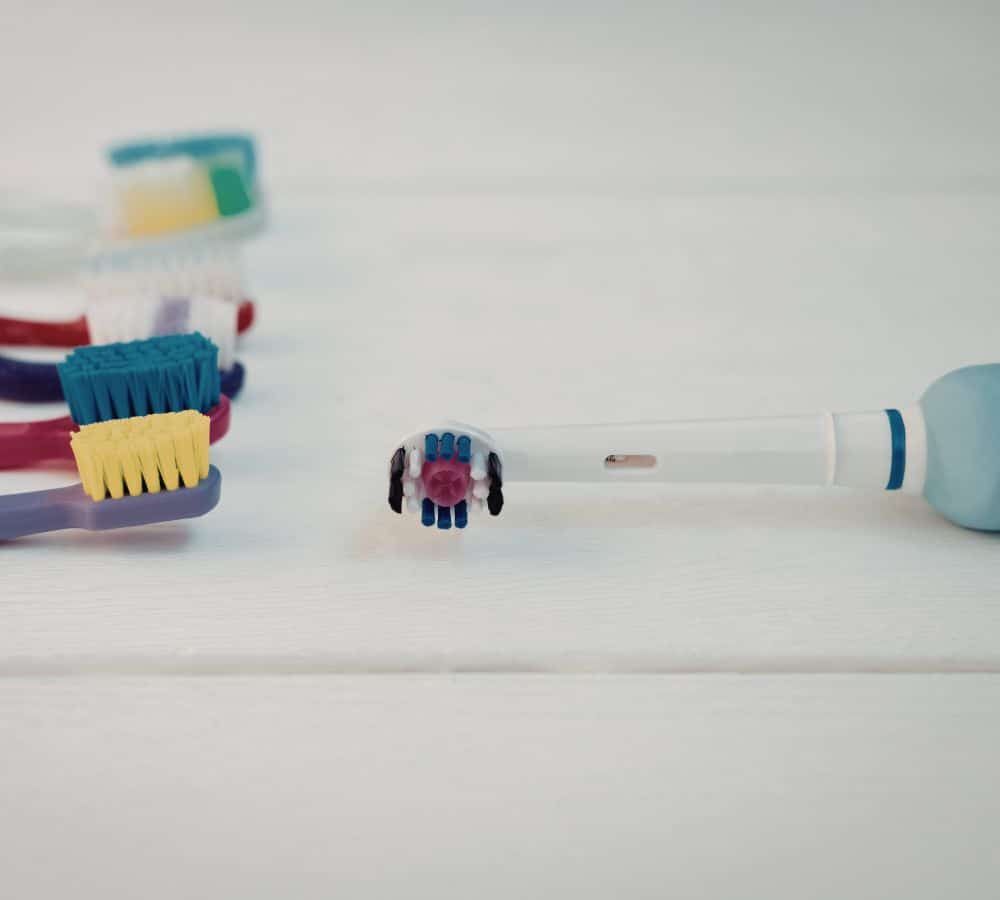
Use a soft toothbrush. A firm brush adds nothing to plaque removal and increases the risk of gum damage. “Medium” is firmer than most people need; soft is the default recommendation, and extra-soft if you already have recession. Which toothbrushes dentists recommend covers the choice in more detail.
Take two minutes and work systematically — outer surfaces, inner surfaces, biting surfaces, in a set order — rather than scrubbing whatever the brush lands on. Duration and coverage do the work that pressure was trying to do.
With an electric brush, let it do the work. Guide it slowly tooth by tooth and hold it against the surface. Moving it like a manual brush defeats the mechanism and adds force.
Two timing points that matter as much as pressure
- Do not brush straight after anything acidic — wine, citrus, soft drink, a sports drink, or after vomiting or reflux. Enamel is temporarily softened for roughly an hour, and brushing then removes a little of the softened surface — which is how acid wear starts. Rinse with water, wait, then brush.
- Spit, do not rinse. Rinsing with water after brushing washes away the fluoride you have just applied.
Toothpaste is part of the equation
Abrasion depends on what is on the brush as much as the brush itself. Highly abrasive pastes — many “whitening”, “smoker's” and charcoal products — combined with hard brushing accelerate wear, particularly on exposed dentine, which abrades many times faster than enamel. If you have recession, ask which toothpaste suits you rather than choosing the one that promises the most — and fluoride content matters more than the marketing on the front.
A simple test
If your toothbrush bristles are splayed outwards well before three months of use, you are brushing too hard. A brush used correctly keeps its shape — assuming it is being stored and cared for properly.
A second one: run a fingernail along the gumline of your upper canines. If it catches in a groove, there is already wear there.
What can be done if the damage is there
Recession does not reverse on its own, but none of it is untreatable:
- Stopping the cause comes first. Technique, brush firmness and toothpaste choice. Nothing else holds if the habit continues.
- Desensitising toothpastes and professionally applied fluoride varnish for sensitivity. These help most people and take a few weeks.
- Tooth-coloured restorations to fill notches, protect exposed dentine and improve appearance.
- Gum grafting, in selected cases, to cover an exposed root. This is surgery and is carried out by a specialist periodontist — a protected title held only by practitioners on the Dental Board's specialist register. Specialist Periodontists.
Recession is not always caused by brushing. Periodontal disease, tooth position, a thin gum type, clenching and grinding, orthodontic movement, and lip or tongue piercings all produce it. Which cause applies to you determines what should be done about it, and that requires examination — the treatment for recession from gum disease is not the treatment for recession from over-brushing.
When to be seen
- Gums that bleed regularly when you brush or floss.
- Sensitivity that is new, worsening, or localised to one tooth — a single sensitive tooth is a different problem from generalised sensitivity.
- Teeth that look longer, or gaps appearing between them at the gumline.
- A visible notch or groove at the gumline.
- A brush that splays within weeks.
- Pain that lingers for more than a few seconds after cold, wakes you at night, or comes on spontaneously — that is not sensitivity and should be assessed promptly.
- Waking with a sore jaw or worn-flat teeth, which points to night-time grinding rather than to your brushing.
Common questions
If I get the technique right, is brushing on its own enough?
No, and the Australian Dental Association's own list is short enough to check yourself against. Its oral hygiene policy names four main strategies:
“brushing for two minutes twice a day; using an age-appropriate fluoride toothpaste; clean between teeth once a day using floss or interdental brushes; and visit a dental professional for regular check-ups and professional cleaning.”
The policy's one-sentence summary is blunter still: “brushing, cleaning between teeth, and seeing a dental professional regularly are essential for good oral health.” Three things, all described as essential, and brushing is one of them rather than the whole of it.
The reason the list has four items rather than one is stated in the same policy: “tooth decay (dental caries) and gum disease (periodontal disease) are two of the most common diseases experienced by Australians. Plaque is the primary cause of both diseases.” A toothbrush cannot reach the surfaces between teeth, and no amount of pressure changes that — which is the practical link between this page and the interdental one. It is also why calculus, once formed, needs a professional clean: strategy four exists because strategies one to three do not catch everything.
If you are brushing hard because you feel your mouth is not clean enough, the honest diagnosis is usually that one of the other three is missing rather than that the brushing is too gentle.
Should I use a mouthwash as well — or instead?
As well, if you want to, and never instead. The distinction the ADA draws is precise and worth having. Mouthrinse does not appear in its list of main oral hygiene strategies quoted above. It does appear in a separate list of “proven aids to oral hygiene”, alongside the toothbrush, fluoridated toothpaste, interdental aids and sugar-free chewing gum. So the ADA's position is not that mouthwash is useless — it is that mouthwash is adjunctive rather than essential. Australian Prescriber puts the same point more directly: it is “an adjunct to, not a substitute for, regular brushing and flossing” and “should never be the sole means of oral hygiene.”
The best-quantified case is chlorhexidine, and the Cochrane review of it repays reading because it gives both sides. Used as an adjunct to mechanical cleaning, chlorhexidine mouthrinse reduced gingivitis by 0.21 points on the 0 to 3 Gingival Index (95% CI 0.11 to 0.31) after four to six weeks, from 10 trials and 805 participants, rated high-quality evidence — and produced a large reduction in plaque (standardised mean difference 1.45, 95% CI 1.00 to 1.90; 12 trials, 950 participants), also high-quality.
Three limits sit alongside those numbers, and all three matter.
- Those participants had only mild gum inflammation (mean Gingival Index score of 1). The review states there were “insufficient data to determine the reduction in gingivitis” in people with moderate or severe inflammation — which is to say, in exactly the people most likely to be handed a bottle.
- It stains teeth, substantially. The review found a large increase in extrinsic staining (standardised mean difference 1.07, 95% CI 0.80 and above) at four to six weeks, and its plain-language summary is unambiguous: “rinsing for 4 weeks or longer causes tooth staining.” It also notes calculus build-up and transient taste disturbance among other effects.
- Every trial tested it as an addition to brushing, not as a replacement for it. There is no evidence base for using it instead.
So: a rinse can be a sensible adjunct, particularly short-term or where someone genuinely cannot clean mechanically. It is not a shortcut, and chlorhexidine in particular is a product to use on advice and for a defined purpose rather than indefinitely. Ask your dentist which — if any — is appropriate for you and for how long. The truth and myths about mouthwashes.
Should I be brushing my tongue too, and how hard?
Gently if at all, and the honest answer on whether it helps is that the ADA contradicts itself on this page and it is worth seeing both halves.
Its consumer key messages say “cleaning your tongue can help to reduce bad breath.” Its own body text on the same subject says the opposite: “a review of the scientific evidence in 2019 found no evidence that cleaning your tongue, using several different methods including mouthwash or chewing gum, were effective for managing the cause of halitosis”, and adds that “bad breath can actually be caused by other areas of the body including the lungs and the nose!” The page's own summary line resolves the two: cleaning the tongue reduces the bacterial load on it, “but the impact of this reduction has not been proven yet.”
The underlying trial evidence is thin in the way that should make anyone cautious. Cochrane's assessment of mechanical tongue cleaning found a reduction in volatile sulphur compounds of mean difference −0.20 (95% CI −0.34 to −0.07) — from two trials with 46 participants between them. That is a real measured effect on a chemical marker, from a very small evidence base, and not the same as demonstrating that anyone's breath improved in a way others noticed.
If you do it, the technique matters more than the frequency, and it is the same principle as the rest of this page. The ADA's instruction: “you need to be very gentle because the tongue surface is delicate and sensitive”; a soft-bristled toothbrush is fine, as are tongue scrapers; and “start gently at the back of the tongue, pulling or brushing forward and use water to lubricate the process so the brush doesn't drag along the tongue surface.”
One practical consequence: if bad breath is the actual reason you are scrubbing your tongue, scrubbing harder is not the answer, and persistent bad breath is worth having examined rather than managed with force.
Is the fluoride doing more than the brushing is?
They do different jobs, and separating them explains the two instructions on this page that sound fussiest.
Brushing removes plaque. Fluoride changes the tooth surface, making the repaired enamel more resistant to acid than it was before. Both the ADA and the World Health Organization treat the fluoride as part of the specification rather than an optional extra: the ADA's strategy list specifies “an age-appropriate fluoride toothpaste”, and the WHO, setting out how decay develops, names “toothbrushing with fluoride toothpaste containing 1000-1500 ppm concentration” as the step whose absence, alongside high sugar intake, leads to caries. The concentration is printed on the tube, and an adult paste below that band is not delivering what the recommendation assumes.
On the scale of what fluoride contributes, the National Health and Medical Research Council's assessment of community water fluoridation — a different delivery route, but the same active agent — found it reduces tooth decay by 26 to 44 per cent in children and adolescents and by about 27 per cent in adults. That is the size of the effect the mineral is capable of.
Which is exactly why spit, do not rinse. Rinsing with water immediately after brushing washes off the fluoride before it has had time to act, which throws away the second half of what you just did while keeping all of the mechanical work. The same logic applies to drinking or eating straight afterwards. It is the cheapest improvement available to anyone reading this page, and it costs nothing but a habit.
Do bleeding gums matter to anything other than my mouth?
On the evidence for one condition, yes, and the relationship runs both ways.
Diabetes Australia states that “there is increasing evidence of a two-way relationship between periodontitis and diabetes.” In one direction: “the risk of developing periodontitis is greater in people with diabetes, particularly when blood glucose levels are not within the recommended range of 4-7 mmol/L” — though, importantly, “with optimum blood glucose management the risk of developing periodontitis is the same as for a person without diabetes.” In the other: people with periodontitis “exhibit a higher chance of developing prediabetes and diabetes” and have “poorer glycaemic status (higher level of HbA1C), compared to people without periodontitis.”
Two honest limits on that, both stated by the same source. Professional periodontal treatment has been shown to produce “a mild improvement in blood glucose levels”, but “these results lasted for only a short three-month period”, with longer-term studies ongoing. And the relationships differ between type 1 and type 2 diabetes. So gum treatment is not a diabetes treatment, and it should not be sold as one.
Worth knowing about the system, too: Diabetes Victoria points out that dental visits are not formally included in the Annual Cycle of Care for diabetes in Australia — the annual checklist covers blood pressure, HbA1c, cholesterol, kidney function, podiatry and eye examinations, and omits oral health. Nobody in that cycle is going to raise your gums with you, which makes it your question to ask.
The practical version for this page: bleeding gums are worth acting on in their own right, and if you have diabetes they are worth mentioning at both appointments — the dental one and the medical one. See diabetes and dental health and what is periodontal disease?
Related reading
What over-brushing is · Which toothbrush do dentists recommend? · How to care for your toothbrush · How often should I brush my teeth? · Brushing your teeth: before or after breakfast? · Why do I have sensitive teeth? · Bleeding Gums · Dental Cleans and Hygienists · What is gum disease?
Practical details
We are at Level 1, 220 Collins Street, Manchester Unity Building, Melbourne VIC 3000. Phone 13 13 96, or theteam@smilesolutions.com.au. Monday–Friday 8.00am–6.00pm, Saturday 8.30am–1.30pm, Sunday by appointment.
If you already have gum recession or sensitivity, a hygienist appointment can identify whether brushing technique is the cause and what can be done to stop it progressing.
Registration for any practitioner, and whether they hold specialist registration, can be verified free on the AHPRA public register at ahpra.gov.au.
Published 28 May 2015. Quoted comments are attributed to Dr Peter Alldritt of the Australian Dental Association. In the questions above: the oral hygiene strategies and the classification of mouthrinse are from the ADA's policy statement on community oral health promotion and oral hygiene; the chlorhexidine figures are from a Cochrane review of chlorhexidine mouthrinse as an adjunctive treatment for gingival health; the tongue-cleaning material is from the ADA's consumer page on tongue cleaning and a Cochrane assessment of tongue scraping; fluoridation figures are from the National Health and Medical Research Council and the toothpaste concentration from the World Health Organization; the diabetes material is from Diabetes Australia and Diabetes Victoria.
General information only — it is not a diagnosis, a treatment plan, a quote or a promise of any particular clinical outcome, and it does not replace advice from your treating practitioner. Pressure figures are typical guidance rather than a measured prescription, gum recession has several possible causes and only examination can establish which applies to you, and treatments including restoration and grafting carry their own risks and are not suitable for everyone. Nothing here is advice about any medicine or medicated rinse, or about the management of diabetes; those belong with the practitioner who prescribes for you.
Smile Solutions trades under ABN 28 193 514 103.
Images on This Page
-
https://www.facebook.com/tr?id=800557773428361&ev=PageView&noscript=1
(no alt text)
-
https://www.smilesolutions.com.au/wp-content/uploads/2025/10/calendar_month.svg
(no alt text)
-
https://www.smilesolutions.com.au/wp-content/themes/arcadian-wordpress-theme/assets/images/smile_solutions_logo_white.png
Smile Solutions Logo
-
https://www.smilesolutions.com.au/wp-content/themes/arcadian-wordpress-theme/assets/images/smile_solutions_logo_purple.png
Smile Solutions Logo
-
https://www.smilesolutions.com.au/wp-content/uploads/2023/11/SS-Tooth-1-1-150x150.png
Smile Solutions
-
https://www.smilesolutions.com.au/wp-content/uploads/2013/09/Toothbrushes.jpg
How to choose a toothbrush
-
https://www.smilesolutions.com.au/wp-content/uploads/2025/09/Root-Canal-2-300x217.jpg
Root Canal
-
https://www.smilesolutions.com.au/wp-content/uploads/2026/08/Mouth-Breathing-300x270.jpg
Mouth Breathing
-
https://www.smilesolutions.com.au/wp-content/uploads/2025/09/Dental-Crown-at-Smile-Solutions-300x300.jpg
Dental Crown at Smile Solutions
-
https://www.smilesolutions.com.au/wp-content/themes/arcadian-wordpress-theme/assets/images/family_owned_bussiness.png
Family Owned Business
-
https://www.smilesolutions.com.au/wp-content/themes/arcadian-wordpress-theme/assets/icons/icon--phone.svg
Smile Solutions Contact
-
https://www.facebook.com/tr? id=800557773428361&ev=PageView&noscript=1
(no alt text)
-
https://bat.bing.com/action/0?ti=25148060&tm=gtm002&Ver=2&mid=9708c381-959b-488b-ab88-79f2b8e43a80&bo=1&sid=570ed600ab2711f190afdf9bb4cf13a7&vid=570f2c50ab2711f19d05b533a9c45074&vids=1&msclkid=N&pi=918639831&lg=en-US&sw=800&sh=600&sc=24&nwd=1&tl=How%20much%20pressure%20should%20I%20apply%20when%20brushing%20my%20teeth%3F%20-%20Smile%20Solutions&p=https%3A%2F%2Fwww.smilesolutions.com.au%2Fdental-articles%2Farticle%2Fbrushing-teeth%2F&r=&evt=pageLoad&sv=2&cdb=AQAQ&rn=827742
(no alt text)