What is acid wear?
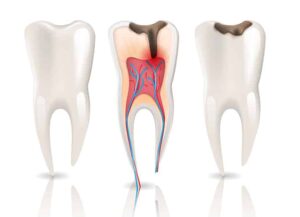
Acid wear — dental erosion — is the loss of tooth structure caused by exposure to acids in the mouth. The acids dissolve the outer surface of the tooth, the enamel, first. If erosion progresses into the middle layer, the dentine, it can cause pain and sensitivity. If it reaches the inner layer, the pulp, severe pain and infection may follow, and the tooth may then need root canal treatment or extraction.
The Australian Dental Association describes the mechanism in a single line in its Policy Statement 2.2.2 on diet and nutrition: "Exposure to acid from the consumption of acidic or sugar-sweetened foods and beverages can lead to softening and loss of tooth structure" — adding that "The combination of sugar and food acid can be particularly destructive." Its position summary is blunter still: "Dietary sugars and acids cause damage to teeth."
The defining feature, and the reason it is worth acting on early: dental erosion is not naturally reversible. Enamel dissolved by acid does not grow back — if enamel is the hardest substance in the body, why do teeth break? explains why the hardest tissue you have is still on a one-way trip.
Erosion progresses faster where other processes are also present — decay and tooth grinding in particular. Grinding on softened enamel removes far more than either would alone. See how does tooth decay develop? for the first, and what is bruxism and how is it managed?, night-time tooth grinding and clenching and teeth grinding and TMD for the second.
How it differs from decay
This distinction governs what you should do about it.
| Decay | Erosion | |
|---|---|---|
| Cause | Acid produced by plaque bacteria from sugar | Acid in contact with the tooth directly |
| Bacteria involved? | Yes | No |
| Pattern | Localised — grooves, contact points, gumline | Generalised — broad, smooth, shiny surfaces |
| Does brushing help? | Yes | Not directly — and brushing straight after acid makes it worse |
| Does sugar-free help? | Yes | No — sugar-free drinks are just as acidic |
The decay column has its own well-documented chemistry. The ADA describes it this way: "The process of caries initiation consists of the metabolism of simple carbohydrates by bacteria in the dental plaque which produces acids. The production of these acids causes the pH of dental plaque to fall below the critical level leading to softening of tooth structure." Same end result, different route — which is why a sugar-free acidic drink removes one of those routes and leaves the other wide open.
That last row is the one people get wrong most often — are sugar-free soft drinks better for my teeth? sets out the research behind it. On the decay side, the stages of dental decay and can you reverse tooth decay? explain how far that process can be turned back, and sugar: what does it do to your teeth? explains why frequency beats quantity. That last point is the ADA's too: "The form, frequency, timing and total amount of sugar intake are significant in the initiation of the caries process."
What to look for
Erosion is easy to miss because it is gradual and painless at first:
- Enamel losing its gloss, looking dull or chalky — different in pattern from the other causes of white spots on teeth
- Teeth becoming more yellow, as thinning enamel reveals the dentine beneath
- Front teeth becoming thin and translucent at the biting edges
- “Cupping” — shallow craters on the tips of molars and canines
- Sensitivity to cold and sweet
- Fillings appearing to stand proud of the tooth — diagnostic, since filling materials do not erode, so a raised filling means the tooth around it has been lost
Over time the teeth also shorten, which shortens the lower face — teeth and aging covers that, and what is dental erosion and how is it addressed? is the companion article to this one.
Where the acid comes from
Acid wear is prevented by identifying and limiting exposure. Common sources:
- Acidic drinks — fizzy drinks, alcohol, fruit juices, cordial. See Victorians’ love of soft drink, damage within 30 seconds of a soft drink and is soda water bad for your teeth?
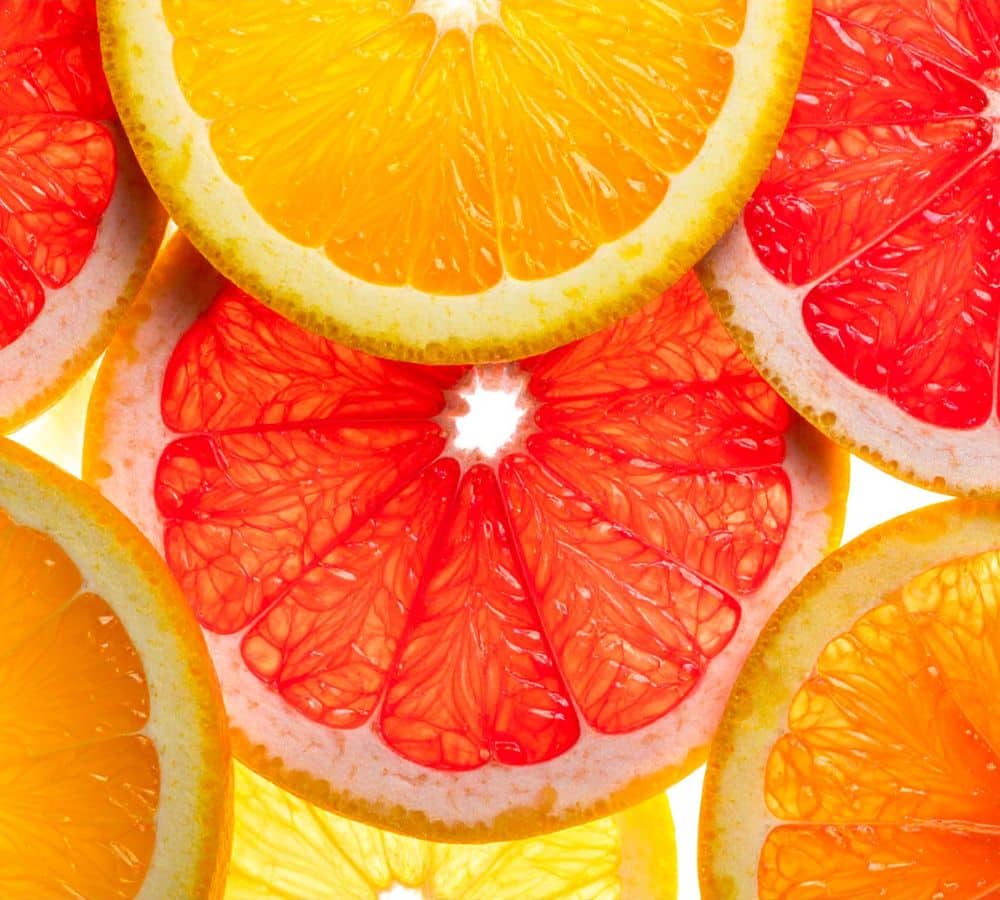
- Acidic foods — citrus fruits, pickles and other vinegar-containing foods. How does acidic food affect your teeth?, six foods to avoid for healthy teeth and how does your diet affect your teeth?
- Acid regurgitation — from reflux, or vomiting, including morning sickness. How do I protect my teeth during pregnancy?
- Acidic medications — chewable vitamin C tablets and aspirin
- Frequent exposure to improperly chlorinated pool water
Worth adding, because they surprise people: sugar-free soft drinks (the acid, not the sugar, causes erosion), flavoured sparkling water, sports and energy drinks, kombucha, cider, wine, and fruit and herbal teas — plain black and green tea is the exception.
And two sources most people would never put on a list of acids. Some mouthwashes are themselves acidic: Australian Prescriber notes of the enzyme-based rinses marketed for dry mouth that they "do not contain alcohol or detergent, but they do have a low pH (5.15) which may pose a risk of dental erosion during long-term use", and says that essential-oil mouthwashes "are not recommended for patients suffering from xerostomia, dental erosion due to a low oral pH, or oral mucosal disease". Some over-the-counter whitening rinses carry the same problem: a review in Frontiers in Dental Medicine warns that their "indiscriminate use" can damage the tooth surface, "mainly the ones presenting low pH, which can be erosive, and cause even greater damage to exposed dentin", and that "the continuous use of these rinses associated with tooth brushing can increase the enamel abrasion potential promoted by daily tooth brushing". A product bought to improve the look of your teeth is capable of thinning them.
The two most significant non-dietary causes are worth naming plainly, because both need treating rather than managing: gastro-oesophageal reflux, including silent reflux you may not be aware of, and recurrent vomiting, including that associated with eating disorders. Erosion on the inner surfaces of the upper front teeth is a pattern that points to stomach acid rather than diet.
Who is most at risk
The ADA's policy names the circumstances in which acidic foods and drinks "should be avoided especially", and it is a more specific list than "people who drink a lot of soft drink":
- "individuals with poor oral hygiene"
- "individuals with low or no fluoride exposure"
- "individuals with conditions which lead to a reduction in salivary flow"
- "exertion resulting in a dry mouth"
- "individuals using medication(s) which lead to a reduction in salivary flow"
- "sipping drinks, other than water, during interrupted sleep"
- "chewing and sucking acidic vitamin tablets"
Three of those seven are about saliva, which is the point of the next section.
Dry mouth
Saliva plays an important role in buffering acid and reducing its effect. Anything that reduces saliva therefore accelerates erosion.
It is a common problem rather than an exotic one. The Better Health Channel reports that "About 10% of the general population and 25% of older people have dry mouth, which means they don't have enough saliva", that it "is a symptom of an underlying problem, rather than a condition in itself", and that "about 600 drugs and medications, both legal and illegal, are known to cause dry mouth" — naming antihistamines and blood pressure medications among them.
Other causes include medical conditions such as Sjögren’s syndrome. Mouth breathing, dehydration and alcohol also contribute, as does heavy exercise. The Better Health Channel's own advice is to "Avoid any substance that increases or irritates mouth dryness", listing "cigarettes, e-cigarettes, alcohol, caffeinated drinks and spicy foods", and to avoid "lollies (especially fruit-flavoured and sour lollies) and alcohol-containing mouthwashes, as these products tend to aggravate dry mouth tissue".
If you have a dry mouth, your erosion and decay risk is elevated regardless of what you eat. Tell your dentist every medication you take. My mouth is always dry — why is this, and does it affect my teeth? and my mouth always feels dry! What can I do? cover the management.
How to limit the damage
Erosion is driven by contact time and frequency, not volume. So the useful measures are about how you consume, not only what:
- Drink quickly rather than sipping frequently. One drink in five minutes is a single acid attack; the same drink nursed over an hour is a continuous one.
- Use a straw, to reduce contact with the teeth.
- Rinse with water immediately afterwards, to help return the mouth to neutral.
- Do not brush for at least 30 minutes afterwards — and an hour is better. Acid temporarily softens the enamel surface, and brushing straight away abrades away the softened layer. This is one of the few situations where doing the right thing at the wrong time causes the harm. What is the ideal daily routine for oral hygiene?, over brushing and which toothbrushes do dentists recommend? cover technique; a soft brush matters more here than anywhere else.
- Keep acidic items to mealtimes rather than grazing.
- Finish with something that raises pH — cheese, milk, plain nuts — or chew sugar-free gum to stimulate saliva. Sugar-free chewing gum is on the ADA's own list of "proven aids to oral hygiene", alongside toothbrushes, fluoride toothpaste and interdental cleaning.
- For acidic medications, limit contact: swallow chewable vitamin C or aspirin whole, or break tablets into fragments and swallow those. Where a liquid medicine is taken long term, ask the prescriber or pharmacist about a sugar-free formulation — the ADA's policy is that "The pharmaceutical industry should be encouraged to provide sugar-free formulations or minimise sugar content for medications taken orally."
If reflux is the cause, treating the reflux is the intervention that matters — see your doctor. If vomiting is the cause, rinse with water and do not brush afterwards; a fluoride or bicarbonate rinse is preferable. The truth and myths about mouthwashes is worth reading before choosing one.
Management
Erosion is not naturally reversible. But once identified, it can be monitored for change — typically with dental models or photographs taken at intervals, so that progression is measured rather than guessed at. That record is what tells you whether your preventive measures are working.
The cause should be addressed with the preventive strategies above. Fluoride treatments may be prescribed to strengthen the remaining tooth structure and increase its acid resistance. That is the actual mechanism, in Australian Prescriber's words: "Fluoride assists in the prevention of dental caries by promoting remineralisation with fluorapatite and fluoro-hydroxyapatite, thereby increasing enamel resistance to acid attack." See the benefits of fluoride, and selecting a toothpaste: fluoride or non-fluoride? for what to buy in the meantime.
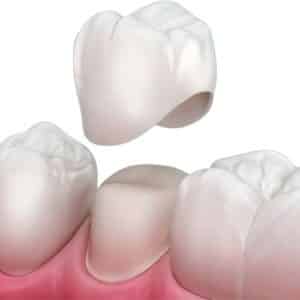
Once the disease process is stabilised, teeth may be restored with veneers, filling materials or crowns. In some cases further procedures are required, such as root canal treatment where erosion has approached or reached the pulp. Extensive cases become restorative dentistry proper, sometimes under a prosthodontist or through complex dentistry.
One point that matters if veneers are proposed for an eroded front tooth: bonding depends on enamel, and erosion is what has been removing it. A study in Materials measuring prepared veneer surfaces found "approximately 30%" exposed dentine and 70% enamel on intact teeth — noting that this "is above the minimally acceptable for the enamel exposure (40%) required to obtain an efficient bond strength". On a tooth that is already eroded, less enamel is available to begin with. Stabilising the erosion is therefore not just good sequencing; it protects the option.
The sequence there matters: stabilise first, restore second. Restorations placed into an active erosive environment fail, because the tooth continues dissolving around them.
Why a comprehensive examination matters
Tooth erosion frequently occurs alongside other tooth and gum disease. A comprehensive examination is essential to identify those before treatment begins — restoring an eroded tooth while missing the grinding, the reflux or the decay that will destroy the restoration achieves very little. Understanding your treatment, how often should I go to the dentist? and when do you need deeper cleaning? set out what those appointments involve.
Common questions
My teeth have gone yellow. Will whitening fix that?
It depends entirely on why they are yellow, and erosion is the case where whitening is the wrong tool. If enamel has thinned, what you are seeing is the dentine underneath showing through — dentine is naturally darker, and bleaching the surface does not change what is behind it. Staining sits on the tooth; thinning reveals what is in it. Those are different problems.
There is a safety dimension as well. The ADA's policy on teeth whitening notes that ‘Percolation of hydrogen peroxide into the nerve tissues — often accelerated by exposed dentine and enamel fractures — can lead to nerve inflammation', and that ‘The most common side-effects are transient tooth sensitivity and soft tissue irritation'. Exposed dentine is exactly what erosion produces, which is why the same policy says an ‘Appropriate examination to diagnose and treat any dental or oral health problems is required to minimise any potential discomfort or health risks associated with exposure to bleaching agents.'
So the order is examination first, cause identified and stabilised second, and only then a conversation about appearance — which may turn out to be about restoring shape rather than changing colour. The whitening-rinse caution above applies with particular force here: a low-pH product bought to make eroded teeth look whiter can make the underlying problem worse. Teeth whitening and why should I go to a dentist for whitening?
Would a fluoride mouthwash help?
Possibly, and it is worth asking your dentist about — but be clear about what the published evidence does and does not cover, because it is narrower than the shelf suggests.
The mechanism is well described. Australian Prescriber states that ‘Fluoride assists in the prevention of dental caries by promoting remineralisation with fluorapatite and fluoro-hydroxyapatite, thereby increasing enamel resistance to acid attack.' Increased acid resistance is plainly relevant to erosion.
The trial evidence, though, is about something else. The Cochrane review of fluoride mouthrinses pooled 37 trials and 15,813 participants and found that ‘daily and weekly/fortnightly supervised rinse programmes result on average in 27% (95% CI 23% to 30% reduction) fewer decayed, missing or filled permanent tooth surfaces' — moderate-certainty evidence, in children and adolescents, for caries, not for erosion in adults. It also notes that ‘Because of the risk of swallowing too much fluoride, fluoride mouthrinses are not recommended for children younger than six years of age', and that ‘No trials have looked at the effect of fluoride rinse on baby teeth.'
So: a reasonable adjunct with a sound mechanism and a strong evidence base for a neighbouring problem, rather than a proven treatment for erosion. Ask which product and which strength, and check the pH — as the body of this page sets out, some rinses are themselves acidic.
Do ‘enamel repair' toothpastes actually rebuild enamel?
Not in the sense the packaging implies. Remineralisation and regrowth are not the same thing. What fluoride does, in Australian Prescriber's description, is promote ‘remineralisation with fluorapatite and fluoro-hydroxyapatite, thereby increasing enamel resistance to acid attack' — it hardens and reinforces the mineral that is still there and helps repair very early, sub-surface demineralisation. It does not restore enamel that has already dissolved away, and no toothpaste does.
That is why the honest framing on this page is prevention and monitoring rather than repair. A cupped molar or a thinned incisal edge is a structural loss, and structural loss is restored by a dentist with a material, not by a tube.
What these products are good for: delivering fluoride, which is genuinely useful. The ADA's list of ‘proven aids to oral hygiene' includes fluoridated toothpaste, and its main strategies include ‘using an age-appropriate fluoride toothpaste'. Choose one with fluoride, use a soft brush, and observe the 30-to-60-minute rule after anything acidic — the timing does more than the branding.
I train hard and drink sports drinks. How much does that matter?
More than the same drink would at a desk, and the ADA's own list explains why. Among the circumstances in which acidic foods and drinks ‘should be avoided especially', it lists ‘exertion resulting in a dry mouth' as its own separate item, alongside ‘individuals with conditions which lead to a reduction in salivary flow'.
That is the compounding factor. Saliva is what buffers acid and washes it away; exercise reduces it through mouth breathing and fluid loss. So an acidic drink taken during or straight after training meets a mouth with less defence than usual, and it is typically sipped over a long session — which maximises frequency, the variable the ADA identifies as significant.
Practical, without telling anyone how to train: water for hydration during ordinary sessions; where a sports drink is genuinely being used for its carbohydrate and electrolytes, take it in mouthfuls rather than sipping continuously, rinse with water afterwards, and do not brush for at least half an hour. If you also grind or clench, the two mechanisms stack — softened enamel plus mechanical load removes far more than either alone. Are sports drinks really that bad for your teeth? and why running can cause a dry mouth
Is plain sparkling water a problem too?
We are going to be straight about the limits of what we can tell you here: we have not found an independent Australian source in the reference material we check that measures the erosive potential of plain carbonated water, so we are not going to put a number or a ranking on it.
What can be said with confidence is the general rule the ADA states — that acid exposure softens and removes tooth structure, and that the form, frequency and timing of the exposure matter. Carbonation makes water mildly acidic; added flavourings, and particularly citrus ones, make it more so, which is why flavoured sparkling water is on the list above and plain tap water is the one drink the ADA exempts from its sipping caution.
So the low-risk position is unchanged: plain water is the default between meals, anything fizzy or flavoured is better taken with a meal than sipped through an afternoon, and if you are already showing erosion, that is the conversation to have with your dentist rather than a general rule to apply. Is soda water bad for your teeth?
Related reading
- Is flossing really that important?
- Dental cleans with our hygienists
- How do I prevent dental decay?
- What can I do to strengthen my teeth?
- Protecting your child from dental disease
- Sports drinks linked to poor dental health in athletes
- Caring for your teeth: 8 steps to dental health
Practical details
For further information, call Smile Solutions on 13 13 96.
Specialist registration can be verified on the AHPRA register, or by calling 1300 419 495. The clinical team is listed by name, and fee ranges are in the price guide.
Smile Solutions, Level 1, 220 Collins Street, Manchester Unity Building, Melbourne VIC 3000 — getting here. Phone 13 13 96, contact us, or theteam@smilesolutions.com.au. Monday–Friday 8.00am–6.00pm, Saturday 8.30am–1.30pm, Sunday by appointment.
Published 17 February 2017. General information only; it does not replace advice from your treating practitioner. If reflux or vomiting is contributing, speak with your doctor.
Smile Solutions trades under ABN 28 193 514 103.
Images on This Page
-
https://www.facebook.com/tr?id=800557773428361&ev=PageView&noscript=1
(no alt text)
-
https://www.smilesolutions.com.au/wp-content/uploads/2025/10/calendar_month.svg
(no alt text)
-
https://www.smilesolutions.com.au/wp-content/themes/arcadian-wordpress-theme/assets/images/smile_solutions_logo_white.png
Smile Solutions Logo
-
https://www.smilesolutions.com.au/wp-content/themes/arcadian-wordpress-theme/assets/images/smile_solutions_logo_purple.png
Smile Solutions Logo
-
https://www.smilesolutions.com.au/wp-content/uploads/2023/11/SS-Tooth-1-1-150x150.png
Smile Solutions
-
https://www.smilesolutions.com.au/wp-content/uploads/2022/04/Acidic-Foods-and-Oral-Health.jpg
Acidic Foods and Oral Health
-
https://www.smilesolutions.com.au/wp-content/uploads/2025/09/Root-Canal-2-300x217.jpg
Root Canal
-
https://www.smilesolutions.com.au/wp-content/uploads/2026/08/Mouth-Breathing-300x270.jpg
Mouth Breathing
-
https://www.smilesolutions.com.au/wp-content/uploads/2025/09/Dental-Crown-at-Smile-Solutions-300x300.jpg
Dental Crown at Smile Solutions
-
https://www.smilesolutions.com.au/wp-content/themes/arcadian-wordpress-theme/assets/images/family_owned_bussiness.png
Family Owned Business
-
https://www.smilesolutions.com.au/wp-content/themes/arcadian-wordpress-theme/assets/icons/icon--phone.svg
Smile Solutions Contact
-
https://www.facebook.com/tr? id=800557773428361&ev=PageView&noscript=1
(no alt text)
-
https://bat.bing.com/action/0?ti=25148060&tm=gtm002&Ver=2&mid=f25f4a64-57e6-4544-86c6-ef1da33c23f0&bo=1&sid=1076a2c0ab2711f1b37f5dae247f5cac&vid=1076d040ab2711f193110926ba82551c&vids=1&msclkid=N&pi=918639831&lg=en-US&sw=800&sh=600&sc=24&nwd=1&tl=I%E2%80%99ve%20heard%20a%20lot%20about%20acid%20wear.%20What%20is%20this%20and%20how%20can%20I%20avoid%20it%3F%20-%20Smile%20Solutions&p=https%3A%2F%2Fwww.smilesolutions.com.au%2Fdental-articles%2Farticle%2Fwhat-is-acid-wear-and-how-can-i-avoid-it%2F&r=&evt=pageLoad&sv=2&cdb=AQAQ&rn=469947
(no alt text)