What is dental erosion?
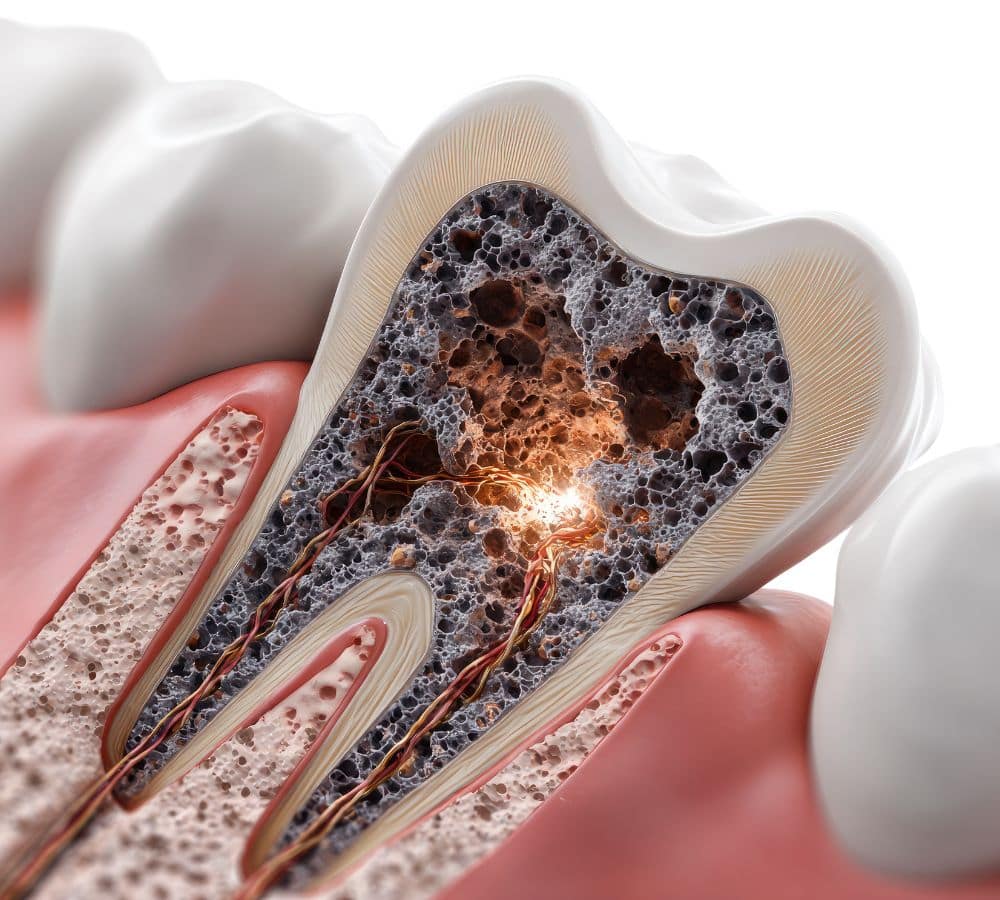
Dental erosion is a common finding at dental examinations. It occurs when the dental enamel on the tooth surface has dissolved.
Affected teeth have worn-down surfaces and appear shorter.
Clinical signs range from slight loss of tooth surface to extensive loss of tissue, with nerve exposure. Patients may be completely asymptomatic, or in pain ranging from mild to severe — which is why erosion is so often found rather than reported, and why the interval between check-ups matters for catching it.
Erosion is one of three kinds of tooth wear
The distinction matters, because the three have different causes and different answers — and most worn mouths have more than one operating at once.
- Erosion — chemical. Acid dissolves mineral out of the tooth surface. No bacteria are involved, which is what separates it from decay. Acid wear, and how to avoid it
- Attrition — tooth against tooth. Grinding and clenching. It produces flat, matching wear facets on opposing teeth. TMD & Teeth Grinding and what bruxism is
- Abrasion — something else against the tooth. Hard brushing with an abrasive toothpaste is the usual cause, producing notches at the gumline. What over-brushing is
They compound each other. Enamel softened by acid abrades and grinds away far faster than sound enamel — which is why someone who drinks citrus water through the day, brushes hard immediately afterwards, and clenches at night can lose a startling amount of tooth in a few years. If enamel is the hardest substance in the body, why do teeth break? covers what enamel can and cannot withstand.
Telling them apart is a clinical judgement, and it determines whether the answer is a diet change, a night splint, a different toothbrush, a medical referral, or several of those.
What causes it
The causes are all environmental, coming either from inside the body (intrinsic) or from outside it (extrinsic).
Extrinsic sources
- Dietary — acidic drinks and foods: soft drinks including diet varieties, sports and energy drinks, fruit juice, cordial, citrus fruit, vinegar and pickled foods, wine, kombucha, flavoured mineral water, and vitamin C or effervescent tablets that are chewed or held in the mouth
- Industrial — workplace acid exposure, historically in battery manufacture, galvanising and plating; also chlorinated pool water where pH is poorly controlled, which is a recognised risk for competitive swimmers
- Pharmacological — medications, either because the preparation itself is acidic or because it reduces saliva
The diet-drink point catches people out. Sugar-free does not mean acid-free, and it is the acid that erodes enamel. Are sugar-free soft drinks better for my teeth than regular soft drinks? — and the damage starts within thirty seconds of the first mouthful.
How you consume it matters as much as what. Sipping over an hour, swishing, or holding a drink in the mouth extends the exposure far beyond the volume consumed. How your diet affects your teeth and six foods to avoid go further.
The Australian Dental Association's policy statement on diet and nutrition puts the same point in regulatory language, asking for “special emphasis” on “the form, frequency, timing and total amount of sugar consumption”, and going on to call for health warnings on labels to be mandatory for all consumables that significantly contribute to dental disease and tooth erosion.
Intrinsic sources
These are the body's own stomach acid reaching the mouth. Stomach acid is around pH 1 to 2 — far more aggressive than any drink.
Gastro-oesophageal reflux is the most common. It may be entirely silent: a substantial proportion of people with reflux erosion have never had heartburn, and erosion on the inner surfaces of the upper teeth is often the first evidence of it they encounter.
Vomiting is the other route, and it should be named rather than left out. Recurrent vomiting from any cause produces the same pattern — including eating disorders, severe pregnancy sickness, rumination, and chronic heavy alcohol use.
This is worth stating plainly for one reason: a dentist is sometimes the first health professional to see the sign. The wear pattern is characteristic and appears well before other physical signs. If a practitioner raises it, it is a clinical observation, not an accusation — and a conversation that is uncomfortable for ten minutes is a great deal better than the alternative. Where an eating disorder is involved, dental treatment is supportive and the primary care belongs with a medical team; the Butterfly Foundation national helpline (1800 33 4673) is one starting point.
Anything that reduces saliva — medication, medical conditions, radiotherapy, dehydration — makes every one of these causes substantially worse. My mouth is always dry — why is this, and does it affect my teeth?
Reading the pattern
Where the wear sits tells an experienced clinician a great deal:
- Inner (palatal) surfaces of the upper front teeth, often with a smooth, cupped, glassy look — strongly suggests an intrinsic acid source, because that is where stomach acid pools.
- Outer (labial) surfaces of the upper front teeth — suggests a dietary source, from the way drinks wash across the front of the mouth.
- Cupped hollows on the biting surfaces of molars, frequently with an old filling standing slightly proud — the filling does not dissolve, so it sits up as the tooth around it is lost. This is one of the clearest early signs, and it is one reason fillings do not last forever.
- Generalised, on every surface — often dietary combined with dry mouth.
None of this is a diagnosis you can make from a mirror, but it is why the dentist asks about diet, reflux and medications when they see wear.
The two questions to answer
For an affected patient, it is important to:
- Identify the acid source
- Determine whether the erosion has ceased, or is still progressing
Identifying the cause helps prevent further acid exposure, or minimise its effects where the cause cannot be removed — an essential medication, for instance.
The second question is answered by monitoring over time rather than by a single look: standardised photographs, study models or digital scans taken at intervals, and a documented wear index. Historic erosion that stopped years ago needs no intervention beyond keeping an eye on it. Active erosion needs the cause found now — and the two look identical on the day.
This is why “we'll photograph it and compare in twelve months” is a real plan, not a delay. Understanding your treatment covers what you should be told either way.
Why saliva matters
Saliva dilutes and washes away food particles and acids.
If you have a dry mouth, erosion acts faster, because there is not enough saliva present to protect the tooth surfaces. Dry mouth and acid exposure together are considerably worse than either alone.
Saliva does three separate jobs here: it dilutes and clears the acid, it buffers it back towards neutral, and — because it is supersaturated with calcium and phosphate — it puts minerals back into a surface that has just lost them. Recovery after an acid exposure typically takes 20 to 60 minutes, and that window is the reason for the brushing rule below.
The ADA's diet and nutrition policy singles out reduced saliva repeatedly as the thing that changes the risk: it lists conditions which lead to a reduction in salivary flow, medications which lead to a reduction in salivary flow, and “exertion resulting in a dry mouth” among the situations in which acidic foods and drinks should be avoided, and it specifically asks that dietary education reach older people “because of the increased risk of caries from reduced saliva flow and more exposed root surfaces”.
Prevention and treatment
Several things influence whether erosion progresses — oral hygiene practices, choice of medication, and fluoride.
Smile Solutions recommends that all patients:
- Rinse the mouth immediately after acidic drinks or foods
- Avoid brushing for at least 30 minutes after external acid exposure — brushing softened enamel removes it
- Change the diet towards more neutral and less acidic choices
- Avoid drinking juices between meals — frequency of acid exposure matters more than volume
- Drink acidic juices or soft drinks through a straw, to minimise contact within the mouth
- Chew sugar-free gum, which stimulates the saliva that neutralises acid
- Ask your medical practitioner about an alternative if a current medication is reducing saliva flow or causing dry mouth
- Drink fluoridated tap water in preference to bottled water. If fluoridated tap water is unavailable, bottled water is still better for your teeth than juice, cordial, sports drinks, or carbonated and uncarbonated soft drinks
The second and fourth points are the ones most often reversed in practice — people brush straight after an acidic drink, and sip through the day rather than finishing in one go. Both make erosion worse.
Additional measures worth asking about
- A soft brush and a low-abrasion toothpaste. Many whitening and charcoal pastes are the opposite of what an eroded mouth needs.
- High-fluoride toothpaste or professionally applied fluoride varnish, which harden the surface and reduce sensitivity — see also what else strengthens teeth.
- Finishing an acidic drink or meal with something neutral — cheese, milk or plain water — rather than letting the acid linger. The ADA's policy asks that “calcium rich foods and drinks such as milk, cheese and some fish should be promoted as the preferred source of dietary calcium”.
- A night splint where grinding is compounding the wear.
- Treating the reflux, not the teeth, where reflux is the cause. That belongs with your general practitioner. Dental measures alone will not stop erosion driven by an untreated intrinsic source.
If restoration is needed
Enamel does not grow back. Early softening remineralises; lost thickness does not. Where erosion has progressed far enough to need restoring, the ladder runs roughly:
- Monitoring and prevention only — the right answer for most cases found early
- Composite bonding to rebuild worn surfaces and protect exposed dentine — relatively conservative and repairable Composite Bonding
- Onlays or crowns where more tooth has gone Dental Crowns
- Full-mouth rehabilitation in severe generalised wear, often involving a specialist prosthodontist Specialist Prosthodontists. What restorative dentistry is covers the range.
Two things to understand before starting. Restoring eroded teeth without identifying the cause means the new restorations will fail the same way, and once a mouth has been extensively restored it stays restored — those restorations need maintenance and eventual replacement for life. The cheapest and least invasive point to intervene is always before there is anything to restore. The Price Guide shows the difference between the two ends of that ladder.
When to be seen
- Sensitivity to cold, sweet or touch that is new or worsening
- Front teeth becoming thin, glassy or transparent at the edges, or chipping
- Teeth looking yellower without an obvious staining cause — as enamel thins, the yellow dentine beneath shows through, and this does not respond to whitening. See teeth and ageing.
- Fillings that seem to be standing up out of the tooth
- Heartburn, regurgitation, or a sour taste — mention it, even if it seems unrelated to teeth
- Recurrent vomiting for any reason
- A dry mouth, or a new medication
Common questions
I only drink diet soft drink and sparkling water. Am I still at risk?
Yes, because it is the acid rather than the sugar that erodes enamel, and that is true of a sugar-free drink as much as a sweetened one.
What is more useful than a list of drinks is the Australian Dental Association's list of the situations in which acid matters most. Its policy statement on diet and nutrition says acidic foods and drinks “should be avoided especially when an individual is at high risk of developing caries or erosion of teeth”, and names those individuals as: people with poor oral hygiene; people with low or no fluoride exposure; people with conditions that reduce salivary flow; “exertion resulting in a dry mouth”; people taking medications that reduce salivary flow; “sipping drinks, other than water, during interrupted sleep”; and “chewing and sucking acidic vitamin tablets”.
Three of those seven are about a dry mouth, and one is about exercise — which is the reason a sports drink sipped through a long training session is a worse combination than the same drink with a meal. Two others are habits rather than products: the glass of something acidic kept beside the bed, and the chewable vitamin C tablet. If none of the seven applies to you, sparkling water with meals is a different proposition from sparkling water sipped all day.
Is fruit juice better for my teeth than soft drink?
Not by as much as most people assume, and the national dietary guidance is direct about it. The Australian Dietary Guidelines put fruit juice and dried fruit together in a section headed “vegetables and fruit to limit”, noting that juices provide energy but “most lack dietary fibre”, that “they are acidic and frequent consumption may contribute to an increased risk of dental erosion”, and that dried fruit “can also stick to the teeth and increase the risk of tooth decay”. Its conclusion is that both “should be consumed only occasionally and in small amounts”, and that fruit juice should not be given to infants less than 12 months of age.
Note which word is doing the work: frequent. A glass of juice with breakfast is a single acid exposure; the same glass sipped across a morning is many. Whole fruit is a different matter again, because chewing it stimulates saliva and the fibre is still attached.
Will a mouthwash help — or make it worse?
Both, depending on which one, and this is the question most worth asking before buying anything. The reference point in Australia is the Australian Prescriber review of mouthwashes, and it draws some sharp distinctions.
Against. Mouthwashes containing essential oils “are not recommended for patients suffering from xerostomia, dental erosion due to a low oral pH, or oral mucosal disease”, because of possible ethanol-induced irritation and dryness — and it adds that they are unsuitable for children because of the risk of swallowing a high dose of ethanol. More surprisingly, some rinses marketed for dry mouth are themselves a risk: the enzyme-based antibacterial peroxidase rinses contain no alcohol or detergent but have “a low pH (5.15) which may pose a risk of dental erosion during long-term use”.
Charcoal rinses are worth singling out. A review in Frontiers notes that charcoal-containing mouthwashes may have a low pH “with an erosive potential”, that the documented harms include enamel erosion from low pH and increased abrasion when combined with brushing, and that indiscriminate use “especially those with a high risk of developing erosive wear” is the concern.
For. Australian Prescriber describes a simple sodium bicarbonate rinse — one teaspoon dissolved in a glass of water — as “recommended in patients suffering from xerostomia or erosion due to its ability to increase salivary pH and suppress the growth of aciduric micro-organisms”, adding that it neutralises acids “and thus prevents erosion” and will not irritate the lining of a dry or ulcerated mouth. Fluoride mouthwashes are described as reducing decay and being recommended for high-risk patients, including those with a dry mouth after radiotherapy or chemotherapy, those who find brushing and flossing difficult, and those in fixed braces — but not indicated in children under six, because of the risk of swallowing it.
That review was published in 2009, so check current product formulations and confirm with your own clinician before adding anything to your routine. The general principle holds: read the pH and the alcohol content rather than the front of the bottle.
Can whitening fix teeth that look yellow from erosion?
No, and this is the single most common wasted purchase in an eroded mouth. As enamel thins, the yellow dentine underneath shows through; the colour you are seeing is not stain in the enamel, so bleaching the enamel does not address it. A worn edge can also look grey or translucent rather than yellow, and no whitening product changes shape.
There is a second reason for caution. Many whitening and charcoal toothpastes are more abrasive than ordinary paste, and an eroded surface is exactly the surface that should not be abraded. If you are considering any peroxide product, it is worth knowing the Australian legal position: under Schedule 10 of the Poisons Standard, products containing more than 6 per cent hydrogen peroxide or more than 18 per cent carbamide peroxide may only be sold, supplied and used by registered dental practitioners. A product above those thresholds sold to you directly is being sold unlawfully, and a product below them is not going to change the colour of dentine either. See Teeth Whitening.
If I have bonding or veneers put on eroded teeth, will they hold?
Less reliably than on sound teeth, and for a mechanical reason worth understanding: modern bonding works best to enamel, and erosion is the loss of enamel. A 2022 laboratory study of veneer preparations described 40 per cent remaining enamel exposure as “the minimally acceptable” for efficient bond strength, and a review of veneer failure notes plainly that “the process of erosion (loss of enamel) promotes debonding”. The less enamel there is, the more the restoration depends on bonding to dentine, which is weaker.
On how long restorations last once placed, the honest numbers are survival at stated time points rather than a lifespan. A systematic review pooling 25 studies and 6,500 porcelain laminate veneers reported a 10-year cumulative survival of 95.5 per cent when fracture, debonding, secondary decay and the need for root canal treatment were all counted as failure. A 10-year practice-based comparison by Mazzetti and colleagues found composite veneers failing at an annual rate of 3.9 per cent at five years and 4.1 per cent at ten, against 1.4 per cent and 1.2 per cent for ceramic — a hazard ratio of 4.00 (95% CI 2.74 to 5.83) for composite on survival analysis. Those studies were done on teeth restored for appearance, not specifically on eroded mouths, so read them as the general pattern.
The practical conclusion is the one already in this page: find and stop the acid first. A restoration placed into an active acid environment fails at the margins, and it takes some remaining tooth with it when it does.
Does this article replace an individual dental assessment?
No. It provides general information. Symptoms, suitability, risks and treatment choices depend on examination and, where indicated, imaging or other records from an appropriately registered practitioner.
Related reading
What teeth are made of, and why acid matters · Why do I have sensitive teeth? · My mouth always feels dry — what can I do? · 10 ways to avoid ruining your teeth · Tooth Fillings · Dental Cleans and Hygienists · General Dentistry
Practical details
Written by Naomi Hoopmann, Dental Hygienist at Smile Solutions.
Ask a dentist or hygienist for further information about prevention or treatment of dental erosion. Where erosion has progressed far enough to need restoration, the options depend on how much tooth structure remains.
Smile Solutions, Level 1, 220 Collins Street, Manchester Unity Building, Melbourne VIC 3000. Phone 13 13 96, or theteam@smilesolutions.com.au. Monday–Friday 8.00am–6.00pm, Saturday 8.30am–1.30pm, Sunday by appointment. See Contact Us.
Registration for any practitioner, and whether they hold specialist registration, can be verified free on the AHPRA public register at ahpra.gov.au.
Published 5 March 2014. The section on intrinsic causes has been expanded: reflux is the most common intrinsic source but not the only one, and recurrent vomiting from any cause produces the same effect.
General information only — it is not a diagnosis, a treatment plan, a quote or a promise of any particular clinical outcome, and it does not replace advice from your treating practitioner or doctor. Wear patterns described here are typical rather than diagnostic, and whether you have erosion, what is causing it and whether it is active can only be determined by examination and monitoring over time. Nothing here is medical, medication or dietary advice — do not start, stop or change any medication on the basis of this page; reflux, vomiting and eating disorders are matters for your general practitioner or a medical team. Quoted product and mouthwash guidance reflects the publications named and the dates given; formulations and recommendations change. Survival percentages come from pooled international studies of restorations placed for appearance and are not predictions for your own teeth. All restorative treatment carries risks and is not reversible. Fees are indicative and subject to change; confirm at your consultation.
Smile Solutions trades under ABN 28 193 514 103.
Images on This Page
-
https://www.facebook.com/tr?id=800557773428361&ev=PageView&noscript=1
(no alt text)
-
https://www.smilesolutions.com.au/wp-content/uploads/2025/10/calendar_month.svg
(no alt text)
-
https://www.smilesolutions.com.au/wp-content/themes/arcadian-wordpress-theme/assets/images/smile_solutions_logo_white.png
Smile Solutions Logo
-
https://www.smilesolutions.com.au/wp-content/themes/arcadian-wordpress-theme/assets/images/smile_solutions_logo_purple.png
Smile Solutions Logo
-
https://www.smilesolutions.com.au/wp-content/uploads/2016/05/Naomi-150x150.jpg
Naomi Hoopmann
-
https://www.smilesolutions.com.au/wp-content/uploads/2013/12/Stages-of-Dental-Decay.jpg
Stages of Dental Decay
-
https://www.smilesolutions.com.au/wp-content/uploads/2025/09/Smile-Solutions-Level-10.png
Smile Solutions Level 10
-
https://www.smilesolutions.com.au/wp-content/uploads/2025/11/Smile-Solutions-7-300x270.png
Smile Solutions Melbourne CBD
-
https://www.smilesolutions.com.au/wp-content/uploads/2016/08/Dry-Mouth-300x270.jpg
Dry Mouth
-
https://www.smilesolutions.com.au/wp-content/uploads/2013/01/Mouthwash-300x270.jpg
Do I need to use mouthwash?
-
https://www.smilesolutions.com.au/wp-content/themes/arcadian-wordpress-theme/assets/images/family_owned_bussiness.png
Family Owned Business
-
https://www.smilesolutions.com.au/wp-content/themes/arcadian-wordpress-theme/assets/icons/icon--phone.svg
Smile Solutions Contact
-
https://www.facebook.com/tr? id=800557773428361&ev=PageView&noscript=1
(no alt text)
-
https://bat.bing.com/action/0?ti=25148060&tm=gtm002&Ver=2&mid=6777e829-9962-4001-a09e-4b5d75fc892c&bo=1&sid=45ff44a0ab2611f1a8f9e17165f07753&vid=46000830ab2611f19d8ef5c673037564&vids=1&msclkid=N&pi=918639831&lg=en-US&sw=800&sh=600&sc=24&nwd=1&tl=What%20is%20dental%20erosion%20and%20how%20is%20it%20addressed%3F%20-%20Smile%20Solutions&p=https%3A%2F%2Fwww.smilesolutions.com.au%2Fdental-articles%2Farticle%2Fdental-erosion-addressed%2F&r=<=1411&evt=pageLoad&sv=2&cdb=AQAQ&rn=472211
(no alt text)