Why do teeth break?
A tooth is made up of four main substances:
- Enamel
- Dentine
- Cementum
- Pulp
Enamel is the mineral layer covering the outside of the crown, and it is the hardest substance in the human body.
Despite that, teeth still break. There are three routes to it — and a fourth that accounts for more broken teeth than any of them.
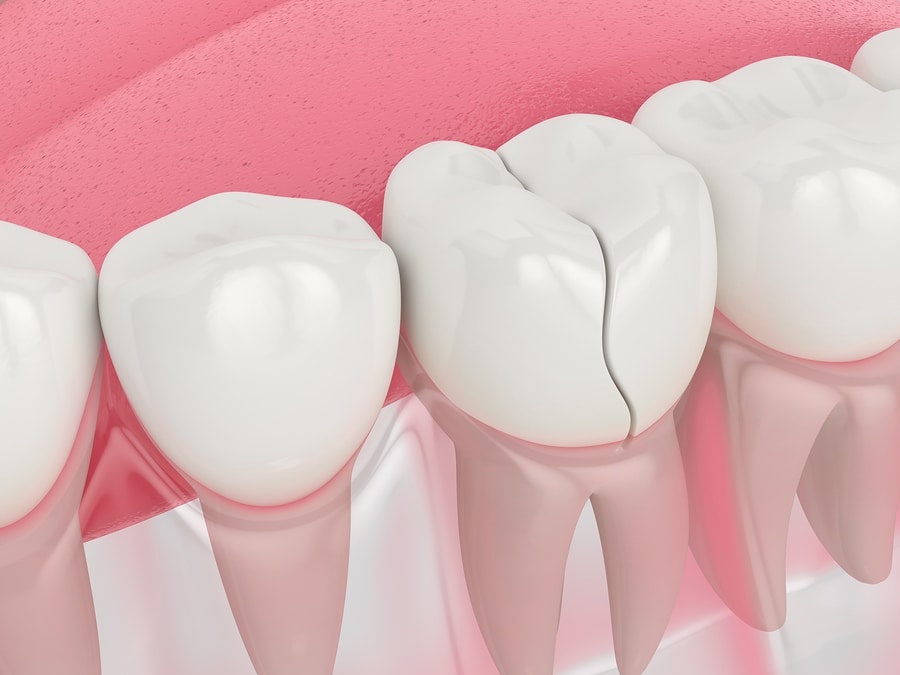
The reason hardness is not the whole story: enamel is hard but brittle. Hardness resists scratching and wear; it does not resist cracking. Enamel is a dense mineral shell with very little give, supported by the softer, more elastic dentine underneath. Take away that support — with decay, or with a large filling — and the shell above it fractures under ordinary biting force. A tooth does not break because the enamel was weak. It breaks because what was holding the enamel up was removed.
1. Decay
Cavities develop from frequent sugary food and drink combined with plaque build-up.
The mechanism: when sugar is consumed, acid is formed, which over time softens the enamel, then spreads to the dentine underneath, and a hole develops. A tooth hollowed out from within will eventually fail under normal biting force — which is why teeth so often break while eating something perfectly ordinary.
The World Health Organization describes the same sequence and is precise about what feeds it: decay “results when plaque forms on the surface of a tooth and converts the free sugars … contained in foods and beverages into acids that destroy the tooth over time.” Free sugars is a defined term and a wider category than most people assume — all sugars added to foods and beverages by the manufacturer, cook or consumer, plus sugars naturally present in honey, syrups and fruit juices. Fruit juice is in; so is honey.
The WHO’s threshold: limiting free sugars to less than 10% of total energy intake — and ideally to less than 5% — minimises the risk of dental caries throughout the life course. It names the two other levers in the same breath: adequate fluoride exposure, and removal of plaque by toothbrushing with a fluoride toothpaste containing 1000–1500 ppm.
To reduce the risk
- Reduce sugary foods and drinks, especially as snacks between meals
- Brush twice a day with a fluoridated toothpaste, and spit rather than rinse — and gently, because over-brushing causes its own damage
- Clean between the teeth once a day
- See your dentist and hygienist regularly for checks and cleans
- Ask about products to strengthen enamel, such as fluoride mouthwash, high-fluoride toothpaste, or CPP-ACP paste
How much difference fluoride actually makes
Because this question follows immediately, here is the measured answer rather than a general reassurance. The National Health and Medical Research Council found that water fluoridation reduces tooth decay by 26 to 44% in children and adolescents, and by about 27% in adults.
That sits on a full evidence review: the NHMRC reviewed the scientific research on water fluoridation in 2016, and its Public Statement of 9 November 2017 recommends community water fluoridation as a safe, effective and ethical way to help reduce tooth decay. Its conclusion on safety was that there is no reliable evidence that water fluoridation at current Australian levels causes health problems.
We link the contrary case as well rather than only our own: fluoridated water — why I worry, alongside the benefits of fluoride and selecting a toothpaste.
2. Trauma
Teeth break from injury, or from biting something particularly hard — ice, an unpopped popcorn kernel, a bone, or a stray olive pit. A tooth knocked out completely is a different emergency again, and what you do in the first ten minutes decides whether it can be saved.
To avoid injury-related breakage: always wear a mouthguard during contact sports — including at training, not only in games. Training is where a large share of these injuries happen, and where guards are most often left in the bag. A guard made from a mould of your teeth protects better than a boil-and-bite one from a chemist. Sports Mouthguards.
That last point is the Australian Dental Association’s position, not just ours. Its policy statement on mouthguards holds that “the most effective protection against oral damage is a custom fitted mouthguard, where precision fit and quality materials offer maximum comfort & injury prevention.” On the shop-bought alternative it is careful rather than dismissive: over-the-counter mouthguards provide better protection than no mouthguard, but their protection varies depending on the design, comfort, adaptation and thickness of the final product — and, in the ADA’s words, “quality control of at-home custom adaptation is not achievable.” You cannot tell, at home, whether the one you moulded yourself came out well.
Two further points from the same policy are worth carrying. First, the need for a guard should be assessed by a dentist based on risk factors — including your sporting or occupational activities and your dental anatomy. Occupational risk is the half of that sentence nobody reads; some trades carry more facial-impact risk than weekend sport does. Second, the ADA’s view is that all dental care funding schemes should allow for the provision of custom-made mouthguards — which tells you it regards them as a health measure rather than an accessory.
The other common causes in this category are habits rather than accidents: opening packaging with your teeth, biting nails or pens, holding hairpins or nails in your mouth, and chewing ice. All are avoidable, and all appear regularly in emergency appointments — usually as a chipped front tooth.
3. Tooth wear
From grinding
Night-time grinding — nocturnal bruxism — weakens enamel and leads to fracture.
Causes include stress or anxiety, disturbed sleep, certain drugs, and sleep apnoea.
Signs you may be grinding:
- waking with a headache or a sore jaw
- someone telling you they can hear you grinding at night
- flattened, chipped or shortening front teeth
- increasing generalised sensitivity
- fine vertical crack lines appearing in the enamel
The sleep apnoea link is worth noting: grinding can be a marker for a breathing problem, and treating the grinding alone leaves that unaddressed. If you also snore, wake unrefreshed, or are tired through the day, say so — that is a medical matter as well as a dental one. Snoring & Sleep Apnoea.
Your dentist can advise on the habit and may prescribe a nightguard to protect the teeth from excessive wear. Be clear about what it does: a splint protects the teeth from the grinding; it does not stop the grinding. How bruxism is actually managed covers the rest. TMD & Teeth Grinding.
From erosion
Acids thin the enamel — from food, drink, or acid reflux.
Acidic foods: citrus fruits, foods pickled in vinegar.
Acidic drinks: fruit juices, sports drinks, soft drinks, wine, and kombucha.
The key insight: frequency of intake, rather than total intake, is the greatest risk factor for erosion. A glass of juice finished at breakfast does far less damage than the same glass sipped across the morning. Minimise the number of acid exposures, not just the volume.
Who is most at risk from acid
The ADA’s policy statement on diet and nutrition advises that acidic foods and drinks should be avoided especially where someone is at high risk of caries or erosion, and it sets out who that is:
- people with poor oral hygiene
- people with low or no fluoride exposure
- people with conditions that reduce salivary flow
- exertion resulting in a dry mouth
- people taking medications that reduce salivary flow
- sipping drinks other than water during interrupted sleep
- chewing and sucking acidic vitamin tablets
Two of those deserve flagging, because they catch out people who think they are being healthy. Exertion resulting in a dry mouth is the sports-drink problem in one phrase: the acid arrives exactly when saliva, the mouth’s own buffer, is at its lowest. And acidic vitamin tablets held in the mouth are a daily acid exposure that never registers as one. The same goes for a bottle of anything but water kept by the bed. See my mouth is always dry and how does your diet affect your teeth?
The ADA also singles out the elderly for dietary advice specifically because reduced saliva flow and more exposed root surfaces raise the risk of decay together.
Practical measures that work:
- Drink acidic drinks with a meal, and finish them rather than nursing them
- Rinse with water afterwards
- Do not brush for 30 to 60 minutes after anything acidic, or after vomiting — softened enamel scrubs away
- Use a soft brush and light pressure. Erosion plus hard brushing is the fastest combination there is
- Chewing sugar-free gum stimulates saliva flow, which is the mouth’s own recovery mechanism — what that can and cannot do
If reflux is a problem, your doctor can advise — that one is not solved at the dentist. Worth knowing that reflux can be silent: in some people the first sign is the wear pattern a dentist notices on the inner surfaces of the upper teeth. The same pattern appears with frequent vomiting from any cause, including pregnancy sickness and eating disorders, and it is handled without judgement.
4. The one that breaks the most teeth: old fillings
This belongs on the list because it is the most common story behind a fractured back tooth in an adult.
A large filling fills a hole; it does not restore the strength of the tooth around it. Every time a filling is replaced, a little more sound tooth goes with it, and the remaining walls get thinner. Eventually a wall snaps off — typically while chewing something unremarkable, and typically with no warning.
This is why a dentist may suggest a crown or an onlay rather than another large filling on a heavily restored back tooth. It is not upselling; it is the point at which covering the tooth prevents the fracture rather than repairing it afterwards. Ask what proportion of the tooth is filling and what the alternatives are. CEREC Restorations and Dental Crowns.
A root-treated tooth without a crown is in the same category, and at higher risk again — what root canal treatment involves explains why the tooth is more brittle afterwards.
Early warnings worth acting on
Teeth usually signal before they break:
- sharp pain on releasing a bite rather than biting down — the classic sign of a crack
- sensitivity to cold in one specific tooth
- a rough edge you keep finding with your tongue
- food packing into one spot that never used to
- a filling that feels different, or an ache that comes and goes
A cracked tooth caught early can often be crowned and saved. The same crack left to propagate can split the root, and that tooth is lost. The gap between those two outcomes is usually weeks to months, and it is the strongest argument for getting an odd sensation looked at. Chipped or Cracked Teeth.
The point that governs all four
Once tooth enamel has been lost, the damage is irreversible. Enamel does not regrow. Everything above is about protecting what you have rather than repairing what you lose.
So, to keep a healthy smile: visit your dentist regularly, eat a healthy diet, protect your teeth from grinding and impact, and maintain good hygiene at home.
Common questions
I can see fine lines in my front teeth. Is that a crack?
Almost certainly not, and the distinction has a name.
The European Society of Endodontology's 2024 position statement on longitudinal cracks and fractures separates the two precisely. A craze line is a "superficial, coronal crack line confined to the enamel with no compromise of the integrity of the tooth". A cracked tooth is "a crack extending into the dentine, of unknown depth or size", which may run down into the root and may involve the nerve.
Craze lines are normal. The ESE describes them as "naturally occurring through mastication and becoming more prominent with age", and notes they are readily visible on front teeth and also show up on the marginal ridges and side surfaces of back teeth. Its position on treating them is short: "treatment of craze lines is not indicated, except for aesthetic reasons, i.e., stained craze lines."
Telling them apart is not something you can do in a mirror. The ESE calls magnification — a dental operating microscope or loupes — "critical in detecting dentinal cracks, as well as distinguishing them from craze lines", alongside fibre-optic transillumination, where a genuine crack blocks the light. So: worth mentioning at your next check-up, not worth losing sleep over. What changes the answer is symptoms — a sharp pain on releasing a bite, or cold sensitivity in one specific tooth.
Why does this seem to start happening in middle age?
Because dentine changes with time, independently of anything you do.
The ESE reports that cracked teeth become more prevalent with age and are most common in people over 40, and gives the mechanism: age-related changes in the biomechanical properties of dentine increase the mineral-to-collagen and cross-linking ratio, which renders the dentine in the root less resilient and more susceptible to crack propagation. The material gets stiffer and less forgiving. The same bite force that a thirty-year-old tooth absorbed, a fifty-year-old tooth may transmit into a crack.
Two other things load the dice, and neither is your fault either. Back teeth are affected far more often than front ones — the statement names upper premolars and molars and lower molars specifically. And the ESE notes "a significant increase in the prevalence of cracked teeth has been reported since the COVID-19 pandemic", which is generally attributed to clenching under stress.
What is genuinely within your control is the loading, and the ESE is direct about it: managing clenching and grinding and correcting an interfering bite is "essential to reduce the likelihood of the propagation of existing cracks". That is the lever, not the enamel.
My tooth is cracked but it does not hurt. Can I just leave it?
Sometimes yes — and the honest answer includes how little is known about it.
The ESE says shallow cracks with a low risk of propagation may be periodically reviewed rather than treated immediately. Then it admits the gap: "it remains unclear for how long asymptomatic, untreated cracked teeth can remain stable and without further crack propagation, as current studies have only monitored cracks for 1–3 years." Nobody can tell you what happens at year seven, because nobody has followed them that long.
What shifts the recommendation towards treating now is a specific list of high-risk situations, and it is worth checking yourself against it. The ESE names: the distal marginal ridge of a last-standing premolar or molar; an extensively restored tooth; a lone or last-standing tooth; and patients with chronic clenching or grinding habits. In those cases it says active treatment is indicated — typically a restoration that caps the cusps — "to reduce the likelihood of the crack propagating, thus increasing the longevity of the tooth".
Also worth knowing: symptoms are a poor guide. A practice-based study of 2,858 teeth across 209 dentists found only 45% of cracked teeth were symptomatic, and only 2% showed any sign of the crack on a radiograph when the nerve was still alive. A crack you cannot feel and cannot see on an x-ray is a perfectly ordinary finding.
So the reasonable position is not "leave it" or "treat it" but review it deliberately — with a date in the notes, and with the high-risk list checked.
What happens if a cracked tooth is left until it splits?
The outlook changes sharply, which is the whole argument for acting earlier.
The ESE defines a split tooth as "complete, visible separation of the entire tooth into two parts", and its assessment is blunt: a split tooth "has an unfavourable prognosis, and timely extraction should be considered to minimise the development of acute symptoms and limit bone loss". That is the one outcome on this page that is not recoverable.
Before that point, teeth can usually still be saved. Where a crack has inflamed or killed the nerve, the ESE reports that root-filled cracked teeth have a survival rate of 84% to 88% over one to five years of follow-up, with success rates of 76% to 82% after one to two years. Those are reasonable odds for a tooth that already has a problem.
The factors that worsen them are specific, and your dentist can check every one: a periodontal pocket of 5 mm or more next to the crack, multiple cracks, a crack extending down into the root, the tooth being the last one in the arch, existing infection at the root tip before treatment, and a post placed inside the root. If several apply, that is a conversation about whether saving the tooth is the right plan rather than the default one.
Between the extremes, one number is worth carrying: across the literature, between 7.7% and 20% of cracked teeth went on to need root canal treatment after restorative management, whichever restoration was chosen. A crack is a reason to watch a tooth for years, not a problem closed on the day it is fixed.
A tooth has been knocked out completely. What do I actually do?
The International Association of Dental Traumatology's guidance is more forgiving than the countdown most people have in their heads, and getting it right matters more than getting it fast.
First, is it a permanent tooth? Primary — baby — teeth should never be replanted. Putting one back risks damaging the adult tooth forming above it. Keep it, bring it, and let the dentist check nothing has been pushed up into the gum.
For an adult tooth, the best treatment is immediate replantation at the scene. Handle it by the crown, not the root. If it is dirty, rinse it gently in milk, saline or the patient's own saliva — not by scrubbing — and put it back in its socket.
If you cannot replant it, the thing that matters is keeping the root wet, not the clock. The variable in the IADT guidance is extra-oral dry time, not total elapsed time: after about 30 minutes of dry time most of the ligament cells on the root are no longer viable, and drying "starts to happen in a matter of a few minutes". A tooth kept in a suitable medium for an hour is in a far better position than one kept dry for fifteen minutes.
The IADT's storage media, in its own descending order of preference: milk, then HBSS (a balanced salt solution sold as a tooth-preservation kit), then saliva — spat into a glass — then saline. And explicitly: "although water is a poor medium, it is better than leaving the tooth to air-dry."
Go anyway, even if a long time has passed. The IADT states that "the decision to replant a permanent tooth is almost always the correct decision even if the extra-oral dry time is more than 60 minutes", because replanting maintains the bone and keeps later options open — the tooth can always be removed afterwards if it has to be.
Call 13 13 96. If there is any loss of consciousness, or injury beyond the teeth, that is a hospital emergency first. See my tooth has been knocked out and emergency dentistry.
Practical details
Written by Dr Madeleine Hoopmann, Smile Solutions.
Custom mouthguards and splints are made in the practice's own on-site laboratory. Smile Solutions holds emergency appointment slots each day for broken teeth.
Smile Solutions, Level 1, 220 Collins Street, Manchester Unity Building, Melbourne VIC 3000. Phone 13 13 96, or theteam@smilesolutions.com.au. Monday–Friday 8.00am–6.00pm, Saturday 8.30am–1.30pm, Sunday by appointment.
Related: Chipped or Cracked Teeth, TMD & Teeth Grinding, Sports Mouthguards, Tooth Fillings, What is dental erosion?, Emergency Dentistry, What kind of mouthguard should I use?.
Registration for any practitioner can be verified free on the AHPRA public register at ahpra.gov.au.
Published 25 June 2018. General information only — it is not a diagnosis, a treatment plan or a promise of any particular clinical outcome, and it does not replace advice from your treating practitioner or doctor. The depth of a fracture and whether a tooth can be saved can only be established by examination, usually with radiographs, and outcomes vary between individuals. Figures attributed to the NHMRC, the WHO, the Australian Dental Association, the European Society of Endodontology and the International Association of Dental Traumatology are those publishers’ own and were current when this page was updated; check the source for the current position. Reflux and sleep-disordered breathing are medical matters for your doctor.
Smile Solutions trades under ABN 28 193 514 103.
Images on This Page
-
https://www.facebook.com/tr?id=800557773428361&ev=PageView&noscript=1
(no alt text)
-
https://www.smilesolutions.com.au/wp-content/uploads/2025/10/calendar_month.svg
(no alt text)
-
https://www.smilesolutions.com.au/wp-content/themes/arcadian-wordpress-theme/assets/images/smile_solutions_logo_white.png
Smile Solutions Logo
-
https://www.smilesolutions.com.au/wp-content/themes/arcadian-wordpress-theme/assets/images/smile_solutions_logo_purple.png
Smile Solutions Logo
-
https://www.smilesolutions.com.au/wp-content/uploads/2016/05/Madeleine-150x150.jpg
Dr Madeleine Hoopmann
-
https://www.smilesolutions.com.au/wp-content/uploads/2024/07/crcaked-tooth.jpg
If enamel is the hardest substance in the body, why do teeth break?
-
https://www.smilesolutions.com.au/wp-content/uploads/2026/01/Cosmetic-Consult-300x270.jpg
Consultation at a cosmetic clinic.
-
https://www.smilesolutions.com.au/wp-content/uploads/2021/03/Rojina-1-300x270.jpg
Rojina 1
-
https://www.smilesolutions.com.au/wp-content/uploads/2025/11/Smile-Solutions-Whitening-Trays-300x300.png
Professional Take-Home Whitening Trays
-
https://www.smilesolutions.com.au/wp-content/themes/arcadian-wordpress-theme/assets/images/family_owned_bussiness.png
Family Owned Business
-
https://www.smilesolutions.com.au/wp-content/themes/arcadian-wordpress-theme/assets/icons/icon--phone.svg
Smile Solutions Contact
-
https://www.facebook.com/tr? id=800557773428361&ev=PageView&noscript=1
(no alt text)
-
https://bat.bing.com/action/0?ti=25148060&tm=gtm002&Ver=2&mid=73d689cb-fb50-4c33-8f40-76f88dfbd206&bo=1&sid=f70b2550ab2411f1af56e976771e76cd&vid=f70b6a30ab2411f186021f4957ac039e&vids=1&msclkid=N&pi=918639831&lg=en-US&sw=800&sh=600&sc=24&nwd=1&tl=If%20enamel%20is%20the%20hardest%20substance%20in%20the%20body,%20why%20do%20teeth%20break%3F%20-%20Smile%20Solutions&p=https%3A%2F%2Fwww.smilesolutions.com.au%2Fdental-articles%2Farticle%2Fenamel-hardest-substance-body-teeth-break%2F&r=&evt=pageLoad&sv=2&cdb=AQAQ&rn=668809
(no alt text)