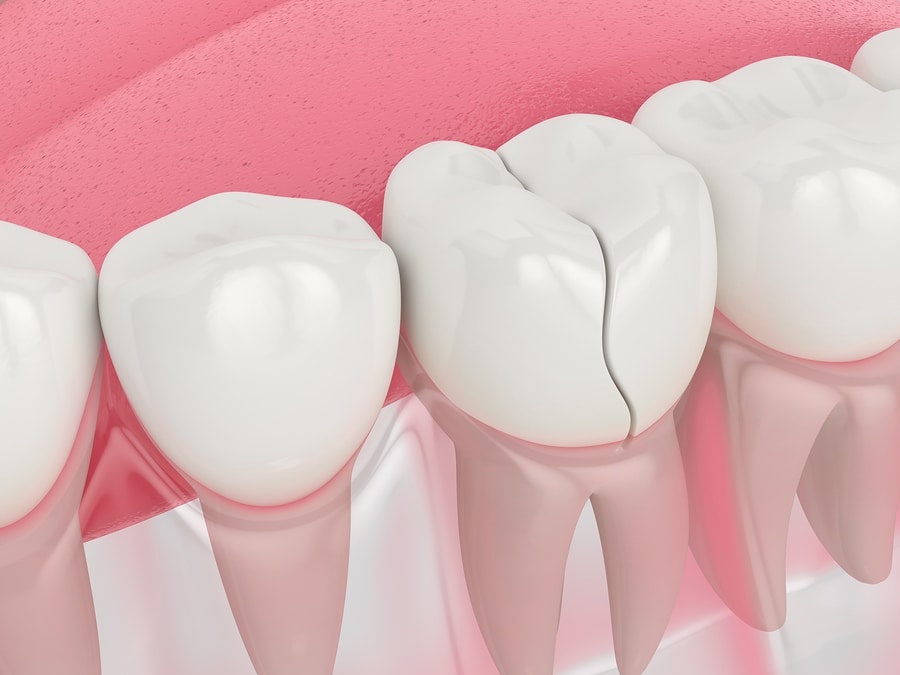
Why does a cracked tooth hurt so much?
Because the cracked pieces move independently when you bite, and that movement irritates the nerve directly. It is a mechanical problem producing a neurological response, which is why the pain can be so sharp and so specific.
If you get sudden pain on chewing or biting down, or erratic pain to hot and cold, you may have a cracked tooth.
What counts as a cracked tooth
The term covers a range, and the endodontic literature is more precise about it than everyday use. The definition approved by the European Society of Endodontology is a tooth with one or more incomplete, longitudinal fractures originating in the coronal tooth structure and extending apically — the crack typically runs front-to-back across the tooth, involves the marginal ridges, and includes the proximal surfaces. (Quoted in Fransson and Dawson, Tooth survival after endodontic treatment, International Endodontic Journal, 2023.)
Two words in that definition carry most of the weight. Incomplete — the tooth has not broken into separate pieces, which is exactly why it can still flex and still hurt. And extending apically — the crack runs down toward the root, which is the direction that determines whether the tooth can be saved.
The mechanism
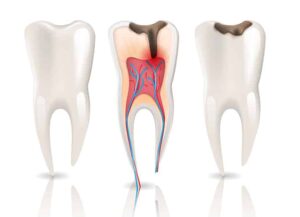
A tooth has three layers:
- A hard outer layer of enamel
- An inner hard layer of dentine
- A soft inner core, the pulp, which houses the nerves and blood vessels
When the hard layers are cracked, chewing causes the pieces to flex and move against each other, and that movement causes considerable irritation to the pulp.
Over time this can lead to the pulp becoming permanently damaged, beyond the point where it can heal. That in turn causes infection of the pulp, which can spread into the surrounding bone and gum — the point at which root canal treatment stops being avoidable.
A crack also provides a direct route for bacteria into the tooth, leading to pulpal infection and eventual death of the nerve. The specialist literature makes the same point in two parts: a crack is both a route of microbial ingress and a problem for the structural integrity of the tooth, and its presence, or inferred presence, is treated as a negative prognostic factor for whether the tooth survives (Success and failure of endodontic treatment: predictability, British Dental Journal, 2025). Those are two separate threats from one defect, which is why a crack is taken more seriously than its size alone suggests.
Why the symptoms are so erratic
This is the part that makes cracked teeth genuinely difficult, and worth understanding:
- The pain comes and goes. It appears on biting a certain way, or on release, and is absent otherwise. A tooth can hurt sharply at breakfast and be entirely normal at lunch.
- It is often hard to localise. People frequently cannot say which tooth it is, or even which side.
- A crack is often invisible on a radiograph, because it runs in a plane the X-ray passes straight through.
That combination — intermittent, poorly localised, invisible on imaging — means cracked teeth are sometimes diagnosed over more than one appointment, using bite tests on individual cusps, transillumination, dyes, and magnification. If your dentist says they want to test it rather than treat it immediately, that is careful diagnosis rather than delay.
One classic sign worth reporting: pain on releasing a bite rather than on clenching down. That is close to characteristic of a cracked cusp.
It is also why a cracked tooth is often mistaken for something else. Poorly localised upper back tooth pain gets attributed to sinus trouble; intermittent ache gets attributed to grinding; pain to cold gets attributed to ordinary sensitivity. See Tooth Pain and Ache and What could be causing my toothache? for how the causes are told apart.
The sign that changes the outlook
There is one finding your dentist will be looking for, and it is not one you can see or feel yourself: a narrow, deep pocket in the gum immediately beside the crack.
Ordinary gum pocketing is broad and follows the gumline. A pocket that is localised and narrow, sitting right against a crack, is described in the British Dental Journal review as often considered pathognomonic of a crack affecting the root — that is, close to diagnostic on its own. It forms because the crack has propagated down onto the root surface, producing a combined endodontic-periodontal lesion, damage to the nerve space and the supporting tissue at once.
That finding matters because it changes the answer to “can this tooth be kept?” The same review names the presence of that pocket as a negative prognostic indicator for tooth survival, along with the tooth being the last one in the arch and the crack extending into the canal orifices.
It is found with a periodontal probe, in a few seconds, at an examination. It is one of the better reasons not to manage intermittent bite pain at home indefinitely. When do you need deeper cleaning? describes the probing that finds it, and what is periodontal disease? the ordinary kind of pocketing it has to be told apart from.
Common symptoms
- Sensitivity to extreme temperatures, both hot and cold
- Sensitivity to sweet things
- Pain that comes and goes when chewing
- An unprovoked toothache
- Swelling around the tooth
What causes cracks
- Teeth grinding or clenching — see TMD and Teeth Grinding
- Biting down on something hard — an olive stone, ice, an unpopped popcorn kernel
- Uneven bite patterns, which orthodontic treatment sometimes addresses
- Large fillings, particularly old large amalgams, which leave thin remaining walls — see Tooth Fillings
- Physical trauma to the face — a sports injury, a fall, a blow
- Habits such as chewing pens, fingernails or ice
Worth adding: large temperature swings — something very hot immediately followed by something very cold — can propagate an existing crack, and acid erosion thins enamel and makes cracking substantially more likely. See How does acidic food affect your teeth?.
One thing not to do while a tooth is cracked
Do not whiten it. The Australian Dental Association’s policy statement on teeth whitening notes that percolation of hydrogen peroxide into the nerve tissues is often accelerated by exposed dentine and enamel fractures, and can lead to inflammation of the nerve (ADA Policy Statement 2.2.8). A cracked tooth is, by definition, a tooth with an enamel fracture.
This is one of the practical reasons whitening is preceded by an examination rather than bought off a shelf — a crack you have not noticed is exactly the thing that turns a cosmetic procedure into a painful one. See Why should I go to a dentist for teeth whitening? and Teeth Whitening. Get the tooth diagnosed and restored first; the whitening conversation keeps.
Why it should not be left
Untreated, cracked teeth can cause severe pain and serious damage. The critical point about timing is structural rather than about the pain: cracks propagate.
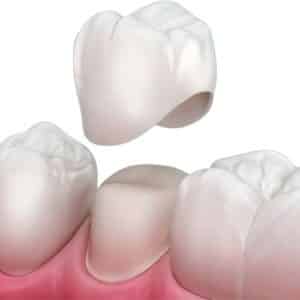
A crack confined to the crown of the tooth is usually restorable, often with a crown or onlay that holds the tooth together and stops the flexing. A crack that extends below the gumline, or down into the root, may make the tooth unrestorable — at which point the treatment is extraction rather than a restoration, and the conversation moves to replacing the tooth with a dental implant or a bridge.
So the difference between an onlay and an extraction is frequently just how long the tooth was left flexing. That is the argument for having intermittent bite pain looked at now rather than when it becomes constant. Can a cracked tooth be treated? sets out what is possible at each stage.
In the meantime
- Chew on the other side — the single most useful thing, since it stops the crack propagating
- Avoid hard and chewy foods, and extremes of temperature
- Over-the-counter pain relief per the packet
- If you grind, mention it — a splint is likely to be part of the eventual plan. See How can I stop grinding my teeth when I sleep?
Seek prompt care if there is swelling, severe or constant pain, fever, or pain that wakes you at night. Spreading facial swelling or difficulty swallowing is a hospital emergency, not a dental appointment — see What is considered a dental emergency?.
Getting it assessed
If you are experiencing pain when eating, or any of the symptoms above, see a dentist. They will work to identify which tooth is involved and how far the crack extends, and develop a treatment plan for your case — which may range from monitoring a minor craze line, through a bonded restoration or a crown, to root canal treatment where the pulp is already involved. Where the diagnosis or the root canal work is difficult, a specialist endodontist has the magnification and the experience for it.
Chipped and Cracked Teeth is the treatment page, and Emergency Dentistry covers being seen at short notice.
Common questions
The x-ray came back clear. Does that mean my tooth is fine?
No, and this is the most important single number on the page. The European Society of Endodontology's 2024 position statement on longitudinal cracks and fractures reports that only 2% of cracked teeth with living pulps had evidence of a crack on a radiograph. A clear film is the expected result, not a reassuring one.
The reason is geometric. A crack usually runs front-to-back through the tooth, in the same plane the x-ray beam travels, so there is nothing for the beam to be stopped by. The statement notes that early-stage cracked teeth may show ‘no obvious signs of a crack and/or pathology' on a periapical radiograph.
What does find them is the clinical examination, which is why it can take more than one appointment. The same statement recommends fibre optic transillumination and/or the use of stains such as methylene blue, and describes a dental operating microscope or loupes as critical in detecting dentinal cracks. Add to that the bite test on individual cusps, and the narrow probing defect described above.
So if you have bite pain and a clear x-ray, that is a reason to keep investigating, not a reason to stop.
Will I need a cone beam CT scan?
Possibly, but not to see the crack — and it is worth knowing that before you are quoted for one. The ESE's position is that cone beam CT may be indicated if the clinical and periapical radiograph assessments are inconclusive, but that ‘CBCT is not predictable in detecting cracks'. What it can show is something adjacent and useful: subtle crestal bone loss associated with a cracked tooth, which is the bone-level counterpart of that narrow probing defect.
On the radiation question people usually want to ask: the International Atomic Energy Agency gives dental cone beam CT doses, from median values in the literature, as 50 microsieverts or below for small or medium scanning volumes, and 100 microsieverts for large volumes — against 1 to 8 microsieverts for an intraoral film and 4 to 30 for a panoramic. So a CBCT is a genuine step up in dose from an ordinary dental radiograph, even though it remains a small exposure. See how safe are dental x-rays?
The question to ask is the same one that applies to any radiograph: what will this change? If the scan is being taken to find the crack itself, the answer from the evidence is that it probably will not.
Can a crack just be watched, rather than treated?
Sometimes — and the ESE says so, with a caveat that deserves reading. Its position is that ‘shallow cracks and/or low risk of crack propagation may be periodically reviewed'. So monitoring is a legitimate plan for the right crack, not a fobbing off.
The caveat is that nobody knows how long that holds. The same statement is candid: ‘it remains unclear for how long asymptomatic, untreated [cracked teeth] can remain stable and without further crack propagation, as current studies have only monitored cracks for 1–3 years'. One to three years is the whole span of the evidence. A decision to watch is therefore a decision to keep watching, on a schedule, not a decision to forget about it.
Two things make watching less appropriate: symptoms — particularly pain on release of a bite — and the narrow probing defect described above, which indicates the crack has already reached the root.
And the ESE attaches a practical instruction to the watching plan: where indicated, patients ‘should be given advice on managing parafunctional habits', and occlusal interferences addressed. In plain terms, if you clench or grind, that gets dealt with as part of the monitoring rather than left for later.
Filling or crown — does the choice actually change the outcome?
The profession has not settled it, and the ESE says so directly: ‘there is no clear evidence on the most suitable restorative treatment approach to manage' cracked teeth.
What it does report is a pattern rather than a proof. Cracked teeth managed with direct bonded composite restorations may be more likely to require root canal treatment and further repair of fractured restorations, compared with teeth managed with cuspal coverage — a crown or onlay that caps over the cusps and stops them flexing apart, rather than a filling placed between them.
On root canal treatment, there is a figure. The reported incidence of endodontic intervention after restorative management of a cracked tooth is between 7.7% and 20%. That is the honest answer to ‘will I end up needing a root canal anyway' — a minority, but not a small one.
So the useful conversation is not filling-versus-crown in the abstract. It is: how much sound tooth is left around the crack, does the restoration need to hold the cusps together, what does that cost, and what happens if the tooth needs root canal treatment afterwards. Ask for both options and the reasoning. See can a cracked tooth be treated?
I can see fine vertical lines in my front teeth. Are those cracks?
Almost certainly not, in the sense this page means. Those are craze lines, and the ESE defines them as a ‘superficial, coronal crack line confined to the enamel with no compromise of the integrity of the tooth'. They are described as ‘typically asymptomatic', and as occurring ‘naturally through mastication and becoming more prominent with age'.
The position on treating them is explicit: ‘treatment of craze lines is not indicated, except for aesthetic reasons.' They are a normal feature of teeth that have been used, not a fault and not a warning sign.
What distinguishes them from the thing this page is about is symptoms and depth. A craze line does not hurt, does not flex, and does not reach the dentine. A cracked tooth, by the definition at the top of this page, has one or more incomplete longitudinal fractures extending toward the root — and it announces itself by biting pain, particularly on release.
If lines you have had for years are being pointed out as a reason for extensive treatment, that is worth a second look, and a second opinion is a reasonable step.
Where to go next
- Treatment options for a cracked or broken tooth — Chipped and Cracked Teeth, Can a cracked tooth be treated?
- A piece has actually broken off — What should I do if I have a chipped tooth?
- If grinding is the cause — TMD and Teeth Grinding
- If it needs a crown or onlay — Dental Crowns, Same-day CEREC restorations
- If the tooth cannot be saved — Dental Implants and Prosthodontists
Practical details
Smile Solutions accommodates emergency dental appointments at short notice.
Specialist registration can be verified on the AHPRA register, or by calling 1300 419 495.
Smile Solutions, Level 1, 220 Collins Street, Manchester Unity Building, Melbourne VIC 3000. Phone 13 13 96, or theteam@smilesolutions.com.au. Monday–Friday 8.00am–6.00pm, Saturday 8.30am–1.30pm, Sunday by appointment. Full details on Contact Us.
Published 8 July 2024. General information only; it does not replace advice from your treating practitioner. Outcomes vary between individuals. Statements attributed to the European Society of Endodontology, the Australian Dental Association and the International Atomic Energy Agency are those publishers' own.
Smile Solutions trades under ABN 28 193 514 103.
Images on This Page
-
https://www.facebook.com/tr?id=800557773428361&ev=PageView&noscript=1
(no alt text)
-
https://www.smilesolutions.com.au/wp-content/uploads/2025/10/calendar_month.svg
(no alt text)
-
https://www.smilesolutions.com.au/wp-content/themes/arcadian-wordpress-theme/assets/images/smile_solutions_logo_white.png
Smile Solutions Logo
-
https://www.smilesolutions.com.au/wp-content/themes/arcadian-wordpress-theme/assets/images/smile_solutions_logo_purple.png
Smile Solutions Logo
-
https://www.smilesolutions.com.au/wp-content/uploads/2023/11/SS-Tooth-1-1-150x150.png
Smile Solutions
-
https://www.smilesolutions.com.au/wp-content/uploads/2024/07/crcaked-tooth.jpg
Why does a cracked tooth hurt so much?
-
https://www.smilesolutions.com.au/wp-content/uploads/2025/09/Root-Canal-2-300x217.jpg
Root Canal
-
https://www.smilesolutions.com.au/wp-content/uploads/2026/08/Mouth-Breathing-300x270.jpg
Mouth Breathing
-
https://www.smilesolutions.com.au/wp-content/uploads/2025/09/Dental-Crown-at-Smile-Solutions-300x300.jpg
Dental Crown at Smile Solutions
-
https://www.smilesolutions.com.au/wp-content/themes/arcadian-wordpress-theme/assets/images/family_owned_bussiness.png
Family Owned Business
-
https://www.smilesolutions.com.au/wp-content/themes/arcadian-wordpress-theme/assets/icons/icon--phone.svg
Smile Solutions Contact
-
https://www.facebook.com/tr? id=800557773428361&ev=PageView&noscript=1
(no alt text)
-
https://bat.bing.com/action/0?ti=25148060&tm=gtm002&Ver=2&mid=924bc0c1-2400-4952-9348-5a8db7af4de8&bo=1&sid=dac6ac60ab2611f199ef5906a2a6d7c7&vid=dac6cac0ab2611f1b319cd056809d8ee&vids=1&msclkid=N&pi=918639831&lg=en-US&sw=800&sh=600&sc=24&nwd=1&tl=Why%20does%20a%20cracked%20tooth%20hurt%20so%20much%3F%C2%A0%20-%20Smile%20Solutions&p=https%3A%2F%2Fwww.smilesolutions.com.au%2Fdental-articles%2Farticle%2Fwhy-does-a-cracked-tooth-hurt-so-much%2F&r=&evt=pageLoad&sv=2&cdb=AQAQ&rn=227532
(no alt text)