What is considered a dental emergency?
Any dental problem needing treatment to relieve severe pain, stop uncontrolled bleeding, or save a tooth. Also in that category: any tooth-related swelling of the face or neck, which should be treated immediately to avoid obstruction of the airway or spread of the infection.
Everything else — a chip you dislike, a lost filling that does not hurt, sensitivity that comes and goes — is urgent to varying degrees, but it is not an emergency.
If you need the first aid rather than the definition, it is on What should I do in a dental emergency?, and Emergency Dentistry covers how urgent appointments are arranged. Dental emergencies explained and common dental emergencies and what to do take them problem by problem.
Go to a hospital emergency department — or call 000 — not a dentist, if
- You have difficulty breathing or swallowing
- Facial or neck swelling is spreading, particularly toward the eye or under the jaw
- You have a high fever with rapidly worsening swelling
- You cannot open your mouth
- There has been significant facial trauma, a head injury, or loss of consciousness
- Bleeding will not stop with sustained pressure
Dental infections can spread through the tissue spaces of the head and neck. This is uncommon, but it can progress within hours, and it is the one situation where waiting for a dental appointment is the wrong call.
Genuine dental emergencies
| Problem | Why it is urgent |
|---|---|
| A knocked-out adult tooth | What governs the outcome is how long the root surface is allowed to dry. Replant it straight away if you can; if you cannot, keep it wet — milk first — and get to a dentist. Never replant a baby tooth |
| Severe, unrelenting toothache | Usually an infected pulp or an abscess; it will not resolve on its own |
| Facial or gum swelling | Infection that the body is no longer containing |
| Uncontrolled bleeding, including after an extraction | Needs assessment if firm pressure for 20 minutes does not stop it |
| A tooth pushed out of position, or loosened by trauma | Repositioning and splinting is time-sensitive |
| A fractured tooth with the nerve exposed | Sensitive to air and cold; prompt treatment improves the chance of saving it |
| Trauma to the soft tissue — lip, tongue, cheek | May need suturing, and other injuries need excluding |
For a child, the thresholds and the first aid differ in several places — see Children's Dental Emergencies.
The professional position on all of the above is not nuanced. The Australian Dental Association's policy on the prevention and management of oral injuries states that “oral damage is often irreversible, frequently complex, difficult, and costly to repair”, and that persons who have suffered an oral injury should be promptly assessed by a dentist and be treated and reviewed as recommended by the dentist — with dentists working to the International Association of Dental Traumatology (IADT) guidelines for the management of traumatic dental injuries. “See how it goes over the weekend” is not in that document.
The two most common causes
Dental emergencies can happen at any time, but most arise from one of two sources:
Trauma — to the soft tissue, the bone, or the teeth. Sport, falls, and accidents. Much of it is preventable with a custom mouthguard.
An undiagnosed or untreated infected tooth, where the body can no longer contain the infection and it begins to cause severe pain or spread beyond the mouth.
Who actually ends up in the chair
The ADA's oral injury policy is more specific about risk than most people expect, and it is worth reading if you are deciding whether a mouthguard is warranted.
By activity. The policy sorts sports into four risk levels. The group where mouthguard use is strongly recommended includes off-road bike riding, skateboarding, rock climbing, white-water rafting, trampolining, combat sports, football, basketball, squash and field hockey. Note what is on that list and is not a contact sport. A separate group — high diving, surfboarding and skiing — is where oral protection is not normally worn but could be justified in certain circumstances. And a third group, where it is impractical or not warranted because the injury risk is low, is swimming, athletics, aerobics and rowing. The ADA's consumer material adds cricket, netball, touch football and soccer to the list of sports that can damage teeth and mouths.
By occupation. The same policy identifies work hazards in two forms: physical impact from work equipment where fracturing of teeth is likely — labourers, tradespeople and riggers — and tooth abrasion where abrasive dust or particles may enter the mouth — miners, bricklayers and tilers. It calls for workplace measures such as dust extraction or filtration where abrasive particles are generated.
By age and anatomy. The policy identifies young children and teenagers as high-risk groups, particularly when learning to walk and when new or high-risk activities are involved — and notes that children with prominent front teeth may be at higher risk of injury and may benefit from orthodontic assessment and early treatment to reduce that risk. That is an unusual and practical point: orthodontics is not only cosmetic, and prominence of the upper front teeth is a mechanical exposure. Children's dentistry covers assessment timing.
On the guard itself, the ADA is explicit: the most effective protection against oral damage is a custom-fitted mouthguard, where precision fit and quality materials offer maximum comfort and injury prevention. Over-the-counter guards provide better protection than no mouthguard, but their protection varies with design, comfort, adaptation and final thickness, and the ADA notes that quality control of at-home custom adaptation is not achievable. Its consumer material makes the same point in plainer terms: boil-and-bite fitting can leave some parts of the guard thinner than others. Protective equipment, it adds, should be worn during training as well as competition. See should I wear a mouthguard while playing sports? and sports mouthguards.
The reason all of that belongs on a page about emergencies is the ADA's own summary of the trade-off: dental injuries can be painful and disfiguring, may involve lengthy and complex dental treatment, and can mean time off school or work to recover — and the cost of an injury to the teeth or jaw far exceeds the cost of a mouthguard. Its consumer material goes further, noting these injuries can need a lifetime of dental treatment.
The avoidable infection
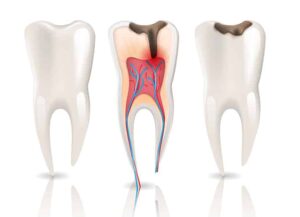
The second cause is worth dwelling on, because it is the avoidable one. An abscess that becomes an emergency at 2am was almost always a small cavity two years earlier, found and treatable at a routine check-up or a clean with a hygienist. Once the pulp is infected, the choice narrows to root canal treatment or removing the tooth; endodontists are the specialists who handle the difficult ones. The stages of dental decay sets out how far in advance that was visible.
The World Health Organization sets out what untreated decay does to the person who has it, and the list goes well past toothache: pain, discomfort or chronic systemic infection; functional limitations such as difficulty eating, speaking, breathing or sleeping; and detrimental impacts on emotional, mental and social wellbeing. In children it often leads to absence from school; in adults it is associated with absence from work. An emergency appointment is the last stop on that sequence, not the start of it.
Aesthetic urgency is not the same thing
It is worth distinguishing a dental emergency from an aesthetic one.
An aesthetic problem may involve no pain, bleeding or swelling — a chip, a fracture, wear from grinding. If you are deeply unhappy with how your teeth look, that is a real reason to book an appointment sooner rather than later, and no one should feel they must justify it. But it is not the same as an infection, and it should not compete with one for an emergency slot. Cosmetic Dentistry and Composite Bonding cover the repairs; wear from grinding is dealt with on TMD and Teeth Grinding.
The reverse mistake is more dangerous, and more common.
What people get wrong in both directions
When something out of the ordinary happens to our teeth, the instinct is to panic. The smile is often the first thing people notice, and any disruption to it feels like it needs fixing immediately.
But people also delay treatment that is genuinely urgent — because of fear of the dentist, lack of time, or cost. Knowing the difference between an emergency and something that can wait is a basic piece of dental literacy, and it protects you in both directions.
Each of those three reasons has an answer. Fear is worth naming when you book, because it changes how the appointment is run — see Dental Anxiety. Time is the argument for calling early rather than late, since an early problem needs a shorter appointment. Cost is worth saying out loud, because settling the pain and staging the rest is a legitimate plan; for children, the Child Dental Benefits Schedule may cover it. Published fee ranges are in the price guide.
The pattern worth recognising: pain that stops is not the same as a problem that has resolved. When an abscess finds a route to drain, the pain often disappears. People take that as recovery. It is a chronic infection with an outlet, still destroying bone.
Until you are seen
- Over-the-counter pain relief per the packet directions
- Rinse with warm salty water
- Keep the area clean; keep brushing gently
- Cold compress on the outside of the face for swelling or trauma
- Sleep propped up if it throbs
- Do not place aspirin against the gum — it burns the tissue
- Do not apply heat to a facial swelling
How to relieve toothache goes through what helps and what does not while you wait.
When in doubt, call
If you are unsure what care you need, do not wait. Err on the side of caution and call a dentist — many can triage over the phone, tell you whether it needs seeing today, and answer your concerns. A phone call costs nothing and settles the question.
Common questions
An adult tooth has been knocked out. What do I do, and how long have I got?
The International Association of Dental Traumatology publishes the protocol, and the first thing to know is that the clock people usually quote is the wrong clock. What determines whether the tooth survives is extra-oral dry time — how long the root surface spends drying in air — not total elapsed time. The IADT notes that dehydration of the root surface ‘starts to happen in a matter of a few minutes', and that ‘After an extra-alveolar dry time of 30 minutes, most PDL cells are non-viable.' A tooth kept wet for an hour is in a far better position than a tooth carried dry in a tissue for fifteen minutes.
So, in order:
- Check it is an adult tooth. The IADT is unambiguous that ‘primary teeth should not be replanted'. Replanting a baby tooth risks the adult tooth forming above it.
- Put it straight back in the socket if you can. ‘Immediate replantation of the avulsed tooth is the best treatment at the place of the accident.' Hold it by the crown, not the root.
- If you cannot, keep it wet. The IADT's order of preference is explicit: ‘In descending order of preference, milk, HBSS, saliva (after spitting into a glass for instance), or saline are suitable and convenient storage mediums. Although water is a poor medium, it is better than leaving the tooth to air-dry.'
- Go straight to a dentist, and tell them how long the tooth was dry before it went into the milk. The IADT says that information is ‘very important to obtain as part of the history', because it determines the treatment.
And if a lot of time has already passed, do not give up on it. The IADT's position is that ‘the decision to replant a permanent tooth is almost always the correct decision even if the extra-oral dry time is more than 60 minutes', because ‘Replantation will keep future treatment options open. The tooth can always be extracted, if needed.' What should I do when a tooth is knocked out?
My dentist is closed. Can I just get antibiotics from a GP or the emergency department?
They may well be appropriate as part of the management, but understand what they will and will not do, because this is the single most common misunderstanding about dental infections. The RACGP states it as a flat rule: ‘Antibiotic treatment without dental treatment to remove the cause always fails.' And: ‘If an abscess spreads beyond the tooth, it requires dental treatment and will not respond to antibiotics alone.'
The reason is mechanical rather than microbiological. The source of the infection is inside a tooth, where the blood supply that carries a medicine has already died. Removing that source — root canal treatment, extraction, or drainage — is the treatment; anything else buys time.
What that means in practice: if you are given antibiotics out of hours, treat it as a bridge and book the dental appointment anyway, including if the pain has gone by Monday. The pain going is expected, and it is not the same as the problem going. Any medicine you are prescribed is a matter for the prescriber; this page is not advice on what to take.
How do I tell a swelling that can wait from one that cannot?
By where it is going and how fast, rather than by how much it hurts. Two specifics are worth knowing.
First, the direction matters because of anatomy. The RACGP notes that infections from the upper front teeth — ‘the incisors, canines and premolars in the anterior maxilla' — can spread ‘via the infraorbital veins to the ocular veins to the cavernous sinus', and that ‘Spread is facilitated as these veins have no valves.' Swelling tracking up towards the eye is therefore a different proposition from a swelling sitting over a lower back tooth. Downwards under the jaw and into the neck is the other dangerous direction; the RACGP describes the submandibular space as ‘The most dangerous space'.
Second, the breathing signs arrive late. In the emergency guidance used by NSW Health's Agency for Clinical Innovation, the features suggesting a spreading infection are swelling, trismus, inability to protrude the tongue, drooling and difficulty swallowing — with ‘dysphonia and dyspnoea are late signs'. Waiting until your voice changes or your breathing feels tight means waiting too long.
The practical threshold: any facial swelling gets seen the same day. Swelling that is spreading, closing the eye, crossing under the jaw, or coming with fever, drooling or trouble swallowing goes to a hospital emergency department rather than a dental chair. This is not common — but it is the case where the cost of being wrong is high.
I cracked a tooth. It only hurts sometimes, so can it wait a few weeks?
It can usually wait a short time, but it should not be ignored, and the reason is that cracks are much harder to see than people assume. The European Society of Endodontology's 2024 position statement reports that in a practice-based study of 2,858 teeth from 209 dentists, only ‘2% of CTs with vital pulps had evidence of a crack on a radiograph' — in other words, an x-ray that shows nothing does not mean there is nothing there. Diagnosis is mostly clinical.
The same study found that 45% of cracked teeth were symptomatic, with the commonest symptoms being ‘pain to cold (37%), biting pain (16%), and spontaneous pain (11%)'. Intermittent pain on biting that you can reproduce with a particular tooth is a classic presentation, not a reassuring one.
Why earlier is better: once a crack progresses into the pulp, the treatment changes. The ESE reports that ‘The reported incidence of endodontic intervention after restorative management has been reported to be between 7.7% and 20%.' It also says plainly that ‘There is no clear evidence on the most suitable restorative treatment approach' — so expect a discussion of options rather than a single obvious answer, and ask what each one preserves.
Book it as an ordinary appointment, not an emergency, unless there is pain you cannot manage, swelling, or a piece that has broken away and left the nerve exposed. Why does a cracked tooth hurt so much? and chipped or cracked teeth
How often does this actually end up in hospital?
Often enough to be a national statistic, and the striking part is the word Australia's own health agency uses for it. The Australian Institute of Health and Welfare counts ‘potentially preventable hospitalisations' for dental conditions — hospital stays that appropriate earlier care could have avoided — and reports that ‘In 2023–24 there were 88,600 such admissions.' That figure is all ages combined; the AIHW's own material advises against splitting it by age group, so we will not.
At the severe end, an Australian hospital series described by the RACGP recorded that ‘Sixty-four per cent of patients were assessed as being at high risk of airway obstruction', with low-risk patients staying ‘1.9 ± 1.3 days' and high-risk patients ‘5.1 ± 4.9 days'. Even after successful treatment, ‘Persistent firm swelling in the region of the infection, scars from the incision and drainage, and persistent trismus were common', and ‘These sequelae took 1–2 months to settle.'
None of that is meant to frighten anyone with a sore tooth; the overwhelming majority of dental problems never come close to it. The point is the one the RACGP makes about how these infections begin: ‘By this time, all patients have had intermittent episodes of pain as a warning that something is wrong.' The warning almost always arrives early, and it is usually ignored rather than missed.
Where to go next
- First aid, by problem — What should I do in a dental emergency?
- A tooth has come out — What should I do when a tooth is knocked out?, or for a child, a knocked-out baby tooth
- It hurts but nothing happened to it — Tooth Pain and Ache and What could be causing my toothache?
- Jaw pain rather than tooth pain — TMD and Teeth Grinding
- How the practice handles urgent appointments — Emergency Dentistry and Why choose Smile Solutions in a dental emergency?
Practical details
Smile Solutions accommodates emergency dental appointments at short notice.
The risk categories, mouthguard positions and injury-management statements attributed above are from the Australian Dental Association's own published policy and consumer material; the consequences of untreated decay are from the World Health Organization. Both remain the primary source.
Specialist registration can be verified on the AHPRA register, or by calling 1300 419 495.
Smile Solutions, Level 1, 220 Collins Street, Manchester Unity Building, Melbourne VIC 3000. Phone 13 13 96, or theteam@smilesolutions.com.au. Monday–Friday 8.00am–6.00pm, Saturday 8.30am–1.30pm, Sunday by appointment. Full details on Contact Us.
Published 28 April 2022. General information only; it does not replace advice from your treating practitioner. Any medicine mentioned here is a matter for your treating practitioner to decide. In a life-threatening emergency call 000.
Smile Solutions trades under ABN 28 193 514 103.
Images on This Page
-
https://www.facebook.com/tr?id=800557773428361&ev=PageView&noscript=1
(no alt text)
-
https://www.smilesolutions.com.au/wp-content/uploads/2025/10/calendar_month.svg
(no alt text)
-
https://www.smilesolutions.com.au/wp-content/themes/arcadian-wordpress-theme/assets/images/smile_solutions_logo_white.png
Smile Solutions Logo
-
https://www.smilesolutions.com.au/wp-content/themes/arcadian-wordpress-theme/assets/images/smile_solutions_logo_purple.png
Smile Solutions Logo
-
https://www.smilesolutions.com.au/wp-content/uploads/2023/11/SS-Tooth-1-1-150x150.png
Smile Solutions
-
https://www.smilesolutions.com.au/wp-content/uploads/2022/04/Dental-Emergency.jpg
What is considered a dental emergency?
-
https://www.smilesolutions.com.au/wp-content/uploads/2025/09/Root-Canal-2-300x217.jpg
Root Canal
-
https://www.smilesolutions.com.au/wp-content/uploads/2026/08/Mouth-Breathing-300x270.jpg
Mouth Breathing
-
https://www.smilesolutions.com.au/wp-content/uploads/2025/09/Dental-Crown-at-Smile-Solutions-300x300.jpg
Dental Crown at Smile Solutions
-
https://www.smilesolutions.com.au/wp-content/themes/arcadian-wordpress-theme/assets/images/family_owned_bussiness.png
Family Owned Business
-
https://www.smilesolutions.com.au/wp-content/themes/arcadian-wordpress-theme/assets/icons/icon--phone.svg
Smile Solutions Contact
-
https://www.facebook.com/tr? id=800557773428361&ev=PageView&noscript=1
(no alt text)
-
https://bat.bing.com/action/0?ti=25148060&tm=gtm002&Ver=2&mid=e1e1ab63-93d2-4da6-8ae3-423d55eb8206&bo=1&sid=512831f0ab2611f1b7c735c8c123fd73&vid=51286b20ab2611f1a62f079adbe2a830&vids=1&msclkid=N&pi=918639831&lg=en-US&sw=800&sh=600&sc=24&nwd=1&tl=What%20is%20considered%20a%20dental%20emergency%3F%20-%20Smile%20Solutions&p=https%3A%2F%2Fwww.smilesolutions.com.au%2Fdental-articles%2Farticle%2Fwhat-is-considered-a-dental-emergency%2F&r=&evt=pageLoad&sv=2&cdb=AQAQ&rn=527478
(no alt text)