Why choose Smile Solutions in a dental emergency?
If you have seen the Manchester Unity Building tower lit up at night, you might think we are a practice that never sleeps. That is close to the point of what follows.
In an emergency, four things determine how quickly a problem gets resolved: when you can be seen, who can see you, where they are, and whether you have to be sent elsewhere.
If you are in pain right now, the first aid is on What should I do in a dental emergency? — read that first and come back to this. How urgent appointments are arranged is on Emergency Dentistry, and dental emergencies explained sets out what each kind needs.
We open early and close late
Not everyone is available between 9am and 5pm, which is precisely when most dental practices are open.
Weekdays: 8.00am to 6.00pm.
That matters for emergencies because pain that starts overnight can be dealt with before work, and pain that starts during the day does not have to wait until tomorrow.
We're open on weekends
Dental emergencies do not restrict themselves to weekdays.
Saturday: 8.30am to 1.30pm.
Sunday: by appointment.
Specialists are available
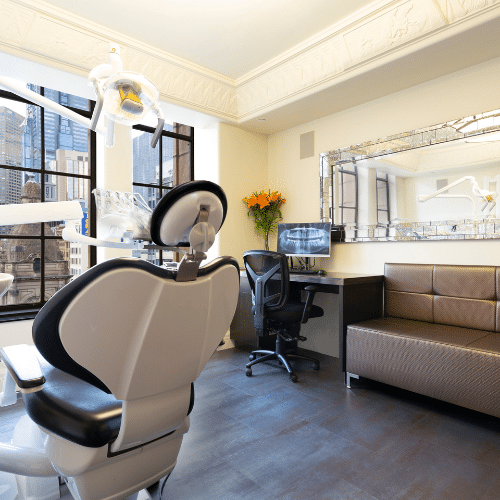
We have a large, diverse team, so anyone needing emergency or time-sensitive treatment can rely on a comprehensive group of clinicians in the one building.
The practical consequence: alongside a large team of general dentists, you can be referred directly to a specialist rather than being sent to another practice and waiting for an appointment there.
This matters most for treatments such as root canal therapy, where treatment by a registered specialist endodontist is well suited to difficult cases — curved or calcified canals, unusual anatomy, and treatment that has failed before. It matters again for facial trauma and difficult extractions, which are the province of an oral and maxillofacial surgeon, and for injuries to a child's mouth, where a paediatric dentist is often the shorter road.
Specialist availability depends on the day and the case, and is not guaranteed at any given appointment. Ask when you call. The clinicians and their registrations are listed on Our Team, and why patients choose us covers what else the practice does and does not offer.
Central location
We are on the corner of Swanston Street and Collins Street in Melbourne — within walking distance of Flinders Street station and tram lines.
For someone in pain, a short trip on public transport rather than a drive and a park is not a small thing. It makes prompt treatment genuinely accessible for:
- toothache
- an abscess
- impacted wisdom teeth
- traumatic jaw injury
Travel and access details are on Contact Us and Location.
Trusted for time-critical care
We are a provider of choice for sporting clubs such as Collingwood Football Club, sporting tournaments including the Australian Open, touring companies such as Cirque du Soleil, and the emergency dentist of choice for many of Melbourne's leading hotels.
The common thread among those clients is that time is not negotiable — there are fans waiting, or a travel itinerary that cannot move. That is the same constraint a patient in pain is under.
What counts as a dental emergency
Call promptly for:
- severe or worsening toothache
- facial or gum swelling
- a knocked-out permanent tooth — this is genuinely time-critical; put it straight back in the socket if you can, and otherwise keep it wet, in the IADT's order of preference: milk, HBSS, the person's own saliva, then saline. If you have none of those, use water — a poor medium, but the IADT is explicit that it is better than letting the tooth air-dry. Never let it dry, and get seen immediately
- a broken or badly chipped tooth — see what should I do if I have a chipped tooth? for what to do before you arrive
- uncontrolled bleeding after an extraction
- trauma to the jaw
For difficulty breathing or swallowing, or rapidly spreading facial swelling, call 000 or attend a hospital emergency department — that is beyond dental care.
What is considered a dental emergency? draws the line between what needs seeing today and what can wait for a routine appointment. For a child, Children's Dental Emergencies is the page to open.
One point about how injuries are managed once you arrive, which is not a Smile Solutions policy but a professional standard: the Australian Dental Association directs dentists to the International Association of Dental Traumatology (IADT) guidelines for the management of traumatic dental injuries. That is why the advice you get on the phone for a knocked-out tooth is specific and time-bound rather than general — the protocol is published, and it depends on the minutes elapsed and how the tooth has been stored. (Source: ADA Policy Statement 2.2.5, Prevention and Management of Oral Injuries.)
Preventing the next one
Most of what is listed above arrives by accident. A meaningful share of it — the sporting share in particular — is preventable, and the published guidance on that is unusually specific.
The ADA's policy on oral injuries states plainly that “oral damage is often irreversible, frequently complex, difficult, and costly to repair”, and that “the cost of an injury to the teeth or jaw far exceeds the cost of a mouthguard”.
Which activities carry which risk. The ADA sorts sports into four levels, with the protection matched to each:
- Mouthguard strongly recommended — off-road bike riding, skateboarding, rock climbing, white-water rafting, trampolining, combat sports, football, basketball, squash and field hockey
- Head protection worn, which may remove the need for a mouthguard — full-face helmets in ice hockey, goalkeepers in field hockey, cricket, rollerblading and cycling
- Not normally worn, but justifiable in some circumstances — high diving, surfboarding and skiing
- Impractical or not warranted — swimming, athletics, aerobics and rowing
Worth noticing what is on the first list: skateboarding and trampolining, neither of which most families would describe as a contact sport.
Custom-fitted against shop-bought. The ADA's position is that “the most effective protection against oral damage is a custom fitted mouthguard, where precision fit and quality materials offer maximum comfort & injury prevention”. It does not dismiss the alternative — over-the-counter guards “provide better protection than no mouthguard” — but adds that their protection “varies depending on the design, comfort, adaptation and thickness of the final product”, because “quality control of at-home custom adaptation is not achievable”. See getting a new mouthguard — a trip to the chemist or the dentist?, what kind of mouthguard should I use?, should I wear a mouthguard while playing sports? and should my child wear a mouthguard?.
Two risk factors people do not anticipate. The same policy notes that oral piercing jewellery may increase both the risk and the degree of oral injury, and that children with prominent front teeth may be at higher risk and may benefit from orthodontic assessment and early treatment to reduce it — see orthodontics and when should I take my child to see an orthodontist?.
The ADA also asks that protective equipment be worn during training as well as competition, and supports sporting bodies adopting a mandatory “no mouthguard, no play” policy. On looking after one, the ADA's consumer guidance is to keep it out of direct sunlight, wash it in cool or warm water, store it dry in a protective case, and write your name on both the guard and the case — and notes that a guard that is used, stored and fit-checked by your dentist can last multiple sporting seasons, as long as you are no longer growing. Sport Mouthguards covers how one is made here. (Sources: ADA Policy Statement 2.2.5, Prevention and Management of Oral Injuries; Australian Dental Association, Sports Mouthguards, teeth.org.au.)
Common questions
It is two in the morning. What do I do until somewhere opens?
Three things, in this order.
1. Decide whether this is a hospital problem rather than a dental one. The features that move it are about the airway, not the pain level. Healthdirect Australia lists the complications of an untreated dental abscess as trouble breathing — "swelling in your neck or mouth can block your airway" — sepsis, and longer-term problems including facial scarring, difficulty opening the jaw, vision loss or brain injury. Difficulty swallowing, difficulty breathing, an inability to open the jaw, a hoarse voice, or spreading swelling means an emergency department or 000, tonight, not a dental appointment in the morning. Healthdirect's own word for life-threatening spread is "rarely", so this is not the likely outcome — it is the one you check for first.
2. If it is a knocked-out permanent tooth, act now rather than at opening time. The IADT's thresholds turn on extra-oral dry time, so the tooth needs to be back in the socket or in milk immediately — the order of preference is milk, a tooth-rescue solution, the person's own saliva, then saline, with water a poor last resort that is still far better than letting it dry. Then ring, whatever the hour.
3. Otherwise, get advice rather than sitting up alone with it. Healthdirect runs a helpline on 1800 022 222 — known as NURSE-ON-CALL in Victoria — where "a registered nurse is available 24 hours a day, 7 days a week." They can help you judge whether this waits until morning.
And the unglamorous part: book first thing rather than waiting to see if it settles. Pain that fades overnight has not necessarily resolved — a nerve that dies stops reporting, and Healthdirect is explicit that "a tooth abscess will not get better on its own."
Will I actually get it fixed at an emergency appointment, or just sent away with a prescription?
The intended answer is that the source of the problem gets dealt with, because that is what the evidence says works.
Cochrane's 2024 review of antibiotics for acute dental infection describes the standard: clinical guidelines recommend the first-line treatment should be removal of the source of inflammation or infection by local operative measures, with systemic antibiotics reserved for cases showing "evidence of spreading infection (cellulitis, lymph node involvement, diffuse swelling) or systemic involvement (fever, malaise)." Healthdirect puts the same point in consumer terms: you may need "antibiotics to help fight the infection (although antibiotics alone are not enough to treat a tooth abscess)."
What that looks like in practice varies with the diagnosis — draining a swelling, opening and cleaning a root canal system, or removing the tooth. Cochrane's plain-language summary describes the usual route as "extraction of the tooth or cleaning of the root canal system," sometimes completed the same day and sometimes finished at a later visit.
A reasonable benchmark afterwards, from Healthdirect: "You should start feeling better within 2 to 3 days after starting treatment. If you don't, you may need more tests or a different treatment." If you are not improving by then, ring back rather than waiting out the week.
One honest caveat. An emergency appointment is usually about settling the immediate problem, not completing the whole plan. Ask before you leave what has been done, what is still outstanding, and when the rest needs to happen — and ask what it will cost, since the price guide lists published fees and understanding your treatment explains how a plan is set out.
What should I say when I ring, so I am triaged properly?
Lead with the things that change the urgency, not with how much it hurts. Pain is real but it is a poor sorting tool; a great deal of severe pain is not urgent, and some dangerous presentations are not especially painful.
Say these, in roughly this order:
- Whether you can swallow and breathe normally, and whether you can open your mouth. The Australian Family Physician review of dental infections is blunt that "the most important feature on examination is the patency of the airway," and lists trismus, difficulty swallowing, an inability to protrude the tongue or swallow saliva, a hoarse voice and stridor as the features of a progressing infection.
- Whether there is facial or neck swelling, and whether it is spreading.
- Whether there is a fever. Fever or malaise is one of the two circumstances in which antibiotics are indicated at all.
- Which tooth, upper or lower, front or back. This matters more than people expect: the same review notes that "deep extension is more likely when the mandibular molars are involved, as their root structures lie close to the cervical fascia," whereas "maxillary teeth generally do not cause such problems." A swollen lower back tooth is triaged differently from an upper front tooth that aches on cold.
- Whether there was an injury, and when. For a knocked-out permanent tooth the clock is the treatment.
- Any medical conditions or medicines that affect bleeding, healing or infection.
Then ask two things back: how soon can I be seen, and what should I be doing in the meantime. If the answer to the first is not soon enough, ask what would make it sooner — that question is how the list above gets used.
If a replanted tooth will probably need root canal treatment anyway, is it worth rushing?
Yes. The alternative is not a tooth that needs no treatment — it is no tooth.
Healthdirect Australia is straightforward about the expectation: "when an adult tooth is reimplanted, there is a high chance it will need root canal therapy in the future." That is worth knowing in advance so nobody feels misled later. But the IADT still calls an avulsed permanent tooth "one of the few real emergency situations in dentistry", and the reason is what is being saved: the root, the bone around it and the ligament that holds it, none of which a replacement restores.
The comparison that matters is between a root-filled natural tooth and the work required to replace a missing one, which is why the ADA's framing of dental injury is that it "can also need a lifetime of dental treatment." A single root canal treatment now is a much smaller undertaking than a lifetime of replacing an absent front tooth, particularly in a young person whose jaw is still growing.
So the rushing is worth it — and the variable to rush is the one the IADT actually measures. It is extra-oral dry time, not how long since the accident. A tooth kept wet in milk for an hour is in a far better position than one carried dry in a tissue for twenty minutes, and a tooth put straight back in its socket at the scene is in the best position of all.
Never replant a baby tooth — that one exception is absolute, because it risks damaging the adult tooth forming above. What should I do when a tooth is knocked out? has the full sequence.
Where to go next
- In pain or injured now — What should I do in a dental emergency?, or Tooth Pain and Ache for pain without an injury.
- A tooth has been knocked out — What should I do when a tooth is knocked out?. Minutes matter; read it on the way.
- A tooth is broken or chipped — Chipped and Cracked Teeth.
- It is a child — Children's Dental Emergencies.
- You are dreading the appointment — say so when you book. Dental Anxiety explains what can be adjusted.
- You want to avoid the next one — Sport Mouthguards, which prevent a large share of the injuries described above.
Practical details
Smile Solutions, Level 1, 220 Collins Street, Manchester Unity Building, Melbourne VIC 3000. Phone 13 13 96, or theteam@smilesolutions.com.au. Monday–Friday 8.00am–6.00pm, Saturday 8.30am–1.30pm, Sunday by appointment.
Specialist registration can be verified free on the AHPRA public register at ahpra.gov.au.
Published 25 June 2015. Opening hours and the client relationships described are as at publication; confirm weekend and after-hours availability when you call. Sponsorship and provider relationships are commercial arrangements and are not statements about clinical outcomes. Material quoted from the Australian Dental Association, Healthdirect Australia, Cochrane and the Royal Australian College of General Practitioners is those organisations' published wording, reproduced for reference; it is general guidance, not advice about your circumstances.
General information only — it is not a diagnosis, a treatment plan or a promise of any particular clinical outcome, and it does not replace examination by a registered practitioner. In a medical emergency — difficulty breathing or swallowing, spreading facial swelling, uncontrolled bleeding or significant facial trauma — call 000 or attend a hospital emergency department rather than waiting for a dental appointment.
Smile Solutions trades under ABN 28 193 514 103.
Images on This Page
-
https://www.facebook.com/tr?id=800557773428361&ev=PageView&noscript=1
(no alt text)
-
https://www.smilesolutions.com.au/wp-content/uploads/2025/10/calendar_month.svg
(no alt text)
-
https://www.smilesolutions.com.au/wp-content/themes/arcadian-wordpress-theme/assets/images/smile_solutions_logo_white.png
Smile Solutions Logo
-
https://www.smilesolutions.com.au/wp-content/themes/arcadian-wordpress-theme/assets/images/smile_solutions_logo_purple.png
Smile Solutions Logo
-
https://www.smilesolutions.com.au/wp-content/uploads/2023/11/SS-Tooth-1-1-150x150.png
Smile Solutions
-
https://www.smilesolutions.com.au/wp-content/uploads/2025/11/Smile-Solutions-Level-10.png
Why choose Smile Solutions in a dental emergency?
-
https://www.smilesolutions.com.au/wp-content/uploads/2025/09/Root-Canal-2-300x217.jpg
Root Canal
-
https://www.smilesolutions.com.au/wp-content/uploads/2026/08/Mouth-Breathing-300x270.jpg
Mouth Breathing
-
https://www.smilesolutions.com.au/wp-content/uploads/2025/09/Dental-Crown-at-Smile-Solutions-300x300.jpg
Dental Crown at Smile Solutions
-
https://www.smilesolutions.com.au/wp-content/themes/arcadian-wordpress-theme/assets/images/family_owned_bussiness.png
Family Owned Business
-
https://www.smilesolutions.com.au/wp-content/themes/arcadian-wordpress-theme/assets/icons/icon--phone.svg
Smile Solutions Contact
-
https://www.facebook.com/tr? id=800557773428361&ev=PageView&noscript=1
(no alt text)