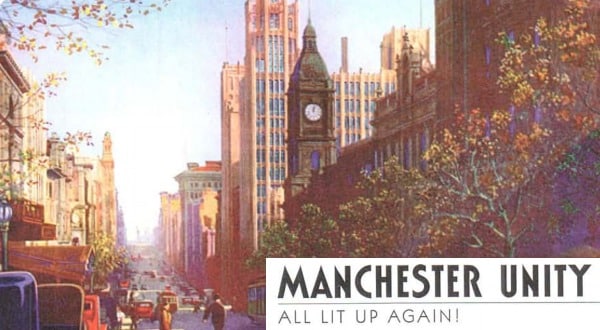
Manchester Unity all lit up again
Media item: article
Date published: 1 September 2012
This page records the media item. The original article is the property of its publisher and is not reproduced here.
The archive preserves the headline and the date. The technical side of heritage facade lighting — why faience is difficult to light, the heritage permit constraints, obtrusive-light control and what LED changed — is covered at Let there be light for Manchester Unity's brighter future, with a duplicate record at Let there be light.
This page takes the other half of the subject: what a lit landmark is for.
‘Again' is the word that matters
The headline says again, and that is the interesting part.
Buildings go dark. Lighting schemes are switched off during recessions, during energy shortages, when a building changes hands, when the equipment fails and nobody wants to pay for the access equipment to fix it, or simply when a lease turns over and no one is responsible for it any more.
A relighting is therefore usually a signal about the building's circumstances rather than a decision about aesthetics: it tends to follow restoration, new ownership, or a return to full tenancy. The 2000s restoration is described in Inside the Manchester Unity Building. A dark landmark reads as a building in trouble, whatever is actually happening inside it.
How landmarks actually work
People navigate cities by landmarks, not by street names.
This is well established in the study of how people form mental maps of places: the elements that structure a city in the mind are paths, edges, districts, nodes and landmarks — and landmarks do a specific job. They are fixed reference points that let you locate yourself without reading anything.
A good landmark has three properties:
- It is visible from a distance and from several directions.
- It is distinctive — it cannot be confused with its neighbours.
- It is memorable in outline, so it works when you can only see its shape.
The Manchester Unity Building has all three. Cream faience against darker neighbours; a stepped, vertical mass; and a tower silhouette that reads from a long way down Collins Street and from across the city. See Manchester Unity Building and Our City: Manchester Unity Building.
And at night, only the third property survives — unless the building is lit. After dark an unlit facade collapses into a silhouette, and a landmark that cannot be seen is not doing its job. That is the actual argument for illuminating heritage buildings, and it is a public-realm argument rather than a decorative one.
What a lit skyline does for a city
Beyond wayfinding, three things:
Identity. A city's night-time image is made of a handful of buildings. They are what appears in photographs, on television and in people's memories, and heritage buildings are disproportionately represented because they are the distinctive ones. On the building as a photographic subject, see Manchester Unity Building — John Gollings and Manchester Unity Building — Penny Craswell.
Activity and safety. Well-lit street frontages support pedestrian movement after dark. A lit facade is not primarily lighting the footpath — the streetlights do that — but it changes how occupied and overlooked a street feels, which is a genuine influence on whether people use it. On the ground floor itself, see The new shopping centre opens today.
Continuity. A building lit the way it was lit thirty years ago is a small piece of civic constancy in a skyline that otherwise changes continuously.
The counter-argument, stated fairly
It would be one-sided to leave this out.
Lighting buildings uses energy, and light that escapes upward is wasted entirely. ‘Sky glow' is a real and measurable form of pollution: it washes out the night sky, and there is a substantial body of work on the effects of artificial light at night on nocturnal wildlife, on insects, and on human sleep.
Which is why current practice is not ‘more light':
- Tight optical control, so light lands on the facade and nowhere else
- Curfews — dimming or switching off after a set hour
- Lower levels than intuition suggests. A facade only needs to be brighter than its surroundings, not bright in absolute terms; over-lighting flattens a building and defeats the purpose.
- Warm, tuned colour rather than colour-changing effects, which conservation practice generally resists. The aim is to reveal the building, not to decorate it.
LED made all of that achievable, which is the honest reason facade lighting became both better and more defensible over the last fifteen years.
The building
Manchester Unity Building, 220 Collins Street, Melbourne. Architect Marcus Barlow, completed 1932, for the Manchester Unity Independent Order of Oddfellows. On the Victorian Heritage Register. The Oddfellows and what they were for are covered in Party time to mark milestone.
Smile Solutions is on Level 1 — see Our Location.
Elsewhere in this archive
- Let there be light for Manchester Unity's brighter future — the technical side of lighting faience
- Have a Deco at a Classic — origins, Marcus Barlow, and the cladding
- Melbourne, Australia: Manchester Unity Building — the building in the city, and Melbourne's height limit
- Manchester Unity Building, Open House — part 4 — the tower and the roof, where the equipment goes
- Art Deco oasis in the heart of Melbourne and Barry Humphries gets his teeth into art deco beauty
- The Manchester Unity Building — Costa Rolfe and Manchester Unity Building — Leonard Joel
- Mothers in Unity and Unity in Smiling: Suzanne Carbone
- Open House: Melbourne Open House, Part 1, Part 2, Part 3, Part 5, Part 6, Part 7
- The complete index is Our Media
Common questions
Does heritage listing mean the owner cannot change anything?
No, and this is the most persistent misconception about registration. Heritage Victoria applies general exemptions to every place on the Victorian Heritage Register, which exist by design "to allow everyday activities, maintenance and changes to your property, which don't harm its cultural heritage significance, to proceed without the need to obtain approvals under the Heritage Act 2017."
For this building it goes considerably further. The published permit exemptions state that on "tenancy units on floor levels two to ten", "all interior alterations, including decorative changes, refits and changes to internal layout are permit exempt" — with the exception that "any changes to location of unit doorways leading out to corridors will require a permit." Heritage Victoria's own reasoning is that "many of the individual tenancy units (levels 2 to 10) have already been subject to alterations", whereas "the public areas and corridors retain a high level of integrity and changes to these areas are subject to permit." So a tenancy is refitted freely; the corridor outside it is not. Registration is a set of controls calibrated to what survives, not a freeze.
Is "landmark" just a word people use, or does it appear in the actual listing?
It is in the listing, and in a specific and testable form. Heritage Victoria finds the building to be of "architectural, historical, social, aesthetic and technical significance to the State of Victoria" — and under the social heading its wording is that the building "is socially significant as a landmark in both positioning and scale. It challenges, for scale and presence, the Melbourne Town Hall located opposite."
That is a relational claim rather than a flattering adjective: the argument is about what the building does to the intersection it stands on. Its register entry is VHR H0411, and the statement of significance can be read in full, free, on the Victorian Heritage Database. Worth knowing, because landmark, iconic and heritage-listed get used interchangeably in property copy, and only the last of the three is a fact you can verify.
Practical details
Smile Solutions, Level 1, 220 Collins Street, Manchester Unity Building, Melbourne VIC 3000. Phone 13 13 96, or theteam@smilesolutions.com.au. Monday–Friday 8.00am–6.00pm, Saturday 8.30am–1.30pm, Sunday by appointment. See also Contact Us and Our Team.
If you have specific access requirements, phone ahead on 13 13 96. This is a 1932 heritage-listed building and what can be altered is constrained. If the appointment rather than the building is the difficulty, see Dental Anxiety.
Every practitioner's registration can be verified free on the AHPRA public register at ahpra.gov.au.
This page records a published article and its date. The material above is general background rather than a summary of the item; for authoritative heritage information consult Heritage Victoria and the Victorian Heritage Database. The building is not a claim about clinical care. This is not a diagnosis or a treatment plan. Third-party published content is not reproduced.
Smile Solutions trades under ABN 28 193 514 103.
Images on This Page
-
https://www.facebook.com/tr?id=800557773428361&ev=PageView&noscript=1
(no alt text)
-
https://www.smilesolutions.com.au/wp-content/uploads/2025/10/calendar_month.svg
(no alt text)
-
https://www.smilesolutions.com.au/wp-content/themes/arcadian-wordpress-theme/assets/images/smile_solutions_logo_white.png
Smile Solutions Logo
-
https://www.smilesolutions.com.au/wp-content/themes/arcadian-wordpress-theme/assets/images/smile_solutions_logo_purple.png
Smile Solutions Logo
-
https://www.smilesolutions.com.au/wp-content/uploads/2019/04/Manchester-Unity-All-Lit-Up-1.jpg
Manchester Unity All Lit Up
-
https://www.smilesolutions.com.au/wp-content/themes/arcadian-wordpress-theme/assets/images/family_owned_bussiness.png
Family Owned Business
-
https://www.smilesolutions.com.au/wp-content/themes/arcadian-wordpress-theme/assets/icons/icon--phone.svg
Smile Solutions Contact
-
https://www.facebook.com/tr? id=800557773428361&ev=PageView&noscript=1
(no alt text)
-
https://bat.bing.com/action/0?ti=25148060&tm=gtm002&Ver=2&mid=2e241dc7-6dd6-4383-9296-3aec8d5f7c49&bo=1&sid=1afaf0c0ab2911f19b8931715f49e13b&vid=1afb4ac0ab2911f1aef157e9290a5b1b&vids=1&msclkid=N&pi=918639831&lg=en-US&sw=800&sh=600&sc=24&nwd=1&tl=Manchester%20Unity,%20all%20lit%20up%20again%20-%20Smile%20Solutions&p=https%3A%2F%2Fwww.smilesolutions.com.au%2Four-media%2Fmanchester-unity-all-lit-up-again%2F&r=&evt=pageLoad&sv=2&cdb=AQAQ&rn=77215
(no alt text)