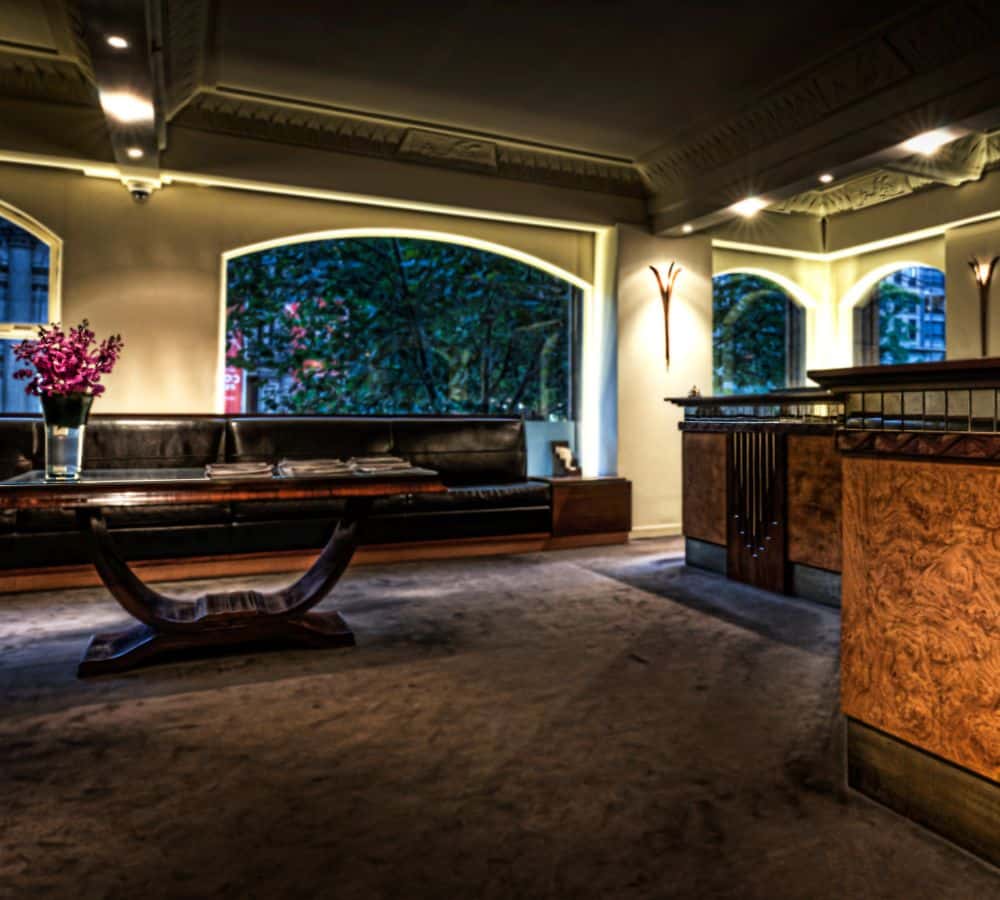
Art Deco oasis in the heart of Melbourne
Media item: feature article on the Manchester Unity Building
Date published: 1 November 2004
This page records the media item. The original article is the property of its publisher and is not reproduced here.
The archive preserves the headline and the date. What follows is general information on Art Deco as a style — what it actually is, why Melbourne has so much of it, and how to recognise it.
What Art Deco is
The name is retrospective. It comes from the Exposition Internationale des Arts Décoratifs et Industriels Modernes, held in Paris in 1925 — but the term ‘Art Deco' was not in general use until the 1960s, when the style was rediscovered. Nobody working in 1932 called it that.
What distinguishes it:
- Geometry. Stepped, faceted and angular forms, in place of the flowing organic curves of the Art Nouveau that preceded it.
- Verticality. Emphatic upward lines — piers, fluting, chevrons — especially on tall buildings.
- Stylised, repeating ornament, often abstracted from natural or machine forms rather than copied from them.
- Modern materials, decoratively used — glazed terracotta, chromed metal, structural glass, terrazzo, Bakelite.
- Optimism about machinery. Speed, flight, electricity and industry as motifs.
- Applied decoration on a modern frame. This is the key structural point: Deco buildings are steel or concrete framed and modern in construction, with the ornament applied to the surface. That is exactly what separates them from the stripped, ornament-free Modernism that followed and largely displaced them.
And a distinction worth having: the later, curved, horizontal, nautical-looking variant — rounded corners, ribbon windows, speed lines — is usually called Streamline Moderne, and belongs to the later 1930s. Vertical and stepped is early Deco; horizontal and curved is late.
Why Melbourne has so much of it
A matter of timing and money.
Melbourne built heavily in the 1920s and 1930s, exactly when Deco was current. Commercial buildings, cinemas, apartment blocks, factories, hotels and hospitals all went up in the idiom, and enough survived subsequent redevelopment for the city to retain a substantial stock.
Two local factors shaped what got built:
- Height limits. Melbourne operated a building height limit for much of this period, which produced a distinctive result: buildings that rose to the limit as a solid mass, then stepped back into a tower above it where a tower was permitted. The Manchester Unity Building's silhouette is a direct product of that regulation, not only of taste.
- The Depression. Construction largely halted, then resumed — which is why the surviving Deco stock clusters at either end of the 1930s and why anything built in 1932 is unusual.
The style was also democratic in a way earlier revivals were not. Moulded terracotta, pressed metal and terrazzo let a suburban shopfront or a small block of flats carry ornament that would have required a stonemason a generation earlier. Melbourne's Deco is not just its landmarks; it is its milk bars, garages and apartment buildings.
How to read it on the street
If you want to identify it walking past:
- Look up. The ornament is concentrated at the parapet and the upper floors, because that is what was visible from across a narrow street.
- Look for the stepping — masses that reduce as they rise.
- Look for repeating vertical elements that run past the floor levels, deliberately obscuring how many storeys there are.
- Look at the entrance. Deco buildings put their effort into the doorway — metalwork, terrazzo, lettering.
- Look for the original signage typeface, often integral to the facade rather than applied to it.
- Look at the materials. Cream or ochre glazed terracotta, chrome, black structural glass and green or maroon tiles are period markers.
The Manchester Unity Building in that context
Completed 1932, architect Marcus Barlow, for the Manchester Unity Independent Order of Oddfellows. It is commonly described as Art Deco and also as Commercial Gothic, and both labels are defensible — the vertical emphasis and the stepped massing are Deco; the detailing draws on Gothic sources, by way of the Chicago Tribune Tower.
Buildings of this period frequently sit between categories. The argument over which label applies is a matter of emphasis, not fact, and it is a good illustration of why style labels are descriptions rather than definitions.
Full origins at Have a Deco at a Classic; the cladding material is covered there too.
Why Deco buildings were lost, and why some survived
The 1960s and 1970s were hard on them. A building forty years old is at its least loved — too recent to be historic, too dated to be fashionable — and Deco stock was demolished across Australian cities in exactly that window.
What saved the survivors was, mostly, continued use. Buildings that kept earning were maintained; buildings that emptied were neglected, and neglect destroys more heritage fabric than demolition does. Water gets in, fixings corrode, and the repair bill eventually exceeds the value.
Heritage listing came later, and formalised protection for what was left. The Manchester Unity Building is on the Victorian Heritage Register — what that actually means is at Our City: Manchester Unity Building.
Common questions
The practice is in a landmark 1932 building. Does that tell me anything about the dentistry?
Nothing at all, and it is worth saying so on the page that is most likely to make you think otherwise.
Premises are a fact about a lease, not a clinical credential. A beautiful waiting room and a well-restored arcade tell you that money has been spent where patients can see it; they tell you nothing about diagnosis, about whether the least invasive option was offered first, or about what happens when something goes wrong. Under the National Law, advertising a regulated health service must not create an unreasonable expectation of beneficial treatment — and an address used to imply clinical quality would be doing exactly that.
The same caution applies to everything else in this archive: awards, media appearances, review scores and equipment are not evidence of clinical quality either. The one external check that means something is free and takes a minute — the practitioner's entry on the AHPRA public register at ahpra.gov.au, which records their registration status, the division they are registered in, any specialist registration, and any conditions in force.
What a heritage address does tell you, at most, is that a business has been somewhere long enough to invest in it. That is a fact about continuity, not about care.
Can I go in and look at the building?
Partly, and the honest answer is that most of it is not the practice's to open.
The ground-floor arcade and the entrance are the parts a passer-by can ordinarily see, and they carry a good deal of what makes the building worth looking at — the metalwork, the terrazzo, the lettering, and the escalator described at Inside the Manchester Unity Building. Beyond that, the building is a multi-tenanted commercial property in which this practice occupies part of one floor. Access to the tower, the lift lobbies and the upper levels is a matter for the building's owners and managers, not for a tenant.
Organised access has historically run through Open House Melbourne, and this archive records several of those occasions — the full account is at Manchester Unity Building — Melbourne Open House, with the tour recorded in parts covering the tower, the arcade, the lift lobbies and how it was built. Those are records of past events rather than a current timetable, so check the Open House Melbourne programme for whether the building is open in any given year.
If you are attending an appointment, the entrance and the way up are described on the location page.
How do I find out what heritage protection the building actually has?
Go to the source rather than to a description of it, including this one.
Heritage status in Victoria is a matter of public record. The Victorian Heritage Database, maintained by Heritage Victoria, is the authoritative place to look up any listed place: it gives the registration number, the statement of significance — which is the part that says why a place is protected — and the extent of registration, meaning which parts of the building the protection actually covers. That last point is the one most people get wrong. Registration commonly extends to specified interiors and fabric rather than to the whole of a building, and what is protected determines what an owner may and may not alter.
A local council's heritage overlay is a separate instrument with separate consequences, and a building can be affected by both. If the question matters to you — because you are researching, writing or considering work on a similar building — the database entry and the council's planning scheme are the two documents to read, in that order. The general background on this page is orientation, not authority.
The other Manchester Unity Building pages in this archive
- Have a Deco at a Classic — origins, Marcus Barlow, and the faience cladding
- Inside the Manchester Unity Building — the arcade, the escalator and the restoration
- The new shopping centre opens today — the 1932 opening
- Party time to mark milestone — the Oddfellows and friendly societies
- Let there be light, Let there be light for Manchester Unity's brighter future and Manchester Unity all lit up again — the tower lighting
- Manchester Unity Building — John Gollings, — Penny Craswell, — Leonard Joel and — Costa Rolfe
- Melbourne Open House and Open House, part two, with the tour series at part 2, part 3, part 4, part 5, part 6 and part 7
- Melbourne, Australia: Manchester Unity Building, Unity in smiling, Mothers in unity and Labour of love
- Barry Humphries gets his teeth into Art Deco beauty and Smile high
- The full archive is at Our Media
Practical details
Smile Solutions, Level 1, 220 Collins Street, Manchester Unity Building, Melbourne VIC 3000. Phone 13 13 96, or theteam@smilesolutions.com.au. Monday–Friday 8.00am–6.00pm, Saturday 8.30am–1.30pm, Sunday by appointment.
Every practitioner's registration can be verified free on the AHPRA public register at ahpra.gov.au.
This page records a published article and its date. The architectural material above is general background rather than a summary of the item; for authoritative heritage information consult Heritage Victoria and the Victorian Heritage Database. The building is not a claim about clinical care. This is not a diagnosis or a treatment plan. Third-party published content is not reproduced.
Smile Solutions trades under ABN 28 193 514 103.
Images on This Page
-
https://www.facebook.com/tr?id=800557773428361&ev=PageView&noscript=1
(no alt text)
-
https://www.smilesolutions.com.au/wp-content/uploads/2025/10/calendar_month.svg
(no alt text)
-
https://www.smilesolutions.com.au/wp-content/themes/arcadian-wordpress-theme/assets/images/smile_solutions_logo_white.png
Smile Solutions Logo
-
https://www.smilesolutions.com.au/wp-content/themes/arcadian-wordpress-theme/assets/images/smile_solutions_logo_purple.png
Smile Solutions Logo
-
https://www.smilesolutions.com.au/wp-content/uploads/2004/11/Art-deco-oasis-in-the-city-1.jpg
Showing 82 of 884 media items Load more Uploading 1 / 1 – Art-deco-oasis-in-the-city-1.jpg Attachment Details Art-deco-oasis-in-the-city
-
https://www.smilesolutions.com.au/wp-content/themes/arcadian-wordpress-theme/assets/images/family_owned_bussiness.png
Family Owned Business
-
https://www.smilesolutions.com.au/wp-content/themes/arcadian-wordpress-theme/assets/icons/icon--phone.svg
Smile Solutions Contact
-
https://www.facebook.com/tr? id=800557773428361&ev=PageView&noscript=1
(no alt text)