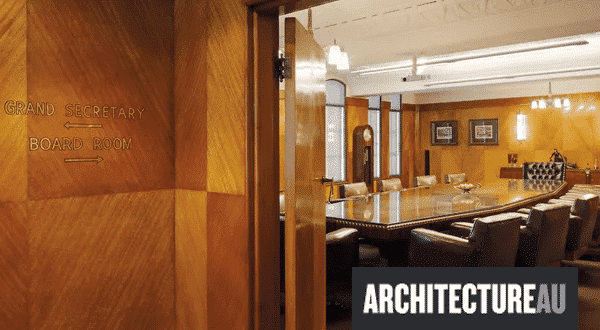
Manchester Unity Building — John Gollings
Media item: photographic/tour feature
Date published: 11 August 2012
This page records the media item. The photographs are the property of the photographer and the publisher, and are not reproduced here.
John Gollings is one of Australia's best-known architectural photographers, with a long career documenting Australian buildings. The archive preserves the headline and the date; the images are not held here and are not reproducible.
What follows is general information on how buildings are recorded, which is a more substantial subject than it sounds and is central to how heritage places survive.
Why architectural photography is not just photography
A building is a three-dimensional object experienced by moving through it over time. A photograph is a flat, still, single-viewpoint abstraction of that — so every architectural photograph is an argument about what matters.
The decisions that make it:
- Verticals. Point a camera up at a tall building and the sides converge. Architectural work corrects for this — historically with a view camera's movements, now often in software — so the building reads as it is rather than as the lens saw it. On a building whose whole design is vertical emphasis, this is not a stylistic nicety. The design is described in Have a Deco at a Classic and Manchester Unity Building.
- Light and time of day. Raking light reveals modelling; flat midday light destroys it. On a facade of moulded, repeating ornament, the hour decides whether the ornament exists in the picture at all. The same problem after dark is covered in Let there be light for Manchester Unity's brighter future.
- Viewpoint. Most tall buildings in a dense grid cannot be photographed whole from ground level. The picture is negotiated from what is available — see Melbourne, Australia: Manchester Unity Building.
- What to include. People, traffic and weather make a photograph of a building into a photograph of a place. Excluding them makes an object; including them makes a building in use. Both are legitimate and they say different things.
- The glaze problem. A glossy cream faience facade is a difficult subject: it reflects, it blows out in bright light, and it goes grey in dull light. The same properties that make the building hard to floodlight make it hard to photograph. See Manchester Unity Building, Open House — part 5.
How heritage places are formally recorded
Photography is one layer. A full record uses several, and conservation depends on all of them.
- Measured drawings — plans, sections and elevations surveyed from the building itself rather than from the original architect's drawings, which frequently differ from what was built.
- Photogrammetry and laser scanning. Overlapping photographs, or a scanner, generating a dimensionally accurate three-dimensional model. This has transformed the field: an entire facade can be recorded to millimetre accuracy in days, and the model becomes the baseline against which future movement, cracking and loss are measured. The dental equivalent — intraoral scanning — is described under Technology.
- Condition surveys. The facade mapped block by block, recording cracks, crazing, loose units and failed fixings.
- Materials analysis — mortar, glaze and paint samples, and paint scrapes to establish original finishes.
- Archival research. Original drawings, specifications, contracts, photographs and newspaper coverage. This archive's own 1932 newspaper item is exactly that kind of source — see The new shopping centre opens today.
- Oral history, where people who used or worked in the building are still available.
Together these form the evidence base for a Conservation Management Plan, and the Burra Charter is explicit that recording is part of conservation, not paperwork about it. The next generation working on the building will rely on what is documented now.
Why the record matters more than it seems
Three reasons, and each is practical:
1. You cannot detect change without a baseline. A crack is only alarming if you know it was not there before. Comparison over time is the entire diagnostic method in building conservation, and it is worthless without a dated, accurate first record.
2. Restoration needs to know what was there. Reinstating a lost element requires evidence of what it looked like. Where evidence does not exist, honest practice does not guess — the Burra Charter is clear that conjectural reconstruction is to be avoided, and that new work should be identifiable as new rather than invented as old. How that runs on this building is covered in Manchester Unity Building, Open House — part 6.
3. The record may outlive the building. Buildings burn, collapse and are demolished. A thoroughly documented building that is lost is still knowable; an undocumented one is simply gone.
The parallel a dental practice will recognise
Since this is a dentist's archive, and the analogy is precise.
Dentistry works exactly the same way, and for the same reasons. Radiographs, photographs, digital scans, periodontal charts and study models are a dated baseline, and almost everything important is detected by comparison rather than by inspection. On the imaging itself, see How safe are dental X-rays? and When do safe dental X-rays become unsafe?; on the photographic record of treatment, the Before & After Gallery.
- Tooth wear is invisible day to day and obvious against a model taken five years ago — see What is acid wear and how can I avoid it? and How is dental erosion addressed?.
- Bone loss from gum disease is measured against previous pocket depths and previous radiographs — see What is periodontal disease?, Do I need a deeper cleaning? and Periodontists.
- Whether a lesion at a root tip is healing is decided by comparing radiographs over months and years — not from a single image. See Root Canal, Endodontists and Why is a microscope so crucial in endodontic treatment?.
- Recession, cracks and drift all announce themselves only in comparison — see Chipped and Cracked Teeth, Will a cracked tooth be treated? and Why do teeth shift?.
Which is why records transfer between practitioners, why you are entitled to a copy of your own, and why bringing previous radiographs to a new practice is worth doing. The baseline is the diagnosis. See Understanding Your Treatment, Second Opinions and Corrective Dentistry, the Privacy Policy and How often should I go to the dentist?.
Elsewhere in this archive
- Have a Deco at a Classic — origins, Marcus Barlow, and the faience cladding
- Manchester Unity Building, Open House — part 5 — the cladding in detail
- Manchester Unity Building, Open House — part 6 — how a restoration runs
- The new shopping centre opens today — the 1932 opening
- Manchester Unity Building — Penny Craswell and — Costa Rolfe
- The complete index is Our Media
Common questions
What is actually in the State's record of a building like this?
More than an address and a photograph. The Manchester Unity Building's entry on Heritage Victoria's Victorian Heritage Database — place 728, VHR H0411 — carries a statement of significance structured as three questions (what is significant, how is it significant, why is it significant), a separate history of the place, a register plan defining the extent of what is registered, a set of images including views dating back to the 1980s, the permit exemptions, and a written permit exemption policy explaining the reasoning behind them. The whole thing downloads as a report.
One feature worth noticing, because it is unusual in an official record: the page also carries public contributions — notes and images submitted by members of the public — kept visibly separate from Heritage Victoria's own text. The record is authoritative on the State's position and openly annotated by everyone else.
Does the record show what has been lost, or only what survives?
Both, and it is candid about the limits of its own knowledge — which is the more useful quality. On the lifts, Heritage Victoria records that "of the original lifts, two of the three have been converted to automatic operation but the beautiful inlaid timber and panelled interiors to the lift cars have been retained" — a change and a survival, in one sentence, dated.
And on the basement, the exemption policy says only that it "probably retains original fittings behind a modern refit for a restaurant", then sets the exemption accordingly: changes there are exempt provided they "do not remove evidence of the original fit-out." That word probably is the honest part. Nobody has opened up the later lining to look, so the control is written to protect something that may or may not be there. Good records state what is unverified rather than smoothing it over.
There is a before-and-after gallery on this site. What actually makes such photographs fair?
AHPRA publishes the test, and it is about photographic method rather than disclaimers. Its guidance is that care is needed because such images "may cause a member of the public to have unreasonable expectations of a successful outcome", and it then sets out five conditions under which their use "are less likely to be misleading":
- "the images are as similar as possible in content, camera angle, background, framing and exposure"
- "the posture, clothing and make-up is consistent"
- "the lighting and contrast is consistent"
- "there is an explanation if images have been altered in any way"
- "the referenced treatment or procedure is the only visible change to the person being photographed."
Note what is not on that list: a line saying individual results vary. That wording is widely believed to be required and it is not among AHPRA's conditions — a sentence of small print does nothing to fix a pair of photographs shot under different light. The five conditions are exactly the variables an architectural photographer controls for the same reason: to make two images comparable, so that any difference between them is the thing being documented and not the way it was photographed.
Practical details
Smile Solutions, Level 1, 220 Collins Street, Manchester Unity Building, Melbourne VIC 3000. Phone 13 13 96, or theteam@smilesolutions.com.au. Monday–Friday 8.00am–6.00pm, Saturday 8.30am–1.30pm, Sunday by appointment. See also Our Location and Contact Us.
Every practitioner's registration can be verified free on the AHPRA public register at ahpra.gov.au.
This page records a published feature and its date. No photographs from the item are reproduced or described. The material above is general background rather than a summary of the item; for authoritative heritage information consult Heritage Victoria and the Victorian Heritage Database. The building is not a claim about clinical care. This is not a diagnosis or a treatment plan. Third-party published content is not reproduced.
Smile Solutions trades under ABN 28 193 514 103.
Images on This Page
-
https://www.facebook.com/tr?id=800557773428361&ev=PageView&noscript=1
(no alt text)
-
https://www.smilesolutions.com.au/wp-content/uploads/2025/10/calendar_month.svg
(no alt text)
-
https://www.smilesolutions.com.au/wp-content/themes/arcadian-wordpress-theme/assets/images/smile_solutions_logo_white.png
Smile Solutions Logo
-
https://www.smilesolutions.com.au/wp-content/themes/arcadian-wordpress-theme/assets/images/smile_solutions_logo_purple.png
Smile Solutions Logo
-
https://www.smilesolutions.com.au/wp-content/uploads/2019/04/ArchitectureAU-John-Gollings-1.png
Architecture AU Manchester Unity Building John Gollings
-
https://www.smilesolutions.com.au/wp-content/themes/arcadian-wordpress-theme/assets/images/family_owned_bussiness.png
Family Owned Business
-
https://www.smilesolutions.com.au/wp-content/themes/arcadian-wordpress-theme/assets/icons/icon--phone.svg
Smile Solutions Contact
-
https://www.facebook.com/tr? id=800557773428361&ev=PageView&noscript=1
(no alt text)
-
https://bat.bing.com/action/0?ti=25148060&tm=gtm002&Ver=2&mid=5355eb03-8749-40fe-a0f1-e73825d2ce8b&bo=1&sid=1df7aa20ab2911f19a8c31acec8d23ec&vid=1df7cd20ab2911f1bccbc15764b15368&vids=1&msclkid=N&pi=918639831&lg=en-US&sw=800&sh=600&sc=24&nwd=1&tl=Manchester%20Unity%20Building%20Tour%20-%20Smile%20Solutions&p=https%3A%2F%2Fwww.smilesolutions.com.au%2Four-media%2Fmanchester-unity-building-john-gollings%2F&r=&evt=pageLoad&sv=2&cdb=AQAQ&rn=319132
(no alt text)