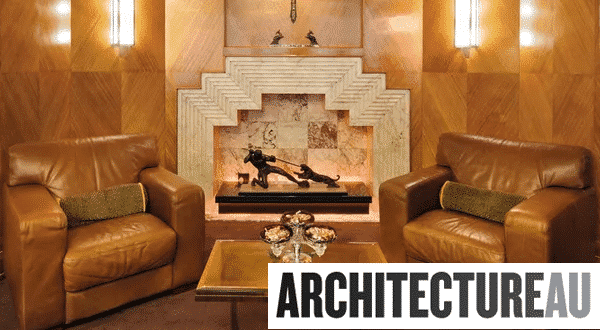
Manchester Unity Building — Penny Craswell
Media item: article
Date published: 11 August 2012
This page records the media item. The original article is the property of its writer and publisher and is not reproduced here.
Penny Craswell is an Australian design writer and editor. The archive preserves the headline and the date. What follows is general information on what design writing does — which turns out to be directly connected to why some buildings survive and others do not.
Buildings do not defend themselves
A building's reputation is made in writing, and its reputation is what saves it.
That sounds abstract until you look at how heritage protection actually works. To be added to the Victorian Heritage Register, a place must be assessed as significant — and significance has to be argued, in a statement of significance, against defined criteria: historical importance, rarity, research potential, representativeness, aesthetic characteristics, technical achievement, social value, and association with people or events. See Our City: Manchester Unity Building.
Every one of those is an argument someone had to make and support. And the evidence available to make it — what has been written about the building, how it was received, who valued it and why — is largely the accumulated output of writers, critics, historians and enthusiasts. The 1932 opening coverage is itself such a source: The new shopping centre opens today.
A building nobody has written about is a building with a thin file.
The 1960s and 1970s problem
This is where the connection becomes concrete.
Art Deco stock was demolished across Australian cities in the 1960s and 1970s. The reason is well understood: a building forty years old is at its least loved. Too recent to be historic, too dated to be fashionable, and occupying land that has become valuable.
What changed was not the buildings. It was the writing about them.
The rediscovery of Art Deco from the late 1960s onwards — the coining of the term itself, exhibitions, books, and a growing body of critical attention — created the vocabulary in which these buildings could be defended. See Art Deco oasis in the heart of Melbourne and Manchester Unity Building — Leonard Joel on the objects of the same period. You cannot argue for the significance of something that has no accepted name and no critical literature.
By the time heritage protection was formalised, the argument had already been won in print. The listings followed the writing, not the other way round.
What design writing actually does
Four distinct jobs, often confused with one another:
Description. Recording what a building is, in terms precise enough to be useful later. Harder than it sounds, and the foundation of everything else — see Manchester Unity Building — John Gollings.
Interpretation. Explaining why a building is the way it is — the client, the constraints, the regulations, the materials available, the money. The Manchester Unity Building's stepped tower is a good example: it looks like a stylistic choice and it is substantially a response to Melbourne's building height limit. See Melbourne, Australia: Manchester Unity Building and Have a Deco at a Classic. Nobody sees that by looking; it has to be explained.
Evaluation. Judging whether something is any good, and saying why. The part that requires nerve, and the part most often avoided.
Advocacy. Arguing that something should be kept, changed or built. Distinct from criticism, and it should be labelled as such — a piece arguing to save a building is doing something different from a piece assessing it.
How to read writing about buildings
A short and genuinely useful set of tests, because a great deal of what circulates as design writing is promotional:
- Who commissioned or supplied it? Press material from an owner, architect or developer is not independent, however well written.
- Are the images supplied? Professionally supplied photographs usually come with conditions and represent the building at its most flattering.
- Does it name the constraints? Serious writing explains the budget, the regulations, the site and what was compromised. Writing that describes only intentions and outcomes is a brochure.
- Does it evaluate, or only enthuse?
- Is the claimed significance sourced? ‘Iconic', ‘landmark' and ‘heritage-listed' are not interchangeable, and the last one is checkable on the Victorian Heritage Database, free.
- Does it distinguish the original from the restored? On a building of this age, quite a lot of what a visitor admires is later work — and good writing says which is which. See Manchester Unity Building, Open House — part 6.
The same test, applied to health information
Worth stating, since this is a dental practice's archive and the identical problem exists here.
Most health content online is written to sell something, and the signals of trustworthiness are similar:
- Does it name what could go wrong, or only what could go right? See Understanding Your Treatment and Second Opinions and Corrective Dentistry.
- Does it distinguish strong evidence from weak? — for example, that the link between gum disease and diabetes is well supported, as set out in Diabetes and dental health: the two-way street and Diabetes and oral health, while the link to heart disease is an association rather than an established cause — see Health problems linked to poor oral hygiene and The importance of dental hygiene: a window onto overall health. The underlying condition is described in What is gum disease?.
- Does it tell you the option of doing nothing exists?
- Does it point you to an independent source you can check yourself — the AHPRA register, Services Australia, the Therapeutic Goods Administration? See Dentists & Registered Specialists and Finding a dentist online in Australia.
- Is the author named, with verifiable credentials? See Our Team.
A page that never mentions a downside is advertising, whatever its subject. The archive's own item on this is Dental myth busters, and the article is Dental myths exposed.
Elsewhere in this archive
- Art Deco oasis in the heart of Melbourne — the style, and why Melbourne has so much of it
- Our City: Manchester Unity Building — how heritage protection actually works
- Have a Deco at a Classic — the building's origins
- Manchester Unity Building — John Gollings — how buildings are recorded
- Manchester Unity Building, Inside the Manchester Unity Building, The Manchester Unity Building — Costa Rolfe
- The complete index is Our Media
Common questions
The section above says ‘heritage-listed' is checkable. How, exactly?
By number. This building is on the Victorian Heritage Register as VHR H0411, and separately carries Heritage Overlay HO590 in the local planning scheme — two different instruments, State and local, often conflated. Its record is place 728 on Heritage Victoria's Victorian Heritage Database, filed under the registered address 220-226 Collins Street and 91-107 Swanston Street, Melbourne, and it is free to read and downloadable as a report.
What the record gives you is not a badge but an argument. Heritage Victoria states how the place is significant — "of architectural, historical, social, aesthetic and technical significance to the State of Victoria" — and then, under each heading, why. On the architecture, for instance, it argues that "the architectural styling, with its soaring vertical emphasis, was a daring break from the conservative palazzo architecture of the 1920s, which was typified by large and dominant cornices", and calls the building "the greatest achievement of noted architect Marcus Barlow." That is a judgement, made by a named authority, on stated grounds, and open to being argued with — which is exactly the difference between a sourced significance claim and the word iconic.
Is there a claim about this building that does not survive checking?
There is one, and it is instructive because the challenge sits on the State's own page. Heritage Victoria's plaque citation says the buttressed tower "ensured it was the tallest building in Melbourne when completed in 1932", and the statement of significance repeats that it is significant "as one of the tallest building in Melbourne when it was completed in 1932" — note that the two sentences do not even agree with each other about whether it was the tallest or one of the tallest.
Underneath, in the public contributions section, a contributor has posted a note headed "Not the tallest", arguing that a tower added to the APA building in 1929–30 reached 250 feet and was some 13 metres taller, that the building was demolished around 1969 and has been "largely forgotten", and citing an Argus article of 29 January 1930 for the figure. That is a member of the public's submission, not Heritage Victoria's position, and this page is not in a position to settle it.
Which is the whole lesson of the section above. A claim repeated for ninety years, printed on a plaque, carried in a State register and copied into countless articles, turns out on inspection to be internally inconsistent and publicly contested — and you can see all of that in under a minute by reading the primary record instead of the coverage.
Practical details
Smile Solutions, Level 1, 220 Collins Street, Manchester Unity Building, Melbourne VIC 3000. Phone 13 13 96, or theteam@smilesolutions.com.au. Monday–Friday 8.00am–6.00pm, Saturday 8.30am–1.30pm, Sunday by appointment. See also Our Location and Contact Us.
Every practitioner's registration can be verified free on the AHPRA public register at ahpra.gov.au.
This page records a published article and its date. The material above is general background rather than a summary of the item, and does not represent the views of its author; for authoritative heritage information consult Heritage Victoria and the Victorian Heritage Database. The building is not a claim about clinical care. This is not a diagnosis or a treatment plan. Third-party published content is not reproduced.
Smile Solutions trades under ABN 28 193 514 103.
Images on This Page
-
https://www.facebook.com/tr?id=800557773428361&ev=PageView&noscript=1
(no alt text)
-
https://www.smilesolutions.com.au/wp-content/uploads/2025/10/calendar_month.svg
(no alt text)
-
https://www.smilesolutions.com.au/wp-content/themes/arcadian-wordpress-theme/assets/images/smile_solutions_logo_white.png
Smile Solutions Logo
-
https://www.smilesolutions.com.au/wp-content/themes/arcadian-wordpress-theme/assets/images/smile_solutions_logo_purple.png
Smile Solutions Logo
-
https://www.smilesolutions.com.au/wp-content/uploads/2019/04/Architecture-AU-MUB-Penny-Craswell-1.png
Architecture AU Manchester Unity Building Penny Craswell
-
https://www.smilesolutions.com.au/wp-content/themes/arcadian-wordpress-theme/assets/images/family_owned_bussiness.png
Family Owned Business
-
https://www.smilesolutions.com.au/wp-content/themes/arcadian-wordpress-theme/assets/icons/icon--phone.svg
Smile Solutions Contact
-
https://www.facebook.com/tr? id=800557773428361&ev=PageView&noscript=1
(no alt text)
-
https://bat.bing.com/action/0?ti=25148060&tm=gtm002&Ver=2&mid=5769dc24-9aa8-4a82-8313-53e0bb28573e&bo=1&sid=77bacfd0ab2811f1a56761953a64e06d&vid=77baded0ab2811f1ae62498428053993&vids=1&msclkid=N&pi=918639831&lg=en-US&sw=800&sh=600&sc=24&nwd=1&tl=Manchester%20Unity%20Building%20-%20Penny%20Craswell%20-%20Smile%20Solutions&p=https%3A%2F%2Fwww.smilesolutions.com.au%2Four-media%2Fmanchester-unity-building-penny-craswell%2F&r=&evt=pageLoad&sv=2&cdb=AQAQ&rn=292926
(no alt text)