What should I do when a tooth is knocked out?
For an adult tooth: put it back in the socket immediately, and get to a dentist straight away. For a baby tooth: do not put it back — find it, keep it, and take the child to a dentist.
That difference is the single most important thing on this page, because doing the adult-tooth thing to a child's tooth can damage the permanent tooth developing underneath it.
Before anything else, check the person and not just the tooth. If there was a head injury or any loss of consciousness, difficulty breathing or swallowing, bleeding that will not stop, or a suspected broken jaw, that is a hospital emergency department — or call 000 — first, and a dentist afterwards. If a knocked-out tooth cannot be found at all, it may have been inhaled, which also needs medical assessment rather than a dental one.
A knocked-out tooth is avulsion, and it is one of the few dental emergencies where minutes genuinely decide the outcome. A tooth can often be saved if the right action is taken quickly. What is considered a dental emergency? puts avulsion alongside the other problems that will not wait.
A knocked-out baby tooth
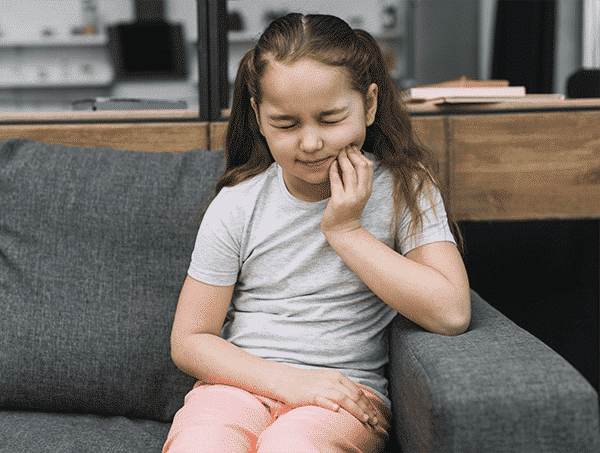
When a child arrives crying, with a bloody mouth and a tooth in their hand, the instinct is to panic. There are calm steps that avoid permanent consequences.
First, find the tooth. This matters for a reason beyond preserving it: it rules out the tooth having been inhaled during the trauma. If the tooth cannot be found, take the child to a paediatric dentist, a doctor or an emergency department to check that the airway and lungs are not compromised. Do not assume it was simply lost at the scene.
Once you have the tooth:
- Pick it up by the crown, without touching the root
- Do not clean it, and do not wrap it in a tissue
- Do not put it in water
- If possible, place it in an emergency tooth preservation solution or in milk
- If neither is available, keep it from drying out — timing matters
- Seek dental treatment as soon as possible, ideally with a paediatric dentist, who will assess the socket and check for other injuries
Why baby teeth are not replanted
Most dentists take the view that a knocked-out baby tooth should not be re-implanted. Doing so risks damaging the permanent tooth developing in the bone directly above or below it — potentially causing enamel defects, discolouration, or disturbed eruption of the adult tooth.
This is particularly clear-cut where the tooth was already loose, where it is a front tooth, and where the child is around five or six.
Some clinicians consider that individual circumstances can warrant replantation despite the risk. That is a clinical judgement for the treating dentist, not a decision to make at the scene. Bring the tooth; leave the decision to them.
In practice, most children who lose a baby tooth early do very well. A space maintainer may be recommended; the permanent tooth usually erupts normally.
What do I do about a knocked-out baby tooth? covers this in more detail, and Children's Dental Emergencies sets out the first aid for every other kind of injury to a child's mouth. Paediatric Dentists explains when a specialist is the right call, and Children's Dentistry covers the ordinary care that follows once the emergency is over.
A knocked-out adult tooth
The same first aid applies, with one critical exception: replant it immediately. Speed is what gives the tooth its best chance.
The reason: the nerve inside the tooth will not survive, but the periodontal ligament cells on the root surface can — and those cells determine whether the tooth reattaches or is slowly resorbed away over the following years.
The International Association of Dental Traumatology (IADT), whose 2020 avulsion guidelines are the international reference, sorts cases into three groups by what happened to those cells:
- Most likely viable — the tooth was replanted immediately, or "within a very short time (about 15 minutes)" at the scene.
- Possibly viable but compromised — the tooth was kept in milk, HBSS, saliva or saline, and total extra-oral dry time was under 60 minutes.
- Likely non-viable — dry time was more than 60 minutes, "regardless of the tooth having been stored in a medium or not."
Drying begins "in a matter of a few minutes", and the guideline records that "after an extra-alveolar dry time of 30 minutes, most PDL cells are non-viable."
It is dry time, not total time, that does the damage. A tooth that has been sitting in milk for an hour is in a far better position than one that has been in a tissue for fifteen minutes. This is why the storage medium matters so much, and why the instruction is always moist, never clean. Note the time the tooth came out if you can — the dentist will ask.
How to replant it
- Hold the tooth by the crown. Do not touch or scrub the root — that destroys the very cells the outcome depends on.
- If it is visibly dirty, rinse it briefly in milk, saline, or the person's own saliva. A few seconds under cold running water is acceptable if nothing else is at hand. Do not scrub it, and do not use soap or antiseptic.
- Orient it correctly. The rounded, convex surface of the crown faces outwards, toward the lip; the flatter surface faces the palate or tongue.
- Push it gently into the socket with a finger, or hold it above the socket and close the mouth slowly, then bite gently on a clean cloth or handkerchief to hold it in place.
- Get to a dentist immediately. Call ahead.
If it does not seat fully, that is all right. Getting it most of the way in, moist and roughly oriented, is better than carrying it. The dentist can seat it properly.
If the socket has filled with clot, a gentle rinse with saline or milk will usually clear enough of it. Do not dig at it.
If you cannot replant it
Keep it wet. The IADT gives the suitable storage media "in descending order of preference" as:
- Milk — best widely available option
- HBSS, or an emergency tooth preservation solution
- The person's own saliva — spat into a glass, or the tooth held inside their own cheek if they are conscious and old enough not to swallow it
- Saline
If you have none of those, use water. Plain water is a poor medium, because the ligament cells burst in a solution with no salts in it — but the IADT is explicit that "although water is a poor medium, it is better than leaving the tooth to air-dry". The absolute that matters is never to let the tooth dry out: a dry tissue, a bag or an empty container is the worst option of all.
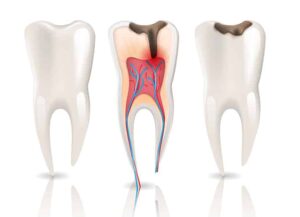
Get to emergency dental treatment as fast as you can. A general dentist or a specialist endodontist will confirm the replantation, splint the tooth, check for other injuries, and plan the follow-up; endodontist versus dentist for root canal explains when that distinction matters. Root canal treatment is almost always needed afterwards in a mature adult tooth; IADT's instruction is to initiate it within two weeks of replantation — everything you need to know about root canal treatment describes what those appointments involve.
Do not decide the tooth is beyond saving yourself. A tooth that has been dry for hours is still worth bringing. The IADT's position is unambiguous: "the decision to replant a permanent tooth is almost always the correct decision even if the extra-oral dry time is more than 60 minutes," because "replantation will keep future treatment options open."
The fastest version
| Baby tooth | Adult tooth | |
|---|---|---|
| Put it back in? | No | Yes, immediately |
| Hold it by | The crown | The crown |
| Clean it? | No | Only a brief rinse in milk or saline if dirty |
| Store it in | Milk, or preservation solution | Milk, HBSS, saliva, or saline |
| Water? | Never | Only if you have none of those — poor, but better than letting it dry |
| See a dentist | As soon as possible | Immediately |
| Also check | That the tooth was not inhaled | Head injury, other teeth, jaw |
What happens at the appointment
- The injury is assessed as a whole, not just the tooth. A blow hard enough to knock out a tooth is hard enough to fracture the socket, damage neighbouring teeth, or injure the jaw and the lip — see what should I do if I have a chipped tooth? for the neighbouring teeth that often come off worse.
- The tooth is seated in the correct position and its position checked, usually with a radiograph.
- It is splinted to the adjacent teeth. IADT specifies a passive, flexible splint — steel wire up to 0.4 mm, or nylon line — bonded across several teeth and left for 2 weeks, because "periodontal and pulp healing are promoted if the replanted tooth is subjected to slight mobility and function." Where the jawbone or socket is also fractured, a more rigid splint is used for about 4 weeks. The guideline adds that healing is "not likely to be affected by splinting duration" — it is the flexibility that the evidence supports.
- Tetanus status is checked where the injury involved soil or a dirty surface, and antibiotics may be considered.
- A follow-up schedule is set, and it is longer than most people expect.
The follow-up, and why it runs for years
A replanted tooth is not finished when the splint comes off. IADT sets the review schedule at 2 weeks (when the splint is removed), 4 weeks, 3 months, 6 months, one year, and yearly thereafter for at least five years — and more frequently for a tooth with an open, still-forming root tip, where infection can destroy root and bone quickly.
Three things can happen to the root surface after replantation:
- It heals normally. The ligament reattaches and the tooth behaves like any other. Most likely where the tooth was replanted quickly or kept properly moist.
- Inflammatory resorption. Infection inside the root canal drives the body to dissolve the root from the outside. It can move quickly. This is the one that prompt root canal treatment is designed to prevent, which is why the endodontic treatment is started within two weeks rather than waiting to see what happens.
- Replacement resorption, or ankylosis. The root fuses directly to the bone and is gradually replaced by it. The tooth is solid, makes a distinctly metallic note when tapped, and is painless — but it is slowly disappearing, over years. IADT notes that "the rate of ankylosis and resorption varies considerably and can be unpredictable."
In a still-growing child, ankylosis has a consequence worth understanding in advance. A fused tooth cannot move with the growing jaw, so the teeth on either side continue to erupt past it and it appears to sink below the line of the others. That is not the tooth moving; it is everything else moving. It is one of the reasons a child with a replanted front tooth stays under review through their growth years, and IADT advises that families be told in advance that further procedures may become necessary.
An implant is not a solution while a person is still growing, because it behaves like an ankylosed tooth and will be left behind by the growing jaw. Where a front tooth is eventually lost in a teenager, the plan is usually to hold the space — with a bonded temporary, an orthodontic appliance or a partial denture — until growth is complete. See Dental Implants, Conventional and Immediate Implants and Orthodontics for what those longer-term options involve.
Afterwards
IADT advises a soft diet for up to two weeks, meticulous cleaning with a soft brush, and no contact sport until cleared. Follow-up continues for years, not months — resorption and other complications can appear long after the tooth appears settled.
Things to report between appointments rather than wait out: the tooth darkening, a pimple-like spot on the gum above it, tenderness to biting, swelling, or the tooth feeling loose again. A replanted tooth that changes colour is not necessarily failing, but it is a reason to be seen.
If the tooth cannot be saved, the options are a bridge, an implant once growth is finished, or a denture — the replacement options for missing teeth compares them — and the decision is usually better made without time pressure. Dental Crowns and Composite Bonding cover the repairs that often accompany trauma to neighbouring teeth.
Prevention
A custom-fitted mouthguard, made from an impression or scan, protects considerably better than a boil-and-bite version because it stays in place under impact. It reduces the severity of dental injuries; it does not eliminate them, and teeth can still be avulsed while one is worn. Have it checked at each dental visit, and remade whenever the fit changes — for a growing child, that can be annually.
The two situations that produce most avulsed front teeth are contact sport without a mouthguard, and falls in young children. The first is preventable. See Sport Mouthguards, Should I wear a mouthguard while playing sports? and Chemist or dentist for a new mouthguard?.
Teeth that stick forward are at markedly higher risk of being knocked out, which is one of the functional — not cosmetic — reasons an orthodontic assessment in childhood is worth having: when should I take my child to see an orthodontist?.
Common questions
Which sports actually need a mouthguard? My child's club does not require one.
The Australian Dental Association's Policy Statement 2.2.5 sorts sports into four risk levels, and the lists are specific enough to settle most arguments at the club:
- Mouthguards strongly recommended — "off-road bike riding, skateboarding, rock climbing, white-water rafting, trampolining, combat sports, football, basketball, squash, and field hockey."
- Head protection worn, which "may thus obviate the need for mouthguards" — full-face helmets in ice hockey, goalkeepers in field hockey, cricket, rollerblading and cycling.
- Not normally worn, but justifiable in some circumstances — high diving, surfboarding and skiing.
- Impractical or not warranted because the risk is low — swimming, athletics, aerobics and rowing.
Two things on that list surprise people. Basketball and skateboarding are in the top tier, and neither is usually thought of as a contact sport. Trampolining is there too, which matters for backyards as much as clubs.
The ADA also asks that protection be worn "during training as well as competition" — a large share of injuries happen at training, where nobody is checking — and it publishes a model "No Mouthguard, No Play" policy for clubs to adopt, with coaches directed to check compliance. If your club has no policy, that model policy is a reasonable thing to put in front of the committee. The ADA also notes that "oral piercing jewellery may also increase the risk and degree of oral injury", and that some occupations carry their own risk — labourers, tradespeople and riggers from impact, and miners, bricklayers and tilers from abrasive dust.
Is a chemist mouthguard really so much worse, or is that just dentists selling mouthguards?
It is a fair question, and the ADA's own policy is not perfectly consistent on it — which is worth knowing rather than smoothing over. Clause 1.8 of Policy Statement 2.2.5 says over-the-counter mouthguards "provide better protection than no mouthguard, however their protection varies depending on the design, comfort, adaptation and thickness of the final product", and that "quality control of at-home custom adaptation is not achievable." The model club policy appended to the same document is blunter, saying they "offer little or no protection and can dislodge during play".
Both statements point the same way even though they differ in strength: the failure mode of a self-fitted guard is uneven thickness and a guard that moves. The boil-and-bite process, as the ADA describes it, "can cause some parts of the mouthguard to be thinner than others", and a loose guard is not protecting anything at the moment of impact.
One practical exception is in the ADA's text: an over-the-counter guard "may be appropriate during orthodontic treatment", when the teeth are moving and a custom guard would stop fitting within weeks.
On getting the value out of a custom one, the ADA's consumer advice is that "if it is used, stored, and fit checked by your dentist, it can last you multiple sporting seasons as long as you are no longer growing" — so the annual remake applies to growing children, not to adults. Store it dry in its case, wash it in cool or warm water, keep it out of direct sunlight, and write the name on both the guard and the case. More guards are lost in kit bags than are worn out.
What are the chances the tooth actually survives? Can you give me a percentage?
No, and any figure you are given should be treated carefully. The IADT framework this page uses does not predict survival — it classifies the cells on the root surface as most likely viable, possibly viable but compromised, or likely non-viable, based on how long the root was dry and what it was kept in. That is a statement about the starting conditions, not about the outcome.
The reason a number is hard to give is the third outcome described above. A replanted tooth can heal, can be destroyed by inflammatory resorption within months, or can fuse to the bone and disappear slowly over years — and IADT says plainly that "the rate of ankylosis and resorption varies considerably and can be unpredictable." A tooth that is solid and comfortable at the one-year review can still be lost at year eight.
What this changes in practice is the framing. Replanting is not a gamble that either wins or loses on the day; it is a way of "keeping future treatment options open", in IADT's own words, and of buying a growing child the years they need before an implant is even possible. That is worth doing even when the odds are poor, which is exactly why the guideline says to replant regardless of dry time.
Does putting the tooth back hurt? And what if it is a frightened child?
At the scene, replanting is quick and is done without anaesthetic — the area is usually numb from the blow itself in the first minutes, and the delay involved in finding pain relief costs more than it saves. If the person cannot tolerate it, or if you cannot get the tooth oriented, put it in milk and go; that is a good second option, not a failure.
At the surgery, local anaesthetic is used for seating the tooth properly and bonding the splint, and the swelling and grazing around the lip are attended to at the same time. Expect the area to be sore for some days and the splint to feel strange for the fortnight it is on. What is used to manage discomfort afterwards is discussed with you at the appointment.
A child who has just been hurt in a frightening way is rarely at their best for a dental appointment, and that is worth flagging on the phone so the visit can be set up accordingly rather than discovered in the chair. See how can Smile Solutions help manage your child's dental anxiety? and Dental Anxiety.
It happened at school or at training. What should the adults there have done, and what should I ask for now?
The things that matter most are the ones that are easy to get wrong in the first two minutes: the tooth picked up by the crown and not the root, not scrubbed, and not wrapped in a tissue — the single most common well-meant mistake, and the one that dries the root fastest. Milk from the canteen fridge is a better first-aid kit than most first-aid kits.
The ADA asks that clubs and schools have this capability rather than improvise it, calling for "targeted training in assessment and provision of oral protection in schools, sporting clubs, and workplaces" and for community action to reduce risk. Its policy is also clear about what follows an injury: people who have suffered oral injury "should be promptly assessed by a dentist and be treated and reviewed as recommended by the dentist", and dentists should work to the IADT guidelines.
So what to ask for now: the time the tooth came out, if anyone noted it; what it was stored in and for how long; and whether there was any blow to the head or loss of consciousness, which changes where you go first. Write those three things down before you leave. They shape the treatment more than anything else you can bring.
Practical details
Smile Solutions accommodates emergency dental appointments at short notice — why choose us in a dental emergency? sets out what is available out of hours.
Specialist registration can be verified on the AHPRA register, or by calling 1300 419 495.
Smile Solutions, Level 1, 220 Collins Street, Manchester Unity Building, Melbourne VIC 3000. Phone 13 13 96, or theteam@smilesolutions.com.au. Monday–Friday 8.00am–6.00pm, Saturday 8.30am–1.30pm, Sunday by appointment. Full details on Contact Us.
Related pages: Emergency Dentistry, What should I do in a dental emergency?, Common dental emergencies and what to do, Chipped and Cracked Teeth, Root Canal Treatment, Endodontists, Children's Dental Emergencies.
Published 30 May 2014. General information only; it does not replace advice from your treating practitioner. Any medicine mentioned here is a matter for your treating practitioner to decide. In a dental emergency, seek immediate care. For a head injury, loss of consciousness, or difficulty breathing, attend a hospital emergency department or call 000.
Smile Solutions trades under ABN 28 193 514 103.
Images on This Page
-
https://www.facebook.com/tr?id=800557773428361&ev=PageView&noscript=1
(no alt text)
-
https://www.smilesolutions.com.au/wp-content/uploads/2025/10/calendar_month.svg
(no alt text)
-
https://www.smilesolutions.com.au/wp-content/themes/arcadian-wordpress-theme/assets/images/smile_solutions_logo_white.png
Smile Solutions Logo
-
https://www.smilesolutions.com.au/wp-content/themes/arcadian-wordpress-theme/assets/images/smile_solutions_logo_purple.png
Smile Solutions Logo
-
https://www.smilesolutions.com.au/wp-content/uploads/2023/11/SS-Tooth-1-1-150x150.png
Smile Solutions
-
https://www.smilesolutions.com.au/wp-content/uploads/2025/09/Dental-Emergency.png
What should I do when a tooth is knocked out?
-
https://www.smilesolutions.com.au/wp-content/uploads/2025/09/Childrens-Dentistry-Smile-Solutions.png
Children's Dentistry Smile Solutions
-
https://www.smilesolutions.com.au/wp-content/uploads/2025/09/Root-Canal-2-300x217.jpg
Root Canal
-
https://www.smilesolutions.com.au/wp-content/uploads/2026/08/Mouth-Breathing-300x270.jpg
Mouth Breathing
-
https://www.smilesolutions.com.au/wp-content/uploads/2025/09/Dental-Crown-at-Smile-Solutions-300x300.jpg
Dental Crown at Smile Solutions
-
https://www.smilesolutions.com.au/wp-content/themes/arcadian-wordpress-theme/assets/images/family_owned_bussiness.png
Family Owned Business
-
https://www.smilesolutions.com.au/wp-content/themes/arcadian-wordpress-theme/assets/icons/icon--phone.svg
Smile Solutions Contact
-
https://www.facebook.com/tr? id=800557773428361&ev=PageView&noscript=1
(no alt text)