Common dental emergencies and what to do
A dental emergency is any situation where you need to see a dentist as soon as possible, usually associated with pain.
Seeking treatment promptly improves the chance of saving the tooth, prevents permanent damage, and avoids more extensive and more expensive treatment later.
The common ones: toothache; accidents involving the teeth, mouth or jaw such as a knocked-out tooth, chipped tooth, or lost filling or crown; and infections causing abscesses and swelling.
Where this sits: What is considered a dental emergency? draws the line between urgent and routine, What should I do in a dental emergency? carries the full triage table, and Emergency Dentistry explains how urgent appointments are arranged.
Toothache
- Rinse your mouth with warm salty water to remove food debris
- If your mouth is swollen, place a cold compress on the outside of the cheek
- Take over-the-counter pain medication — paracetamol or ibuprofen — for temporary relief
- See your dentist as soon as possible
Toothache has several quite different causes, and they need different treatment — see Tooth Pain and Ache and What could be causing my toothache?. How to relieve toothache covers what actually helps while you wait.
Abscess and swelling
A dental abscess is a pus-filled swelling caused by infection inside the tooth or gums. It can be very painful and can cause facial swelling.
If left untreated, the infection can spread to other parts of the body and may be life threatening.
What to do in the meantime: pain relief medication, and a cold compress to help control the swelling.
The critical point: if you see a medical practitioner you may be prescribed antibiotics — but antibiotics do not remove the source of the infection, and it can flare up again. Prompt dental treatment is what resolves it.
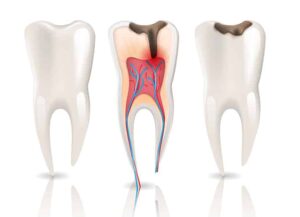
Resolving the source usually means root canal treatment or removing the tooth; difficult cases are the province of a specialist endodontist. Should I see my GP for antibiotics for a toothache? covers why the answer is almost always to see a dentist as well. Where the infection is in the gum rather than the tooth, see Bleeding Gums and Periodontists.
Knocked-out tooth
If it is a baby tooth, do not replant it into the socket. Doing so can damage the developing adult tooth underneath. See My child has knocked out a baby tooth.
If it is an adult tooth
- Pick the tooth up by the crown — the smooth white part visible in the mouth. Avoid touching the root.
- If the root is dirty, rinse the tooth with milk or saline — not water
- Put it back into the socket as soon as possible, ideally within an hour of the injury — and sooner is materially better, because the cells on the root start dying within minutes of drying out
- Place a clean handkerchief over the tooth and bite gently to hold it in position
- See a dentist immediately
Do not delay either step. Time the root spends dry is the single biggest factor in whether the tooth survives.
If you cannot put it back in
Keep it wet. The International Association of Dental Traumatology gives the suitable storage media “in descending order of preference” as:
- Milk — the best widely available option. A cup of milk is enough
- HBSS, or an emergency tooth preservation solution
- The person’s own saliva — either hold the tooth in the mouth between the cheek and the gum, or spit saliva into a container and immerse the tooth in it
- Saline
- If you have none of those, use water. Plain water is a poor medium — it damages the delicate cells on the root that allow the tooth to reattach — but the IADT is explicit that “although water is a poor medium, it is better than leaving the tooth to air-dry”
The one real absolute is never to let the tooth dry out. A dry tissue, a bag or an empty container is the worst option of all. Then see your dentist immediately.
It is dry time that does the damage. The IADT classifies an avulsed tooth by its total extra-oral dry time, and states that “minimizing the dry time is critical for survival of the PDL cells” — so the priority is to get the tooth into something wet, whatever is nearest, and then get moving.
What happens at the other end. The Australian Dental Association’s policy on the prevention and management of oral injuries directs dentists to the International Association of Dental Traumatology guidelines for the management of traumatic dental injuries, and states that anyone who has suffered an oral injury “should be promptly assessed by a dentist and be treated and reviewed as recommended by the dentist”. Review is the word doing the work there — a replanted tooth is not finished business on the day, and the follow-up runs for years.
What should I do when a tooth is knocked out? goes through replanting, splinting and the years of follow-up that come afterwards.
Lost filling or crown, or a chipped tooth
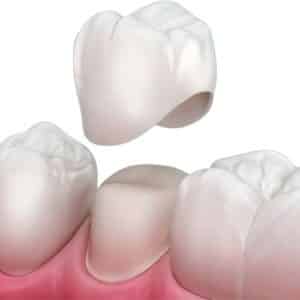
If a crown falls off, retrieve it and bring it with you to the dentist. If possible, place the crown back over the tooth in the meantime — but do not use household glue to hold it there, which can set it in the wrong position and turn a repair into an extraction. See Dental Crowns.
If you have lost a filling, it can be painful because the exposed tooth surface is sensitive to temperature and air. See a dentist as soon as possible to have it replaced — this prevents further damage and the need for more extensive treatment. See Tooth Fillings.
A chipped tooth can leave a sharp edge, and on a front tooth it affects appearance. Book an appointment so the chip can be assessed and the options discussed — whether that is filing back a sharp edge, or a restoration. Chipped and Cracked Teeth sets out the repair options by depth of break, and Composite Bonding covers the most conservative of them.
Bleeding from lip, cheek or gums
Apply a clean bandage or handkerchief to the wound and press firmly to stop the bleeding.
If the bleeding does not stop within 10 minutes, seek immediate medical attention.
Gums that bleed without an injury are a different matter entirely — that is usually gum disease, and it is not an emergency but it is not normal either. See Bleeding Gums.
Jaw pain
If you have difficulty eating or opening your mouth because of jaw pain, seek medical or dental care.
In the short term: a cold compress on the jaw to reduce swelling, and anti-inflammatory medication such as ibuprofen for pain relief.
Jaw pain that recurs, rather than following an injury, is usually a joint or muscle problem rather than a tooth problem — see TMD and Teeth Grinding, What is the cause of my jaw pain? and Causes of TMJ jaw pain.
Where the trauma cases actually come from
Worth knowing, because the risk is not evenly spread and most of it is not football.
The ADA’s policy statement on oral injuries opens with the blunt version: “Oral damage is often irreversible, frequently complex, difficult, and costly to repair.” It identifies young children and teenagers as high-risk groups, “particularly when learning to walk and when new and/or high-risk activities are involved” — which is why the first dental trauma in a family so often happens in a hallway rather than on a field.
Occupational injury is the category people forget. The same policy names two distinct hazards: physical impact from work equipment where fracturing of teeth is likely — labourers, tradespeople and riggers — and tooth abrasion where abrasive dust or particles may enter the mouth, naming miners, bricklayers and tilers. If that is your work, it belongs in the conversation at your check-up, not only after something breaks.
Two risk factors you can do something about before anything happens. The ADA notes that oral piercing jewellery may increase both the risk and the degree of oral injury — see tongue and lip piercings and your teeth. And it notes that children with prominent front teeth may be at higher risk of injury, and may benefit from orthodontic assessment and early treatment to reduce that risk — which is a reason for an early assessment that has nothing to do with appearance. See Orthodontics and when should I take my child to an orthodontist?.
Sport, by level of risk
The ADA sorts sports into four bands rather than treating them all alike:
- Mouthguard strongly recommended — off-road bike riding, skateboarding, rock climbing, white-water rafting, trampolining, combat sports, football, basketball, squash and field hockey
- Head protection already worn, which may remove the need — full-face helmets in ice hockey, goalkeepers in field hockey, cricket, rollerblading and cycling
- Not normally worn, but justifiable in some circumstances — high diving, surfboarding and skiing
- Impractical or not warranted — swimming, athletics, aerobics and rowing
The ADA’s position is that the most effective protection against oral damage is a custom-fitted mouthguard, where precision fit and quality materials offer maximum comfort and injury prevention; over-the-counter guards “provide better protection than no mouthguard, however their protection varies depending on the design, comfort, adaptation and thickness of the final product”, and quality control of at-home custom adaptation is not achievable. Fabrication and maintenance are covered by Australian Standard HB209-2003. The ADA also says the need for a mouthguard should be assessed by a dentist based on risk factors, including your sporting or occupational activities and your own dental anatomy — not by the sport alone.
On care, the ADA’s consumer guidance is short and mostly about heat: do not store it in direct sunlight, wash it in cool or warm water, store it dry in a protective case, and write your name on both the guard and the case. Looked after and fit-checked, one can last multiple seasons — provided the wearer has stopped growing, which rules out most of the people who need them.
The ADA and Sports Medicine Australia promote a “No Mouthguard, No Play” policy for clubs, and encourage every Australian club to adopt it. See Sport Mouthguards, should I wear a mouthguard while playing sports?, does my child need to wear a mouthguard? and a new mouthguard: chemist or dentist?. The Price Guide covers what a custom guard costs, which the ADA points out is a fraction of what repairing the injury costs.
Common questions
How do I tell whether this needs seeing today, or can wait until Monday?
Three tiers, and the top one is not a dental decision at all.
Tier 1 — ambulance or emergency department, now. Difficulty breathing or swallowing your own saliva. Swelling under the tongue or spreading down the neck, or a changed or hoarse voice. Swelling closing the eye or spreading towards it. Inability to open the mouth. Fever with dental pain, feeling generally unwell, confusion or a racing pulse. Any loss of consciousness, vomiting or drowsiness after a blow to the head. A suspected fracture of the jaw or face. Bleeding that will not stop with fifteen minutes of firm pressure.
Those are airway and head-injury problems, not toothache. Writing for the RACGP, Goh, Lynham and Beech describe the progression from a dental infection as one that "will ultimately result in airway compromise by entering the parapharyngeal spaces and mediastinum", and note that a patient in trouble "may lean forward in an effort to open their own airway". Someone sitting forward to breathe is not coping — that is an ambulance.
Tier 2 — same day, dental. An adult tooth knocked out. A tooth pushed out of position or driven into the gum. Facial swelling that is growing, even if you feel otherwise well. Pain that has kept you awake. A tooth that is tender to bite and feels "high". Bleeding after an extraction that has not settled with an hour of firm pressure. A broken tooth with an exposed pink or red centre.
Tier 3 — next available, and Monday is fine. A lost filling or crown with no pain. A small chip with a sharp edge that wax or sugar-free gum will cover. Mild sensitivity to cold. Food packing between teeth. A denture that has broken but is not cutting you.
The question that moves something up a tier is not how much does it hurt but is it spreading, and can you breathe and swallow normally. When you ring, say what happened, whether there is swelling and whether it is getting bigger, and whether you can open and swallow — those three answers set the appointment.
The pain has stopped on its own. Can I cancel the appointment?
No — and this is the most common way a treatable problem becomes an expensive one.
There are two ways dental pain stops without anything being fixed, and both mean the problem has moved forward rather than away.
The nerve has died. Severe toothache that fades over a day or two very often means the pulp has finished dying, not that the tooth has recovered. A dead pulp has no blood supply, so it has no immune defence either, and the root canal system becomes a sealed reservoir of bacteria that the body cannot reach. The next event is usually an abscess, on the practice's timetable rather than yours.
The abscess has burst. If pus finds its own way out — through the gum, or as a small pimple-like swelling that discharges — the pressure drops and the pain goes with it. The infection has not gone anywhere. A sinus tract like that can sit there painlessly for years while bone is quietly lost around the root.
The practical consequence is that a tooth that hurt badly and then went quiet still needs to be examined, and it is worth saying exactly that when you ring, because "it stopped hurting" sounds like a reason to downgrade an appointment and is in fact a reason not to.
The same logic applies with no pain at all. A tooth can have a fracture that needs restoring immediately without ever hurting, and early decay is painless because enamel has no nerve supply. Pain is a late and unreliable signal in dentistry, which is the whole argument for check-ups. See How is a tooth abscess treated? and Why are dental abscesses so painful?.
"May be life threatening" sounds dramatic. How dangerous is a dental abscess, really?
Rare as a cause of death, common as a cause of hospital admission — and the gap between those two is where the honest answer sits.
On admissions, the Australian Institute of Health and Welfare reports that dental conditions caused 88,600 potentially preventable hospital admissions in Australia in 2023–24, a rate of 3.3 per 1,000 population, up from a low of 2.6 per 1,000 in 2019–20. A 2023 systematic review of Australian studies in Dentistry Journal records that dental-related hospitalisations "account for 10% of total potentially preventable hospitalisations and 22% of PPH due to acute conditions" — the second highest cause. Once someone with a severe dental infection is admitted, the mean length of stay across studies ran from 2.6 to 4.18 days, with individual stays of 1 to 21 days.
On deaths, the same review identified six patients reported across two Australian studies as having died following dental infection, from 2,196 reported cases across nine studies — three from sepsis with multiorgan failure. Its authors are explicit that these are case series and that the figure should not be converted into a rate. So: it happens, it is rare, and nobody can tell you a percentage honestly.
The finding that should change behaviour is neither of those. The same review reports that "empirical antibiotics were utilised in up to 75% of cases prior to hospital presentation". Most people who ended up in hospital had already been given antibiotics and had not had the source removed. That is the specific failure this page is trying to prevent — not the abscess itself, but the fortnight spent on a prescription while nothing is drained.
So the proportionate reading: do not panic at a swollen face, do not wait it out either, and take the airway list above seriously because that is the part with no margin in it.
It happened at school or at a game, and I am not there. What should the adult on the spot do?
Four things, in this order, and they can be read out over the phone.
1. Check the head first. If the child is drowsy, vomiting, confused, was knocked out, or has a suspected broken jaw or facial bone, that is an ambulance and a hospital — the teeth are dealt with afterwards. A visible broken tooth pulls attention away from a head injury that matters far more.
2. Find the tooth, and work out which kind it is. A knocked-out baby tooth is never put back — replanting it can damage the adult tooth developing above. Control the bleeding with gentle pressure on a clean cloth and keep the tooth to bring along. A knocked-out adult tooth should ideally go straight back in: hold it by the crown only, never the root, rinse it briefly in milk or saliva if dirty, put it back in the socket the right way round, and have the child bite gently on a clean cloth.
3. If it cannot go back in, get it wet immediately. The IADT's order of preference is milk, then HBSS or a tooth-preservation solution, then the child's own saliva, then saline — and water only as a last resort, because "although water is a poor medium, it is better than leaving the tooth to air-dry". Milk from the canteen or staff-room fridge is the realistic answer. Never a dry tissue, a bag or an empty container. The clock that matters is how long the root spends dry, so the thirty seconds spent finding milk are the most useful thirty seconds of the whole episode.
4. Ring the parent and the dentist, and write down the time the injury happened. That time changes what treatment is possible. For a chipped tooth, find the fragment and put it in milk too — it can sometimes be bonded back on.
It is worth having this conversation with a school or club before it is needed. The ADA and Sports Medicine Australia promote a "No Mouthguard, No Play" policy for clubs, and the ADA's view is that the need for a guard "should be assessed by a dentist based on risk factors" rather than assumed from the sport. A club that has adopted the policy and keeps milk in the fridge has done most of what is available to it. See Children's Dental Emergencies and My child has knocked out a baby tooth.
Where to go next
- Deciding whether this needs seeing today — What is considered a dental emergency?
- Full first aid, problem by problem — What should I do in a dental emergency?
- It is a child — Children’s Dental Emergencies and Paediatric Dentists
- Wisdom tooth pain or swelling at the back — Wisdom Teeth
- Anxious about being seen — Dental Anxiety
- Preventing the trauma cases — Sport Mouthguards
Practical details
Smile Solutions, Level 1, 220 Collins Street, Manchester Unity Building, Melbourne VIC 3000. Phone 13 13 96, or theteam@smilesolutions.com.au. Monday–Friday 8.00am–6.00pm, Saturday 8.30am–1.30pm, Sunday by appointment. Emergency slots are held each day. Full details on Contact Us.
Call 000 or attend a hospital emergency department for difficulty breathing or swallowing, rapidly spreading facial swelling, suspected facial fracture, or bleeding that will not stop.
Published 26 February 2018. Material attributed to the Australian Dental Association is drawn from its policy statement on the prevention and management of oral injuries and its consumer guidance on sports mouthguards; those documents are the ADA’s and are revised from time to time. Avulsion management quoted here is the International Association of Dental Traumatology's published guidance. Hospitalisation figures are the Australian Institute of Health and Welfare's; the hospitalisation review findings and the mortality cases are from a peer-reviewed systematic review of Australian studies and are case-series data that should not be read as a rate. General information only; it does not replace advice from your treating practitioner. Check any medication with your practitioner or pharmacist.
Smile Solutions trades under ABN 28 193 514 103.
Images on This Page
-
https://www.facebook.com/tr?id=800557773428361&ev=PageView&noscript=1
(no alt text)
-
https://www.smilesolutions.com.au/wp-content/uploads/2025/10/calendar_month.svg
(no alt text)
-
https://www.smilesolutions.com.au/wp-content/themes/arcadian-wordpress-theme/assets/images/smile_solutions_logo_white.png
Smile Solutions Logo
-
https://www.smilesolutions.com.au/wp-content/themes/arcadian-wordpress-theme/assets/images/smile_solutions_logo_purple.png
Smile Solutions Logo
-
https://www.smilesolutions.com.au/wp-content/uploads/2023/11/SS-Tooth-1-1-150x150.png
Smile Solutions
-
https://www.smilesolutions.com.au/wp-content/uploads/2022/04/Dental-Emergency.jpg
What is considered a dental emergency?
-
https://www.smilesolutions.com.au/wp-content/uploads/2025/09/Root-Canal-2-300x217.jpg
Root Canal
-
https://www.smilesolutions.com.au/wp-content/uploads/2026/08/Mouth-Breathing-300x270.jpg
Mouth Breathing
-
https://www.smilesolutions.com.au/wp-content/uploads/2025/09/Dental-Crown-at-Smile-Solutions-300x300.jpg
Dental Crown at Smile Solutions
-
https://www.smilesolutions.com.au/wp-content/themes/arcadian-wordpress-theme/assets/images/family_owned_bussiness.png
Family Owned Business
-
https://www.smilesolutions.com.au/wp-content/themes/arcadian-wordpress-theme/assets/icons/icon--phone.svg
Smile Solutions Contact
-
https://www.facebook.com/tr? id=800557773428361&ev=PageView&noscript=1
(no alt text)
-
https://bat.bing.com/action/0?ti=25148060&tm=gtm002&Ver=2&mid=1dc706a8-582c-4bc9-aa10-103e6004ce76&bo=1&sid=f572baf0ab2711f1a584c5f3dfae861d&vid=f572e6d0ab2711f1b67cddc89a714ca4&vids=1&msclkid=N&pi=918639831&lg=en-US&sw=800&sh=600&sc=24&nwd=1&tl=Common%20dental%20emergencies%20and%20what%20to%20do%20-%20Smile%20Solutions&p=https%3A%2F%2Fwww.smilesolutions.com.au%2Fdental-articles%2Farticle%2Fdental-emergency-2%2F&r=&evt=pageLoad&sv=2&cdb=AQAQ&rn=465466
(no alt text)