What are the replacement options for missing teeth?
Why replace a missing tooth at all?
The question worth answering first: what actually happens if you leave the gap?
The human dentition is designed to function with 28 interacting teeth, each meeting two teeth in the opposing arch.
The analogy used is a good one:
Losing a tooth is like knocking a brick out of a wall. At first nothing happens. Then gravity and external forces take over, and the wall starts to collapse.
The teeth either side of the gap begin to tilt inwards, and the opposing teeth start to move — drifting down or up into the space. The result is malocclusion. Why do teeth shift? describes that drift, and what is malocclusion of the teeth? and treatment of malocclusion what it leads to.
The part that costs money
The longer you wait, the more complicated and more costly replacement becomes.
And you may lose options altogether — the bone at the gap resorbs over time, so an implant may no longer be feasible.
That is the substantive reason not to defer. The gap is not stable. It is a slow-moving process that quietly removes your best options: first the tilting neighbours make a bridge harder to fit, then the shrinking bone makes an implant impossible without grafting.
It is also worth understanding why the tooth was lost, because whatever caused it is usually still present. The two common reasons are decay and gum disease, and untreated gum disease is among the most common reasons an implant is not an option later. It also does not stop being relevant once an implant is placed: in the ITI consensus data, peri-implantitis and soft-tissue complications occurred in 8.6% of patients within 5 years of receiving an implant-supported bridge. The tissue around an implant needs the same care as the tissue around a tooth.
The options
There are several ways to replace missing teeth, with different costs and different benefits. As the analogy in the original puts it: much like getting from A to B — you can walk, cycle, or drive a small, medium or extravagant car. Each gets you there differently. Bridges, implants, or dentures for replacing missing teeth? compares the three families directly.
The available options:
- Acrylic partial dentures — dentures and what are the different types of dentures (partial vs full vs implant retained, metal vs plastic)?
- Metal-based chrome cobalt dentures
- Maryland bridges — dental bridges and I’m looking to get a dental bridge to replace a tooth — what are the different types and how do I choose?
- Cantilever bridges
- Implant crowns and bridges — dental implants, what do I need to know about dental implants? and what are the different types of dental implants?
Which is best for you depends on clinical assessment, and is a question for your dentist or prosthodontist — who should I see for dental and teeth implants, and are these costly? explains which practitioner does what. Where several teeth or a whole arch are missing, see All-on-4 dental implants and things to consider when choosing All-on-4 Dental Implants. Mini implants versus standard dental implants covers an option often offered when bone is limited.
Below are the two most common long-term options.
Bridge or implant?
An implant consists of an implant crown and an implant abutment.
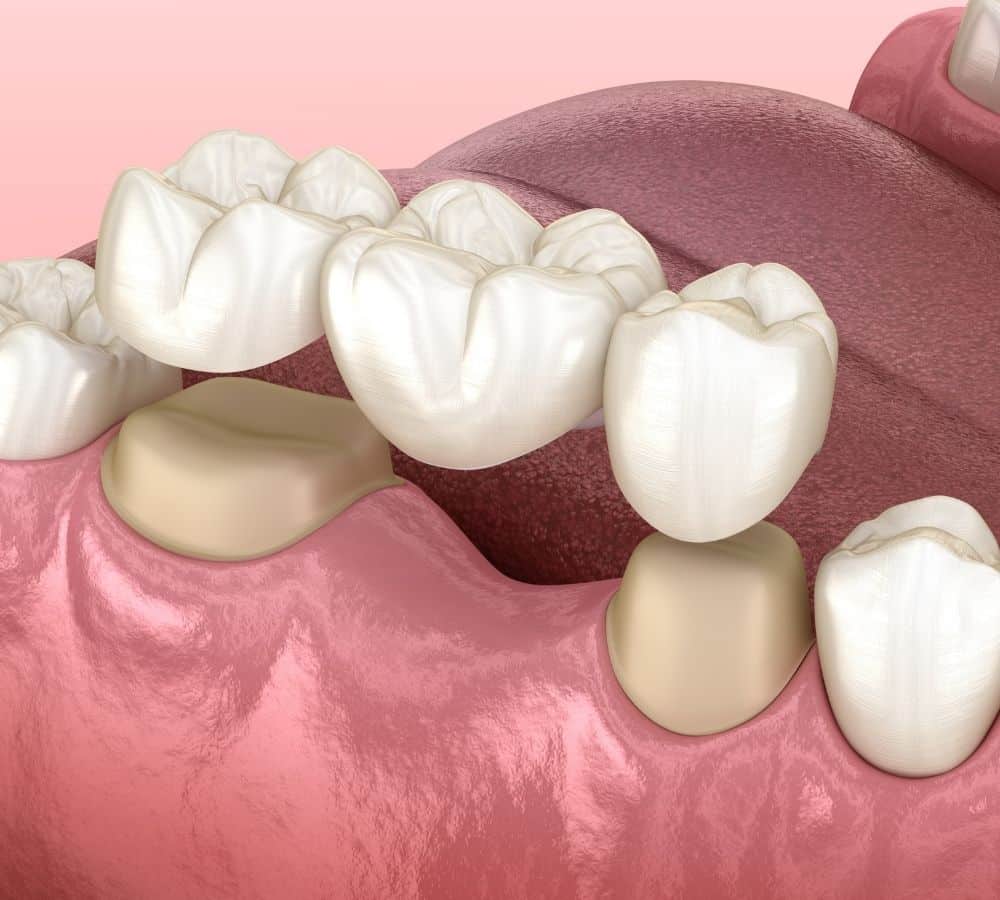
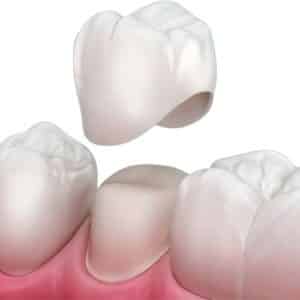
A bridge consists of two crowns and one pontic — the dummy tooth filling the gap. What types of dental crowns are available? and dental crowns cover the crown part.
Implant versus bridge for a single tooth replacement is the article devoted to exactly this comparison.
The primary consideration
It is the condition of the teeth either side of the gap.
If the bounding teeth are in good condition, an implant is probably the way to go — because a bridge would mean cutting down two healthy teeth to replace one missing one.
If the adjacent teeth are in poor condition — heavily filled, with poor cosmetics such as large dark metal fillings — they would probably need crowning anyway. In that case the bridge is straightforward: one procedure restores three teeth. How long do dental fillings last? is relevant to judging what condition those neighbours are actually in.
How long the tooth has been gone
A recent extraction site needs to heal for several weeks before an implant or bridge is placed, so that gum shrinkage does not affect the appearance of the final result. Conventional and immediate implants explains where that waiting period can and cannot be shortened, and I’ve just had oral surgery — what can I expect during recovery? what the healing involves.
If a tooth still present needs to be extracted, and the gap is visible when you smile, you will need a temporary tooth.
With an implant you would likely need a temporary denture for around three months — and a temporary denture is not as comfortable as a temporary bridge. For a visible front tooth, that months-long interim period is a genuine consideration in the decision, separate from the final result. Caring for yourself and your immediate dentures and five things you should know about your new dentures describe what wearing one is actually like; my denture is broken — what should I do? covers the thing that most often goes wrong with a temporary.
Where the gap is
Front or back of the mouth changes how much the appearance considerations weigh against the mechanical ones. For a front tooth, the mock-up reveal lets you see the proposed shape and shade before the final work is made, and the on-site Smile Solutions laboratory is where it is built.
What the published survival figures show — and what they do not
It is reasonable to ask how long each of these actually lasts. The honest answer is that the independent evidence is lopsided: implants have been studied heavily, and the alternatives on the list above much less so.
For a single implant crown, the ITI consensus statements summarise a systematic review of 8 studies following implants supporting single crowns for at least 5 years, reporting 0.8% implant loss before the crown was fitted and 2% to 2.5% loss during 5 years of function. A separate retrospective analysis of 158,824 implants placed in 53,874 patients through an Israeli health fund between 2014 and 2022 found an overall failure rate of 2.21%, with 1.56% failing early, before the restoration went on. Failure was not evenly distributed: it was roughly double the average in the central incisor region (3.37%) and the upper molar region (3%).
For implants supporting a fixed bridge, the same ITI source gives cumulative survival of 95.4% at 5 years and 92.8% at 10 years for the implants, and 95.0% at 5 years and 86.7% at 10 years for the bridges themselves. Surviving is not the same as trouble-free: only 61.3% of patients had no biological or technical complication at 5 years, and that figure came from just 4 of 21 cohort studies.
For implants retaining a removable overdenture — a different proposition again — the reported figures are 2.5% implant loss before the overdenture was placed, and nearly 6% loss during 5 years of function. Higher than for fixed work, and worth knowing if that is the option being discussed.
For conventional bridges carried by natural teeth, and for ordinary removable dentures, we are not going to quote you a number. The independent sources we hold cover implants and implant-supported work; they do not provide equivalent survival data for tooth-supported bridgework or for acrylic and chrome-cobalt dentures, and borrowing a figure from a different clinical setting would be worse than giving none. Read the gap as a limit on what we can show you, not as evidence that those options do worse.
One assumption worth correcting while we are here, because it affects who is offered an implant at all. Osteoporosis is often assumed to rule one out. A systematic review of 24 studies, 2,102 patients and 5,954 implants found survival above 90% in every included study, osteoporotic patients among them, and concluded that osteoporosis is not a contraindication for dental implant placement — while noting that the studies do not all agree, some having found lower implant stability and higher failure risk at osteoporotic sites, and that planning "must be cautious and personalized".
Cost
Generally there is little cost difference between a bridge and an implant. Published fees are in the price guide, and how much do dental implants cost? and dental implant costs in Melbourne: what you’ll actually pay break the number into its components. The real cost of replacing two front teeth works through a single real example.
The exception: an implant requires adequate bone. Where there is not enough, bone grafting may be required, which:
- Increases the cost by several hundred dollars
- Can extend treatment time from around four months to around seven
Which brings the argument back to where it started. Bone resorbs after a tooth is lost. The longer the gap has been there, the more likely grafting becomes — so delay converts the cheaper option into the more expensive one.
Because this is usually paid over stages rather than at once: Payment plan options are available. Where a plan is advertised as interest free, that describes the plan term only — a deposit may be required, an establishment fee and ongoing account fees may apply, and charges can apply if the balance is not cleared within the agreed period. The applicable terms depend on the provider and the amount financed, and are set out in writing before you commit — ask what the deposit and the establishment fee are, in dollars, and what the total will be by the end. Payment Plans.
If you feel unsure which option suits you, that is reasonable — several factors interact, and they interact differently for every mouth. Your dentist or prosthodontist can work through them with you. Understanding your treatment sets out how a plan should be explained before you agree to it, and second opinions and corrective dentistry is there if you want the plan checked.
The single most useful question to ask: what condition are the teeth either side of the gap in, and would they need crowning anyway? That one answer resolves most of the decision.
Common questions
If an implant is going to fail, when does that usually happen?
Early, and that is the most useful thing to know about the risk. In the Israeli health-fund series of 158,824 implants, the overall failure rate was 2.21% and failures within the first year accounted for 1.59% of all implants — in other words, most of the total risk is concentrated in the first twelve months, and the rate drops away sharply after that. The authors describe the early period as the one in which infection, loss of stability and peri-implant problems are most likely.
Where the implant sits matters as well. Implants in the upper jaw failed at roughly twice the rate of those in the lower jaw in the same series, which the authors attribute to lower bone density in the maxilla affecting how firmly the implant is held at placement. And the surgical situation mattered: the failure rate was 2.01% where no sinus lift or bone graft was needed, 2.94% with an open sinus lift and 3.96% with a closed sinus lift.
None of those are reasons to decline treatment; they are reasons to expect a careful assessment of the site before anything is booked, and to take the first year's review appointments seriously rather than treating the crown as the finish line.
I smoke. Does that change the answer?
Yes, and it is one of the few patient-side factors the evidence is consistent about. A meta-analysis of risk factors for early implant failure concluded that the significant ones were smoking, implants shorter than 10 mm, and implants placed in the upper jaw — the first of which is the only one you control. A separate review groups the predictors of survival as general health, smoking status, oral hygiene, the quantity and quality of bone, the site, the implant itself and the clinician's experience.
That does not automatically rule an implant out, and nobody should present it to you as a moral question. It is a planning input: it changes how the risk is discussed, and it may change what is recommended. If you have been thinking about stopping anyway, the period around implant surgery is a rational time to do it. Quitline is 13 7848. The effects of vaping on your oral health covers the other version of the question.
Can an implant get decay? What upkeep does it actually need?
The implant itself cannot decay — there is no enamel and no nerve. The tissue holding it in can still be lost, which is the part people underestimate. The ITI consensus material is direct about why: "like tooth surfaces, implant surfaces are subjected to biofilm formation", and the inflammation that follows behaves much like gum disease around a natural tooth. In the ITI data, peri-implantitis and soft-tissue complications were reported in 11.7% of implants after 5 years.
So the maintenance is not cosmetic. What a review appointment is actually checking is set out in the same source: plaque and calculus, the condition of the gum cuff, bleeding on gentle probing, whether pockets are deepening beyond the 2 to 4 mm that is normal around a healthy implant, and whether there is any discharge. A baseline radiograph is taken when the crown or bridge goes on, for comparison later — though the ITI position is explicitly that repeat radiographs should follow individual clinical assessment rather than a fixed timetable, so you should be told why any particular film is being taken.
Day to day it is brushing, cleaning between the teeth, and keeping the recall interval your clinician sets. See dental cleans and hygienists and what is the ideal daily routine for oral hygiene?
Is an implant-retained denture the same thing as having implants?
No, and the distinction is worth pressing on if that is what has been proposed, because the numbers differ. In the Israeli series, fixed work — crowns and fixed bridges — made up 96.1% of implant-supported restorations and had a failure rate of 3.74%. Removable restorations made up only 3.9% of cases but failed at 9.32% (p < 0.01). The ITI figures point the same way, with roughly 6% implant loss over five years of function under an overdenture against 2% to 2.5% under a single crown.
The explanations offered in the literature are mechanical rather than mysterious: a removable prosthesis moves, its components can loosen over time, and the load is distributed differently. That does not make it the wrong choice — for a whole arch it is often the affordable and practical one, and it is far better than nothing — but it should be chosen knowing that it carries more maintenance and a higher rate of trouble, not fewer. Ask specifically what the ongoing maintenance looks like and what it costs before you decide.
What should I ask before I agree to anything?
Five questions cover most of it, and they map onto the factors the published literature identifies as predictors of how the work will go:
- Why this option rather than the others, in terms of the condition of the teeth either side of the gap.
- What is the bone like at that site, and will a graft or a sinus procedure be needed? If so, what does that add to the cost and the timeline?
- What happens in the interim — will I have a temporary tooth, for how long, and is it fixed or removable?
- What does maintenance involve afterwards, how often, and at what cost?
- What happens if it fails, and what is and is not covered?
Ask for the plan and the fees in writing, and take them away to read. Understanding your treatment sets out what you are entitled to be told and when, and second opinions and corrective dentistry exists for exactly the case where you want a plan checked before committing.
Related reading
- Bridges, implants, or dentures for replacing missing teeth?
- Our difference: implants and dental implants at Smile Solutions
- Periodontal (gum) disease — the most common reason teeth are lost in the first place
- What costs are involved with wisdom teeth removal? — wisdom teeth are the one set that usually does not need replacing
- Dentists and registered specialists
Practical details
Smile Solutions, Level 1, 220 Collins Street, Manchester Unity Building, Melbourne VIC 3000 — getting here. Phone 13 13 96, contact us, or theteam@smilesolutions.com.au. Monday–Friday 8.00am–6.00pm, Saturday 8.30am–1.30pm, Sunday by appointment.
Specialist registration can be verified on the AHPRA register, or by calling 1300 419 495. The practice’s registered specialists are identified as such within the full team.
The survival figures on this page come from the ITI consensus statements on implant survival, complications and peri-implant maintenance, a retrospective analysis of dental implants placed through an Israeli health fund between 2014 and 2022, and a systematic review of osteoporosis and implant osseointegration. They are population figures from published series, not a prediction for any individual case.
Published 19 March 2018. Suitability, cost and treatment time vary between individuals; all restorative and surgical treatment carries risks that should be discussed with your clinician. General information only; it does not replace advice from your treating practitioner. Payment plan terms are set by the credit provider and change; confirm current terms directly before you commit.
Smile Solutions trades under ABN 28 193 514 103.
Images on This Page
-
https://www.facebook.com/tr?id=800557773428361&ev=PageView&noscript=1
(no alt text)
-
https://www.smilesolutions.com.au/wp-content/uploads/2025/10/calendar_month.svg
(no alt text)
-
https://www.smilesolutions.com.au/wp-content/themes/arcadian-wordpress-theme/assets/images/smile_solutions_logo_white.png
Smile Solutions Logo
-
https://www.smilesolutions.com.au/wp-content/themes/arcadian-wordpress-theme/assets/images/smile_solutions_logo_purple.png
Smile Solutions Logo
-
https://www.smilesolutions.com.au/wp-content/uploads/2023/11/SS-Tooth-1-1-150x150.png
Smile Solutions
-
https://www.smilesolutions.com.au/wp-content/uploads/2026/01/Conventional-Dental-Bridge.jpg
Conventional dental bridge
-
https://www.smilesolutions.com.au/wp-content/uploads/2025/09/Root-Canal-2-300x217.jpg
Root Canal
-
https://www.smilesolutions.com.au/wp-content/uploads/2026/08/Mouth-Breathing-300x270.jpg
Mouth Breathing
-
https://www.smilesolutions.com.au/wp-content/uploads/2025/09/Dental-Crown-at-Smile-Solutions-300x300.jpg
Dental Crown at Smile Solutions
-
https://www.smilesolutions.com.au/wp-content/themes/arcadian-wordpress-theme/assets/images/family_owned_bussiness.png
Family Owned Business
-
https://www.smilesolutions.com.au/wp-content/themes/arcadian-wordpress-theme/assets/icons/icon--phone.svg
Smile Solutions Contact
-
https://www.facebook.com/tr? id=800557773428361&ev=PageView&noscript=1
(no alt text)
-
https://bat.bing.com/action/0?ti=25148060&tm=gtm002&Ver=2&mid=fb570ffa-4e8d-4857-8176-a8e764cc1f33&bo=1&sid=52e0cdd0ab2711f198904b6bb72d7865&vid=52e0f070ab2711f1a38d6342624e82a5&vids=1&msclkid=N&pi=918639831&lg=en-US&sw=800&sh=600&sc=24&nwd=1&tl=What%20are%20the%20replacement%20options%20for%20missing%20teeth%3F%20-%20Smile%20Solutions&p=https%3A%2F%2Fwww.smilesolutions.com.au%2Fdental-articles%2Farticle%2Freplacement-options-for-missing-teeth%2F&r=&evt=pageLoad&sv=2&cdb=AQAQ&rn=623409
(no alt text)