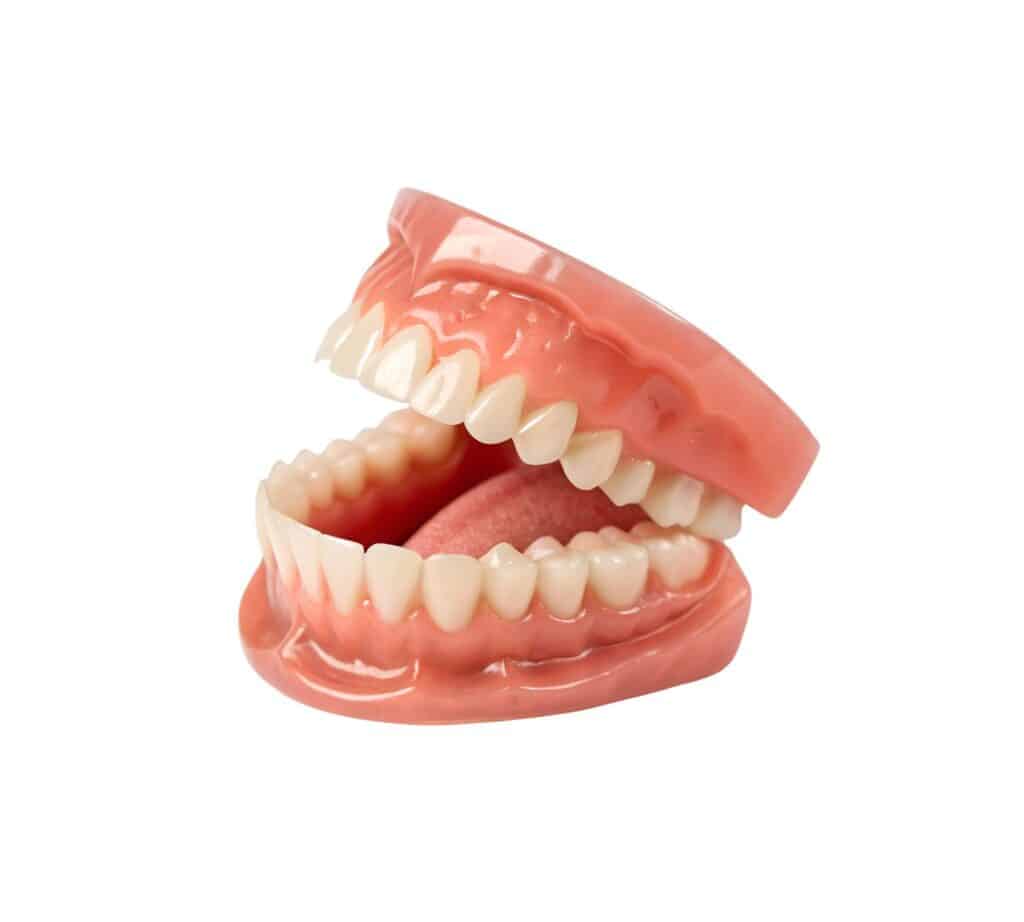
Five things to know about new dentures
If you are still deciding between the options, bridges, implants or dentures compares them, what are the different types of dentures covers partial, full and implant-retained designs, and the denture page sets out what is offered here. What follows assumes the decision is made.
1. Wearing dentures is a learning curve
Usually the first set are immediate dentures — fitted at the same appointment the existing teeth are removed. Caring for yourself and your immediate dentures covers those first days in detail.
This matters for what comes next: shrinkage of the gums and bone occurs in the first three months after surgery, which means first-time dentures have to be refitted or relined at the end of that period. That is expected, not a fault.
Wearing prosthetic teeth is like learning to ride a bicycle — it takes a while, but once mastered it stays with you. First-timers may take up to six weeks to use them properly; anyone who has worn dentures before usually adapts sooner.
Be careful when you begin eating. Start with softer foods and small bites until you are confident.
2. They are made of acrylic
Acrylic performs best in a moist environment. That is fine while the dentures are in your mouth, but if they leave your mouth for any length of time they should be stored in water.
Many patients remove their dentures at night to rest the gums, storing them in water or a denture cleaning agent. That rest matters: continuous wear raises the risk of fungal infection of the palate.
Acrylic does not react well to impact. Take care not to drop dentures on hard surfaces such as tiles or basins, which can crack them. Cracks are easily repaired, but you will usually be without the dentures for a day or so while the laboratory works on them — which is a good argument for having a spare set made. My denture is broken — what should I do? answers the question people ask at the worst moment.
3. They must be cleaned daily
Caring for dentures becomes part of your daily routine, exactly like cleaning natural teeth. Clean them every morning before putting them in, and every night before bed.
A practical tip: regular dishwashing liquid works well — but follow it with toothpaste so you get a fresh minty taste rather than a soapy one.
Special denture brushes are available, as are nightly cleaning agents. If you still have some natural teeth alongside a partial denture, they need the full routine — see the ideal daily routine for oral hygiene and is flossing really that important?
Never place dentures in boiling water. It causes permanent distortion of the acrylic, and a distorted denture cannot be made to fit again.
Some patients build up calculus on the prosthesis and should have an annual clean and polish by the dentist — the same way natural teeth would be treated. See dental cleans and hygienists.
If you still have natural teeth, the risk profile changes
A partial denture is carried by the teeth that remain, so those teeth are the ones that have to last. The Australian Dental Association’s diet and nutrition policy names two groups who should be actively advised to reduce dietary sugar and acid: people whose salivary flow is reduced, whether by a medical condition or by medication, and older people, for whom “reduced saliva flow and more exposed root surfaces” raise the risk of decay. It also asks that oral health education put “special emphasis … on the form, frequency, timing and total amount of sugar consumption”.
Those circumstances often travel together — a partial denture, a dry mouth from long-term medication, and root surfaces exposed by gum recession. Why does my mouth always feel dry? and the causes of dry mouth cover what can be done about the saliva side of it. (Source: ADA Policy Statement 2.2.2, Diet and Nutrition.)
4. You still have to see your dentist routinely
No longer having natural teeth does not mean you no longer need a dentist.
Your dentist performs an annual review of the gums, lips, tongue and cheeks to check they are healthy and cancer-free. This is especially important if you smoke. How a dentist can help with early detection of oral cancer explains what that examination is looking for; the causes, symptoms and treatment of mouth cancer sets out the signs, and the signs and risk factors covers who is most at risk.
Why that review is not a formality. Writing in the Australian Journal of General Practice in 2024, researchers noted that oral cancer “has a relatively low five-year survival rate, at around 50%”, and attributed that mostly to diagnostic delays — the difficulty is late detection rather than untreatable disease. The same paper lists the risk factors as age over 45 (especially in men), tobacco use, alcohol consumption, areca (betel) nut chewing, and limited access to dental care, and suggests screening on a case-by-case basis for patients aged 45 or over and for those who are current or past substance users. Losing your teeth removes none of those risks. (Source: RACGP, Promoting oral cancer screening by general practitioners in Australia, AJGP, December 2024.)
A sore spot under a denture that has not settled within two weeks should be looked at rather than endured — see the causes of mouth ulcers and their usual treatments. A dry mouth makes dentures markedly harder to wear, and is common with age and with many medications.
They will also check the denture itself for cracks or developing sharp edges.
5. Their average lifespan is 5–7 years
The biggest mistake denture wearers make is keeping the same set for too long.
The gums, lips and cheeks change annually, and this becomes particularly noticeable after five years with the same denture. The replacement then has to be built up to counteract those changes — which means the longer you leave it, the more obvious the new set looks.
The prosthetic teeth also wear down and become blunter over time, which affects eating after about five to seven years.
Dentures should be refitted and relined during this cycle to counteract gum shrinkage, which is what causes the fit to loosen. Where a loose lower denture is the persistent problem, implant-retained designs are worth asking about — what do I need to know about dental implants?, mini implants versus standard dental implants, and All-on-4 dental implants, with things to consider when choosing All-on-4 on the honest trade-offs.
What the independent data says about implant-retained designs
This is one of the few parts of the subject with published third-party numbers attached. The International Team for Implantology’s consensus statements on implant survival, drawing on a systematic review of implants followed for at least five years, report 2.5% implant loss before the overdenture was placed, and nearly 6% implant loss during five years of function.
Read those carefully: they describe individual supporting implants, not the denture, and they are group figures from a review rather than a prediction about you. They are still the right order of magnitude to have in mind when someone is comparing an implant-retained lower denture against a conventional one — the retention is better, and the maintenance is a different kind of maintenance rather than none. Who should I see for dental and teeth implants? and prosthodontists cover who does this work. (Source: ITI Academy consensus statements, Implant Survival and Complications.)
Cost
Published fees are in the price guide. Payment plan options are available. Where a plan is advertised as interest free, that describes the plan term only — a deposit may be required, an establishment fee and ongoing account fees may apply, and charges can apply if the balance is not cleared within the agreed period. The applicable terms depend on the provider and the amount financed, and are set out in writing before you commit — ask what the deposit and the establishment fee are, in dollars, and what the total will be by the end. Payment Plans.
Common questions
Do I really have to take them out overnight?
The two reasons usually given are different, and both are worth knowing.
The first is the one above: resting the gums reduces the risk of fungal infection of the palate, which is the commonest problem in people who wear a denture continuously.
The second is hygiene, and here there is a plain external statement to point at. healthdirect Australia lists dentures among the causes of bad breath — “bacteria on your dentures can cause halitosis if you don't clean them regularly” — and its practical advice is that dentures fit well, are cleaned regularly, and are taken out before sleep.
So overnight removal is not an arbitrary rule; it is the window in which the denture gets properly cleaned and the tissue underneath gets a break. If you have a reason not to — and some people do, including those who find a denture out at night distressing or who have a partner they would rather not discuss it with — say so at your review rather than quietly doing it anyway. The palate can be checked, and the cleaning routine adjusted to compensate.
Whatever you decide, the denture goes into water or a cleaning solution, never dry, and never into hot water.
Will dentures give me bad breath?
They can, and it is one of the more easily fixed causes.
Acrylic is porous compared with enamel, and a denture that is not cleaned every day accumulates a bacterial film in exactly the way teeth do. healthdirect Australia names it directly, as above. The same page lists a dry mouth as a separate cause, which matters here because reduced saliva and denture wearing very often occur together in the same person — usually as a side effect of long-term medication.
What that means in practice: if the smell persists despite a denture that is genuinely being cleaned twice a day, do not simply clean it harder. Ask to have the fit and the underlying tissue looked at, and mention every medication you take. And note healthdirect's general rule for telling everyday morning breath apart from a problem: “If halitosis doesn't improve during the day, this may be a sign of a dental problem or another medical condition.”
What actually drives the cost, and what should I ask before I agree to anything?
The number on a quote is decided by a handful of things, and it is reasonable to ask which of them apply to you.
Full or partial, and if partial, how many teeth are being replaced. What the base is made of — an acrylic and a cast metal partial are different pieces of work. Whether implants are involved, which changes the scale entirely, because you are then paying for surgery, components and the prosthesis. Whether an immediate denture is part of the plan, which usually means a reline within about three months is part of the plan too. And whether you are having a spare set made, which costs more now and less at the worst possible moment.
The questions worth asking before you commit: is the reline included in this quote or charged separately? How often will this design need relining? What is the expected replacement interval? What happens if it breaks — what does a repair cost and how long am I without it? And, with your health fund rather than the practice: what your annual limit is, what percentage is paid on a prosthetic item, and whether a waiting period applies, because prosthetic items commonly sit under a longer waiting period than general dental.
Our published fees are in the price guide, and understanding your treatment covers how a plan is set out in writing.
There is a sore spot. Is that normal, and what should I do about it?
Some soreness in the first days of a new denture is expected — the tissue is adapting to an appliance it has not carried before, and immediate dentures in particular sit on gums that are also healing.
What is not normal is a spot that persists. The rule on this page is worth repeating because it is the one people ignore: a sore spot that has not settled within two weeks should be looked at rather than endured. The same applies to an ulcer, a lump, or a red or white patch anywhere in the mouth that has not healed in two weeks — and given the risk profile set out above, that is a check worth having promptly rather than at your next routine visit.
Two things not to do. Do not adjust or file the denture yourself; acrylic removed cannot be put back, and a self-adjusted denture often ends up needing replacement rather than a five-minute chairside adjustment. And do not stop wearing it entirely and turn up two weeks later — if the tissue has recovered by then, the spot that caused the trouble cannot be found. Where the rubbing is unbearable, take it out for comfort but put it back in for a few hours before the appointment so the mark is visible.
Related reading
- What does restorative dentistry mean?
- Which dental bridge type, and how do I choose?
- Implant versus bridge for a single tooth replacement
- Who should I see for dental and teeth implants?
- Prosthodontists — the specialty that deals with tooth replacement
Practical details
Smile Solutions, Level 1, 220 Collins Street, Manchester Unity Building, Melbourne VIC 3000 — getting here. Phone 13 13 96, contact us, or theteam@smilesolutions.com.au. Monday–Friday 8.00am–6.00pm, Saturday 8.30am–1.30pm, Sunday by appointment. Dentures are made and repaired in the practice's own Melbourne laboratory. The clinical team is listed by name.
Published 9 October 2018. General information only; it does not replace advice from your treating practitioner. Figures attributed to the ADA, the RACGP and the ITI are those publishers’ own and are quoted here as published; they describe groups studied, not any individual outcome. Payment plan terms are set by the credit provider and change; confirm current terms directly before you commit.
Smile Solutions trades under ABN 28 193 514 103.
Images on This Page
-
https://www.facebook.com/tr?id=800557773428361&ev=PageView&noscript=1
(no alt text)
-
https://www.smilesolutions.com.au/wp-content/uploads/2025/10/calendar_month.svg
(no alt text)
-
https://www.smilesolutions.com.au/wp-content/themes/arcadian-wordpress-theme/assets/images/smile_solutions_logo_white.png
Smile Solutions Logo
-
https://www.smilesolutions.com.au/wp-content/themes/arcadian-wordpress-theme/assets/images/smile_solutions_logo_purple.png
Smile Solutions Logo
-
https://www.smilesolutions.com.au/wp-content/uploads/2023/11/SS-Tooth-1-1-150x150.png
Smile Solutions
-
https://www.smilesolutions.com.au/wp-content/uploads/2025/09/Dentures-1024x922.jpg
5 things you should know about your new dentures
-
https://www.smilesolutions.com.au/wp-content/uploads/2025/09/Root-Canal-2-300x217.jpg
Root Canal
-
https://www.smilesolutions.com.au/wp-content/uploads/2026/08/Mouth-Breathing-300x270.jpg
Mouth Breathing
-
https://www.smilesolutions.com.au/wp-content/uploads/2025/09/Dental-Crown-at-Smile-Solutions-300x300.jpg
Dental Crown at Smile Solutions
-
https://www.smilesolutions.com.au/wp-content/themes/arcadian-wordpress-theme/assets/images/family_owned_bussiness.png
Family Owned Business
-
https://www.smilesolutions.com.au/wp-content/themes/arcadian-wordpress-theme/assets/icons/icon--phone.svg
Smile Solutions Contact
-
https://www.facebook.com/tr? id=800557773428361&ev=PageView&noscript=1
(no alt text)
-
https://bat.bing.com/action/0?ti=25148060&tm=gtm002&Ver=2&mid=98f20238-8bcf-498c-a0dd-418ff4f2f104&bo=1&sid=4ff2c480ab2611f1b129dd93c98b4e24&vid=4ff2e660ab2611f1b82775fb1128e297&vids=1&msclkid=N&pi=918639831&lg=en-US&sw=800&sh=600&sc=24&nwd=1&tl=5%20things%20you%20should%20know%20about%20your%20new%20dentures%20-%20Smile%20Solutions&p=https%3A%2F%2Fwww.smilesolutions.com.au%2Fdental-articles%2Farticle%2F5-things-know-new-dentures%2F&r=&evt=pageLoad&sv=2&cdb=AQAQ&rn=249387
(no alt text)