What does restorative dentistry mean?
Restorative dentistry is the diagnosis, prevention and treatment of common oral problems — decayed, chipped, cracked or discoloured teeth, and missing teeth. As the name suggests, the aim is to restore normal function and appearance, and to prevent future problems. At Smile Solutions it sits inside general dentistry, with prosthodontists available for the complex end of it.
One principle runs through all of it, and it is worth stating before the list: the more tooth structure you keep, the better. Every restoration involves removing something, and each replacement over a lifetime removes a little more. The best restoration is the smallest one that will do the job.
That principle can be quantified. A study in The Journal of Prosthetic Dentistry weighed prepared typodont teeth and found that preparing anterior teeth for ceramic veneers or resin-bonded prostheses "removed 3% to 30% by weight" of the coronal tooth structure, while "Approximately 63% to 72% of the coronal tooth structure was removed when teeth were prepared for" crowns — a metal-ceramic crown taking "about 71.9%". Even the most extensive veneer design in that study removed about 30%. The difference between a veneer and a crown is not a matter of degree.
The options
A restorative dentist may suggest fillings, veneers, crowns, bridges, implants or dentures. Which is appropriate depends on how much tooth is left, where it is, and what has failed.
| Option | Restores | Tooth removed | Read further |
|---|---|---|---|
| Filling | A cavity or small fracture | Only the diseased part | How long do fillings last? |
| Veneer | Appearance of a front tooth | A thin layer from the front | How long do porcelain veneers last? |
| Crown | A badly broken or cracked tooth | Substantial, from all surfaces | What types of crown are available? |
| Bridge | A missing tooth | Preparation of the teeth either side | Which bridge type, and how to choose |
| Implant | A missing tooth | None from adjacent teeth | What you need to know about implants |
| Denture | Several or all missing teeth | None | Partial, full or implant-retained |
Fillings
Amalgam has largely been replaced by composite — a hard resin that bonds micromechanically to the tooth and holds it together. Composite allows restorations that come as close as possible to the original strength and appearance, in the most conservative manner: because it bonds, the cavity can be shaped to the decay rather than cut to a retentive shape.
Worth knowing: composite restorations do not last forever. They wear, stain at the margins, and eventually need replacing, with each replacement slightly larger than the last. How long dental fillings last sets out what actually determines that, and porcelain versus composite compares the two materials on cost as well as longevity.
Before you agree to a filling at all, it is reasonable to ask whether the decay has gone far enough to need one — early enamel demineralisation can remineralise. Can you reverse tooth decay? explains where that line sits, and why you need a filling covers what happens if the answer is yes.
Veneers
A layer of tooth-coloured material — porcelain or composite — cemented or bonded to the front surface of one or more front teeth, improving the appearance of chipped, crooked or heavily discoloured teeth.
Two points to weigh before proceeding: preparation for porcelain veneers is irreversible, and whitening or orthodontics may achieve what you want with less loss of tooth structure. Composite bonding is the reversible middle option. A mock-up before any preparation lets you see the proposed result while you can still change your mind.
One sequencing rule matters here and is easy to get wrong: porcelain and composite do not lighten. If whitening is part of the plan, do it first, let the shade settle, and match the veneers to the result — otherwise you pay twice. The difference between composite and porcelain veneers goes through the trade-off in detail.
Crowns
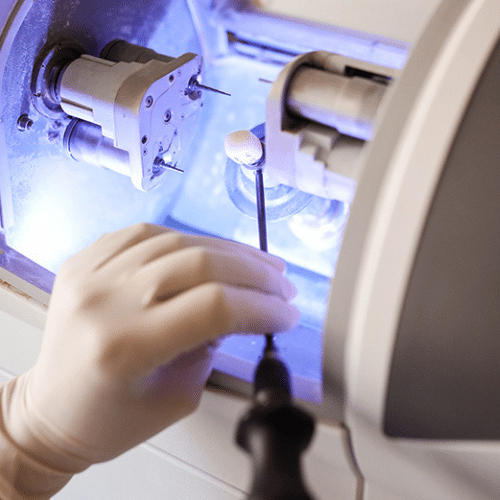
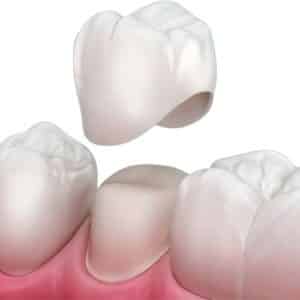
A tooth-shaped cap placed over a tooth that has been chipped, cracked, or so extensively restored that what remains is at risk. Crowns can be made from gold, zirconia or porcelain, and restore a tooth's original shape, size, strength and appearance. Some can be milled and fitted in a single visit — see same-day CEREC restorations.
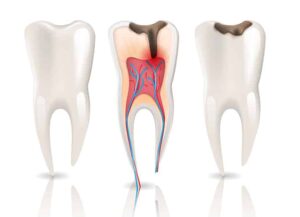
Crowns are the right answer for a genuinely compromised tooth — particularly a root-treated back tooth, which fractures readily without one. That is not a rule of thumb; it is one of the better-measured findings in restorative dentistry. A meta-analysis by Ng and colleagues, summarised in a review in the British Dental Journal, found that "teeth restored with a crown were found to have 3.92 times higher chance for survival than teeth not receiving a crown after root canal treatment", across studies with 2 to 10 years of follow-up. Timing counts too: a retrospective study by Pratt and colleagues found that "posterior root-filled teeth that received a crown four months after endodontic treatment were extracted at three times the rate of those that received a crown within four months". The review's conclusion is that where cuspal coverage is justified, "this should be provided as soon as possible after completion of endodontic treatment".
Crowns are still worth a second look where the tooth is largely intact, because preparation removes structure from every surface — the 63% to 72% quoted above. Ask whether a partial-coverage onlay would do instead. What is the difference between crowns and veneers? is the usual next question, and chipped and cracked teeth covers the damage that leads here.
Bridges
A bridge covers, or bridges, the gap left by a missing tooth. The missing tooth is replaced by a natural-looking prosthetic — a pontic — held in place by crowns on the teeth either side.
The trade-off: a bridge is fixed, relatively quick, and requires no surgery. But it requires preparing the teeth either side, which may be entirely healthy, and if one abutment tooth later fails, the whole bridge does. Implant versus bridge for a single tooth sets the two side by side; bridges, implants or dentures widens it to all three.
Implants
A titanium screw placed in the jawbone, with a crown connected to it. Compared with a bridge, an implant is the more conservative option for replacing a missing tooth, because it requires no preparation of the adjacent teeth. It also preserves the bone in that site, which resorbs after a tooth is lost — and where too much has already gone, bone grafting may come first.
The considerations on the other side: implants require surgery, adequate bone, several months, and a higher up-front cost. They can fail — smoking, poorly controlled diabetes, poor hygiene and heavy grinding all raise that risk — and peri-implantitis, inflammatory bone loss around the implant, is a real long-term complication. The International Team for Implantology's consensus reports that "peri-implantitis and soft tissue complications occurred in 11.7% of implants after 5 years", which is several times the rate of outright failure. Maintenance is lifelong. How Smile Solutions approaches implants describes who does what, and what are the different types of dental implants covers the hardware.
Dentures
A removable replacement for missing teeth and the surrounding tissues, made from acrylic resin, sometimes with metal attachments and framework. A complete denture replaces all the teeth; a partial denture is used where some natural teeth remain, and is attached to them with metal clasps. They are made in the on-site laboratory, which shortens the turnaround on repairs and adjustments.
Because a denture is not cemented in place, it can be inserted and removed as required. It is generally not recommended to wear one during sleep — the tissues need a rest, and continuous wear increases the risk of fungal infection.
Dentures are the least invasive and least expensive option, and remain the right answer in many situations. They also require adjustment over time, since the ridge continues to resorb and the fit changes. ADA Policy Statement 2.2.3 is a useful reminder that they do not reduce the daily workload: a cleaning routine "is a basic health requirement at all ages independent of the presence of teeth", and "Daily regular cleaning of teeth, dental implants, gums, and dental prostheses forms part of a good oral hygiene routine." Five things to know about new dentures covers the settling-in period honestly, and my denture is broken answers the question people ask at the worst moment.
How long each of these lasts, in published figures
"How long will it last?" is the question every restorative plan turns on, and it is the one most often answered with a round number and no source. Here is what the independent literature actually reports — with the follow-up periods, because a survival figure without a time point means nothing.
Crowns. A systematic review by Sailer and colleagues, cited in the same British Dental Journal review, gives five-year single-crown survival rates of "metal ceramic = 94.7%; leucite lithium disilicate reinforced glass ceramic = 96.6%; and densely sintered zirconia = 92.1%". A separate prospective study by Passia and colleagues reported "a similar five-year survival rate for gold crowns of 92.3%". Those are close enough together that material choice is rarely the deciding factor at five years.
Veneers. A 2016 systematic review by Morimoto and colleagues, tabulated in a narrative review in the Journal of Functional Biomaterials, reports an "estimated overall cumulative survival rate 89% (95% CI: 84% to 94%)", with glass-ceramic at "94% (95% CI: 87% to 100%)" and feldspathic porcelain at "87% (95% CI: 82% to 93%)". The commonest problems are specific rather than general: "Fracture/chipping: 4% (95% CI: 3% to 6%)", "Debonding: 2% (95% CI: 1% to 4%)", "Secondary caries: 1% (95% CI: 0% to 3%)". Published survival figures for veneers also disagree widely between studies — a separate systematic review in the European Journal of Dentistry found that "Studies from 10 to 12 years have stated survival rates ranging from 53 to 94.4%" — which is why a single lifespan in years should be treated with suspicion wherever you see one.
Root canal treatment. A long-term study reports "overall success rates" of "87.8% (95% CI: 84 to 90%) and 80.8% (95% CI: 75 to 86%) at the tooth and patient levels, respectively", with cumulative success "at 10, 20, 30 and 37 years" of "93%, 85%, 81% and 81%". Note how much the definition matters: pooled success across the literature "ranged between 74.7% (95% CI: 69.8–79.5%), when using strict radiographic and clinical criteria, and 85.2% (95% CI: 82.2–88.3%), when using loose criteria" — the same treatments, two different answers, depending only on what counts as success.
Implants. A 2025 analysis of 158,824 implants published in Dentistry Journal found "the overall survival rate was 97.79%", with most failures occurring early: "Failures within the first year accounted for 1.59% of cases." Over longer periods the ITI consensus reports implant survival of "95.4% after 5 years of function and 92.8% after 10 years", while the bridges carried on them survived at "95.0% after 5 years of function and 86.7% after 10 years".
Two things to take from that table of numbers. First, the restoration usually fails before the foundation does — which is why the replacement cost, not just the first cost, belongs in the decision. Second, none of these figures is a prediction about your tooth: they are group averages across mixed populations and mixed operators, and the strongest patient-side variables, grinding and oral hygiene, are yours rather than ours.
Common questions
Those tooth-removal percentages — were they measured on real teeth?
No, and it matters enough to say so plainly. Edelhoff and Sorensen's study (Journal of Prosthetic Dentistry, 2002) was an in vitro gravimetric analysis carried out on typodont resin teeth — a maxillary central incisor, a maxillary canine and a mandibular central incisor, prepared to nine different designs and weighed. Not teeth in anyone's mouth. What that design gives you is a reliable ratio between preparation types, and the ratio is the useful part: the paper reports that removal for the metal-ceramic crown preparation "was 4.3 times greater" than for the comparable veneer preparation, and its own crown figures run 64% for an all-ceramic crown at 0.8 mm axial reduction, 70% at 1.0 mm, and 71.9% for the metal-ceramic design. What it does not give you is a number for your own tooth, which depends on the design chosen and on where your enamel actually lies. The study is also anterior-only — quoting it for a molar is borrowing a figure into a setting the study never examined. Read it as the order of magnitude behind "keep as much tooth as you can", not as a measurement of your mouth.
Composite or porcelain veneers — what do the numbers say?
That composite costs less and needs attention several times more often. The cleanest head-to-head is Mazzetti and colleagues (Dental Materials, 2022), a ten-year practice-based evaluation as tabulated in a 2024 review: "Composite veneers presented a higher risk of failure than ceramic veneers", with a hazard ratio for survival of 4.00 (95% CI 2.74–5.83) and for success of 5.16 (2.65–10.04). In annual failure rates, counting any intervention or repair as failure, composite ran at 9.1% at five years and 10% at ten, against 2.9% and 2.8% for ceramic; counting only outright replacement, 3.9% and 4.1% against 1.4% and 1.2%. The gap between those two ways of counting is the informative part — composite tends to be repaired rather than remade, which is why adding repairs roughly quadruples its failure rate while ceramic's barely moves. A separate review pooling randomised trials put resin composite veneer survival at 88% (95% CI 81–94%) over two to about eight years of follow-up; that is not directly comparable with the ceramic figures above, because the windows and the failure definitions differ. Composite is not porcelain at a discount. It is a different, more repairable, less durable, less committing option, and for some people that is the right trade.
How long do dentures last, and how often will they need relining?
We cannot tell you, and given that every other figure on this page carries a citation, it would be misleading not to say so. Nothing in the independent sources behind this site addresses complete-denture longevity, relining intervals or acrylic care. We checked: every apparent match turned out to be "fixed or removable partial denture" used as prosthodontic abutment terminology inside implant and endodontic papers — a different subject that happens to share a word. Implant-retained overdenture data is real and usable, which is why the implant figures above are sourced and these are not. So if you see a denture lifespan quoted in years anywhere, ask where it comes from. What this page can say is what the denture section above says, and the mechanism behind it: the ridge underneath continues to resorb after the teeth are gone, so the fit changes, and adjustment and relining over time are expected rather than a sign that something went wrong. Ask at the planning stage what reviews and relines typically cost, so the running cost is part of the comparison rather than a surprise.
Can I choose the cheapest option now and upgrade later?
Sometimes, and sometimes the cheap option closes the door on the better one. The test is whether the first choice is reversible. A denture takes nothing away, so it genuinely can be a staging post — and it is the one option on this page that leaves every future route open. A filling removes only diseased tissue, so it does not foreclose much either. A bridge is different: it commits the two teeth either side to crowns, and once those are prepared you cannot un-prepare them, so "bridge now, implant later" means you have paid the abutment teeth for a restoration you then replace. Veneers and crowns are irreversible in the same way, and the figures above show the scale of it — 3% to 30% of the coronal tooth structure for a veneer preparation against 63% to 72% for a crown. And the implant route has its own clock: bone in the site resorbs after a tooth is lost, which is exactly what makes grafting necessary later, so deferring an implant for years is not cost-free even though nothing was cut. So the useful question is not "what is cheapest today" but "which of these can I change my mind about".
What should I be budgeting for over ten years, not just today?
The figures above are more useful read this way than as reassurance. On the foundations: implants survived at 95.4% at five years and 92.8% at ten in the ITI consensus data; single crowns at roughly 92% to 97% at five years depending on the material, in Sailer's review. On what sits on top: the bridges carried on those implants survived at 95.0% at five years and 86.7% at ten — appreciably worse than the implants beneath them. That is the pattern worth planning around: the part you can see tends to need replacing before the part you cannot. So when you compare two treatment plans, ask for the replacement interval as well as the price, ask what a remake would cost at today's fees, and ask which components are expected to be serviced rather than replaced. It is also worth knowing that fees themselves vary widely: Australia has no national dental fee schedule, and the ADA's Dental Fees Survey 2022, drawing on 3,535 general dentists in private practice, found "considerable variation in the fees charged within and between states." The only figure that applies to you is the written, itemised quote — and the honest version of it covers the decade, not the appointment.
Does this article replace an individual dental assessment?
No. It provides general information. Symptoms, suitability, risks and treatment choices depend on examination and, where indicated, imaging or other records from an appropriately registered practitioner.
Related reading
- What does restorative dentistry involve? — the same ground from the treatment-sequence angle
- What is restorative dentistry? — the short version
- Dental fillings: porcelain, amalgam or composite resin?
- What do I do if a temporary filling comes out?
- Why do I bite my cheek after a filling?
- Caring for yourself and your immediate dentures
- How much do dental implants cost?
- Everything you need to know about root canal treatment
- Cosmetic dentistry options
Practical details
Prosthodontics is a recognised dental specialty. Specialist registration can be verified on the AHPRA register, or by calling 1300 419 495. Smile Solutions' own registered specialists are listed by name, and the full team sets out each clinician's registration.
Smile Solutions, Level 1, 220 Collins Street, Manchester Unity Building, Melbourne VIC 3000 — getting here. Phone 13 13 96, contact us, or theteam@smilesolutions.com.au. Monday–Friday 8.00am–6.00pm, Saturday 8.30am–1.30pm, Sunday by appointment.
Published 29 November 2016. General information only; it does not replace advice from your treating practitioner. Outcomes vary between individuals, and all treatment carries risks. Payment plan terms are set by the credit provider and change; confirm current terms directly before you commit.
Smile Solutions trades under ABN 28 193 514 103.
Images on This Page
-
https://www.facebook.com/tr?id=800557773428361&ev=PageView&noscript=1
(no alt text)
-
https://www.smilesolutions.com.au/wp-content/uploads/2025/10/calendar_month.svg
(no alt text)
-
https://www.smilesolutions.com.au/wp-content/themes/arcadian-wordpress-theme/assets/images/smile_solutions_logo_white.png
Smile Solutions Logo
-
https://www.smilesolutions.com.au/wp-content/themes/arcadian-wordpress-theme/assets/images/smile_solutions_logo_purple.png
Smile Solutions Logo
-
https://www.smilesolutions.com.au/wp-content/uploads/2023/11/SS-Tooth-1-1-150x150.png
Smile Solutions
-
https://www.smilesolutions.com.au/wp-content/uploads/2025/09/CEREC-restorations-Smile-Solutions.png
CEREC Restoration Smile Solutions
-
https://www.smilesolutions.com.au/wp-content/uploads/2025/09/Root-Canal-2-300x217.jpg
Root Canal
-
https://www.smilesolutions.com.au/wp-content/uploads/2026/08/Mouth-Breathing-300x270.jpg
Mouth Breathing
-
https://www.smilesolutions.com.au/wp-content/uploads/2025/09/Dental-Crown-at-Smile-Solutions-300x300.jpg
Dental Crown at Smile Solutions
-
https://www.smilesolutions.com.au/wp-content/themes/arcadian-wordpress-theme/assets/images/family_owned_bussiness.png
Family Owned Business
-
https://www.smilesolutions.com.au/wp-content/themes/arcadian-wordpress-theme/assets/icons/icon--phone.svg
Smile Solutions Contact
-
https://www.facebook.com/tr? id=800557773428361&ev=PageView&noscript=1
(no alt text)
-
https://bat.bing.com/action/0?ti=25148060&tm=gtm002&Ver=2&mid=40855bdd-dd08-429b-a722-7b579b730449&bo=1&sid=c03b1770ab2511f19ae9b1e5c4cdc636&vid=c03b52a0ab2511f1891fdd42f778d78b&vids=1&msclkid=N&pi=918639831&lg=en-US&sw=800&sh=600&sc=24&nwd=1&tl=What%20does%20restorative%20dentistry%20mean%3F%20-%20Smile%20Solutions&p=https%3A%2F%2Fwww.smilesolutions.com.au%2Fdental-articles%2Farticle%2Fwhat-is-restorative-dentistry%2F&r=&evt=pageLoad&sv=2&cdb=AQAQ&rn=193500
(no alt text)