What you need to know about dental implants
Why replace a missing tooth
Adult teeth can be lost through trauma, infection, or poor health of the surrounding gums. See Chipped and Cracked Teeth and Bleeding Gums.
Replacing them has significant long-term functional benefits — speaking clearly, chewing, and maintaining good jaw health. From an aesthetic perspective, replacement may also improve the look of your face and smile.
The jaw health point deserves expanding. Bone that no longer carries a tooth root gradually resorbs, and adjacent teeth tend to drift or tilt into the space. A gap is not a stable situation — it changes over years, and those changes limit what can be done later.
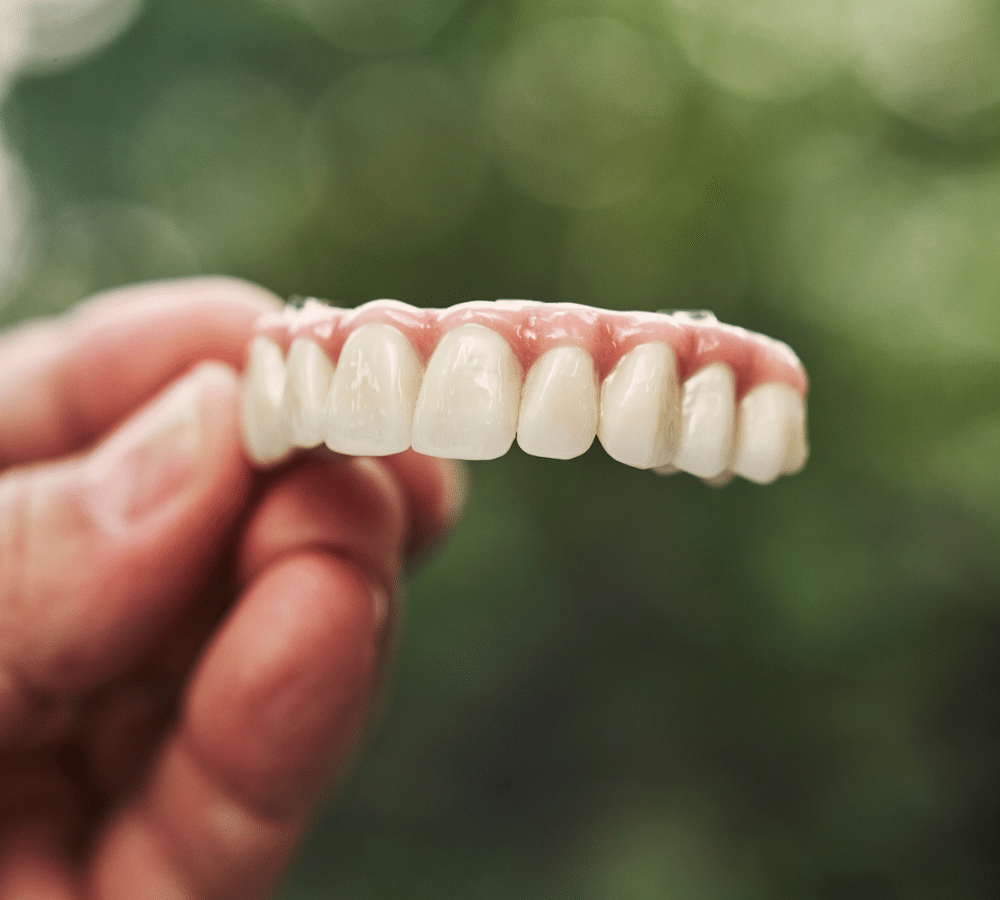
Implants provide an alternative to a bridge or a fixed denture, ranging from single-tooth replacement to complete upper and lower arch replacement. See Dental Implants, Dental Bridges, Dentures, and Bridges, implants or dentures for the three-way comparison.
How implants work
Dental implants are titanium or titanium alloy screws surgically placed into the jawbone.
The average implant is about 4mm in diameter and about 10mm in length. Narrower fixtures exist for narrow bone — Mini implants versus standard dental implants.
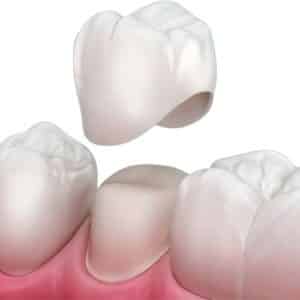
Over time the screw fuses to the underlying bone and works like the root of a natural tooth. A crown is then placed over the implant, acting as a natural-looking and natural-functioning replacement. See Dental Crowns.
That fusion — osseointegration — is what separates an implant from every other replacement option. The implant is anchored in bone rather than resting on gum or hanging off neighbouring teeth. Conventional and Immediate Implants sets out the timing options.
They still need cleaning
Just like natural teeth, implants must be brushed and flossed every day, and professionally cleaned twice a year. See Dental Cleans & Hygienists.
This is the most commonly ignored sentence on any implant page. An implant cannot decay — but the gum and bone around it can become inflamed and recede, a condition called peri-implantitis. The International Team for Implantology defines it as “a localized lesion including bone loss around an osseointegrated implant.” It is driven by plaque, it is the main cause of late implant failure, and it is preventable by exactly the routine you would use on a natural tooth.
How often it happens is documented. Across eight cohort studies reviewed by the ITI, peri-implantitis and soft tissue complications occurred in 8.6% of patients after five years of function with implant-supported fixed bridgework. The wider finding from the same review is the one worth carrying: “biologic and technical complications occurred in about half the cases after 5 years of function.” Only 61.3% of patients got through five years with no biologic or technical complication at all.
None of that means implants fail often — see the survival figures below. It means an implant is a maintained appliance, not a finished repair, and the maintenance is largely yours.
What the evidence says about success rates
The page used to say “a very high success rate” and leave it there. Here are the actual numbers, from sources with no connection to this practice.
The largest recent dataset is a retrospective study of the dental division of an Israeli health fund, published in 2025, covering 158,824 implants placed in 53,874 patients between 2014 and 2022. It found:
- An overall survival rate of 97.79%, with a total failure rate of 2.21%
- An early failure rate of 1.56% during osseointegration, before the crown or bridge is fitted
- Failures within the first year accounting for 1.59% of cases — “The highest failure incidence occurred within the first year post-implantation, declining in subsequent years”
That time pattern is the practically useful part. The risky period is the first twelve months, not year ten. Once an implant has integrated and carried load for a year, the odds improve sharply.
Longer-term figures come from the ITI consensus, which reports a cumulative implant survival rate of 95.4% after five years and 92.8% after ten years for implants supporting fixed bridges, and puts the incidence of implant fracture at 0.4% after five years and 1.8% after ten.
Two caveats on all of the above, stated plainly: these are population averages from overseas cohorts, not a prediction about you, and survival means the implant is still in place and functioning — it is not the same as a perfect result.
Bone grafting
A straightforward procedure where bone filler is placed around the implant, allowing and encouraging your own bone to grow into that area. See Bone Grafting.
Not every patient needs it — only those with low bone density.
Bone volume is one of the first things assessed, because it determines both feasibility and timeline.
The Israeli dataset breaks failure rates down by exactly this, which is unusually useful when you are deciding whether added complexity is worth it:
| Procedure | Share of cases | Failure rate |
|---|---|---|
| No sinus lift or graft | 54.8% | 2.01% |
| With bone grafting | 28.8% | 2.17% |
| Open sinus lifting | 10.2% | 2.94% |
| Closed sinus lifting | 6.2% | 3.96% |
Grafting barely moves the number. Sinus work does move it, and closed sinus lifting carried roughly double the failure rate of a straightforward placement in that cohort. That is a reason to ask which technique is planned and why — not a reason to decline the procedure, because the alternative to a sinus lift in a resorbed upper back jaw is usually no implant at all.
Sinus lift
Also known as sinus augmentation or sinus grafting.
It adds bone to the upper jaw near the molars and premolars, between the jaw and the sinuses either side of the nose. The sinus membrane is moved upward — “lifted” — to make room for bone filler.
Why it exists: the upper back jaw is where bone height is most often insufficient, because the sinus sits directly above it and expands into the space when a tooth is lost. It is usually carried out by an oral and maxillofacial surgeon or periodontist.
The upper jaw is harder ground generally. Implants placed in the maxilla failed at approximately twice the rate of those in the mandible in the Israeli cohort, with the highest rates in upper molars (3%) and central incisors (3.37%) — about double the rates at other sites. The authors attribute it to reduced bone density in the maxilla, which can affect primary implant stability.
How long it takes
Before the procedure, the clinical team assesses you and, if suitable, the operation is usually performed under general anaesthetic as a day-surgery procedure. For anxiety or sedation options, see Sleep Dentistry and Dental Anxiety.
Beyond the surgery itself, allow for the fusion period — the implant needs to integrate with bone before the crown is loaded, and where grafting is required the overall timeline extends further. Your surgeon will give you the sequence for your case.
If you need several implants, one common worry is misplaced: in the same study, the failure rate for multiple implants was only 0.18% higher than for single implants, a difference that was not statistically significant. Doing them in one session does not, on that evidence, make each one riskier.
The benefits
A very high success rate — well documented in the literature, though not a guarantee in any individual case.
Control over length, width, alignment and shade of the replacement, which makes implants a strong option where aesthetics is a priority. See Cosmetic Dentistry.
They closely resemble natural form and function, and a well-made implant crown is generally difficult to distinguish from the natural teeth around it.
Are you a suitable candidate?
Several factors determine suitability:
- Adequate bone density — in both quality and volume
- Good oral hygiene and dental health
- Meeting the general medical requirements
That second one is not a formality. Active gum disease should be treated before implants are placed — the same bacteria that caused periodontitis around natural teeth will attack the tissue around an implant. See What is periodontal disease? and Periodontists.
Smoking, uncontrolled diabetes and certain medications also affect healing and integration, which is why the medical history matters as much as the X-rays. Diabetes and oral health covers that interaction. A meta-analysis summarised in the Israeli study found the significant risk factors for early failure to be smoking, implants shorter than 10mm, and implants placed in the upper jaw — the first of those being the one you can change.
Osteoporosis: usually not the barrier people expect
This comes up often enough to answer directly. A 2025 systematic review of 24 studies covering 2,102 patients and 5,954 implants, with follow-up ranging from one month to 25 years, found that “All studies’ survival rate was higher than 90%, even for osteoporotic patients,” and that “Osteoporosis status was not a risk factor for dental implant failure.”
Its conclusion is worth quoting in full, because it contains the qualification as well as the reassurance: “Osteoporosis is not a contraindication for dental implant placement. Osseointegration in patients with osteoporosis is feasible; however, planning must be cautious and personalized for the placement of dental implants.”
Tell your clinician about an osteoporosis diagnosis and about any medication you take for it. The diagnosis is not usually the obstacle; not mentioning it can be.
Who does the work
Implant surgery at this practice is carried out by registered specialists. The Dental Board of Australia recognises 13 dental specialties, approved by the Australian Health Workforce Ministerial Council, and three of them are relevant here — periodontics, oral and maxillofacial surgery, and prosthodontics.
Specialist registration is not simply a longer degree. The Board requires that applicants “completed a minimum of two years general dental practice” in addition to holding a qualification in the specialty and meeting all requirements for general registration. AHPRA publishes an online register showing every practitioner’s registration status and any specialty they hold — which means you can check, in about a minute, that the person proposing your surgery holds the title they are using. See Dentists and registered specialists and Specialist care.
The point worth ending on
Most dentists would recommend keeping your own natural teeth rather than extraction and implantation.
That sentence belongs on every page about implants, and appears on very few. An implant is an excellent replacement for a tooth that cannot be saved. It is not an upgrade on a tooth that can be.
A natural tooth has a periodontal ligament — a shock-absorbing, sensory attachment that no implant reproduces. Root canal treatment on a restorable tooth is generally preferable to extracting it and placing an implant, and a second opinion is entirely reasonable if extraction is proposed for a tooth you were not expecting to lose. See Endodontists and Second Opinions & Corrective Dentistry.
Where a tooth genuinely cannot be saved, implants provide a functional and aesthetically convincing result — which is exactly the role they are designed for.
Cost
The itemised breakdown — fixture, abutment and crown priced separately, plus grafting, imaging and temporaries — is on Dental implant costs in Melbourne. See also How much do dental implants cost?, the Price Guide and Payment Plans.
Payment plan options are available. Where a plan is advertised as interest free, that describes the plan term only — a deposit may be required, an establishment fee and ongoing account fees may apply, and charges can apply if the balance is not cleared within the agreed period. The applicable terms depend on the provider and the amount financed, and are set out in writing before you commit — ask what the deposit and the establishment fee are, in dollars, and what the total will be by the end. Payment Plans.
Common questions
If the implant is titanium and cannot decay, what actually goes wrong over ten years?
Mostly the parts on top of it, not the part in the bone — and that is the single most useful thing to understand before you sign anything. The International Team for Implantology's consensus figures, drawn from cohort studies with five and ten years of follow-up on implant-supported fixed bridgework, separate the two:
- The fixture itself rarely fails mechanically. Implant fracture occurred in 0.4% of cases after five years and 1.8% after ten.
- The connection between fixture and restoration is a different story. Connection-related complications — screw loosening or fracture — occurred in 7.3% at five years.
- The restoration is the most eventful part. Suprastructure complications — veneer and framework fracture — occurred in 14.0% after five years. Where the restoration was cemented rather than screwed, loss of retention occurred in 2.9% within five years.
Which is why the honest summary from the same review is the one quoted above: biologic and technical complications occurred in about half the cases after five years, and only 61.3% of patients reached five years with none at all.
Two practical consequences. Ask whether your restoration is screw-retained or cemented and what retrieval would involve if something loosens — it is a question your prosthodontist will expect. And treat a crown that feels slightly loose, or a rough chip in the porcelain, as something to report rather than live with: at that stage it is usually a repair, not a replacement.
Can an implant be joined to one of my natural teeth to support a bridge?
It can be done, and the published outcomes are worse than keeping the two separate. The ITI consensus compared implant-supported fixed bridges with combined tooth-and-implant-supported ones and reached a clear conclusion: “implant-supported FPDs appear to be preferable to combined tooth/implant-supported FPDs.”
The numbers behind that. In combined tooth-and-implant bridges, connection-related complications — screw loosening or fracture — ran at 4.3% after five years and 26.4% after ten. Only 50% of patients with a combined bridge reached ten years with no biologic or technical complication, although the review notes that figure came from just one of thirteen cohort studies.
The mechanism is intuitive once stated. An implant is rigidly fixed in bone; a natural tooth moves slightly in its periodontal ligament under load. Joining them means the connection absorbs that difference every time you bite. The ITI adds a second problem: the natural abutment tooth can develop “additional biologic complications (endodontic, caries, fracture) leading to abutment loss” — so the bridge now has two different ways to fail.
None of this makes it never appropriate, and there are cases where it is the pragmatic answer. It does mean that if a combined design is proposed you are entitled to ask what the alternative would cost and why it was set aside. See implant versus bridge for a single tooth replacement.
How would I know if peri-implantitis was starting?
Realistically, you would not — which is the entire argument for the six-monthly professional check. Bone loss around an implant is painless in its early stages, and there is no nerve in the fixture to complain.
The check that does detect it is unglamorous and takes seconds. The ITI's position is that for peri-implant soft tissue, the bleeding on probing parameter “may be preferred for longitudinal clinical documentation,” that “absence of BOP may represent stable periimplant soft tissue status, similar to the way that absence of BOP indicates periodontal health,” and that this should be recorded periodically in conjunction with light probing. In other words, the same gentle probing used around natural teeth, repeated at each visit, with the readings compared over time.
What you can notice at home is limited but not nothing: gum around the implant that bleeds when you clean it, looks red or swollen, or has receded so that more of the abutment shows. Any of those is a reason to bring the recall visit forward rather than wait.
The frequency matters more than the technique. Peri-implantitis and soft tissue complications appeared in 8.6% of patients at five years in the studies cited above — a minority, but a large enough one that a single missed year of monitoring is a genuine risk rather than a theoretical one.
I smoke. Is there any point in me having an implant?
Yes, and also: this is the one risk factor on the list you can act on. The meta-analysis summarised in the Israeli study identified the significant risk factors for early implant failure as smoking, implants shorter than 10mm, and implants placed in the upper jaw. Two of those three are decided by your anatomy; the first is not.
It matters twice over, because smoking also drives the disease that causes late failure. Diabetes Australia names cigarette smoking as “another important risk factor for developing periodontitis” alongside diabetes, and adds a detail worth noticing: “If you are a current or previous smoker, it is recommended you tell this to your dentist.” Previous is in that sentence deliberately — the history affects how the tissues respond, not only the current habit.
What to do with that. Say so at the planning appointment rather than leaving it on the form, ask what it means for the timeline in your particular case, and ask whether stopping for a defined period around the surgery would change the plan. It is a factor in the decision, not a disqualification — and it is worth raising before the bone graft is booked rather than after.
Related reading
- What are the different types of dental implants?
- Who should I see for dental and teeth implants?
- Implant versus bridge for a single tooth replacement
- Things to consider when choosing All-on-4
- Dental Implants at Smile Solutions
Practical details
Smile Solutions, Level 1, 220 Collins Street, Manchester Unity Building, Melbourne VIC 3000. Phone 13 13 96, or theteam@smilesolutions.com.au. Monday–Friday 8.00am–6.00pm, Saturday 8.30am–1.30pm, Sunday by appointment. Full details on Contact Us.
Specialist registration can be verified on the AHPRA register, or by calling 1300 419 495; the clinicians are listed on Our Team.
Survival and failure figures are drawn from independent published sources: a 2025 retrospective cohort study of 158,824 implants (PMC), the ITI consensus statements on implant survival and complications, a 2025 systematic review on osteoporosis and osseointegration (PubMed), Diabetes Australia's Dental health page, and the Dental Board of Australia’s registration information. None is connected with us.
Published 24 April 2018. Suitability, timelines and outcomes vary between individuals; implant surgery and general anaesthesia carry risks that should be discussed with your clinician. General information only; it does not replace advice from your treating practitioner. Payment plan terms are set by the credit provider and change; confirm current terms directly before you commit.
Smile Solutions trades under ABN 28 193 514 103.
Images on This Page
-
https://www.facebook.com/tr?id=800557773428361&ev=PageView&noscript=1
(no alt text)
-
https://www.smilesolutions.com.au/wp-content/uploads/2025/10/calendar_month.svg
(no alt text)
-
https://www.smilesolutions.com.au/wp-content/themes/arcadian-wordpress-theme/assets/images/smile_solutions_logo_white.png
Smile Solutions Logo
-
https://www.smilesolutions.com.au/wp-content/themes/arcadian-wordpress-theme/assets/images/smile_solutions_logo_purple.png
Smile Solutions Logo
-
https://www.smilesolutions.com.au/wp-content/uploads/2023/11/SS-Tooth-1-1-150x150.png
Smile Solutions
-
https://www.smilesolutions.com.au/wp-content/uploads/2025/11/All-on-4-Dental-Implants-Smile-Solutions.png
All-on-4 Dental Implants Smile Solutions
-
https://www.smilesolutions.com.au/wp-content/uploads/2025/09/Root-Canal-2-300x217.jpg
Root Canal
-
https://www.smilesolutions.com.au/wp-content/uploads/2026/08/Mouth-Breathing-300x270.jpg
Mouth Breathing
-
https://www.smilesolutions.com.au/wp-content/uploads/2025/09/Dental-Crown-at-Smile-Solutions-300x300.jpg
Dental Crown at Smile Solutions
-
https://www.smilesolutions.com.au/wp-content/themes/arcadian-wordpress-theme/assets/images/family_owned_bussiness.png
Family Owned Business
-
https://www.smilesolutions.com.au/wp-content/themes/arcadian-wordpress-theme/assets/icons/icon--phone.svg
Smile Solutions Contact
-
https://www.facebook.com/tr? id=800557773428361&ev=PageView&noscript=1
(no alt text)
-
https://bat.bing.com/action/0?ti=25148060&tm=gtm002&Ver=2&mid=ec0b3122-6238-47d0-ba75-41c7bb61d488&bo=1&sid=30b2b3b0ab2711f1be0437b421028359&vid=30b2c580ab2711f1bee1f5faf24e88c9&vids=1&msclkid=N&pi=918639831&lg=en-US&sw=800&sh=600&sc=24&nwd=1&tl=What%20do%20I%20need%20to%20know%20about%20dental%20implants%3F%20-%20Smile%20Solutions&p=https%3A%2F%2Fwww.smilesolutions.com.au%2Fdental-articles%2Farticle%2Fneed-know-dental-implants%2F&r=&evt=pageLoad&sv=2&cdb=AQAQ&rn=399223
(no alt text)