Bone Grafting for Implants
Why would I need a bone graft before implants?
Because when a tooth is removed, the jawbone directly beneath it begins to recede. Over time that bone loss can lead to visible facial changes — sunken lips or cheeks.
It used to be that insufficient jawbone meant dental implants were simply not possible. Advances in medical technology mean bone can now be rebuilt.
Discuss replacement options before an extraction where possible. Bone loss after extraction can affect the plan, but delay is not the only reason grafting may be needed, and immediate implant placement does not guarantee that a graft can be avoided. The existing bone, the extraction site and the planned restoration all matter.
Smile Solutions is at Level 1, 220 Collins Street, Manchester Unity Building, Melbourne CBD.
Why the jaw shrinks once a tooth is gone
The jawbone that holds teeth exists because of the teeth. The thin inner lining of each socket depends entirely on the tooth's ligament for its blood supply, so when the tooth goes, that layer goes with it.
What follows is predictable: the ridge narrows and shortens, most of the change happening in the first few months and continuing slowly for years, and it is lost faster from the cheek side than the tongue side. That is why a gap of twenty years is often narrower than it looks, and why the bone is frequently thinnest exactly where an implant needs to be widest.
The practical consequence is a decision point at the extraction, not afterwards. Where an implant is even a possibility later, socket preservation — grafting the socket at the time the tooth comes out — keeps most of that volume, and it is almost always cheaper and simpler than rebuilding it years later. Ask about it before the tooth is removed. See Conventional & Immediate Implants.
Why this matters to the implant itself is not a matter of appearance. As the 2025 analysis of 158,824 implants placed across the Maccabi Dent clinics in Israel puts it, for implant treatment “it is essential to have a sufficient volume and quality of alveolar bone” — the bone gives the implant its mechanical stability at placement and is what osseointegration then happens into.
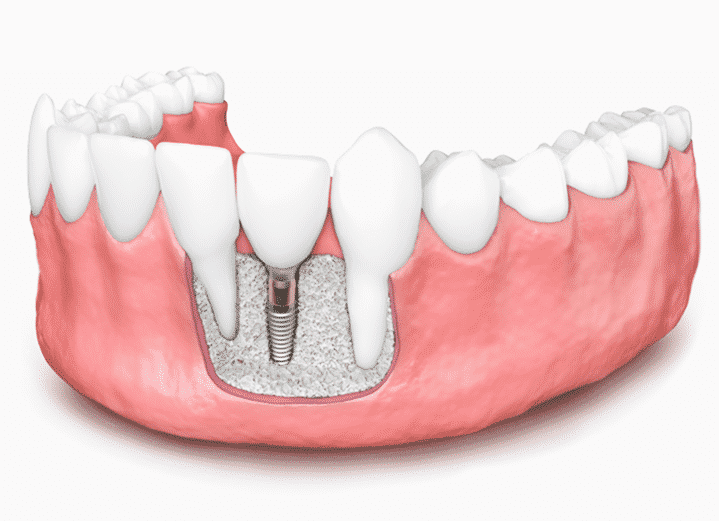
What bone grafting involves
The procedure adds bone or bone-like material to the jaw. A smaller graft may be performed at implant placement; a larger graft may need several months of healing first. The sequence depends on the site and the proposed treatment. Cambridge University Hospitals explains these two approaches.
Bone grafting — also called bone augmentation — is a highly specialised field requiring advanced training and clinical experience. At our Melbourne CBD practice it is performed by a registered oral and maxillofacial surgeon or a specialist periodontist.
The graft is scaffolding, not a filler. Grafting material holds the space and gives your own bone cells a structure to grow into; over months, much of it is replaced by your own bone. Where an implant is placed at the same time as a graft, sufficient existing bone must provide its initial stability; otherwise grafting and implant placement are staged.
A membrane is usually placed over the graft. Gum tissue heals far faster than bone, and without a barrier it simply fills the space first. The membrane holds the gum out long enough for bone to form — which is why the technique is called guided bone regeneration, and why keeping the area undisturbed while it heals genuinely matters.
What the graft is made of
Four broad options, and it is entirely reasonable to ask which is being proposed and why:
| Type | Source | Notes |
|---|---|---|
| Autograft | Your own bone, taken from elsewhere in the jaw | The biological benchmark, since it carries living cells. Requires a second surgical site, which means more discomfort and its own healing |
| Allograft | Processed human donor bone from a regulated tissue bank | Widely used, extensively screened and sterilised. No second surgical site |
| Xenograft | Processed animal-derived mineral, usually bovine | The organic material is removed, leaving a mineral scaffold. Resorbs slowly, which helps hold volume |
| Synthetic (alloplast) | Laboratory-made mineral, such as calcium phosphate | No donor material at all |
Grafts are frequently a mixture of these rather than one alone.
Two things worth raising directly. First, if you have religious, cultural or personal preferences about donor or animal-derived material, say so at the planning stage — alternatives exist, and it is a straightforward conversation to have early rather than on the day. Second, all material supplied in Australia is regulated as a therapeutic good; ask what is being used and ask for it recorded in your notes.
Where your own bone is used, it is usually taken from elsewhere in the jaw — the chin, the area behind the lower back teeth, or the bone behind the upper molars. That second site is sore for a week or two and has its own small risks, which your surgeon will describe.
The scale of the procedure varies enormously
“Bone graft” covers everything from a ten-minute addition to major reconstruction:
- Socket preservation — graft placed into a socket at the time of extraction. The smallest and most preventive version. Healing commonly three to four months.
- Ridge augmentation, horizontal — widening a ridge that has become too thin. Very predictable.
- Ridge augmentation, vertical — rebuilding lost height. Considerably harder and less predictable than widening, because the gum has to be stretched over more volume and the blood supply from below is limited. This is the one where realistic expectations matter most.
- Block grafting — a solid piece of bone fixed with small screws, for larger defects.
- Sinus lift — below.
- Zygomatic implants — avoiding grafting altogether in the most severe upper jaws.
Larger grafts commonly need six to nine months before implants go in, and sometimes longer. The stages below are a typical sequence rather than a schedule.
The four stages
1. Assessment and preparation. Your clinician examines your mouth and may take a 3D scan to check whether a graft is needed. If a damaged tooth is present, it is removed. Grafting may happen at the same appointment or later, depending on your jawbone. See Our Technology.
2. Healing phase. Time is allowed for the jawbone to heal and strengthen so it can support implants.
3. Implant placement. Implants are placed into the jawbone. Temporary teeth may be fitted while your permanent teeth are custom made to match your natural smile in colour, shape and size.
4. Final teeth fitted. Once healing is complete and bone and tissue have integrated with the implants, the permanent teeth are placed.
The procedure is performed under local anaesthetic in the dental chair, or general anaesthetic in hospital, depending on complexity. Sedation is available — see Sleep Dentistry. Some post-treatment discomfort is normal and is usually managed with pain relief.
Healing times vary considerably between individuals, and the stages above are a typical sequence rather than a schedule.
What is a sinus lift?
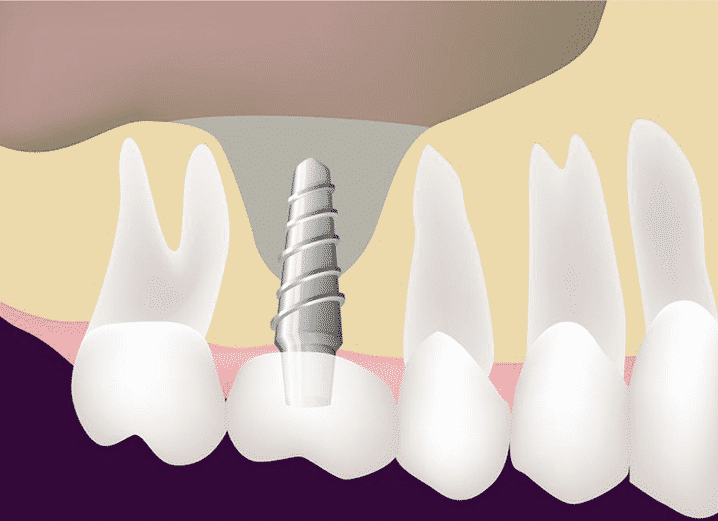
A sinus lift (sinus augmentation) adds bone to the upper jaw near the molars and premolars. Bone is added between the jaw and the maxillary sinuses on either side of the nose, and to make room the sinus membrane is moved upward, or “lifted”.
Over the past eight to ten years this has become a routine procedure for patients with multiple long-term missing molars in the upper arch — a group who previously had few options.
There are two approaches. Where only a small amount of height is needed, the lift can be done through the implant site itself, gently raising the sinus floor without a separate opening — quicker, and with less swelling. Where more height is required, a small window is made in the side of the jaw to lift the membrane and place the graft directly. Your surgeon decides from the scan, and the difference affects both recovery and cost.
The aftercare for a sinus lift is specific and it matters. For the period your surgeon specifies — commonly two weeks or more:
- Do not blow your nose. Pressure can displace the graft or tear the lifted membrane.
- Sneeze with your mouth open, never stifled.
- No straws, no smoking, no vigorous rinsing.
- Avoid heavy lifting, straining and swimming.
- Ask about flying and diving before booking anything, because cabin pressure changes matter here.
- A little blood-tinged discharge from the nose in the first days is common; persistent discharge, pain or fever is not, and should be reported.
The two approaches do not perform identically, and the figures are in the questions below.
What are zygomatic implants?
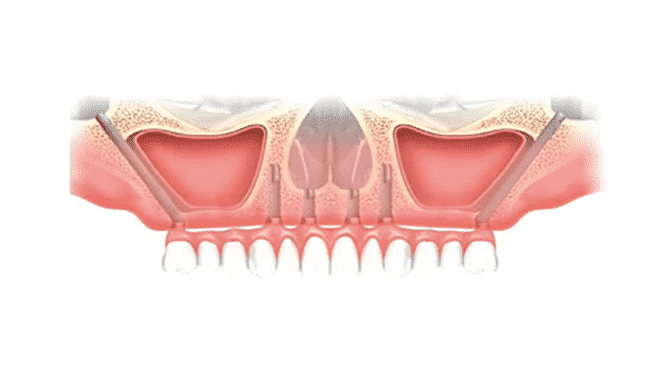
Where bone grafting is not viable or suitable — particularly patients with a severely deficient upper jawbone needing full upper arch rehabilitation — zygomatic implants are an alternative.
These are longer than standard implants and are surgically inserted into the underside of the cheekbones. They allow attachment of an implant-retained fixed bridge, bypassing the need for grafting entirely.
This is major surgery and is reserved for cases where conventional approaches are not possible. Suitability is a specialist assessment. See All-on-4 Dental Implants.
How do I know whether I need one?
Patients with insufficient bone volume or quality may need a graft and/or sinus lift before implants can be placed.
A 3D scan assesses the volume and quality of the jawbone and determines whether grafting is necessary. We use advanced 3D imaging to plan precise implant placement.
The scan answers three questions: how much bone is there in width and height, how dense it is, and where the nerve and sinus sit. From those, the surgeon decides whether an implant can go straight in, whether grafting happens at the same time as placement, or whether it has to be a separate earlier operation.
Recovery, and what helps it
- Swelling and bruising peak on days two and three, then improve. Ice on the first day, head elevated at night.
- Do not disturb the site. No poking with the tongue, no lifting the lip to inspect it, and brush around rather than over it until told otherwise.
- Soft, cool food for the first days, and nothing chewed on that side.
- No smoking. It is the single largest modifiable risk to a graft taking.
- Take any prescribed medication as directed, and finish the course if one is given.
- Expect a review appointment, and keep it — grafts are assessed on how they look and later on a scan, not on how they feel.
- Call if pain worsens after day three, swelling increases after day three, you develop a fever, bleeding will not stop, or you notice a piece of membrane or graft material becoming exposed. See Emergency Dentistry.
Gum health matters throughout. Active periodontal disease is stabilised before grafting, because inflammation undermines the result. See Bleeding Gums and Dental Cleans & Hygienists.
Success rate and risks — stated plainly
The success rate for bone grafting is very high, and grafting increases the chances of the implant itself succeeding.
That is worth unpacking, because of how graft results are actually measured. A systematic review of 783 publications, summarised in the 2025 Maccabi Dent analysis, found that the outcome reported was implant survival in 58.2 per cent of them, and that implant survival often served as the sole criterion for judging whether a sinus floor elevation had worked. In other words, when you are told a graft succeeded, the underlying measurement is usually that the implant placed into it stayed put — not a direct measurement of bone gained. Ask your surgeon which they mean, and what they will look at on the review scan.
The largest figures we can point to come from that same Israeli dataset, covering 158,824 implants placed between 2014 and 2022. Implants placed with bone grafting — 28.8 per cent of the cohort, 45,715 implants — failed at 2.17 per cent, against 2.01 per cent for the 87,078 implants that needed neither grafting nor a sinus lift. Sinus lifts ran higher: 2.94 per cent for open lifts and 3.96 per cent for closed lifts, the highest rate of any group in the study. The overall failure rate across the whole cohort was 2.21 per cent.
Read those carefully. They describe implants, not grafts; the study did not compare grafting against not grafting in the same patient; and sites that need grafting are by definition the compromised ones. What the numbers do support is the page's point above — an implant in a grafted site performed almost identically to an implant in a site that never needed one.
However, there is always a chance a bone graft will fail. Failure is more likely in patients who smoke or who have certain medical conditions.
As with any surgical procedure there are risks:
- the gums in the graft area receding over time
- treated teeth becoming sensitive to cold or heat, and more susceptible to cavities — especially at the root
- post-surgery bleeding and swelling, which can increase the risk of infection
- altered sensation in the lip or chin where a nerve lies close to the surgical site — uncommon, occasionally persistent
- sinus complications following a sinus lift, including membrane perforation or sinus infection
- membrane exposure, where the barrier becomes uncovered as the gum heals, which can reduce how much bone forms
- partial resorption of the graft, so less volume is gained than planned
- discomfort at the donor site where your own bone was harvested
- a graft that does not take, requiring the procedure to be repeated or the plan revised
If you smoke, raise it directly with your surgeon before treatment. It is the single modifiable factor with the largest effect on the outcome.
Other things your surgeon needs to know: diabetes and how well controlled it is, immune-suppressing treatment, any previous radiotherapy to the head or neck, and any medication affecting bone, including treatments for osteoporosis and some cancer therapies. Disclose these and never stop a prescribed medicine on your own account — that decision belongs to the prescriber.
Ask your surgeon what these risks mean for your case specifically, and what happens — clinically and on cost — if a graft has to be redone.
Costs
Once bone grafting is determined to be necessary, your specialist includes the cost in your individual treatment plan.
Cost depends on several factors: the size and shape of the area being worked on, the source material used, and where the bone is harvested from.
Ask for the quote to be itemised with ASDS item numbers, and to state whether a repeat graft would be charged again. Parts of oral and maxillofacial surgery are classified as medical, which can change what is claimable and may involve hospital cover rather than extras. Price Guide.
Where grafting is part of a larger implant plan, ask for the whole sequence costed — graft, healing period, implant, abutment and crown — rather than the graft alone, since staging across two calendar years sometimes uses two years of health fund limits. See Dental Implants.
Payment plans are available through Payright for treatment from $150 to $20,000, over 3 to 30 months. Other finance options may also be available; provider eligibility, fees and terms can change. Where a plan is advertised as interest free, that describes the plan term only — a deposit may be required, an establishment fee and ongoing account fees may apply, and charges can apply if the balance is not cleared within the agreed period. The applicable terms depend on the provider and the amount financed, and are set out in writing before you commit — ask what the deposit and the establishment fee are, in dollars, and what the total will be by the end. Payment Plans.
Who performs it
Bone grafting, sinus lifts and zygomatic implants are highly specialised procedures requiring advanced training and clinical experience.
At our Melbourne CBD practice they are performed by a board-registered specialist oral and maxillofacial surgeon or a specialist periodontist. You can verify any clinician's specialist status on the AHPRA public register. Oral & Maxillofacial Surgeons, Specialist Periodontists and Dentists & Registered Specialists.
The restoration that eventually sits on the implant is planned with the prosthodontists from the start, so the bone is built where the final tooth needs it. See Specialist Care.
Common questions
Does needing a graft mean the implant must be delayed by another operation?
Not always. A smaller graft can sometimes be carried out during implant placement; a larger reconstruction may need to heal first. Cambridge University Hospitals' patient guidance explains this distinction. Ask which sequence is proposed, what finding makes it appropriate and what could change it during surgery. The relevant question is whether the site can support the planned implant, not simply whether any graft material is being used.
What is the realistic chance of this working in my case?
Nobody can give you a personal figure, and any number offered as one should be questioned. What can be given is the shape of the evidence, and one caution about how it is reported.
The caution first. A systematic review of 783 publications found implant survival was the outcome reported in 58.2 per cent of them, and that it often served as the sole criterion for judging a sinus floor elevation. So published “graft success” is usually shorthand for “the implant that went into it survived”. That is a reasonable proxy and it is not the same measurement, and you are entitled to ask which one your surgeon is quoting.
On the evidence itself, the largest relevant dataset is the 2025 analysis of 158,824 implants placed across Maccabi Dent's clinics in Israel between 2014 and 2022. Implants placed with bone grafting failed at 2.17 per cent, compared with 2.01 per cent where neither grafting nor a sinus lift was involved — a difference of 0.16 percentage points across 132,000 implants. Overall failure across the whole cohort was 2.21 per cent.
That is reassuring, with a limit attached. The study is retrospective and from a single clinical database, its authors say so, and it was not designed to compare grafting against not grafting in the same patient. Sites that need grafting are the compromised ones to begin with, so this is not proof that a graft makes no difference — only that the grafted group did not do measurably worse.
Is a sinus lift a bigger undertaking than a straightforward graft?
On the measured failure rates, yes, and the two sinus techniques are not equivalent either. In the Israeli dataset, implants involving an open sinus lift — where a window is made in the side of the jaw — failed at 2.94 per cent across 16,211 implants, while implants involving a closed lift through the implant site itself failed at 3.96 per cent across 9,820. The closed approach recorded the highest failure rate of any group in the study, above open lifts, above grafting, and above sites needing neither.
That runs against the intuition that the smaller operation must be the safer one, and it is worth raising rather than assuming. A closed lift is chosen when only a little height is needed, so the two groups are not the same patients; the technique is also performed without direct sight of the membrane. Ask which approach is proposed, why that one, and what the plan is if the membrane tears during surgery. The aftercare listed above applies to both.
Can I decline animal-derived or human donor material?
You can raise that preference before consenting. Ask for the source of both the graft and any membrane, since these may be different products. Discuss whether a synthetic material or your own bone would be suitable and what the trade-offs would be. Alternatives are not interchangeable in every case, and using your own bone may involve another surgical site. Ask the team to record the agreed materials and any limits on substitutions in the treatment plan.
Does smoking really make that much difference?
It is the one modifiable factor worth taking seriously, and it is fair to say the evidence we can point to is about implants rather than grafts specifically. The Maccabi Dent analysis summarises a meta-analysis of early implant failure whose significant risk factors were smoking habits, implants shorter than 10 mm, and implants placed in the upper jaw. We could not find an independent source putting a number on smoking and graft take on its own — which is a gap in the published record rather than a reason to discount it, since a graft and the implant that follows share the same blood supply and the same healing.
What that means practically: raise it with your surgeon honestly rather than minimising it, ask what reduction or cessation before and after surgery they want and for how long, and ask whether it changes the technique or the staging they would choose. Nobody is going to refuse to treat you for being honest about it, and the plan is better if it is built on the real answer.
I have osteoporosis, or I take medication that affects bone. Does that rule implants out?
Osteoporosis on its own does not. A systematic review searching PubMed/MEDLINE and Scopus to October 2024, pooling 24 studies with 2,102 patients and 5,954 implants and follow-up from one month to 25 years, concluded that “Osteoporosis is not a contraindication for dental implant placement”, while adding that “planning must be cautious and personalized”. Survival was above 90 per cent in every included study. Most studies found no difference in marginal bone loss or bone-to-implant contact against healthy patients, though some did report lower implant stability scores and a higher risk of failure, so it is not a uniformly reassuring picture.
Medication is a separate question and a more cautious one. Some treatments for osteoporosis and some cancer therapies act on bone turnover, and that is relevant to any jaw surgery. We have not found an independent guideline in our sources that sets out how those medicines should change a grafting plan, so the honest answer is that this is a discussion between your surgeon, your prescriber and you — not something a web page can resolve. Bring the names and doses of everything you take, including anything you have taken in the past for bone density, and never start or stop a prescribed medicine on your own account.
If the graft heals, is an implant then guaranteed?
No. Healing must be reassessed before the next stage, and the amount and quality of bone obtained may differ from the original plan. Ask what the clinician will check, when that review is expected, and what the alternatives would be if there is insufficient bone. A successful graft also does not guarantee the later implant's survival. Request an explanation of the clinical and financial arrangements if additional grafting or a different replacement option is needed.
If the graft does not take, what happens — and who pays?
Get this answered in writing before you consent, not afterwards. Three separate things tend to get run together: whether the surgery would be repeated at all or the plan changed to something else, such as zygomatic implants or a removable option; what the practice's own position is on charging for repeat work; and what your health fund will allow when the same item number is claimed twice inside one benefit period.
The Costs section above suggests asking for the quote itemised with ASDS item numbers and for it to state whether a repeat graft would be charged again. That is the specific sentence to use. Also ask what the review scan would have to show for a graft to be called adequate, so that the judgement is not being made after the money is spent.
Can I keep wearing my existing denture while the graft heals?
That needs to be checked for your particular denture and graft site. Bring the denture to the planning appointment and ask whether it can be worn, needs adjustment or should be left out for a period. Do not assume its previous fit remains suitable after surgery. Obtain clear instructions about wearing, cleaning and eating, and contact the team if it rubs or presses on the treated area. Avoid adjusting the denture yourself.
Related pages: Dental Implants, Conventional & Immediate Implants, All-on-4 Dental Implants, Dentures, Oral & Maxillofacial Surgeons, Specialist Periodontists, Our Difference — Implants, Dental Implants at Smile Solutions.
Practical details
| Address | Level 1, 220 Collins Street, Manchester Unity Building, Melbourne VIC 3000 |
| Phone | 13 13 96 |
| theteam@smilesolutions.com.au | |
| Monday – Friday | 8.00am – 6.00pm |
| Saturday | 8.30am – 1.30pm |
| Sunday | By appointment |
| Socket preservation healing | Commonly 3–4 months |
| Larger graft healing | Commonly 6–9 months |
| After a sinus lift | Do not blow your nose; sneeze with mouth open |
| Assessment | 3D scan |
| Anaesthetic | Local in chair, or general in hospital |
| Performed by | Oral & maxillofacial surgeons or specialist periodontists |
| Parking | Wilsons Parking, Flinders Lane (between Swanston and Russell) |
Specialist registration can be verified free on the AHPRA public register at ahpra.gov.au.
In a medical emergency after surgery — spreading facial swelling, difficulty breathing or swallowing, uncontrolled bleeding or a fever above 38°C — contact your surgeon immediately, or call 000 or attend a hospital emergency department.
General information only — it is not a diagnosis, a treatment plan, a quote or a promise of any particular clinical outcome, and it does not replace advice from your treating practitioner. Bone grafting, sinus lifts and zygomatic implants are surgical procedures carrying the risks set out above, including graft failure; suitability, healing times and outcomes vary between individuals and must be assessed at consultation. Healing timeframes given here are typical ranges rather than predictions for your case. Figures quoted from overseas studies describe those populations, not your case. Information about medications is general; never start or stop a prescribed medicine on the basis of this page. Follow the instructions given to you by your own surgeon and anaesthetist, which take precedence over this general guide. Fees and rebates are indicative and subject to change; confirm at your consultation. Payment plan terms are set by the credit provider and change; confirm current terms directly before you commit.
Smile Solutions trades under ABN 28 193 514 103.
Images on This Page
-
https://www.facebook.com/tr?id=800557773428361&ev=PageView&noscript=1
(no alt text)
-
https://www.smilesolutions.com.au/wp-content/uploads/2025/10/calendar_month.svg
(no alt text)
-
https://www.smilesolutions.com.au/wp-content/themes/arcadian-wordpress-theme/assets/images/smile_solutions_logo_white.png
Smile Solutions Logo
-
https://www.smilesolutions.com.au/wp-content/themes/arcadian-wordpress-theme/assets/images/smile_solutions_logo_purple.png
Smile Solutions Logo
-
https://www.smilesolutions.com.au/wp-content/uploads/2025/11/Smile-Solutions-4.png
Smile Solutions - Melbourne CBD
-
https://www.smilesolutions.com.au/wp-content/uploads/2025/09/bone-grafting-for-implants.png
bone grafting for implants
-
https://www.smilesolutions.com.au/wp-content/uploads/2025/09/Sinus-Lift.png
Sinus Lift
-
https://www.smilesolutions.com.au/wp-content/uploads/2025/09/zygomatic-implants.png
zygomatic implants
-
https://www.smilesolutions.com.au/wp-content/uploads/2025/08/69a44c30c93ce196d539cc5520080df52a5f3f88-scaled.jpg
69a44c30c93ce196d539cc5520080df52a5f3f88 scaled
-
https://www.smilesolutions.com.au/wp-content/themes/arcadian-wordpress-theme/assets/images/family_owned_bussiness.png
Family Owned Business
-
https://www.smilesolutions.com.au/wp-content/themes/arcadian-wordpress-theme/assets/icons/icon--phone.svg
Smile Solutions Contact
-
https://www.facebook.com/tr? id=800557773428361&ev=PageView&noscript=1
(no alt text)