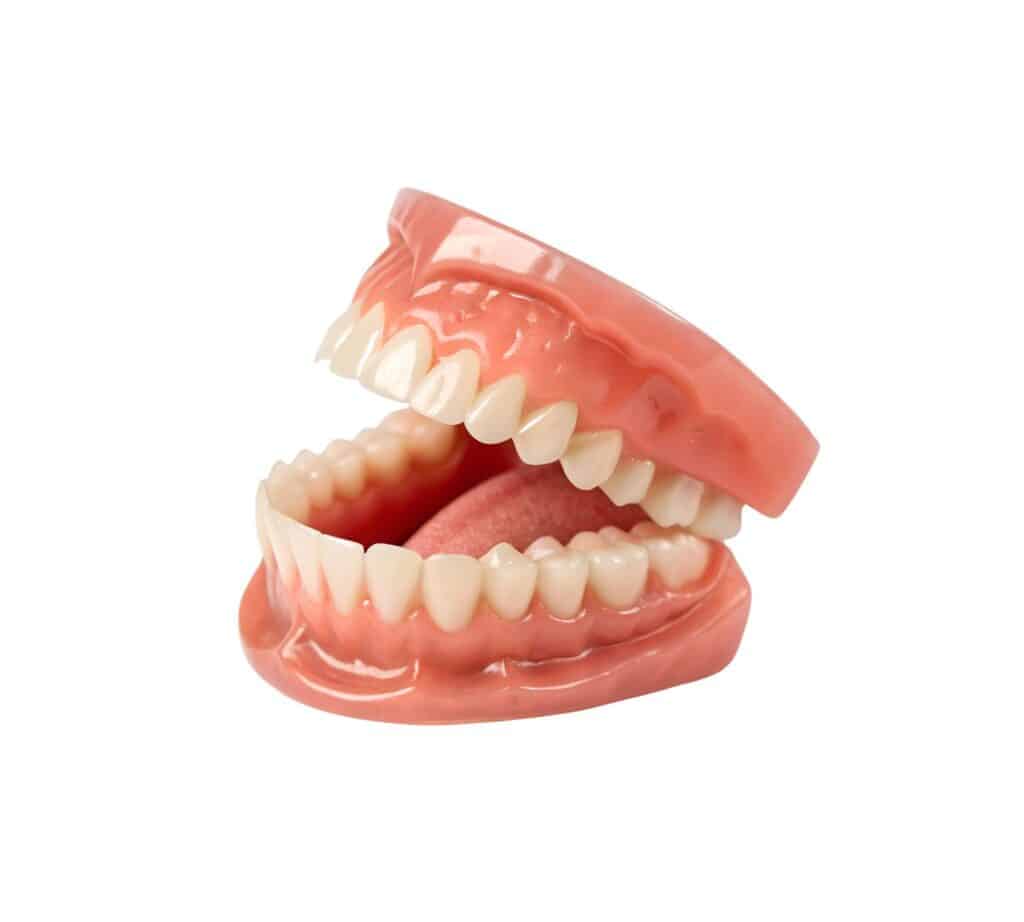
When a denture breaks
You have a denture you barely think about. With it you eat well, speak clearly, and smile without hesitation.
Then a clasp breaks off — or worse, a tooth.
It feels like a disaster, and it is genuinely disruptive. It is also, in most cases, fixable. What follows is what determines how quickly. If it happens out of hours, emergency dentistry is the route in; the number is 13 13 96.
First: what not to do
Do not repair it yourself with household adhesive.
This is the single most important line in this article, because it is the most common response and it does lasting damage.
Superglue and similar adhesives are not made for the mouth, they are not stable in saliva, and — the part that matters most — they contaminate the fracture surfaces. A denture base is repaired by chemically bonding acrylic to acrylic. Once glue has soaked into the broken edges, that bond cannot be made properly, and a repair that would have been straightforward becomes a remake.
Keep every piece, including small fragments, and bring them all with you. Missing fragments make an accurate repair harder.
Do not keep wearing a badly broken denture. Sharp acrylic edges cut soft tissue — see the causes of mouth ulcers and their usual treatments — and a denture that no longer fits correctly loads the gums unevenly, which can accelerate the bone loss underneath.
What can often be done the same day
Simple fractures of the acrylic base, where the pieces fit back together cleanly and all fragments are present.
A tooth that has come off the base, where the tooth itself is undamaged and available.
These are repairs, not remakes — the existing denture is cleaned, the surfaces prepared, and new acrylic chemically bonded across the join.
Where a practice has an on-site laboratory or a same-day arrangement with one, these can often be turned around within hours. Smile Solutions makes and repairs dentures in its own Melbourne laboratory. Where the work must go to an external laboratory, it is usually one to two days.
What generally takes longer
A broken metal clasp or metal framework. Chrome-cobalt framework repair requires laser welding or soldering and specialist laboratory equipment. This is not a chairside repair.
Multiple fractures, or a denture broken into several pieces. Reassembling accurately takes laboratory work, and the more fracture lines there are the more likely the pieces no longer fit together precisely.
A denture that has broken more than once in the same place. That is a signal, not an accident — see below.
Any repair where the fit is also wrong. If the denture has been loose or rocking, repairing the break without addressing the fit means it will break again, usually in the same place.
Why dentures break
Worth understanding, because a repair that ignores the cause is temporary.
Dropping it. The most common cause, and the most avoidable. Clean dentures over a basin of water or a folded towel — acrylic that survives a fall onto a towel will shatter on a tiled floor or a porcelain basin. Five things to know about your new dentures covers the rest of the daily routine, including why acrylic must be stored wet and never in boiling water.
A poor fit. The jawbone under a denture resorbs — shrinks — continuously after teeth are lost. A denture made five years ago no longer matches the ridge it sits on, so it flexes with each bite. Repeated flexing causes fatigue fracture, typically down the midline of an upper denture. That resorption is also why immediate dentures need relining after about three months.
Uneven biting forces, including from natural teeth opposing the denture, or a heavy bite. If you grind or clench, say so — TMD and teeth grinding and night-time grinding and clenching explain what that load does.
Age of the material. Acrylic becomes more brittle over years of use, thermal cycling and cleaning.
If a denture breaks repeatedly, the problem is almost never the repair — it is the fit. A reline or a remake is the actual solution, and continuing to repair it is money spent on the symptom. Where a lower denture will not stay put no matter how often it is relined, implant retention is the option worth asking about: what do I need to know about dental implants?, mini implants versus standard dental implants, and All-on-4 dental implants — with things to consider when choosing All-on-4 on the trade-offs.
Who does denture work, and how to check
Most denture repairs are handled by a general dentist working with a laboratory. Where the case is complex — a framework failure, a denture that keeps breaking, or a plan that involves implants — a prosthodontist is the relevant specialist.
That is a protected title, not a description. Prosthodontics is one of the 13 dental specialties recognised by the Dental Board of Australia, approved by the Australian Health Workforce Ministerial Council. To hold specialist registration a practitioner must hold a qualification in the specialty, meet all the requirements for general registration as a dentist, and have “completed a minimum of two years general dental practice.”
AHPRA publishes an online register of all dental practitioners, showing registration status and “details of the specialty or specialties for dentists who hold specialist registration.” If someone is described to you as a specialist, that register is where you confirm it — it takes about a minute, and it is the only authoritative answer. See prosthodontists and dentists and registered specialists.
What to do now
- Collect every fragment and keep them together, dry.
- Stop wearing it if the edges are sharp or the fit has changed.
- Do not glue it.
- Phone the practice and describe what broke — acrylic base, a tooth, or a metal clasp. That determines whether it is a same-day repair or a laboratory job, and lets reception book the right appointment length. Contact us.
- Bring the denture and all fragments to the appointment.
At the appointment, the denture is assessed for both the break and the fit — because the second explains the first more often than people expect. Prosthodontists are the specialists in this area where the case is complex; published fees are in the price guide.
Common questions
What about the denture repair kits sold in chemists? Those are made for the mouth.
They are still the wrong answer, for the reason set out above — and it is worth being clear that it is not about the packaging. The objection to a home repair is not that household glue is unhygienic; it is that anything soaking into the fracture surfaces prevents the chemical bond between old and new acrylic that a laboratory repair depends on. A kit sold for dentures does exactly the same thing to that surface as any other adhesive.
The second problem is alignment. A denture broken in two halves can be reassembled in a position that feels right in your hands and is out by a fraction of a millimetre against the ridge. Cured in that position, the denture no longer fits, and the fit was very likely what broke it in the first place.
Where a kit genuinely has a place is as a stopgap when you are away from any dental care and have no alternative — and even then, say so at the appointment, because it changes what the laboratory has to do. A repair attempted at home and then brought in is a harder job than a break brought in untouched, and sometimes it is the difference between a repair and a remake.
Should I be taking my denture out at night?
Unless you have been told otherwise for a specific reason, yes — and there is published support for it beyond simple habit. A review of oral malodour in the International Journal of Oral Science names “unclean acrylic dentures (worn at night or not regularly cleaned or with rough surfaces)” among the odontogenic causes of bad breath. Acrylic is porous, and a denture worn continuously is a surface that never gets cleaned and never dries.
A study of older people cited in the same review found that “the accumulation of bacterial plaque on the tongue, oral dryness, burning mouth, overnight denture wear, and lower educational levels” were all significantly related to oral malodour. Overnight wear appears there as its own item, separate from cleaning.
The tissues also need the break. Leaving the denture out overnight gives the gums a period without load — which matters more, not less, if the fit is already imperfect and the denture has been rocking.
Two practical notes. Store it in water rather than dry, as five things to know about your new dentures sets out, because acrylic left dry distorts. And if you have a dry mouth, the denture will be harder to wear and more prone to rubbing in the first place — see my mouth always feels dry! What can I do?
It has broken three times now. Should I stop repairing it and get implants?
The first question is not implants, it is whether the fit has ever been corrected. Repeated fracture in the same place is a fatigue failure, and fatigue comes from flexing, and flexing comes from a base that no longer matches a ridge that has kept shrinking. A reline or a remake addresses that directly and is a far smaller undertaking than implants. Paying for a fourth repair on an ill-fitting base is the option least likely to work.
Where implants genuinely change the picture is a lower denture that will not stay put however often it is relined, because there is too little ridge left to hold it. Implant retention is a different mechanism rather than a better version of the same one.
The honest caveat is that implants are not maintenance-free either. An International Team for Implantology consensus, summarising a systematic review of implants followed for at least five years, reported 2.5% implant loss before the overdentures were placed and nearly 6% implant loss during five years of function — a figure specifically for implant-retained overdentures, and higher than the equivalent figure that review gives for single crowns. That is not an argument against them; it is the number to have in mind when a plan is described as permanent.
Read the trade-offs before the consultation, not after: what do I need to know about dental implants?, what are the different types of dentures? and how much do dental implants cost?
What will a repair cost, and how would I know whether a quote is reasonable?
The cost depends on which of the three jobs it is — a simple acrylic repair, a tooth reattached, or a metal framework that has to be welded — and that is settled by examination rather than over the phone. Published fees are in the price guide, and a written quotation is the thing to ask for before work starts, particularly if the conversation has moved from repair to reline or remake.
The wider difficulty is real and not of any one practice's making. A consumer submission to the Australian Parliament's inquiry into private health insurance and out-of-pocket costs put it this way: “private patients can go to multiple dentists and receive conflicting diagnoses and widely varying quotes for unpredictable dental fees,” and “there are no consumer guidelines to ascertain the reasonableness of dental fees charged.” Australia has no national dental fee schedule, so there is no published benchmark to measure a quote against.
What you can do instead is make the quote specific. Ask what is being charged for — repair, reline, or remake — whether an impression is included, how long the work is expected to hold given the state of the fit, and what the alternative plan would cost if the denture turns out not to be worth repairing. If the recommendation is a remake and you want another view first, second opinions and corrective dentistry exists for exactly that.
Related reading
- What are the different types of dentures?
- Bridges, implants or dentures for replacing missing teeth?
- What does restorative dentistry mean?
- Which dental bridge type, and how do I choose?
- Why does my mouth always feel dry? — a dry mouth makes any denture harder to wear
- How a dentist can help with early detection of oral cancer
Practical details
Smile Solutions, Level 1, 220 Collins Street, Manchester Unity Building, Melbourne VIC 3000 — getting here. Phone 13 13 96, contact us, or theteam@smilesolutions.com.au. Monday–Friday 8.00am–6.00pm, Saturday 8.30am–1.30pm, Sunday by appointment.
Specialist registration can be verified on the AHPRA register, or by calling 1300 419 495. The clinical team is listed by name, with registered specialists identified as such.
The specialty and registration details above are the Dental Board of Australia’s, which is not connected with us. The questions above additionally cite Bollen and Beikler's review in the International Journal of Oral Science (2012), an International Team for Implantology consensus statement on implant survival and complications, and a consumer submission to the Australian Parliament's inquiry into the value and affordability of private health insurance and out-of-pocket costs (2017) — a submission representing one consumer's view, not a government finding. The repair timeframes and laboratory turnaround described on this page are the practice’s own and vary with the damage and the workload on the day.
Published 18 April 2017. Whether a particular denture can be repaired, and how quickly, depends on the specific damage and can only be determined on examination. General information only; it does not replace advice from your treating practitioner.
Smile Solutions trades under ABN 28 193 514 103.
Images on This Page
-
https://www.facebook.com/tr?id=800557773428361&ev=PageView&noscript=1
(no alt text)
-
https://www.smilesolutions.com.au/wp-content/uploads/2025/10/calendar_month.svg
(no alt text)
-
https://www.smilesolutions.com.au/wp-content/themes/arcadian-wordpress-theme/assets/images/smile_solutions_logo_white.png
Smile Solutions Logo
-
https://www.smilesolutions.com.au/wp-content/themes/arcadian-wordpress-theme/assets/images/smile_solutions_logo_purple.png
Smile Solutions Logo
-
https://www.smilesolutions.com.au/wp-content/uploads/2023/11/SS-Tooth-1-1-150x150.png
Smile Solutions
-
https://www.smilesolutions.com.au/wp-content/uploads/2025/09/Dentures-1024x922.jpg
My denture is broken, can it be fixed by my dentist on the spot?
-
https://www.smilesolutions.com.au/wp-content/uploads/2025/09/Root-Canal-2-300x217.jpg
Root Canal
-
https://www.smilesolutions.com.au/wp-content/uploads/2026/08/Mouth-Breathing-300x270.jpg
Mouth Breathing
-
https://www.smilesolutions.com.au/wp-content/uploads/2025/09/Dental-Crown-at-Smile-Solutions-300x300.jpg
Dental Crown at Smile Solutions
-
https://www.smilesolutions.com.au/wp-content/themes/arcadian-wordpress-theme/assets/images/family_owned_bussiness.png
Family Owned Business
-
https://www.smilesolutions.com.au/wp-content/themes/arcadian-wordpress-theme/assets/icons/icon--phone.svg
Smile Solutions Contact