What is malocclusion, and how is it treated?
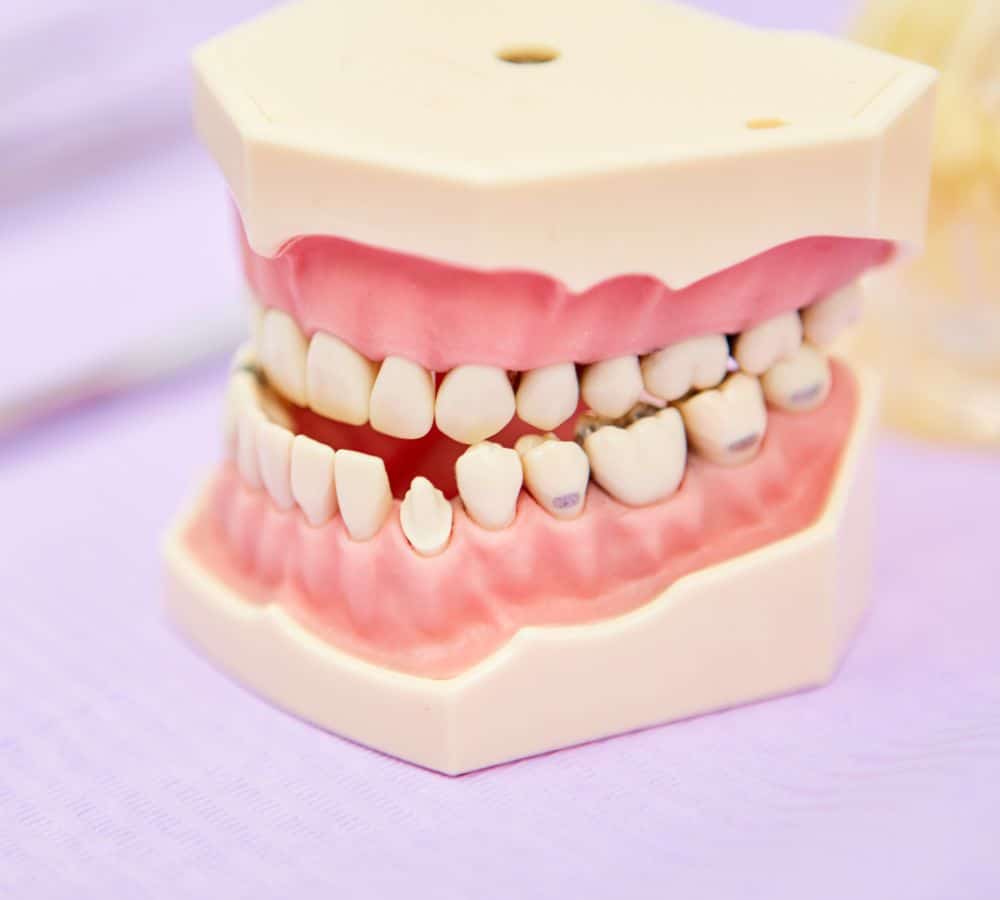
Malocclusion is any deviation from an ideal bite — crowding, spacing, rotation, or a mismatch between the upper and lower jaws. Treatment depends entirely on which type you have: tooth position is corrected by orthodontics, tooth shape by restorative work, and jaw position by growth modification in children or surgery in adults.
Mild malocclusion often needs no treatment at all. That is a legitimate outcome, and worth saying first — not every bite that is less than textbook-perfect is a problem to be fixed. What is malocclusion of the teeth? is the companion article, written as a plainer introduction.
What “occlusion” means
Occlusion simply means the contact between teeth. More precisely, it is the relationship and alignment between the maxillary (upper) and mandibular (lower) teeth when they come together, either during chewing or at rest.
In an ideal occlusion:
- Teeth fit within the arch without crowding or spacing
- No tooth is rotated or twisted
- The upper teeth slightly overlap the lower teeth
- The pointed cusps of the molars sit into the grooves of the opposing molars
Dental malocclusion is any departure from that — the result of a misalignment of some kind. Left uncorrected, more significant malocclusions can lead to further dental and oral health complications over time. Crowded teeth are harder to clean, which raises the risk of both decay and gum disease; an unbalanced bite loads some teeth more than others, which shows up over years as wear and cracked teeth. The Australian Dental Association makes the same point about what treatment is for: "Orthodontic treatment is not just about straight teeth. It can correct a bad biting pattern, help with sleep apnoea, and prevent uneven wear of the teeth."
One claim needs care, though: the bite as a cause of jaw-joint pain. The US National Academies of Sciences, Engineering, and Medicine reviewed the evidence in its 2020 report Temporomandibular Disorders: Priorities for Research and Care and concluded that "occlusion should not be considered a contributing cause for the common TMDs". The Royal Australian College of General Practitioners, writing in Australian Journal of General Practice in 2018, is more specific still: "Malocclusion of the teeth should be noted if present; however, this does not contribute to the manifestation of TMD and orthodontic referral is not recommended for this finding alone." Sources are not unanimous — healthdirect's consumer page still lists "an uneven bite" among the causes of TMJ dysfunction — but the weight of the specialist reviews is against it, and we do not present straightening as a treatment for jaw pain. What causes TMJ pain and how is it treated? covers the jaw joint on its own terms.
The types
Malocclusion presents in many forms, falling into two main categories.
Tooth-related malocclusion — the teeth themselves are misaligned or misshapen within otherwise normal jaws:
- Crooked or rotated teeth
- Crowding
- Spacing or gaps
- Small or malformed teeth
Skeletal malocclusion — the jaws themselves are mismatched in size or position:
| Type | What it looks like |
|---|---|
| Overbite / prognathism | The upper arch sits in front of the lower, giving prominent front teeth |
| Underbite / retrognathism | The lower arch sits in front of the upper, giving a prominent chin |
The distinction matters more than any other point on this page, because braces move teeth; they do not move jaws. A tooth-related problem can be corrected by orthodontics alone — braces or Invisalign. A significant skeletal discrepancy in an adult usually cannot — orthodontics can camouflage it to a degree, but correcting the underlying jaw relationship requires surgery, or, in a growing child, appliances that guide growth while growth is still available. What is orthognathic surgery? explains that operation, and what does oral and maxillofacial surgery involve? the specialty that performs it.
(Clinicians also classify malocclusion using Angle’s Class I, II and III system, which describes how the first molars meet. If you see those terms on a referral, that is what they mean.)
The ADA's own list of what orthodontics treats runs across both categories: "Crooked or crowded teeth. Incorrect biting patterns. Severe misalignment of teeth and/or jaws. Past habits such as thumb sucking that have affected the position of the tooth and development of the jaw bones."
What causes it
Malocclusion is usually inherited — jaw size and tooth size are both largely genetic, and a mismatch between them is a common inheritance.
Some circumstances and habits also contribute:
- Frequent use of a dummy or pacifier
- Thumb sucking after the age of three
- Prolonged bottle-feeding in early childhood
- Injuries causing misalignment of the jaw
Others worth knowing: early loss of baby teeth allowing the neighbouring teeth to drift into the space — why do teeth shift? covers drift in both children and adults — prolonged mouth breathing, and tongue-thrust habits. Mouth breathing: the silent habit that’s changing your face and your health sets out how a breathing pattern becomes a jaw-development problem, and orofacial myofunctional therapy is the treatment aimed at the habit rather than the teeth.
Treatment options
Some people with mild malocclusion neither want nor need treatment. Where treatment is indicated, the options depend on the type and severity. How do I know which orthodontic treatment is best for me? works through the choice in more detail.
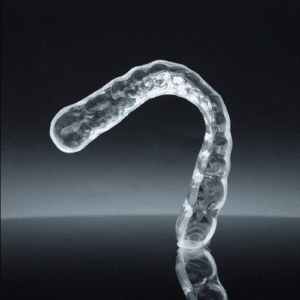
Braces or Invisalign — to correct the position of the teeth, best provided by a specialist orthodontist. These position the teeth correctly within the jaw and in relation to the opposing teeth. Treatment time varies with the severity of the problem — see how long does it take to have orthodontic treatment?. For the comparison between appliances, benefits of conventional braces vs lingual braces vs Invisalign, all your conventional braces questions answered and what are the most common complaints associated with conventional braces? are the honest versions. Note that whatever moves teeth once, retention is lifelong — without a retainer, teeth drift back: will my teeth need retainers after I’ve had braces?.
Who provides the treatment changes what is on offer, and the corpus says so plainly: orthodontic treatment — general dentist vs specialist orthodontist? and specialist orthodontist vs general dentist: which is best for Invisalign?. For aligners specifically, see exploring Invisalign, how to get straight teeth without braces, what are the hygiene benefits of Invisalign?, how to protect your aligners and your smile and why should I choose a Blue Diamond Invisalign provider?.
What the ADA advises against. On tooth-straightening bought online without an in-person assessment, the Australian Dental Association is unambiguous: it "do not recommend Australians have DIY orthodontic treatment. There are many risks to this treatment. They can lead to permanent damage to your teeth, gums, and jaw joints." Its position is that treatment should be in person "which includes a thorough assessment before starting treatment and ongoing supervision". A malocclusion is diagnosed before it is treated, and the diagnosis is what decides whether an aligner is even the right tool.
Removal of teeth — to relieve overcrowding, either alone or alongside orthodontic treatment. Which teeth are removed, and the position of those around them, determines whether extraction alone is sufficient or whether orthodontics is also required. That judgement comes from an orthodontic consultation, not from the extraction itself. Where the teeth in question are wisdom teeth, see wisdom teeth — though the belief that wisdom teeth cause front-tooth crowding is weaker than most people assume.
Reshaping, bonding, crowns or veneers — provided by a general dentist or a specialist prosthodontist. This does not correct the position of the teeth. It changes their size and shape so that they appear better aligned. That is a real and sometimes ideal option for mild cases, but it should be chosen knowingly: it treats appearance rather than position, and crowns and veneers involve irreversible preparation of the tooth. How irreversible has been measured: a study in The Journal of Prosthetic Dentistry found that preparing anterior teeth for veneers removed "3% to 30% of the coronal tooth structure by weight", against "approximately 63% to 72%" for crown preparations. Even the most extensive veneer design in that study removed about 30%. See what is the difference between porcelain crowns and veneers?, dental crowns, porcelain veneers, composite bonding and what are my options if I want to change the shape of my teeth?. The mock-up reveal lets you see the proposed result before any tooth is prepared, which matters most precisely when the work is irreversible.
Surgery to reshape or reposition the jaw — most often carried out in conjunction with orthodontic treatment, in a planned sequence of orthodontics, surgery, then further orthodontics. This is the option for significant skeletal discrepancy in a patient who has finished growing. Jaw surgery and the oral and maxillofacial surgeons page describe the pathway; what can I eat and drink following jaw surgery? and I’ve just had oral surgery — what can I expect during recovery? cover the recovery, which is long and should not be underestimated.
What it costs
Orthodontic fees depend on the appliance, the complexity and the length of treatment, so a figure only means something once a plan exists. What is the cost of braces?, Invisalign cost in Melbourne: a complete breakdown by treatment type and is having Invisalign as an adult worth it? set out how the numbers are built, and published fees are in the price guide.
Orthodontic treatment is usually paid over its duration rather than up front. Payment plan options are available. Where a plan is advertised as interest free, that describes the plan term only — a deposit may be required, an establishment fee and ongoing account fees may apply, and charges can apply if the balance is not cleared within the agreed period. The applicable terms depend on the provider and the amount financed, and are set out in writing before you commit — ask what the deposit and the establishment fee are, in dollars, and what the total will be by the end. Payment Plans.
A complimentary orthodontic consultation is offered as a first step. Confirm the current terms when you book — what the appointment includes, whether records such as scans or radiographs are part of it or charged separately, and whether any deposit applies.
Why timing matters
Malocclusion is usually first diagnosed by your general dentist, who will advise on suitable options and refer to an appropriate specialist — usually an orthodontist, at least in the first instance. Why would I need to see a dental specialist? explains how that referral works.
Early detection can reduce both the length and the severity of the treatment needed. In children this is not just about starting sooner; it is about having growth available to work with. There is a published age range for the first look: according to the Australian Dental Association, "The Australian Society of Orthodontists' recommend children have an orthodontic assessment between the ages of 7 – 10", and it adds that "All the adult teeth do not have to be present in the mouth for an assessment to be done. An examination at this age can allow for early intervention treatment should it be needed." That is the correction to a common assumption — waiting for the last adult tooth can mean waiting past the point where growth could have been guided. The same discrepancy in an adult may need surgery to correct what an appliance could have influenced at ten. See when should I take my child to see an orthodontist?, how long does my child need to wear braces? and children’s braces and Invisalign.
That is not an argument for treating every child early. Many cases are better managed by monitoring and starting at the right moment. It is an argument for having the assessment early, so the timing is a decision rather than an accident.
If you have had orthodontic treatment before and are unhappy with where it finished, second opinions and corrective dentistry is the relevant page.
Common questions
Which option is the least visible — and is any of them actually invisible?
None of them is invisible, and the Australian Dental Association is precise about the differences in a way that marketing generally is not. Its wording, taken directly:
- Ceramic braces are the same as metal braces but made from white or tooth-coloured ceramic. They "are not completely invisible but are less obvious than metal braces."
- Lingual braces are metal braces bonded "to the inside surface of the teeth making them practically invisible." Practically, not entirely — and they sit against the tongue, which is its own adjustment.
- Clear aligners are custom-made thin plastic trays worn over the teeth. The ADA's sentence is blunt: "Although the aligners are clear plastic, they are not invisible."
That is worth holding onto, because the gap between "barely noticeable at conversational distance" and "nobody will ever know" is where disappointment lives. Aligners are noticeable close up, particularly in photographs and particularly if attachments — small tooth-coloured bumps bonded to the teeth to give the trays something to push against — are part of your plan. Ask at the consultation whether attachments are needed on your front teeth, because that is the single biggest determinant of how visible aligner treatment actually is.
Visibility is also only one axis. Lingual braces are the least visible fixed option and the most demanding to speak and eat with at first; aligners are removable, which is an advantage for cleaning and a liability for anyone who will not wear them. See benefits of conventional braces vs lingual braces vs Invisalign.
If my bite does not bother me, is there any reason to treat it?
Sometimes there is, and the reasons are functional rather than cosmetic. The ADA's framing is that "orthodontic treatment is not just about straight teeth. It can correct a bad biting pattern... and prevent uneven wear of the teeth."
The three that are worth weighing:
- Cleaning. Crowded and rotated teeth are harder to clean between, and that is exactly where adult decay and gum disease start. If you are having repeated problems in the same crowded spot, the crowding is part of the cause.
- Wear. A bite that loads a few teeth harder than the rest shows the result over decades, not months — flattened edges, chipping, and eventually cracks in teeth that carry more than their share.
- Trauma risk, in children. This one is rarely mentioned and is genuinely useful. The ADA's oral-injury policy states that "children with prominent front teeth may be a higher risk of injury and may benefit from orthodontic assessment and early treatment to reduce this risk." Teeth that stick forward are the teeth that get knocked out.
Against that, mild malocclusion in an adult with good hygiene, no wear pattern and no symptoms is a reasonable thing to leave alone. Treatment has a cost, a duration, and a lifelong retention requirement, and "not textbook" is not a diagnosis. What a consultation should give you is a reason specific to your mouth — not a general case for straight teeth.
I have heard braces can help sleep apnoea. Is that right?
This needs unpicking, because the ADA sentence quoted higher up this page is looser than the detailed position, and the two are easy to conflate.
What has real support is oral appliance therapy — a custom appliance worn at night that holds the lower jaw forward — and not braces. The ADA's own policy on sleep-disordered breathing describes oral appliances as a first-line option only for snoring and mild to moderate obstructive sleep apnoea, and for severe OSA only where the person is not compatible with continuous positive airway pressure. It is explicit that medical expertise is needed to determine whether appliance therapy is indicated: the diagnosis comes first, from a medical pathway, not from a dental chair.
Two further points from the same policy are worth knowing before anyone starts. Dentists "are the only dental practitioners who are qualified to manage oral appliance therapy" for sleep-disordered breathing. And long-term use has to be monitored, because the appliance itself has orthodontic effects — the policy requires monitoring of temporomandibular joint function and orthodontic movement of teeth. An appliance that holds the jaw forward every night for years is, unavoidably, also moving teeth.
So: if you snore, or someone has told you that you stop breathing at night, the first step is a medical assessment, not an orthodontic one. See snoring and sleep apnoea.
How do I keep my teeth clean once I am in braces or aligners?
This is the part that decides whether you finish treatment with straight teeth or straight teeth with white marks on them, and the ADA gives a specific method rather than general encouragement.
With braces, it advises brushing after every meal, because food lodges around the brackets, and either a manual or an electric brush is fine. Its sequence: take out any rubber bands or removable parts and rinse them before they go back in; a pea-sized amount of toothpaste; start at the gumline with the brush at 45 degrees, bristles split between teeth and gums, in small circles; then turn the brush down to clean the tops of the brackets, and up to clean along the bottom of them. Then — and this is the step everyone skips — "spit out the excess toothpaste but do not rinse your mouth with water. This allows the fluoride paste to sit on the teeth for longer, increasing protection."
Between the teeth, the ADA acknowledges that "cleaning between your teeth with string floss can be tricky while wearing braces" and names the alternatives: floss threaders made for braces, and interdental brushes, which clean both between the teeth and between the brackets.
With clear aligners, clean the trays whenever you clean your teeth, ideally twice a day. The ADA's method is antibacterial liquid soap and a spare toothbrush, rinsed well afterwards with warm water. Teeth themselves are brushed and flossed as normal, which is the practical hygiene advantage of a removable appliance.
One diet warning specific to aligners, in the ADA's words: the trays should be worn at all times other than when eating and drinking anything other than water, because "drinking liquids such as fruit juice or soft drink while wearing clear aligners can trap the liquids against the teeth, which can cause damage to the teeth if it happens frequently." A tray turns a sugary drink into a sealed reservoir.
Does it have to be an orthodontist, and how do I check that someone is one?
You can check it yourself in a minute, and it is worth doing because "specialist" is a protected term with a specific meaning here.
The Dental Board of Australia recognises 13 dental specialties, approved by the Australian Health Workforce Ministerial Council — orthodontics among them. To hold specialist registration, a practitioner must already hold general registration as a dentist, hold a Board-approved qualification in that specialty, and have completed a minimum of two years of general dental practice. The register records it, which means a person's registration type and any specialty are matters of public record rather than of description.
So the check is: look the practitioner up on the AHPRA public register, or call 1300 419 495. What the register tells you is whether they hold specialist registration in orthodontics, and whether there are conditions on their registration. What it does not tell you is anything about the outcome you will get, or how many cases like yours they have treated — those are questions to ask in the room.
General dentists can and do provide orthodontic treatment, including aligners, and that is lawful and often appropriate. The honest version of the distinction is about the kind of case rather than about the person: a significant skeletal discrepancy, an unerupted or impacted tooth needing to be brought into the arch, or a case where extractions are on the table is the kind of case that belongs with a specialist orthodontist. See orthodontic treatment — general dentist vs specialist orthodontist? and dentists and registered specialists.
Related reading
- What is malocclusion of the teeth?
- Why do teeth shift?
- Understanding your treatment
- Dentists and registered specialists
Practical details
Orthodontics and prosthodontics are recognised dental specialties. Specialist registration can be verified on the AHPRA register, or by calling 1300 419 495. The practice’s registered specialists are identified as such within the full team.
Smile Solutions, Level 1, 220 Collins Street, Manchester Unity Building, Melbourne VIC 3000 — getting here. Phone 13 13 96, contact us, or theteam@smilesolutions.com.au. Monday–Friday 8.00am–6.00pm, Saturday 8.30am–1.30pm, Sunday by appointment.
Published 27 November 2018, by Dr Yasmin Coulthard. General information only; it does not replace advice from your treating practitioner. Outcomes vary between individuals, and all treatment carries risks. Payment plan terms are set by the credit provider and change; confirm current terms directly before you commit.
Smile Solutions trades under ABN 28 193 514 103.
Images on This Page
-
https://www.facebook.com/tr?id=800557773428361&ev=PageView&noscript=1
(no alt text)
-
https://www.smilesolutions.com.au/wp-content/uploads/2025/10/calendar_month.svg
(no alt text)
-
https://www.smilesolutions.com.au/wp-content/themes/arcadian-wordpress-theme/assets/images/smile_solutions_logo_white.png
Smile Solutions Logo
-
https://www.smilesolutions.com.au/wp-content/themes/arcadian-wordpress-theme/assets/images/smile_solutions_logo_purple.png
Smile Solutions Logo
-
https://www.smilesolutions.com.au/wp-content/uploads/2016/05/Yasmin-150x150.jpg
Dr Yasmin Coulthard
-
https://www.smilesolutions.com.au/wp-content/uploads/2018/11/malocclusion.jpg
malocclusion
-
https://www.smilesolutions.com.au/wp-content/uploads/2025/09/CEREC-restorations-Smile-Solutions-300x300.png
CEREC Restoration Smile Solutions
-
https://www.smilesolutions.com.au/wp-content/uploads/2025/11/Speciality-Splints-300x300.png
Speciality Splints
-
https://www.smilesolutions.com.au/wp-content/uploads/2025/09/Smile-Solutions-Level-10-300x270.png
Smile Solutions Level 10
-
https://www.smilesolutions.com.au/wp-content/themes/arcadian-wordpress-theme/assets/images/family_owned_bussiness.png
Family Owned Business
-
https://www.smilesolutions.com.au/wp-content/themes/arcadian-wordpress-theme/assets/icons/icon--phone.svg
Smile Solutions Contact
-
https://www.facebook.com/tr? id=800557773428361&ev=PageView&noscript=1
(no alt text)
-
https://bat.bing.com/action/0?ti=25148060&tm=gtm002&Ver=2&mid=a6ce8d56-a890-4417-8b0f-34cc64fc774b&bo=1&sid=2eed4910ab2711f1bce593042aff432e&vid=2eed4110ab2711f1b5e407a19b19a21e&vids=1&msclkid=N&pi=918639831&lg=en-US&sw=800&sh=600&sc=24&nwd=1&tl=Treatment%20of%20malocclusion%20-%20Smile%20Solutions&p=https%3A%2F%2Fwww.smilesolutions.com.au%2Fdental-articles%2Farticle%2Ftreatment-of-malocclusion%2F&r=&evt=pageLoad&sv=2&cdb=AQAQ&rn=402571
(no alt text)