Comparing conventional braces, lingual braces and Invisalign
Patients often ask which appliance is best and which is most cost-effective.
Every appliance works slightly differently, and the best type of treatment must be individually prescribed. There is no universally superior option — there is one that suits your particular teeth, bite and habits. The overview is Orthodontics; see also How do I know which orthodontic treatment is best for me?.
Who provides the treatment
It is worth understanding the difference between a specialist orthodontist and a general dentist.
A specialist orthodontist performs one type of treatment every day: the alignment of teeth. A general dentist may treat only a handful of orthodontic cases per month, or per year. See General Dentistry and Dentists & Registered Specialists.
That difference in volume is what shows up when a case does not go to plan. Orthodontic treatment: general dentist vs specialist orthodontist? goes further.
Conventional braces
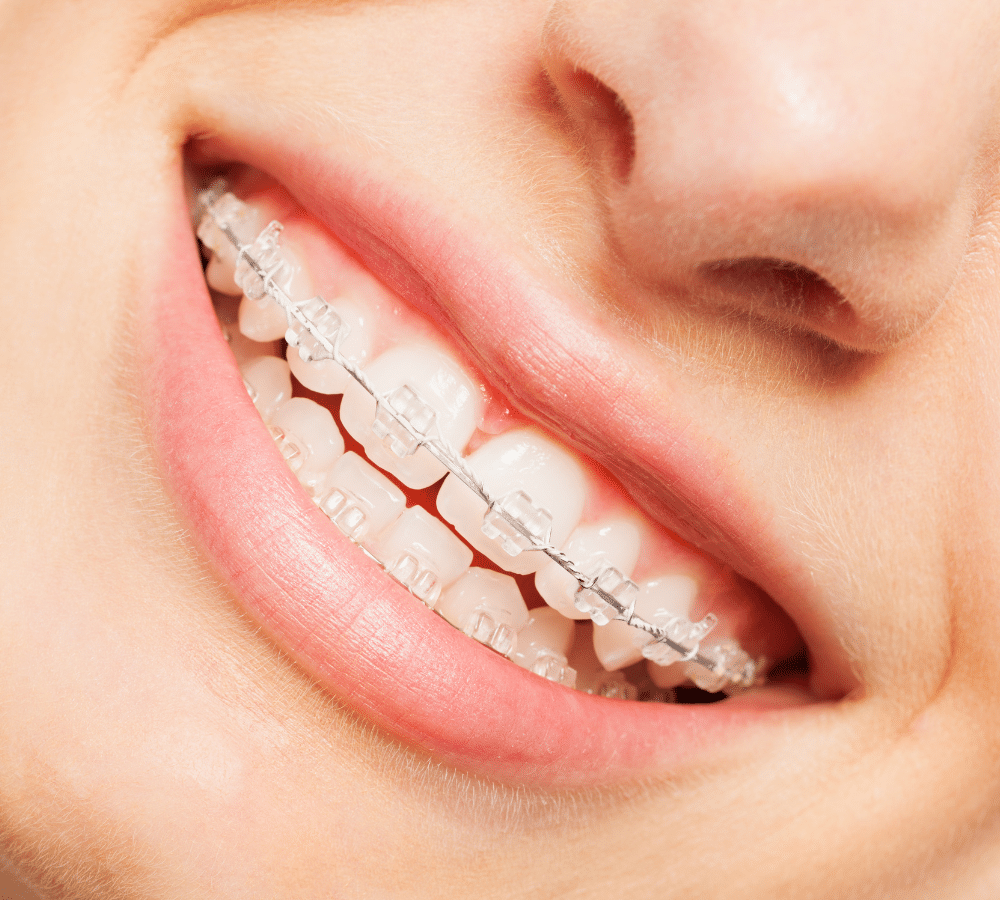
Conventional or “labial” braces are fixed to the cheek side — the outside — of the teeth. They are the most common and best-known orthodontic appliance. See Orthodontic Braces.
Advantages
- Ample scientific evidence for their efficiency, because they have been in use for a very long time
- Suitable for patients of all ages — for children and teenagers, see Children's Braces & Invisalign
- Can correct severely rotated teeth and deep bites
- Can easily close extraction spaces
- Can align impacted teeth, such as upper canines
- Fixed, not removable — so they are constantly working, with no reliance on the patient remembering
Materials
Originally stainless steel, and therefore silver. Now also available in a more aesthetically pleasing ceramic, preferred by most adults.
The trade-off: ceramic braces can chip. Metal braces will not.
The hygiene risk
Because they are not removed for eating, you can eat more or less what you like — provided you brush and then floss after each meal. See All your conventional braces questions answered for the tools and technique.
Patients who do not maintain good oral hygiene may develop white spot lesions. These white areas only become apparent when the braces are removed at the end of treatment, and they are the beginning of tooth decay, caused by plaque build-up that inhibits salivary flow. See Dental Cleans & Hygienists and Tooth Fillings.
This is the single most common avoidable disappointment in orthodontic treatment: straight teeth with permanent white marks on them. What are the most common complaints associated with conventional braces? covers the rest.
Lingual braces
Many adult patients say: “I don't mind braces, I just don't want anyone to see them.”
Lingual braces are fixed to the tongue side of the teeth. The Australian Dental Association describes them as "metal braces … stuck to the inside surface of the teeth making them practically invisible" — practically, because they sit behind the teeth rather than because they cannot be seen at all. In ordinary conversation most people will not notice them.
Advantages
- The hardest of the fixed appliances to see from the front, in the ADA's words "practically invisible"
- Fully customised for each individual, including the wires
- Best suited to adult patients, who appreciate the bespoke nature of the appliance
Disadvantages
- A longer waiting time because of the technology involved in manufacture — which may lengthen overall treatment by two to three months. See How long does orthodontic treatment take?
- Higher cost
- Not recommended for patients with a narrow jaw, because the braces can invade the space for the tongue, creating a feeling of claustrophobia
With either kind of fixed brace
Some discomfort is felt in the initial stages — typically a wire poking into the cheek or tongue, causing an ulcer, or an increase in the usual salivary flow.
A soft diet is recommended during the first phases, particularly with ceramic braces, where there is a risk of chipping enamel if the lower braces sit high enough to affect the bite. See Chipped and Cracked Teeth.
Depending on the type, the elastic ties may discolour over time. Wires and elastics are changed at every visit, so this is not a major concern.
Invisalign
The service page is Invisalign; see also Why should I choose a Blue Diamond Invisalign provider?.
What it cannot do
Invisalign is not suitable for everyone. It cannot correct severely rotated teeth or deep bites.
It is also not the best option for extraction cases — with one exception: where a patient has an ideal bite on the back teeth but severe crowding on the lower front teeth, removing a single lower incisor is a good plan, and sometimes better than braces.
The compliance question — the deciding factor
Invisalign must be worn 22 hours per day, including while sleeping, or the desired result will not be achieved.
Some patients easily manage 23 hours. Others struggle to reach 20. As an overall treatment option it can be slower than braces if the aligners are not worn as required.
This is the honest test for anyone considering Invisalign: not whether you want it, but whether you will wear it.
Where it works well
A great prospect for people who know they will wear the aligners full time and be diligent with eating and brushing.
Such patients can eat whatever they like — but after each meal must brush, ideally floss, then re-insert the aligners. That routine is the major practical difference between braces and Invisalign. See What are the hygiene benefits of Invisalign? and How to protect your aligners and your smile.
There is a waiting time while the aligners are custom-made, but treatment time may be shorter than with braces, and can be accelerated with the optional use of an electronic device called Acceledent.
The two types
Invisalign Full — suitable for most patients, including complex conditions such as severe crowding or spacing, or cases needing jaw surgery. It offers maximum flexibility: if the plan needs to change during treatment, it can, at no extra cost.
Invisalign Lite — fewer aligners and a shorter treatment time, for simple cases. Most suited to patients who recently finished orthodontic treatment, did not wear their retainers well, and have noticed a slight shift. It is usually 20–30% cheaper than standard Invisalign from the same clinician, but does not offer the same flexibility in planning. On the retainer point, see Will my teeth need retainers after I've had braces?.
The majority of patients require Invisalign Full.
Indicative cost
Cost varies with the complexity of the case. As published at the time of writing:
| Provider | Full course of Invisalign |
|---|---|
| General dentist | $4,800 – $7,500 |
| Specialist orthodontist | $6,500 – $9,000 |
Some people assume Invisalign costs considerably more than braces. At this practice it does not: Invisalign Full was priced the same as clear braces, at $8,200.
These are indicative figures from the date of publication — confirm current fees at your consultation. See the Price Guide, What is the cost of braces? and Payment Plans.
Payment plan options are available. Where a plan is advertised as interest free, that describes the plan term only — a deposit may be required, an establishment fee and ongoing account fees may apply, and charges can apply if the balance is not cleared within the agreed period. The applicable terms depend on the provider and the amount financed, and are set out in writing before you commit — ask what the deposit and the establishment fee are, in dollars, and what the total will be by the end. Payment Plans.
One thing common to all of them
With all kinds of braces you may initially develop a slight lisp, because of the position of the appliance in the upper arch.
It usually disappears within two weeks, but may take longer with lingual braces, since they sit against the tongue.
And one thing common to all of them at the end: teeth continue to move for life, so retainers are part of every plan, whichever appliance you choose.
In short
| Conventional braces | Lingual braces | Invisalign | |
|---|---|---|---|
| Visibility | Visible (metal or ceramic) | Practically invisible (ADA) | Clear, but visible close up |
| Severe rotations / deep bites | Yes | Yes | No |
| Extraction cases | Yes | Yes | Generally not |
| Depends on patient compliance | No | No | Yes — 22 hrs/day |
| Added treatment time | — | +2–3 months | May be shorter |
| Not suited to | — | Narrow jaws | Complex movements |
Common questions
Does straightening my teeth do anything except improve how they look?
Yes, and the Australian Dental Association puts it in one sentence: "Orthodontic treatment is not just about straight teeth. It can correct a bad biting pattern, help with sleep apnoea, and prevent uneven wear of the teeth." The ADA lists what orthodontics treats as "crooked or crowded teeth", "incorrect biting patterns", "severe misalignment of teeth and/or jaws", and "past habits such as thumb sucking that have affected the position of the tooth and development of the jaw bones".
Two of those deserve unpacking, because they are the reasons a dentist may raise orthodontics with someone who was perfectly happy with their appearance.
Uneven wear. Where the bite loads a few teeth instead of spreading across all of them, those teeth wear, chip and crack faster than the rest. That damage is not reversible — enamel does not grow back — so the argument for correcting the bite is about what you are preventing over decades rather than how things look now.
Sleep apnoea, with an important qualification. The ADA's own policy on sleep-disordered breathing is more careful than the single sentence above: oral appliances are described as a first-line option only for snoring and mild to moderate obstructive sleep apnoea, and the ADA is explicit that "medical expertise is needed to determine whether it is indicated". In other words, snoring is not self-diagnosable as sleep apnoea, a dental appliance is not a substitute for a medical diagnosis, and no one should pursue orthodontics as a treatment for apnoea without a sleep physician involved. See Snoring & Sleep Apnoea.
What orthodontics does not do is fix decay or gum disease. Those are treated first, and they are treated because moving teeth through inflamed gums or around untreated decay makes both worse.
When should my child first be seen — and is seven too early?
Seven is the right time to look, not the right time to start. The ADA's consumer guidance is that "the Australian Society of Orthodontists' recommend children have an orthodontic assessment between the ages of 7 – 10", and, crucially, that "all the adult teeth do not have to be present in the mouth for an assessment to be done."
The reason for that window is that a small number of problems are much easier to influence while the jaws are still growing — a crossbite, a severely narrow upper arch, an impacted or missing adult tooth, a thumb-sucking habit that is already moving the front teeth. The ADA's phrasing is that an examination at this age "can allow for early intervention treatment should it be needed". Should it be needed is the operative clause: most children assessed at seven or eight are simply reviewed and nothing is done for years.
So an assessment is not a sales appointment and it is not a commitment. What you should expect to come away with is one of three answers — nothing to do, review in twelve months, or here is a specific problem and here is why acting now is better than acting at fourteen. If you are told treatment is needed, ask what happens if you wait, and ask what the plan would be if you did wait. A clinician who can answer that clearly is giving you a real choice. See When should I take my child to see an orthodontist? and Children's Braces & Invisalign.
What about the aligners you can order online without seeing anyone?
The Australian Dental Association's position on this is unambiguous and worth quoting rather than paraphrasing: "The Australian Dental Association (ADA) do not recommend Australians have DIY orthodontic treatment." Its stated reasoning is that there are "many risks to this treatment" and that they "can lead to permanent damage to your teeth, gums, and jaw joints". What the ADA recommends instead is "in-person treatment with a dentist or orthodontist which includes a thorough assessment before starting treatment and ongoing supervision."
The two phrases that matter there are before starting and ongoing. An impression kit posted to your kitchen table can capture the shape of your teeth. It cannot establish whether the gums are healthy enough to move teeth through, whether the roots are long enough and the bone deep enough to take the force, whether a tooth is already resorbing, or where the bite will end up once the front teeth are straight. Those are the findings that decide whether a case should be treated at all — and they come from an examination and radiographs, not from a photograph.
The ongoing half is the one people underestimate. Orthodontic treatment is a sequence of small corrections in response to how the teeth are actually moving, which is rarely exactly how the plan said they would. Nobody is watching that on a mail-order course.
If cost is what is driving the interest — which it usually is — the more productive conversation is about staging a supervised plan or treating a smaller number of teeth, not about removing the supervision. See How to get straight teeth without braces? Or Invisalign.
I have the aligners. What can I drink while wearing them, and how do I clean them?
Water, and only water. The ADA is specific about why: "Drinking liquids such as fruit juice or soft drink while wearing clear aligners can trap the liquids against the teeth, which can cause damage to the teeth if it happens frequently." An aligner turns a sip of soft drink into a sealed acid bath held against the enamel for as long as the tray is in. The same logic applies to sweetened coffee, sports drinks, cordial and wine — take the aligners out, drink, brush or at least rinse, put them back.
For cleaning the trays themselves, the ADA's instruction is plain: clean them when you clean your teeth, "ideally twice per day"; "the trays can be cleaned with an antibacterial liquid soap and a spare toothbrush"; then "rinse well following with warm water." Warm, not hot — heat distorts the plastic and a distorted tray no longer fits, which costs you time in the plan. Your teeth themselves "can be brushed and flossed as normal when having clear aligner treatments", which is the one genuine hygiene advantage aligners have over fixed braces.
Two practical additions that save people money: keep the previous set of aligners until the next set is confirmed as fitting, because it is the only thing that holds the position if the current tray is lost; and never wrap a tray in a napkin on a restaurant table. More aligners are thrown out with lunch than are ever broken.
What will this actually cost me, beyond the fee I am quoted?
Three things routinely sit outside the headline number, and it is worth asking about each before you sign.
Records and review. Ask whether the diagnostic records — photographs, scans, radiographs — are inside the quoted fee or billed separately, and what happens to the fee if the plan changes partway through. On the Invisalign options above, that difference is explicit: Full carries plan changes at no extra cost, Lite does not.
Retainers, and replacing them. Teeth move for life, so retention is not the end of treatment, it is the permanent part of it. Ask what retainers are included, for how long, and what a replacement costs — because you will lose one.
What no public scheme pays. The Child Dental Benefits Schedule, which covers a useful amount of ordinary dental care for eligible children, does not apply here at all. Services Australia lists the exclusions plainly: "orthodontic dental work", "cosmetic dental work" and "any dental services in a hospital". The CDBS will help with the check-ups, x-rays, cleans and fillings that keep a child fit for orthodontic treatment, which is worth claiming; it will not pay a cent toward the appliance. See Child Dental Benefit Schedule.
That leaves private health insurance as the main offset. The figures to ask your fund for are the annual limit, the lifetime orthodontic limit and the waiting period — orthodontic waiting periods are usually the longest in any policy, and a lifetime limit means what it says. Get the answer in writing before treatment starts, not after the first instalment.
Practical details
To determine whether Invisalign is suitable for you — and which type — book a consultation with a specialist orthodontist. See Complimentary Orthodontic Consultation; confirm the current terms when you book, including what the appointment covers.
Confirm the current terms when you book — what the appointment includes, whether records such as scans or radiographs are part of it or charged separately, and whether any deposit applies.
Smile Solutions, Level 1, 220 Collins Street, Manchester Unity Building, Melbourne VIC 3000. Phone 13 13 96, or theteam@smilesolutions.com.au. Monday–Friday 8.00am–6.00pm, Saturday 8.30am–1.30pm, Sunday by appointment. Full details on Contact Us.
Specialist registration can be verified on the AHPRA register, or by calling 1300 419 495; the clinicians are listed on Our Team.
Published 18 October 2018. Fees quoted were current at that date and are indicative only. Results and treatment times vary between individuals. General information only; it does not replace advice from your treating practitioner. Payment plan terms are set by the credit provider and change; confirm current terms directly before you commit.
Smile Solutions trades under ABN 28 193 514 103.
Images on This Page
-
https://www.facebook.com/tr?id=800557773428361&ev=PageView&noscript=1
(no alt text)
-
https://www.smilesolutions.com.au/wp-content/uploads/2025/10/calendar_month.svg
(no alt text)
-
https://www.smilesolutions.com.au/wp-content/themes/arcadian-wordpress-theme/assets/images/smile_solutions_logo_white.png
Smile Solutions Logo
-
https://www.smilesolutions.com.au/wp-content/themes/arcadian-wordpress-theme/assets/images/smile_solutions_logo_purple.png
Smile Solutions Logo
-
https://www.smilesolutions.com.au/wp-content/uploads/2023/11/SS-Tooth-1-1-150x150.png
Smile Solutions
-
https://www.smilesolutions.com.au/wp-content/uploads/2025/09/Clear-Braces-Smile-Solutions.png
Clear Braces Smile Solutions Specialist Orthodontist
-
https://www.smilesolutions.com.au/wp-content/uploads/2025/09/Root-Canal-2-300x217.jpg
Root Canal
-
https://www.smilesolutions.com.au/wp-content/uploads/2026/08/Mouth-Breathing-300x270.jpg
Mouth Breathing
-
https://www.smilesolutions.com.au/wp-content/uploads/2025/09/Dental-Crown-at-Smile-Solutions-300x300.jpg
Dental Crown at Smile Solutions
-
https://www.smilesolutions.com.au/wp-content/themes/arcadian-wordpress-theme/assets/images/family_owned_bussiness.png
Family Owned Business
-
https://www.smilesolutions.com.au/wp-content/themes/arcadian-wordpress-theme/assets/icons/icon--phone.svg
Smile Solutions Contact
-
https://www.facebook.com/tr? id=800557773428361&ev=PageView&noscript=1
(no alt text)