Jaw Surgery
When is jaw surgery needed, and can it be avoided?
Some people are born with skeletal irregularities that prevent a normal bite — underbite, overbite, or an open bite. Collectively this is severe malocclusion, and it can cause:
- difficulty chewing, which may affect digestion
- speech problems
- headaches
- jaw joint discomfort
- changes to facial appearance, particularly the profile
Most bite problems are correctable with orthodontic treatment alone. Jaw surgery (orthognathic surgery) is required only when the skeletal discrepancy is too significant for orthodontics to fix, in adolescents or adults.
Smile Solutions is at Level 1, 220 Collins Street, Manchester Unity Building, Melbourne CBD.
Teeth or jaws? The distinction that decides everything
Two people can have an identical-looking bite for entirely different reasons, and the reason determines the treatment.
If the jaws relate normally and the teeth are simply in the wrong places, orthodontics alone can fix it. If the jaws themselves are mismatched in size or position, moving teeth can only camouflage the difference — tipping the front teeth to meet in the middle while the underlying skeleton stays as it was.
Camouflage is a legitimate and very common treatment, and for mild to moderate discrepancies it is usually the right one. Its limits are worth knowing: there is only so far teeth can be tipped before the roots leave the supporting bone, the gums recede, or the result looks and functions poorly. Surgery is what is offered when the discrepancy is beyond the point where camouflage produces a good, stable result.
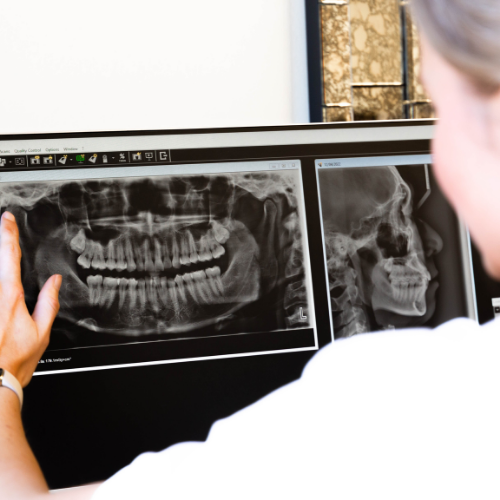
The measurement that separates the two is made on a lateral cephalogram — the side-on x-ray taken at the records appointment — and it is a genuinely reasonable question to ask your orthodontist: is my problem in the teeth, the jaws, or both, and what would each approach give me? See Orthodontic Braces.
The timing question — and how surgery is often avoided
This is the most useful thing on this page for a parent.
With timely intervention, many adolescents avoid surgery entirely through modern orthodontic guidance during growth. In pre-adolescent children, growth modification is the preferred treatment, except in cases of congenital deformity or trauma.
If you are concerned about your child's bite, consult your dentist even if they have not yet developed all their permanent teeth. Bone growth and tooth eruption happen independently, so waiting for the adult teeth can mean missing the growth window where the jaw can still be guided. See Children's Braces & Invisalign.
For adolescents with growth-related bite issues, surgery may be performed before age 18. Otherwise it is generally considered after the growth spurt, or in adulthood — operating before growth is complete risks the discrepancy returning.
Growth finishes at different ages, and generally later in males than females. Where timing is marginal, surgeons sometimes compare x-rays taken months apart, or use a hand-and-wrist film, to establish whether growth has actually stopped rather than assuming from age alone. This is one reason a surgical plan is sometimes deliberately delayed by a year.
The operations, by name
It helps to know what is being proposed, because “jaw surgery” covers several distinct procedures that are often combined.
- Lower jaw (mandibular osteotomy). The jaw is divided behind the back teeth and the tooth-bearing portion moved forward or back. This is the standard operation for an underbite or a receded lower jaw.
- Upper jaw (maxillary osteotomy). The upper jaw is separated above the tooth roots and repositioned — forward, back, up, down, or rotated to correct a tilt. Moving it upward is how an open bite or an excessively gummy smile is corrected skeletally.
- Chin (genioplasty). The chin point is cut and repositioned independently of the rest of the jaw. Often added to the above, sometimes done alone, and it has a disproportionate effect on the profile for a comparatively minor procedure.
- Both jaws (bimaxillary surgery). Where the discrepancy is shared between the two, or where asymmetry needs correcting in more than one plane.
Ask which of these is in your plan, in which direction, and by roughly how many millimetres. A surgeon can tell you, and the answer makes the conversation about your face far more concrete than “we will move your jaw forward”.
How the operation is planned before anyone operates
Modern orthognathic surgery is rehearsed digitally before theatre.
A 3D scan (CBCT) of the facial skeleton is combined with a digital scan of the teeth to build an accurate virtual model. The planned movements are then simulated on that model — how far each jaw moves, in which direction, and how the bite will fit afterwards. From that plan, surgical guides or wafers are printed and used in theatre to position the jaw precisely where the plan put it.
Two honest caveats about the simulation:
- It models bone accurately. It predicts soft tissue approximately. How your lips, cheeks and nose settle over the underlying change is an estimate, and it is why surgeons talk in terms of expected direction of change rather than a guaranteed appearance.
- The plan is for function first. Facial change follows from correcting the bite, and where the two pull in different directions the bite wins.
Other reasons jaw surgery is done
A corrected bite is the usual goal, but not the only one:
- Facial asymmetry, where one side of the jaw has grown differently from the other
- Obstructive sleep apnoea. Advancing both jaws enlarges the airway behind the tongue and soft palate, and in selected patients it is a recognised surgical treatment for OSA. It is a major undertaking decided jointly with a sleep physician on the basis of a sleep study — not a dental decision, and not a first-line one. See Snoring & Sleep Apnoea.
- After facial trauma, where a healed fracture has left the bite wrong
- Congenital conditions including cleft lip and palate, usually within a long-standing multidisciplinary plan
- Where teeth cannot be restored in a collapsed bite without first correcting the skeletal relationship
Jaw surgery is not performed as a treatment for TMD. Joint symptoms may improve, stay the same, or occasionally worsen, and anyone offering surgery primarily to cure jaw pain is overstating what it does. See TMD & Teeth Grinding.
The three stages
1. Pre-surgical orthodontics — six to 18 months
Preparation usually takes between six and 18 months, depending on your needs. This surprises people who expect surgery to be the whole treatment; it is one step in a longer sequence.
Treatment begins with braces to align the teeth so the bite fits correctly after surgery. Impressions are taken throughout to monitor progress.
Be prepared for something counterintuitive: the bite and the profile often look worse during this phase, not better. The teeth are being moved into the position they need to be in after the jaws move, which is not the position that looks best beforehand.
The reason is worth spelling out. Your body has spent years compensating for the skeletal difference by tipping the teeth towards each other. The pre-surgical phase deliberately removes that compensation — putting each set of teeth upright over its own jaw — which temporarily exaggerates the underbite or overjet. That exaggeration is the plan working, not a mistake, and knowing this in advance makes an otherwise demoralising year much easier.
Once the desired alignment is achieved, a strong archwire is fitted in readiness and the procedure is scheduled. During surgery, small pins may be threaded through the braces to stabilise the teeth — this happens only on the day of the operation, not during orthodontic treatment.
Orthodontics continues after surgery too, usually for several more months, followed by lifelong retention.
A note on “surgery-first”: in selected cases, the operation is done at the outset and the orthodontics afterwards, which shortens the period spent with a worsening bite. It is not suitable for every case, and it demands very precise planning — but it is a fair question to ask whether yours is a candidate.
2. The surgical procedure
Orthognathic surgery repositions the jaws into proper alignment:
- the lower jaw can be moved forward or backward to alter its length
- the upper jaw can be adjusted in multiple directions
- the chin can be moved forward, backward, upward or downward
Surgery is carried out behind the back teeth, not in the joint, where the jaw is carefully sectioned. This technique matters for three reasons: it prevents gaps in the bone, it removes the need to wire the teeth shut during healing, and it allows you to open your mouth after the operation.
The repositioned bone is held with small titanium plates and screws, placed inside the mouth. That fixation is what makes wiring unnecessary: the bone is held rigidly from the moment it is set, and healing proceeds around stable segments. The plates are usually left in place permanently and are not felt; occasionally one becomes palpable or irritating and is removed in a minor second procedure.
Light elastics are often used afterwards, stretched between the upper and lower braces, to guide the bite while the muscles adapt to a jaw that is now in a new position. These are not holding the jaw together — they are training it — and wearing them as instructed genuinely affects the result.
Incisions are small — usually around one centimetre, made inside the mouth, typically hidden in natural tissue folds. Sutures either dissolve or are removed after five to seven days.
Depending on complexity, surgery may be an outpatient procedure or need a short hospital stay, with admission usually on the morning of the operation. It is performed under general anaesthetic, which carries its own risks assessed by an anaesthetist beforehand. Sleep Dentistry.
3. Post-surgical care
Your oral and maxillofacial surgeon guides recovery: pain management, dietary recommendations, oral hygiene instructions and follow-up appointments.
All aspects of care — including whether the procedure is outpatient or in hospital — are discussed well in advance.
The risks — stated plainly
Orthognathic surgery is well established and generally very successful. It is also major surgery, and you are entitled to hear the recognised risks before you consent rather than after:
- Altered sensation in the lower lip, chin, upper lip, cheeks, gums or tongue is common immediately after surgery, because the nerves run through the bone that is cut. It usually improves over weeks to months, but some numbness can be permanent, particularly in the lower lip and chin. This is the single most important thing to discuss with your surgeon.
- Swelling and bruising of the face, worst around days two and three, and taking weeks to fully settle.
- Bleeding, and rarely a need for transfusion in larger procedures.
- Infection of the surgical site or the fixation plates.
- An unfavourable split of the bone during sectioning, which is managed at the time but can change the plan.
- Relapse — partial movement of the jaw back towards its original position over the following years.
- Plates or screws needing later removal, or becoming palpable.
- Jaw joint symptoms that improve, stay the same, or occasionally worsen. Surgery is not performed as a treatment for TMD.
- Sinus and nasal changes, including a wider nasal base, after upper-jaw surgery.
- The facial change may not be exactly what you pictured. Surgical planning is precise, but it is planning for function first, and how a face settles varies.
- Time off — typically two weeks away from work or study, longer for physical work, with no contact sport for several months.
Ask your surgeon what the specific risks are for your case, what the plan is if relapse occurs, and how the cost is affected if a second procedure is needed.
More on the numbness, because it is the risk patients most want explained rather than listed. The nerve supplying feeling to the lower lip and chin runs through the lower jaw, close to where the bone is divided; the nerve supplying the upper lip and cheek runs near the upper jaw cuts. These nerves carry sensation, not movement — your face still works, smiles and moves normally; the area simply feels numb, tingly or muffled. Recovery typically comes in stages over weeks to months, and pins and needles are a sign of nerve recovery rather than a bad sign. Practically, while an area is numb, be careful with hot drinks and be aware you may not feel food on that part of the lip.
Recovery, honestly
Timeline. Most patients see initial healing within a few weeks, but full recovery and final results may take several months. Your surgeon provides a timeline for your case.
Pain. It varies between individuals. Some patients describe it as “soreness”; most call it “discomfort”. Some discomfort is normal, especially in the first few days, and your surgeon will recommend pain management.
Roughly how it goes:
- Days 1–3 — swelling builds to its peak. Ice, head elevated, liquids, and rest. This is the hardest stretch and it is expected.
- Week 1 — swelling begins to turn the corner; sutures dissolve or come out around days five to seven; talking is tiring.
- Week 2 — most people are off the strong analgesia, moving about, and often back to study or desk work. Bruising fades.
- Weeks 3–6 — diet broadens, stamina returns, elastics do their work, and the bite starts to feel like yours.
- Months 2–6 — the last of the swelling resolves slowly, sensation continues returning, orthodontics finishes the detail.
- Beyond — retention, indefinitely.
Eating. Diet is initially restricted to soft foods, though the options are less limited than people expect. Because the mouth muscles are weakened and the new bite feels different, chewing certain foods — breads and most meats — is difficult. Most patients are eating a wider variety of foods around four weeks after surgery. Some weight loss during this period is normal.
The practical advice is to plan the food before the operation: smooth soups, yoghurt, custard, mashed and pureed meals, smoothies, and a way to get enough protein and fluid without chewing. Eat small amounts often rather than trying for three meals, and keep the fluids up — dehydration is what most often makes the first week feel worse than it needs to. See what to eat and drink following jaw surgery.
Keeping the mouth clean matters and is awkward at first: a very soft brush, gentle rinsing rather than vigorous swishing, and any rinse your surgeon prescribes. Braces are still on, so plaque control has not become less important — only harder.
Talking. Expect soreness during lengthy conversations. Counterintuitively, the more you talk, the more you exercise the weakened muscles and the faster you recover.
Scars. None visible externally. All incisions are inside the mouth.
The emotional part is real and rarely mentioned. Swelling is at its most dramatic in the first fortnight, sensation is strange, eating is tedious, and it is common to feel flat around weeks two and three — including for people who are entirely happy with the decision. It passes as the swelling does. Knowing it is a normal part of the course, and having someone around in the first week, makes a considerable difference.
Contact the practice if bleeding will not stop, if pain or swelling worsens after day three, if you develop a fever, or if you cannot manage fluids. Difficulty breathing or swallowing is an emergency — call 000.
Planning around it
- Book the time properly — around two weeks off study or desk work, longer for physical work, and no contact sport for several months.
- Have someone with you for at least the first few days at home.
- Sort the shopping and the freezer first. You will not feel like cooking.
- Ask about flying, exercise, and driving before you make plans — timing depends on your procedure and your anaesthetic.
- Tell the surgeon about every medication and condition, including anything affecting bleeding, bone or immunity, and any history of sleep apnoea.
- Expect follow-up appointments with both the surgeon and the orthodontist in the weeks afterwards; these are where the bite is guided, so they are not optional.
Who performs it
Smile Solutions' oral and maxillofacial surgeons are registered specialists with the Dental Board of Australia and Fellows of the Royal Australasian College of Dental Surgeons (FRACDS (OMS)).
The training path is among the longest in healthcare: 15 to 17 years of continuous study, earning degrees in both Dentistry and Medicine, followed by a further four years of specialist training in oral and maxillofacial surgery. Some also hold a Masters degree, such as in Paediatric Maxillofacial Surgery or Surgical Anatomy.
| Surgeon | Role | Qualifications |
|---|---|---|
| A/Prof. Patrishia Bordbar | Specialist Oral & Cranio-Maxillofacial Surgeon | B.D.Sc. (Melb.), M.B.B.S (Hons.) (Melb.), PGDip.Surg.Anat (Melb.), M.D.Sc (O.M.S.) (Melb.), F.R.A.C.D.S (O.M.S.), F.R.C.S (Ed.) |
| Dr Ricky Kumar | Specialist Oral & Maxillofacial Surgeon | BHB (Auck), MBChB (Auck), BDS (Otago), FRACDS (OMS) |
Because the orthodontists and surgeons practise in the same building, the orthodontic and surgical phases are planned together rather than handed between separate practices. Oral & Maxillofacial Surgeons and Specialist Orthodontists.
Costs and rebates
Orthognathic surgery involves several separate accounts — the orthodontist, the surgeon, the anaesthetist and, where applicable, the hospital.
Parts of the surgery are classified as medical rather than dental, so Medicare item numbers and private hospital cover may apply where dental extras would not. Waiting periods apply to hospital cover. Ask for every component quoted in writing, with item numbers, and check with Medicare and your fund before committing. Price Guide and Payment Plans.
Two practical points. Hospital cover usually carries a twelve-month waiting period for this kind of surgery, so the fund conversation belongs at the start of the orthodontic phase rather than near the operation. And because the orthodontics spans two or more years and the surgery falls in the middle, ask how the whole sequence is invoiced — what is payable when, and what happens to the fee structure if the timeline shifts.
Common questions
How do I know whether braces alone can correct the problem?
Records determine whether the discrepancy is mainly in the teeth, the jaws or both. Braces can move teeth but cannot fully correct every adult skeletal relationship. Ask to see the likely compromise with orthodontics alone alongside the combined surgical plan.
Can jaw surgery be avoided?
Sometimes growth modification in a suitable child, orthodontic camouflage or accepting a residual jaw difference can avoid surgery. Each alternative has limits. The team should explain what changes, risks or compromises come with every option.
What happens before surgery?
The page describes six to eighteen months of pre-surgical orthodontics in many cases. The orthodontist and surgeon coordinate tooth positions, jaw movements, imaging and digital planning before the operation.
What are the main risks?
Risks include bleeding, infection, relapse, bite changes, hardware problems, general-anaesthetic complications and altered sensation. Lower-jaw procedures in particular can affect feeling in the lower lip or chin, occasionally permanently.
How long does recovery take?
The page describes swelling peaking around days two to three, a soft diet until about four weeks and around two weeks away from usual work for many patients. Recovery varies, and contact sport is avoided for considerably longer.
Will my jaws be wired shut?
The page states that rigid internal fixation with plates and screws means routine wiring shut is not required. Elastics may still guide the bite, and the surgeon's instructions depend on the operation performed.
Can I see the surgical plan?
Ask to review the digital plan, including which jaw or jaws move, the direction and approximate amount, the intended bite and profile changes, and the limits of prediction.
How should I plan the cost?
Request the orthodontic, surgeon, anaesthetist, hospital and imaging costs, plus the payment stages. Check waiting periods and rebates early because the orthodontic phase can begin long before surgery.
Practical details
| Address | Level 1, 220 Collins Street, Manchester Unity Building, Melbourne VIC 3000 |
| Phone | 13 13 96 |
| theteam@smilesolutions.com.au | |
| Monday – Friday | 8.00am – 6.00pm |
| Saturday | 8.30am – 1.30pm |
| Sunday | By appointment |
| Pre-surgical orthodontics | 6–18 months |
| Anaesthetic | General |
| Fixation | Titanium plates and screws, placed internally |
| Incisions | Inside the mouth; no external scarring |
| Sutures | Dissolve or removed at 5–7 days |
| Swelling peaks | Days two to three |
| Soft diet | Until around 4 weeks |
| Teeth wired shut | Not required |
| Typical time off | Around two weeks |
| Contact sport | Not for several months |
| Parking | Wilsons Parking, Flinders Lane (between Swanston and Russell) |
Oral and maxillofacial surgery and orthodontics are two of the thirteen recognised dental specialties in Australia, and specialist registration can be verified free on the AHPRA public register at ahpra.gov.au.
General information only — it is not a diagnosis, a treatment plan, a quote or a promise of any particular clinical outcome, and it does not replace advice from your treating practitioner. Orthognathic surgery is major surgery carrying the risks set out above, including altered sensation that is occasionally permanent, and it is performed under general anaesthetic, which carries its own risks. Whether surgery is indicated, what it would involve and how you would recover vary between individuals and can only be determined from records, imaging and examination. Recovery timelines here are typical patterns, not predictions for your case. Your surgeon's and anaesthetist's instructions take precedence over this page. Fees and rebates are indicative and subject to change; confirm before booking.
Smile Solutions trades under ABN 28 193 514 103.
Images on This Page
-
https://www.facebook.com/tr?id=800557773428361&ev=PageView&noscript=1
(no alt text)
-
https://www.smilesolutions.com.au/wp-content/uploads/2025/10/calendar_month.svg
(no alt text)
-
https://www.smilesolutions.com.au/wp-content/themes/arcadian-wordpress-theme/assets/images/smile_solutions_logo_white.png
Smile Solutions Logo
-
https://www.smilesolutions.com.au/wp-content/themes/arcadian-wordpress-theme/assets/images/smile_solutions_logo_purple.png
Smile Solutions Logo
-
https://www.smilesolutions.com.au/wp-content/uploads/2025/11/Smile-Solutions-4.png
Smile Solutions 4
-
https://www.smilesolutions.com.au/wp-content/uploads/2025/09/Wisdom-Teeth-Smile-Solutions.png
Smile Solutions Dentist Melbourne
-
https://www.smilesolutions.com.au/wp-content/uploads/2025/08/69a44c30c93ce196d539cc5520080df52a5f3f88-scaled.jpg
69a44c30c93ce196d539cc5520080df52a5f3f88 scaled
-
https://www.smilesolutions.com.au/wp-content/themes/arcadian-wordpress-theme/assets/images/family_owned_bussiness.png
Family Owned Business
-
https://www.smilesolutions.com.au/wp-content/themes/arcadian-wordpress-theme/assets/icons/icon--phone.svg
Smile Solutions Contact
-
https://www.facebook.com/tr? id=800557773428361&ev=PageView&noscript=1
(no alt text)