Smile Solutions Orthodontic Braces
What are braces, and which type should I have?
Braces use brackets fixed to the teeth that apply gentle, continuous pressure to move teeth into their ideal positions. They suit patients of all ages and correct crooked teeth, crowding, spacing and bite problems.
At Smile Solutions, we offer three types, and the choice comes down to visibility, comfort and the specifics of your bite. All are fitted by registered specialist orthodontists at our Melbourne CBD practice, Level 1, 220 Collins Street, Manchester Unity Building.
How teeth actually move
This is worth understanding, because it explains almost every guideline we give you during treatment.
A tooth is not set in the jaw like a post in concrete. It sits in a socket, suspended by a thin ligament, and the bone around it is living tissue that is constantly being removed and rebuilt. When a light, continuous force is applied, the bone on the side the tooth is being pushed towards is resorbed, and new bone is laid down behind it. The tooth does not push through bone; the bone moves out of the way and refills behind.
Three things follow from this:
- Light continuous force works better than heavy force. Too much pressure crushes the blood supply in the ligament and movement stalls rather than accelerates. This is why your orthodontist changes a wire rather than tightening one, and why "tightening it harder to finish sooner" is not a thing.
- It takes months because biology sets the pace. Bone remodelling runs at its own speed, and no appliance changes that.
- Teeth feel loose during treatment and firm up afterwards. The ligament widens while a tooth is moving and re-tightens once it stops. Mobility mid-treatment is expected; mobility that persists long after debond is not, and should be raised with us.
It also explains retention. The bone stabilises within months, but the gum fibres around each tooth have elastic memory that persists for years, which is why teeth drift back if nothing holds them.
What orthodontics actually corrects
Straightness is the visible part. The list is longer, and several items on it matter for function rather than appearance:
| Problem | What it is | Why it matters |
|---|---|---|
| Crowding | Not enough room, so teeth overlap and rotate | Overlapped surfaces cannot be cleaned; decay and gum inflammation follow |
| Spacing | Gaps between teeth | Food packing; sometimes a missing or undersized tooth behind it |
| Increased overjet | Upper front teeth sit well forward of the lowers | Prominent upper incisors are substantially more likely to be injured in a fall or knock |
| Deep bite | Uppers cover the lowers excessively | Lower teeth can bite into the palate; heavy wear on the upper front teeth |
| Open bite | Front teeth do not meet when the back teeth do | Difficulty biting into food; speech effects; often tongue or habit related |
| Crossbite | Upper teeth sit inside the lowers | Uneven loading, tooth wear, and a jaw that may shift to close — worth correcting early in children |
| Midline shift | Upper and lower centre lines do not align | Often a sign of underlying asymmetry or crowding rather than a problem in itself |
| Impacted canines | A canine fails to come through | Can damage the roots of the teeth beside it — the classic reason for an early x-ray |
Our orthodontists also describe bites in classes: Class I where the jaws relate normally and the problem is the teeth; Class II where the lower jaw sits behind the upper; Class III where the lower jaw sits forward. The class matters because it determines whether the answer is moving teeth, guiding growth in a child, or, in significant skeletal cases, surgery. See Jaw Surgery.
Before anything is fitted: the records
No orthodontist can plan from looking at your teeth. A records appointment produces:
- Photographs of the face and teeth, which capture the starting point and the smile line
- A digital scan or impressions, giving a model of how the teeth meet
- An OPG, a whole-jaw x-ray showing every tooth, the roots, unerupted teeth and the jaw joints
- A lateral cephalogram, a side-on x-ray used to measure the relationship between the jaws and the skull, which is what distinguishes a dental problem from a skeletal one
- Occasionally a 3D scan, where an impacted tooth needs locating precisely
Your treatment plan comes out of those records. If you are quoted for braces without records having been taken and analysed, that is a price, not a plan.
Traditional (conventional) braces
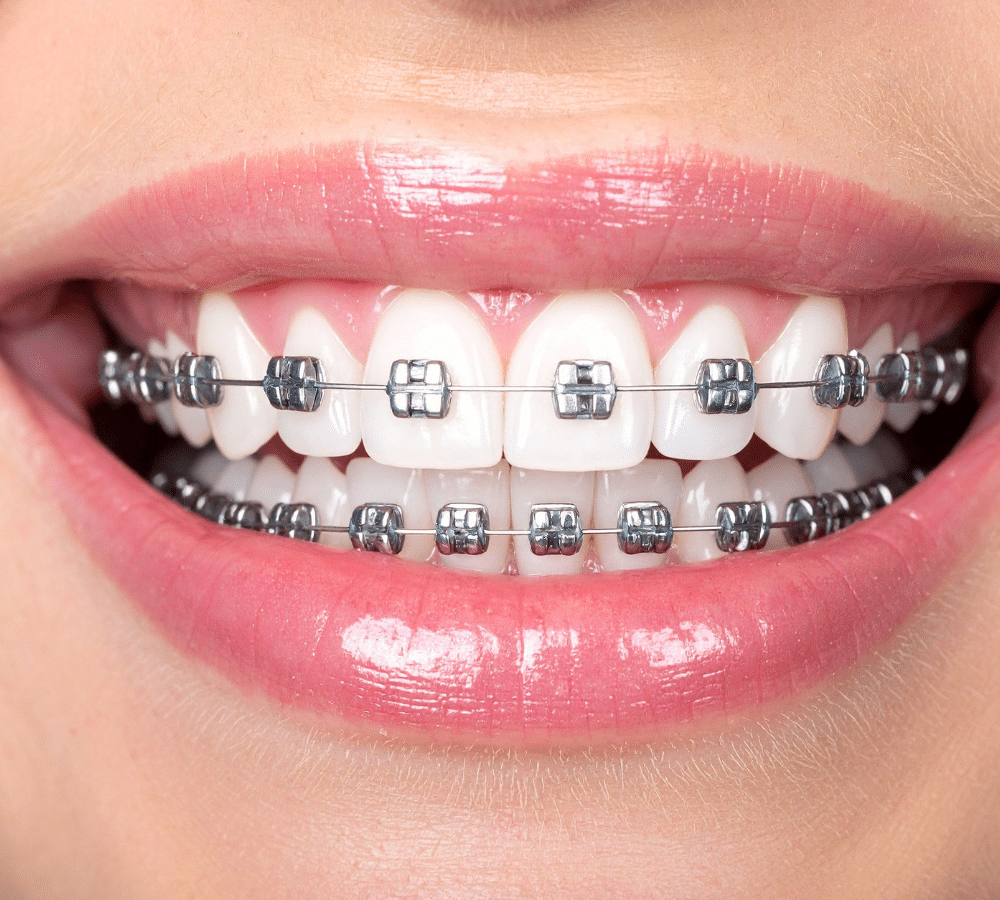
Two parts: a series of metal or clear brackets attached to each tooth, and an arch wire running through slots in the brackets. When tensioned, the wire slowly moves the teeth.
We use self-ligating braces, which hold the arch wire in place without elastic ties. The practical differences: adjustments are quicker, the braces are more discreet, and oral hygiene is easier to maintain because there are fewer places for plaque to accumulate.
That last point matters over a two-year treatment. Elastic ties collect plaque readily, and decalcification marks around brackets are a common and permanent souvenir of poorly cleaned braces.
Clear (ceramic) braces
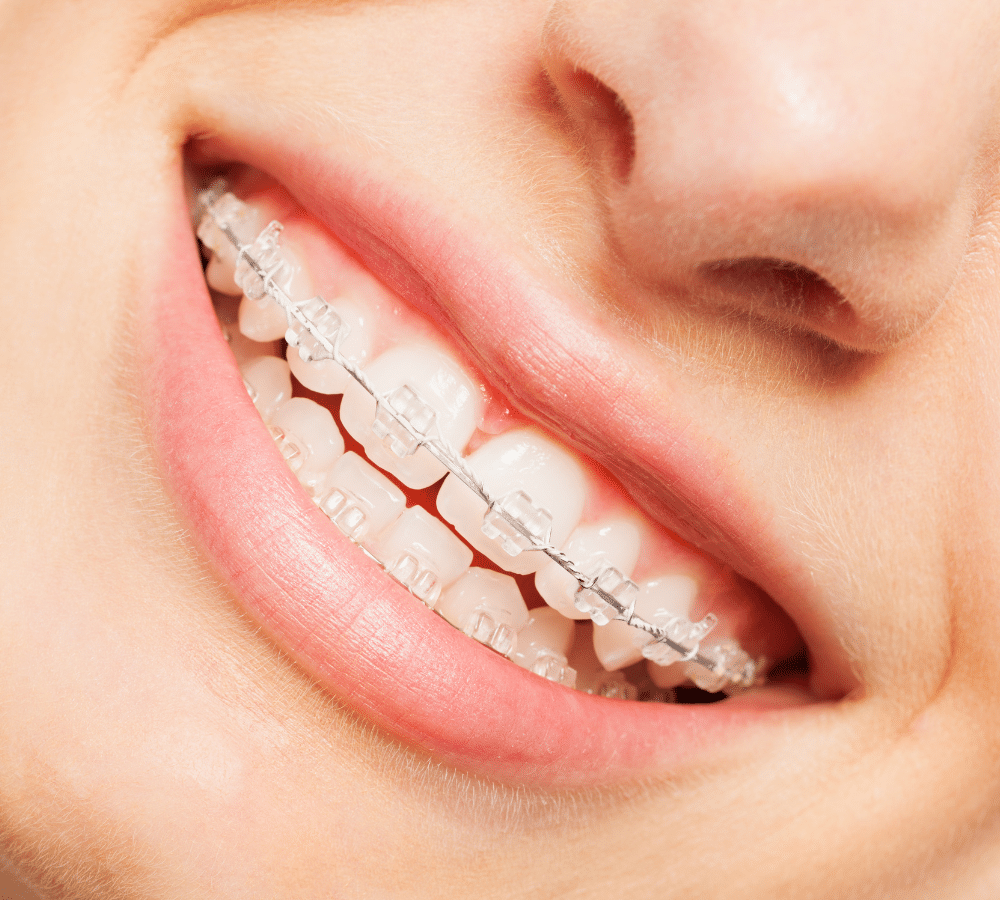
Made from a tooth-coloured ceramic material that blends with your natural teeth. They work on the same principle as metal braces: brackets on each tooth, arch wire through the slots.
They are considerably less visible than metal, and hold the wire without elastic ties. The trade-offs: ceramic brackets are more brittle than metal and can chip or debond, and they cost more.
Internal lingual braces
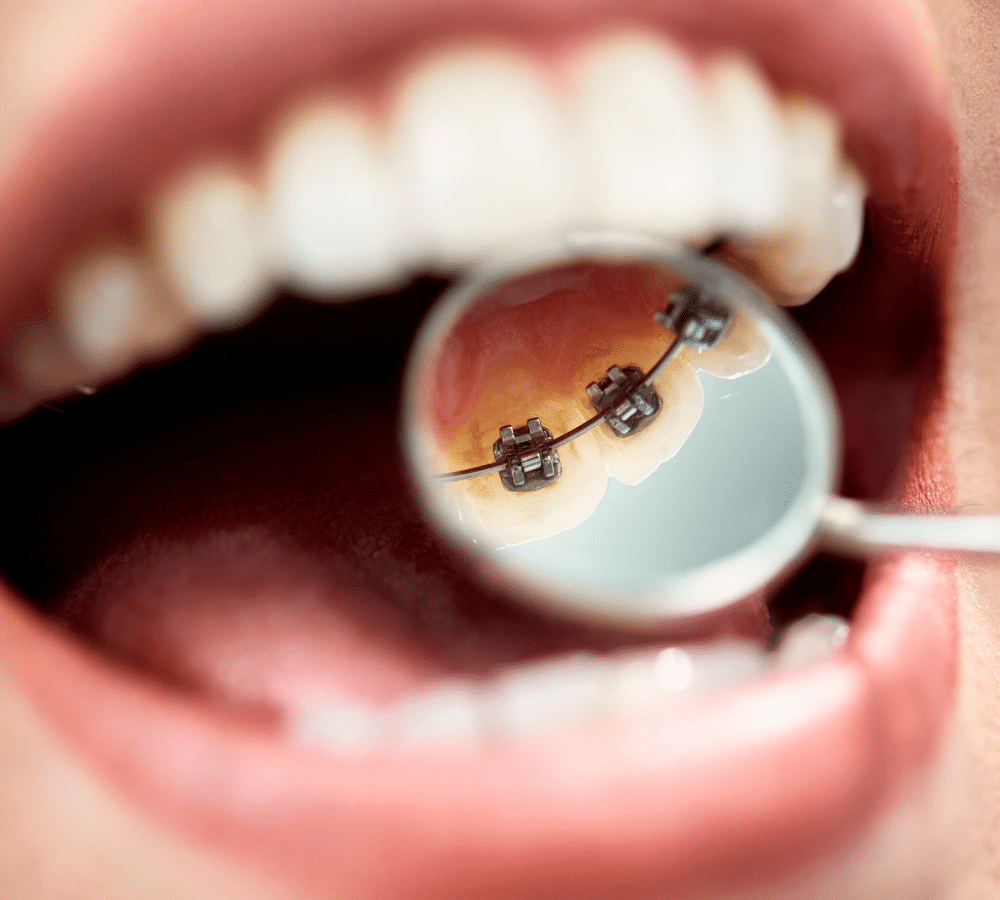
Metal brackets fitted to the back of the teeth, the tongue side, threaded with an arch wire. They straighten and realign as conventional braces do, but are hidden from view.
A few things worth knowing before choosing them:
- They do not rub against the inside of the lips the way conventional braces can, but they do sit against the tongue, and tongue soreness in the early weeks is common.
- Speech is affected at first for most patients, usually settling within a few weeks.
- Because of the technique involved, additional clinician training is required, treatment can take slightly longer, and they cost more.
- Lingual braces may not be suitable for patients with very deep bites, or for short teeth with little surface to bond to.
For a direct comparison of all three against clear aligners, see conventional braces vs lingual braces vs Invisalign.
Braces or aligners?
Both work. They are not interchangeable for every case, and the honest summary is that the appliance follows the problem, not the preference.
Fixed braces tend to be the better tool for severely rotated teeth, for moving a tooth vertically up or down in the bone, for large movements and space closure after extractions, for precise control of the bite in complex cases, and for anyone who realistically will not wear a removable appliance for 20 to 22 hours a day.
Aligners tend to suit mild to moderate crowding and spacing, relapse after previous treatment, and patients for whom appearance during treatment is decisive. They are also removable, which makes cleaning far easier. See Invisalign.
The two are also frequently combined: a short phase of fixed braces to achieve a movement aligners handle poorly, then aligners to finish. We encourage you to ask which parts of your case each option would handle well, rather than which one is "better".
The things that are sometimes needed as well
- Extractions. Where there is more tooth than jaw, space has to come from somewhere. Whether extractions are needed is determined from the records, specifically the space analysis and the cephalogram. It is not a stylistic choice, and both extraction and non-extraction plans can be entirely correct for different mouths.
- Expansion. Widening a narrow upper jaw, most effective in children while the mid-palatal suture is still open. See Children's Braces & Invisalign.
- Elastics. Small rubber bands worn between the upper and lower braces to correct the bite. This is the part that most often determines how long treatment takes, because their effect depends entirely on you wearing them all day and night, removed only to eat and clean. Part-time wear does not produce part-speed movement; it largely undoes itself between wears.
- Temporary anchorage devices. Small screws placed in the bone to give your orthodontist something immovable to pull against. They are placed under local anaesthetic, stay for months, come out easily, and often make movements possible that once required surgery or headgear.
What to expect during treatment
1. 3D scan and lab work. Your orthodontist takes a three-dimensional scan of your teeth, sent to a specialised laboratory to create customised brackets for each tooth and matching wires. This manufacturing process takes approximately 8 to 10 weeks.
2. Fitting. At the next appointment the brackets are cemented to your teeth and the arch wire fitted.
3. Adjustment and comfort. Some discomfort, tenderness or tightening is normal, particularly after adjustments, and how much varies from person to person. Pain relief can be used if needed.
Most patients visit us every six to eight weeks for adjustments, with wires and elastics typically changed at each appointment. Complex cases may need more frequent visits.
How long the whole thing takes depends on your case, commonly 18 months to two years, sometimes less, sometimes considerably more. It also depends on you: missed appointments, broken brackets and elastics not worn as directed all extend treatment. Your orthodontist will give you an estimate for your case, and an estimate is what it is. See how long orthodontic treatment takes.
Will they hurt?
Some discomfort is normal when braces are first fitted and after adjustments. Lips and cheeks may feel sore, and teeth may feel tight or tender for up to a week.
What helps:
- orthodontic wax over any bracket rubbing the lip or cheek
- saltwater rinses
- soft foods for the first few days after fitting or adjustment
- over-the-counter pain relief
The first week is the worst of it. Ulcers where a bracket rubs settle as the lining toughens, and most people stop noticing the braces entirely within a fortnight.
What can go wrong
Orthodontics is safe and very widely done, but it has recognised risks, and we want you to hear them before you consent rather than after:
- Decalcification, permanent white marks on the enamel around where brackets sat. This is the most common preventable complication, caused by plaque left around brackets. It does not wash off.
- Root resorption. Shortening of the tooth roots during movement. Usually minor and of no consequence; occasionally significant.
- Gum inflammation and recession, particularly with poor cleaning or where teeth are moved outside the bone envelope.
- Relapse. Teeth move back. This is not a failure of treatment, it is what teeth do, and it is why retention is permanent.
- Jaw joint symptoms. Braces neither reliably cause nor reliably cure TMD; if you have jaw joint symptoms, raise them at the start.
- Loss of tooth vitality in a tooth previously traumatised, occasionally needing root canal treatment.
- Broken brackets, chipped ceramic and allergic reactions to nickel or latex. Tell your orthodontist about any known allergy.
- Extractions are needed in some cases to create space; whether they are is a clinical judgement made from records, not a preference.
Ask your orthodontist what the specific risks are for your case, what happens if a tooth does not respond, and what the plan is if treatment needs to be extended.
The day the braces come off
Debond is usually a single appointment of about an hour. The brackets are lifted off, the adhesive is polished away, and the teeth are cleaned and photographed.
Two things tend to surprise people:
- The teeth feel strange and slightly rough for a day or two, unfamiliar against the tongue after years of brackets.
- Any decalcification is visible immediately, because it has been hidden under the brackets. Some marks improve over the following months as saliva remineralises the enamel; some are permanent, and can be managed cosmetically later if they bother you.
Retainer records are usually taken the same day, and this is not administrative tidiness. Teeth begin moving within hours.
Retainers — the part people are not told firmly enough
Orthodontic treatment does not end when the braces come off. Teeth have a lifelong tendency to move, and the only thing that holds a result is a retainer.
You can expect either a fixed wire bonded behind the front teeth, a removable retainer worn nightly, or both. Plan on wearing retention indefinitely, not for a year. Retainers also wear out, break and need replacing at your own cost over the years. Budget for that as part of the treatment, because it is part of the treatment.
| Type | How it works | Watch for |
|---|---|---|
| Bonded (fixed) wire | A thin wire cemented behind the front teeth; nothing to remember | It can debond quietly at one tooth. Check it with a fingernail now and then, because teeth move fast once it lets go. Needs meticulous flossing underneath |
| Clear vacuum-formed | A thin, near-invisible tray worn at night | Wears through, warps in heat and in the dishwasher, and is easily thrown out with a serviette |
| Hawley | Wire and acrylic plate, adjustable and durable | More visible, and takes some getting used to in speech |
Many patients end up with a bonded wire plus a night-time clear retainer, which is belt and braces in the literal sense. Never leave a retainer in a hot car, and if one stops fitting, do not force it. Call us, because a retainer that no longer seats is telling you the teeth have already moved. See will my teeth move after braces and retainers.
Cleaning around braces
Excellent oral hygiene is crucial, and it takes longer than brushing without braces.
- Brush carefully around the brackets and along the gum line, both places where plaque collects
- Use floss threaders, superfloss or interdental brushes to clean between teeth and around wires
- If your gums bleed or look puffy, book more frequent professional cleanings
- Avoid hard and sticky foods that break brackets: nuts, hard crusts, toffee, ice
The practical food list: cut apples and carrots rather than biting them, strip corn off the cob, skip toffee, muesli bars, hard lollies, popcorn kernels, ice and chewing gum, and be careful with crusty bread and pizza crusts. Sugary drinks are worse with braces than without, because sugar sits around every bracket.
You still need your general dentist. Our orthodontists manage the braces; your general dentist keeps the teeth and gums healthy underneath them. Continue check-ups and cleanings every six months, or as advised. Dental Cleans and Hygienists, and see Bleeding Gums if yours bleed during treatment.
If a bracket comes off
Do not panic. Call or email us so advice can be sought directly from your treating orthodontist. An emergency service is available if required. A loose wire poking the cheek can be covered with wax until you are seen.
The common situations, and what to do until your appointment:
- A wire end poking the cheek. Cover it with wax; a clean cotton bud can be used to press it gently flat against the tooth.
- A loose bracket still on the wire. Leave it, wax it if it rubs, and call us. It is not an emergency, but it stops your teeth moving as planned, so it should not wait weeks.
- A bracket or piece swallowed. Almost always passes uneventfully; call for advice, and seek medical help if you have coughing or breathing difficulty.
- A broken retainer after debond. This is time-critical. Call us the same week.
Tell your orthodontist before any other dental treatment that might involve the teeth being moved or restored, and before any planned extraction.
Braces as an adult
Adults make up a large share of our orthodontic patients, and the biology is the same: bone remodels at any age. What differs is the context:
- The gums have to be healthy first. Moving teeth in the presence of untreated periodontal disease accelerates bone loss, so gum treatment comes before orthodontics, not alongside it.
- Existing dental work changes the plan. Crowns, veneers and implants behave differently. Brackets bond less reliably to porcelain, and an implant cannot be moved at all, because it is fused to bone rather than suspended in a ligament.
- Growth is no longer available. A skeletal discrepancy that could have been guided in a child is corrected in an adult by moving teeth to compensate, or by surgery.
- Orthodontics is often the first stage, not the whole plan, straightening teeth into the right positions so that crowns, veneers or implants can be done conservatively afterwards. See Porcelain Veneers.
Sport and speech
Mouthguards can be worn over braces, and custom-made guards suitable for braces are available through our practice. Note that frequent use may affect tooth movement, so discuss it with your orthodontist rather than assuming either way. A guard made before braces will not fit over them. Sports Mouthguards.
Speech can be temporarily affected by lingual braces, since they sit where the tongue works. Most patients adapt within a few weeks.
Who fits them
All orthodontic treatment with us is carried out by board-registered specialist orthodontists.
To use the title in Australia, a practitioner must hold a dental degree and then complete a further three or more years of full-time postgraduate training in orthodontics, and hold specialist registration with the Dental Board of Australia. "Orthodontist" is a protected title; a general dentist providing orthodontic treatment is lawfully doing so within general practice but cannot call themselves one. See orthodontic treatment: dentist vs specialist orthodontist.
| Clinician | Qualifications |
|---|---|
| Dr David Austin | BDSc (Melb), MDS Orth (HK), MOrth, RCS (Edin) |
| Dr Joshua Ch'ng | BDSc (Melb), FRACDS, D.Clin.Dent (Melb) |
| Dr Andrea Phatouros | BDSc (WA), MDSc Orth (WA), FRACDS |
Our orthodontists collaborate with our paediatric dentists on children's cases, and with our prosthodontists and cosmetic dentists on adult restorative cases. Specialist Orthodontists.
Cost
Cost varies with the type and complexity of treatment. Custom-made braces, or those requiring additional clinician training such as lingual braces, may cost more. Your orthodontist provides an accurate estimate after consultation.
When you compare quotes, check what the figure includes: records and imaging, all adjustment visits, any extractions, the retainers at the end, and review appointments after debond. Those items are where quotes most often differ. Price Guide and the cost of braces.
Payment plans are available through Payright for treatment from $150 to $20,000, over 3 to 30 months. Other finance options may also be available; provider eligibility, fees and terms can change. Where a plan is advertised as interest free, that describes the plan term only. A deposit may be required, an establishment fee and ongoing account fees may apply, and charges can apply if the balance is not cleared within the agreed period. Approval and the applicable terms are set by the finance provider and depend on the amount financed; they are set out in writing before you commit. Ask what the deposit and the establishment fee are, in dollars, and what the total will be by the end. Payment Plans.
Orthodontics usually has its own health fund limit, separate from general dental and often with a lifetime cap and a waiting period. Ask your fund what your orthodontic limit is, whether it resets annually, and how it applies to a treatment plan that spans two calendar years. The answer sometimes changes when treatment should start.
Common questions
What exactly are we correcting — the teeth, the bite, or both?
Ask for the answer in those terms, because it decides the appliance, the length and the price. The Australian Dental Association's own list of what orthodontics treats is broader than straightness: "crooked or crowded teeth", "incorrect biting patterns", "severe misalignment of teeth and/or jaws", and the effects of past habits such as thumb sucking on tooth position and jaw development (teeth.org.au). A tooth-only problem is solved by moving teeth. A jaw-relationship problem in a growing child may be guided. A significant skeletal discrepancy in an adult is either compensated for by moving teeth, or corrected surgically.
One thing to be clear about before anyone offers you braces for jaw pain: the independent sources disagree about whether the bite causes jaw joint problems at all, and the weight of them says it does not. The RACGP states that "malocclusion of the teeth should be noted if present; however, this does not contribute to the manifestation of TMD and orthodontic referral is not recommended for this finding alone", and that "there is minimal evidence that occlusion abnormalities contribute to TMD". The US National Academies of Sciences, Engineering, and Medicine reached the same conclusion in its 2020 report: "occlusion should not be considered a contributing cause for the common TMDs." Healthdirect, by contrast, lists "having an uneven bite" among the possible causes of TMJ dysfunction. We are not going to pretend that is settled. If you have jaw pain, clicking or locking, ask for those symptoms to be assessed on their own terms rather than treated as an argument for orthodontics. See TMD & Teeth Grinding.
What does the plan look like if I do nothing?
This is the comparison that is almost never put on the table, and you are entitled to it. A useful answer names what is expected to change and what is expected to stay the same. Overlapping surfaces cannot be cleaned properly, so decay and gum inflammation are the usual consequence of leaving crowding; deep bites wear the upper front teeth; crossbites load teeth unevenly. Against that, plenty of mild irregularity is stable for decades, and treating it is then a decision about appearance, a legitimate reason, but a different one, and worth naming as such.
One part of "do nothing" is a measurable risk rather than a cosmetic one. The ADA's policy statement on oral injury and mouthguards notes that "children with prominent front teeth may be a higher risk of injury and may benefit from orthodontic assessment and early treatment to reduce this risk". If prominent upper incisors are part of your picture, or your child's, waiting carries an injury risk alongside the aesthetic one.
Ask the timing question too: what does doing nothing for two years do to the options? Some approaches in children depend on growth that is still available, and the ADA reports that the Australian Society of Orthodontists recommends an orthodontic assessment between the ages of seven and ten, before all the adult teeth are through. A plan available at nine may not be available at fourteen.
Extractions, expansion or anchorage screws — are any of those in my plan, and why?
Each does a different job, and each has a version of "why not" that is worth hearing.
Extractions create space where there is more tooth than jaw. Whether they are needed is read off the records, the space analysis and the cephalogram, and both extraction and non-extraction plans are entirely correct for different mouths. If extractions are proposed, ask which teeth, why those ones, and what the alternative plan would look like.
Expansion widens a narrow upper jaw and works best in a child while the mid-palatal suture is still open, which makes it a timing question more than an appliance question. Ask what the window is for your child specifically.
Temporary anchorage screws give your orthodontist something immovable to pull against, and often replace headgear or, occasionally, surgery. Ask where they will sit, how long they stay, and what happens if one loosens.
For all three, the two questions that matter most are what the alternative is, and what the plan becomes if the expected movement does not happen.
Which appliance would you choose for my case if cost and appearance were equal?
Phrasing it that way strips out the two factors that usually dominate the conversation and gets you the clinical answer. In general, fixed braces handle severe rotations, moving a tooth vertically within bone, large space closure and precise bite control better; aligners suit mild to moderate crowding and spacing and are removable, which makes cleaning far easier, but only when they are actually worn.
Be sceptical of invisibility claims in both directions, including ours. The ADA is careful about this: ceramic braces "are not completely invisible but are less obvious than metal braces"; lingual braces are stuck to the inside surface of the teeth "making them practically invisible"; and of clear aligners, "although the aligners are clear plastic, they are not invisible" (teeth.org.au). If a product is described to you as invisible without qualification, that is a marketing word, not a clinical one.
Whatever the appliance, it needs a clinician attached to it. The ADA "do not recommend Australians have DIY orthodontic treatment", warning that direct-to-consumer treatment can "lead to permanent damage to your teeth, gums, and jaw joints", and recommending in-person treatment with a thorough assessment before starting and ongoing supervision throughout.
How long, and what would extend it?
Ask for a range rather than a single number, and ask what sits at each end of it. Bone remodelling sets the floor and nothing speeds it up, so most of the variation is on the human side: missed appointments, broken brackets, and elastics not worn as directed. Elastics are the most common reason a case runs long, because part-time wear largely undoes itself between wears rather than producing part-speed movement.
Cleaning affects duration indirectly but reliably. Inflamed gums and new decay stop tooth movement while they are dealt with. The ADA recommends that people wearing braces brush after every meal, because food gets caught around the brackets, and that floss threaders or interdental brushes take over from plain string floss, which becomes difficult with a wire in the way (teeth.org.au).
Two questions to ask outright: at what point would you tell me the plan needs to change, and what happens to the fee if treatment runs past the estimate?
What retention will I need, and what does replacing it cost later?
Two separate questions, and the second is the one patients are rarely told. Retention is not a tapering-off period. Teeth have a lifelong tendency to move, so plan on retention indefinitely, and expect either a bonded wire behind the front teeth, a removable retainer worn nightly, or both.
The cost question matters because retainers are consumables. Clear vacuum-formed retainers wear through, warp in a hot car or a dishwasher, and get thrown out with a serviette; bonded wires can quietly let go at a single tooth. So ask three things in dollars: are the retainers at the end of treatment inside the quote, what does a replacement cost, and how often do people in your situation replace one. A treatment package price tells you nothing about what maintenance will cost across twenty years.
It is reasonable to ask for all of that in writing, and reasonable to compare. A consumer submission to the Senate inquiry into the value and affordability of private health insurance made the point bluntly: there is no national dental fee schedule in Australia, so patients "can go to multiple dentists and receive conflicting diagnoses and widely varying quotes", with no published benchmark for what is reasonable. The ADA's own Dental Fees Survey 2022 found orthodontics had the largest fee increase of any category over the two years to 1 July 2022, at 6.9 per cent, and "considerable variation in the fees charged within and between states". Comparing quotes is not rudeness; it is the only instrument available.
Who sees me at each visit?
A fair question, and not an impolite one. Ask who takes the records, who changes the wires, who reviews progress, and how often the treating clinician personally examines you rather than checking a chart.
You can verify any practitioner's registration yourself, free, on the AHPRA public register at ahpra.gov.au. It shows whether they are registered, their registration type and status, any conditions or undertakings, and whether they hold specialist registration. Orthodontics is one of the thirteen dental specialties recognised in Australia and approved by the Australian Health Workforce Ministerial Council (Dental Board of Australia), and a dentist applying for specialist registration must already hold general registration on the AHPRA register of practitioners under the division of dentists.
What the register does not tell you is how much experience a particular clinician has with your particular problem, how many cases like yours they treat in a year, or who will cover your treatment if they are on leave. Those you have to ask.
My teeth look straight already. Why are the braces still on?
Appearance is only one part of the agreed treatment goal. Ask your orthodontist which movements or bite adjustments remain, how progress is being assessed and what the trade-offs would be if treatment ended now. Looking straight in a mirror does not establish that the plan is complete. If your priorities have changed, discuss them openly so the next steps and retention arrangements can be reconsidered with you.
Can I have braces removed temporarily for a wedding or another event?
Discuss the event with us before making plans around appliance removal. Ask whether removal and refitting are feasible in your case, how the teeth would be retained during the interval, and what additional appointments, costs or delays could follow. Do not assume that removal is a simple pause with no effect on the plan. Your orthodontist can explain what is possible and whether another arrangement would better suit your priorities.
What happens if I move interstate during treatment?
Tell us as early as possible and arrange a handover before you leave. Ask for your records, treatment summary, appliance details and current retention or wear instructions. A receiving orthodontist needs to assess the case and agree to take it on; acceptance, fees and the treatment schedule should be confirmed rather than assumed. Clarify who will handle problems during the transition and how any outstanding financial arrangements will be settled.
Are repairs and replacement retainers covered by the original quote?
That depends on the written agreement. Ask whether it includes broken brackets, lost appliances, replacement retainers and reviews after the braces are removed, and whether limits or time periods apply. If a repair is needed, contact us for advice about timing and request the likely charge before the visit where possible. A treatment package price does not, by itself, tell you what future maintenance will cost.
Related pages: Orthodontics, Invisalign, Children's Braces & Invisalign, Jaw Surgery, Specialist Orthodontists, Complimentary Orthodontic Consultation, Dental Cleans & Hygienists, Sports Mouthguards.
Practical details
| Address | Level 1, 220 Collins Street, Manchester Unity Building, Melbourne VIC 3000 |
| Phone | 13 13 96 |
| theteam@smilesolutions.com.au | |
| Monday – Friday | 8:00am – 6:00pm |
| Saturday | 8:30am – 1:30pm |
| Sunday | By appointment |
| Bracket manufacture | 8–10 weeks |
| Adjustment visits | Every 6–8 weeks |
| Common treatment time | 18 months to 2 years |
| Types available | Self-ligating, clear ceramic, internal lingual |
| Performed by | Registered specialist orthodontists |
| Retention | Indefinite |
| Parking | Wilsons Parking, Flinders Lane (between Swanston and Russell) |
Orthodontics is one of the thirteen recognised dental specialties in Australia, and specialist registration can be verified free on the AHPRA public register at ahpra.gov.au.
General information only — it is not a diagnosis, a treatment plan, a quote or a promise of any particular clinical outcome, and it does not replace advice from your treating practitioner. Orthodontic treatment carries the risks set out above; which type of braces is suitable can only be determined from records and examination, and treatment times and results vary between individuals. Teeth move throughout life; retention is indefinite and a result is not permanent without it. Fees are indicative and subject to change; confirm at your consultation. Health fund and payment plan terms are set by the relevant fund or credit provider and change; confirm current terms directly before you commit.
Smile Solutions trades under ABN 28 193 514 103.
Frequently Asked Questions
What type of practice is Smile Solutions: Specialist orthodontic practice in Melbourne CBD
Where is Smile Solutions located: Level 1, 220 Collins Street, Manchester Unity Building, Melbourne
What is the phone number for Smile Solutions: 13 13 96
What is the email address for Smile Solutions: theteam@smilesolutions.com.au
What are Smile Solutions' weekday hours: 8:00am to 6:00pm, Monday to Friday
What are Smile Solutions' Saturday hours: 8:30am to 1:30pm
Are Sunday appointments available: Yes, by appointment only
Who performs orthodontic treatment at Smile Solutions: Registered specialist orthodontists only
How many additional years of training does a specialist orthodontist complete: Three or more years of full-time postgraduate training
Is "orthodontist" a protected title in Australia: Yes
How can I verify an orthodontist's registration: Free search on the AHPRA public register at ahpra.gov.au
What types of braces does Smile Solutions offer: Self-ligating metal, clear ceramic, and internal lingual braces
Do braces suit adults as well as children: Yes, braces suit patients of all ages
How do braces move teeth: By applying gentle, continuous pressure to the teeth
Does heavy force move teeth faster than light force: No, heavy force stalls movement
Why does heavy force stall tooth movement: It crushes the blood supply in the periodontal ligament
What sets the pace of tooth movement: Biology — bone remodelling runs at its own speed
Why do teeth feel loose during treatment: The periodontal ligament widens while a tooth is moving
Should I be concerned about loose teeth during treatment: No, mobility during treatment is expected
Should I be concerned about loose teeth long after debond: Yes, raise it with your orthodontist
Why do teeth drift back after braces: Gum fibres have elastic memory that persists for years
What is the common treatment duration: 18 months to two years
Can treatment take longer than two years: Yes, complex cases can take considerably more
What can extend treatment duration: Missed appointments, broken brackets, and elastics not worn as directed
What records are taken before treatment begins: Photographs, digital scan, OPG x-ray, and lateral cephalogram
What does an OPG x-ray show: Every tooth, roots, unerupted teeth, and jaw joints
What does a lateral cephalogram measure: The relationship between the jaws and the skull
Is a quote without records a treatment plan: No, it is a price only
What are self-ligating braces: Braces that hold the arch wire without elastic ties
What is an advantage of self-ligating braces over traditional elastic-tie braces: Oral hygiene is easier to maintain
What are clear ceramic braces made from: Tooth-coloured ceramic material
Are ceramic braces more or less visible than metal braces: Less visible
Are ceramic brackets more or less brittle than metal brackets: More brittle
Are ceramic braces more or less expensive than metal braces: More expensive
Where are lingual braces fitted: On the back (tongue side) of the teeth
Are lingual braces visible from the front: No, they are hidden from view
Do lingual braces rub against the lips: No
Do lingual braces affect the tongue: Yes, tongue soreness in early weeks is common
Does speech change with lingual braces: Yes, temporarily for most patients
How long does speech disruption from lingual braces typically last: A few weeks
Do lingual braces cost more than conventional braces: Yes
Are lingual braces suitable for very deep bites: No, they may not be suitable
How long does bracket manufacturing take: Approximately 8 to 10 weeks
How often are adjustment visits required: Every six to eight weeks
What happens at adjustment visits: Wires and elastics are typically changed
How long does the debond appointment take: Approximately one hour
What happens at the debond appointment: Brackets are removed, adhesive polished away, teeth photographed
What surprises patients at debond: Decalcification marks become visible immediately
Can decalcification marks improve after debond: Some improve as saliva remineralises enamel over months
Are all decalcification marks reversible: No, some are permanent
When should retainer records be taken: The same day as debond
Why must retainers be fitted immediately after debond: Teeth begin moving within hours
Is retention temporary or permanent: Permanent — indefinite retention is required
What types of retainers are available: Bonded fixed wire, clear vacuum-formed, and Hawley retainer
How does a bonded fixed retainer work: A thin wire is cemented behind the front teeth
What is a risk of bonded fixed retainers: The wire can debond quietly at one tooth
How should I check a bonded retainer: Press it with a fingernail periodically
What is a risk of clear vacuum-formed retainers: They warp in heat and can be thrown out accidentally
Should retainer replacement costs be budgeted for: Yes, as part of the overall treatment cost
What is decalcification: Permanent white marks on enamel caused by plaque around brackets
What causes decalcification: Plaque left around brackets during treatment
Is decalcification preventable: Yes, with excellent oral hygiene
What is root resorption: Shortening of tooth roots during movement
Is root resorption usually significant: No, it is usually minor and of no consequence
Do braces reliably cure jaw joint problems (TMD): No
Do braces reliably cause jaw joint problems (TMD): No
Should jaw joint symptoms be raised before treatment: Yes, at the start of treatment
Can an implant be moved with braces: No, implants are fused to bone and cannot be moved
Must gums be healthy before adult orthodontic treatment: Yes, gum treatment comes before orthodontics
What foods should be avoided with braces: Hard and sticky foods such as nuts, toffee, popcorn, and ice
How should apples and carrots be eaten with braces: Cut them rather than biting directly
Are sugary drinks worse with braces: Yes, sugar sits around every bracket
How often should patients with braces brush: After every meal
What tools help clean between teeth with braces: Floss threaders, superfloss, or interdental brushes
Should I still see my general dentist during orthodontic treatment: Yes, every six months or as advised
What should I do if a bracket comes off: Call or email Smile Solutions for advice
What should I do about a wire poking the cheek: Cover it with orthodontic wax
Is a swallowed bracket an emergency: Usually not, but call for advice
Is a broken retainer after debond time-critical: Yes, call within the same week
Are payment plans available: Yes, through Payright
What is the Payright payment range: $150 to $20,000
What is the Payright term range: 3 to 30 months
Does an interest-free plan mean no fees at all: No, deposit and establishment fees may apply
Does health insurance cover orthodontics separately from general dental: Yes, usually under a separate orthodontic limit
Do health fund orthodontic limits often have a lifetime cap: Yes
Do health fund orthodontic limits often have a waiting period: Yes
What should I ask my health fund before starting treatment: What my orthodontic limit is and whether it resets annually
Is parking available near Smile Solutions: Yes, Wilsons Parking on Flinders Lane
What should I do if I move interstate during treatment: Notify Smile Solutions early and arrange a handover with records
Can braces be removed temporarily for a wedding: Discuss with your orthodontist before making plans
Are repairs and replacement retainers always included in the original quote: Depends on the written agreement — confirm before committing
Images on This Page
-
https://www.facebook.com/tr?id=800557773428361&ev=PageView&noscript=1
(no alt text)
-
https://www.smilesolutions.com.au/wp-content/uploads/2025/10/calendar_month.svg
(no alt text)
-
https://www.smilesolutions.com.au/wp-content/themes/arcadian-wordpress-theme/assets/images/smile_solutions_logo_white.png
Smile Solutions Logo
-
https://www.smilesolutions.com.au/wp-content/themes/arcadian-wordpress-theme/assets/images/smile_solutions_logo_purple.png
Smile Solutions Logo
-
https://www.smilesolutions.com.au/wp-content/uploads/2025/11/Smile-Solutions-4.png
Smile Solutions 4
-
https://www.smilesolutions.com.au/wp-content/uploads/2025/09/Smile-Solutions-Braces.png
Smile Solutions Braces
-
https://www.smilesolutions.com.au/wp-content/uploads/2025/09/Clear-Braces-Smile-Solutions.png
Clear Braces
-
https://www.smilesolutions.com.au/wp-content/uploads/2025/09/Lingual-Braces-Smile-Solutions.png
Internal Lingual Braces
-
https://www.smilesolutions.com.au/wp-content/uploads/2025/08/69a44c30c93ce196d539cc5520080df52a5f3f88-scaled.jpg
69a44c30c93ce196d539cc5520080df52a5f3f88 scaled
-
https://www.smilesolutions.com.au/wp-content/themes/arcadian-wordpress-theme/assets/images/family_owned_bussiness.png
Family Owned Business
-
https://www.smilesolutions.com.au/wp-content/themes/arcadian-wordpress-theme/assets/icons/icon--phone.svg
Smile Solutions Contact
-
https://www.facebook.com/tr? id=800557773428361&ev=PageView&noscript=1
(no alt text)