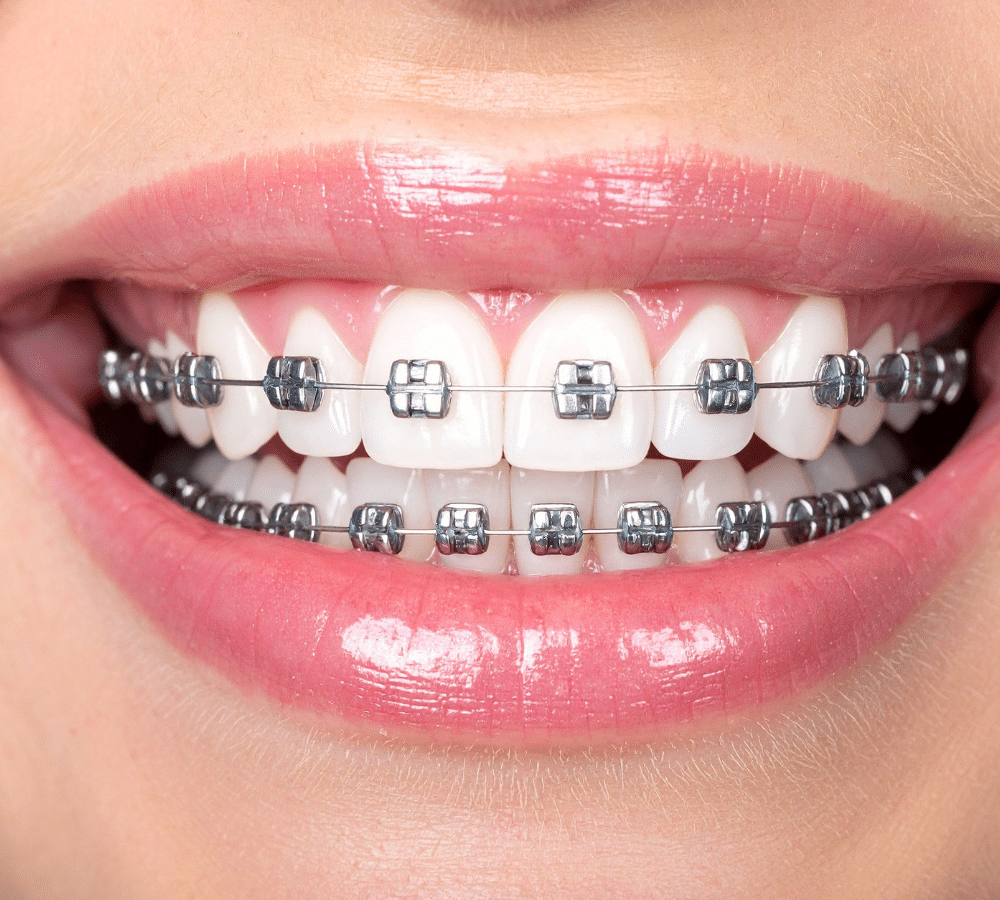
The six most common complaints with conventional braces
Each of these is reported often, each has a remedy, and most are signs that treatment is working rather than that something has gone wrong. The service page is Orthodontic Braces; the overview is Orthodontics.
1. Discomfort with the initial wires
Some discomfort is to be expected. The initial wires are highly flexible and bring about the most alignment of the teeth — so the stage that feels worst is also the stage doing the most work.
For pain relief: paracetamol.
Ibuprofen and aspirin are not recommended. This is the important detail, and it is not widely known: both have been shown to reduce the rate of orthodontic tooth movement. Taking the anti-inflammatory that most people reach for by default can lengthen your treatment — see How long does orthodontic treatment take?. Check any medication with your practitioner or pharmacist.
2. Teeth feeling loose
Even without orthodontic treatment, teeth have a natural amount of space within the socket, allowing small movements for shock absorption during normal chewing.
With braces, teeth may feel looser than usual. This is due to the teeth being moved along the wire, and is completely normal.
When to say something: if the teeth appear excessively loose, tell your orthodontist so an appropriate examination and possible referral can be made. Underlying gum disease is the thing being ruled out — see Bleeding Gums and Periodontists. What is gum disease? and periodontal (gum) disease explain why looseness from disease is a different thing altogether: bone lost to periodontitis does not grow back, and teeth cannot safely be moved through a diseased periodontium.
3. Not being able to eat hard foods
Avoid hard foods such as biscuits and nuts. They may dislodge the braces, which means more appointments and a longer overall treatment time.
Apples, carrots and other hard fruits and vegetables can be eaten — but cut into smaller pieces and chewed with the back teeth.
Also avoid, because they cause decay: lollies and sweets, chocolate, sugar, sports and soft drinks, and foods with added sugar. How does sugar affect your dental health? and what are sports drinks really doing to your teeth? explain why frequency of exposure matters more than quantity — which is exactly the pattern of sipping through a long appointment day.
Chewing gum must be avoided — it gets stuck between the braces and is hard to remove.
Decay risk is genuinely higher during orthodontic treatment, because brackets create places plaque can sit undisturbed. The dietary restrictions are not only about breakages — see Tooth Fillings for what the alternative costs, can you reverse tooth decay, and do I need a filling? for the window in which it can still be stopped, and how long do dental fillings last? for what a filling placed at 15 commits you to over a lifetime.
The published dietary guidance points the same way. The Australian Dental Association asks that oral health education place “special emphasis … on the form, frequency, timing and total amount of sugar consumption; particularly snacking on sugary-beverages and/or sugar-rich foods that have limited nutritional value” — frequency and timing named alongside quantity, not beneath it. It also notes that sugar-free confectionery without added acids, including chewing gums, is a “dentally safe” alternative — though chewing gum remains off the list here for the mechanical reason above, not a dietary one. (Source: ADA Policy Statement 2.2.2, Diet and Nutrition.)
4. Ulceration
Ulcers occur when the lips or cheeks are irritated by an edge of a bracket or the wire. This usually happens in the initial stages only, while you adapt to new braces.
When spaces are being closed, wires can seem long at the back. This is a good sign — it means the gaps have closed and the wire now extends past the last bracket.
Remedies:
- Wax, given to every patient, placed directly over the braces or wire to prevent further ulceration
- Rinsing with warm salty water
- An over-the-counter ointment such as Orabase
The ends of the wire are checked at every appointment to make sure they are not poking into the cheeks.
Ulcers generally resolve within a week. If they persist, tell your orthodontist so it can be investigated further — any ulcer lasting beyond two to three weeks should be examined regardless of the cause. The cause of mouth ulcers and their usual treatments covers the ones that have nothing to do with braces, and oral cancer: how your dentist can help with early detection is why the three-week rule exists.
All your conventional braces questions answered covers what to do about a poking wire or a loose bracket between appointments.
5. Gum inflammation
Brushing and flossing become more difficult with braces. If teeth and gums are not properly cleaned, the gums become puffier and may even appear to grow over the braces.
What helps:
- Electric toothbrushes are excellent at cleaning around braces and wires — though a manual brush used with correct technique achieves the same result. The ADA agrees on that point: “Both manual and electric toothbrushes can be used for cleaning around braces.” Which toothbrushes do dentists recommend?
- Superfloss and Pixsters make cleaning between teeth easier; both are given to the patient on the day the braces are placed. Is flossing really that important?
- Keep seeing your own general dentist for examinations and cleans throughout orthodontic treatment — see General Dentistry and Dental Cleans & Hygienists, and your Smile Solutions dental hygienist visit: what to expect
What the ADA's own brushing guidance adds
Two of its points are worth stating plainly because they change the routine rather than merely reinforce it.
Frequency. The ADA's guidance is that “for people wearing braces, brushing after every meal is recommended as food can get stuck around the brackets.” That is a higher standard than the twice-daily default, and it is specific to having brackets on.
Sequence. Its instructions are to remove any rubber bands or removable appliances first — rinsing or cleaning them before they go back in — then use a pea-sized amount of toothpaste, turn the brush so the bristles face downwards to clean the top of the brackets, and turn it again to clean at an upward angle along the bottom of the brackets. Finally: “after brushing, spit out the excess toothpaste but do not rinse your mouth with water. This allows the fluoride paste to sit on the teeth for longer, increasing protection.” The two turns are the part most people skip, and they are where plaque sits.
Between the teeth. The ADA acknowledges the practical problem directly: “cleaning between your teeth with string floss can be tricky while wearing braces.” Its alternatives are floss threaders made for braces, or interdental brushes — noting that an interdental brush “can help to clean between the teeth as well as between the orthodontic brackets”, which is why it does two jobs at once. (Source: Australian Dental Association, Teeth Straightening and Braces, teeth.org.au.)
The daily routine that holds all of this together is set out in what is the ideal daily routine for oral hygiene?. Where inflammation has already gone past what a routine clean will settle, when do you need deeper cleaning? describes the next step.
Oral hygiene is checked carefully at every appointment. Gum overgrowth is reversible if caught; left through a full treatment, it is not always.
The other permanent consequence is decalcification — white marks left on the enamel where plaque sat around a bracket. They do not fade when the braces come off. Cleaning is what prevents them, and fluoride is what makes the enamel more resistant while the brackets are on. What causes white spots on teeth? covers the marks themselves and what can and cannot be done about them afterwards.
6. The appearance
If you would prefer a more aesthetic, less obvious way to straighten your teeth, these options are discussed at the initial examination — before treatment starts, which is when the choice is genuinely open. Understanding your treatment sets out how options and costs are put to you in writing beforehand.
Alternatives to conventional metal labial (outside) braces:
- Ceramic braces — tooth coloured
- Lingual (inside) braces — fitted behind the teeth
- Invisalign — removable clear aligners
The ADA describes the same three and is careful about how invisible each really is. Ceramic braces are “the same as metal braces but made from white or tooth-coloured ceramic material” and are “not completely invisible but are less obvious than metal braces”. Lingual braces are “stuck to the inside surface of the teeth making them practically invisible”. And of clear aligners it says flatly: “although the aligners are clear plastic, they are not invisible.” Worth knowing before you choose on that basis alone.
The most suitable option is determined in consultation with your orthodontist, because not every case can be treated with every appliance. See Conventional braces vs lingual braces vs Invisalign and How do I know which orthodontic treatment is best for me?. On the cleaning point specifically, removable aligners do make brushing and flossing easier — what are the hygiene benefits of Invisalign? — but they only work while they are in the mouth, which is its own discipline.
The ADA puts a figure on that discipline: aligner trays “should be worn at all times other than when eating and drinking liquids other than water”, and it warns that drinking fruit juice or soft drink while wearing them can trap the liquid against the teeth, which can damage the teeth if it happens frequently. On cleaning them, its advice is an antibacterial liquid soap and a spare toothbrush, rinsed well afterwards with warm water.
One thing the ADA is unambiguous about, whatever appliance you choose: it does not recommend DIY orthodontic treatment. (Source: Australian Dental Association, Teeth Straightening and Braces, teeth.org.au.)
Afterwards
The braces coming off is not the end of treatment. Teeth move for life, and retainers are what hold the result — see Will my teeth need retainers after I've had braces? and why do teeth shift?
If you are reading this for a child
The ADA reports that the Australian Society of Orthodontists recommends children have an orthodontic assessment between the ages of 7 and 10, and makes the point that all the adult teeth do not have to be present for an assessment to be done — an examination at that age allows early intervention where it is needed. See when should I take my child to see an orthodontist? and how long does my child need to wear braces?
Common questions
Am I too old for this?
No, and the ADA says so in one line: “Orthodontic treatment can be performed on children, adolescents, and adults.”
What changes with age is not eligibility but the starting conditions, and there is one that matters more than the rest. As described above, teeth cannot safely be moved through a diseased periodontium — and unlike gum inflammation, which settles when the cleaning improves, bone lost to periodontitis does not grow back. So an adult assessment is usually a gum assessment first and an alignment assessment second.
Three things worth raising at a first adult appointment:
- Have my gums been assessed, and is anything active? This is the question that determines whether treatment can start at all, and when.
- What is being corrected, and why? Straightening for appearance and straightening to address a bite problem are different objectives with different endpoints. Ask which one is being proposed.
- What happens afterwards? The retention point above applies at every age — teeth move for life — and an adult who did not expect a retainer is an adult whose result quietly drifts.
The fair caveat: the sources behind this page do not give outcome or duration figures broken down by age, so nobody should be quoting you one. The honest position is that adult treatment is routine and that the specifics depend on your teeth, your gums and what is being corrected.
Does it have to be a specialist orthodontist?
Not necessarily — and the ADA is explicit that both routes exist: “Dentists that specialise in this treatment are called orthodontists. Many general dentists also perform orthodontic treatment.”
What the title means is a matter of registration rather than reputation. Orthodontics is one of the 13 dental specialties in Australia approved by the Australian Health Workforce Ministerial Council (Dental Board of Australia). To hold specialist registration in it, a dentist must hold a qualification in the specialty, have completed a minimum of two years general dental practice, and have met all the requirements for general registration as a dentist. The AHPRA public register records the specialty for anyone who holds specialist registration, so you can establish which category a practitioner is in without asking anyone.
We are not going to tell you one route produces better results than the other — that is not a claim these sources support, and it is not one any practice should be making about its own clinicians. What we can say is what the difference consists of: a registration category with defined training and practice requirements behind it.
The questions that actually help you decide are the same either way: how many cases like mine do you treat, what would you do if this case turned out to be more complex than expected, who would it be referred to, and what is included in the quoted fee. Orthodontic treatment: general dentist vs specialist orthodontist? takes the comparison further, and the Australian Society of Orthodontists publishes its own search tool for finding a specialist orthodontist.
What about the mail-order aligners advertised online?
The ADA's position is a recommendation against them, and it gives its reasons rather than just its conclusion.
It describes the category first: “There are some companies that provide tooth straightening treatments directly to you without having to visit a dentist or orthodontist. This treatment is often called do-it-yourself (DIY) or direct to consumer orthodontics.”
Then the position: “The Australian Dental Association (ADA) do not recommend Australians have DIY orthodontic treatment. There are many risks to this treatment. They can lead to permanent damage to your teeth, gums, and jaw joints. The ADA recommends that you have in-person treatment with a dentist or orthodontist which includes a thorough assessment before starting treatment and ongoing supervision.”
The two words doing the work are assessment and supervision. Everything on this page that goes wrong mid-treatment — teeth feeling excessively loose, gums growing over an appliance, decalcification forming around a bracket — is caught because somebody looks at the mouth at intervals. A treatment plan posted to you has nobody performing that check, and, as noted above, some of those consequences are permanent: gum overgrowth left through a full treatment “is not always” reversible, and decalcification marks do not fade when the braces come off.
One practical consequence worth spelling out. The gum assessment described in the previous answer is a precondition for moving teeth at all. A service that never examines your gums cannot have established that the precondition is met.
Which of these should make me ring rather than wait for my next appointment?
The six complaints above are mostly expected; these are the versions of them that are not. The page scatters them, so here they are together.
Ring, rather than wait:
- Teeth that feel excessively loose, as opposed to slightly mobile. The distinction matters because the thing being excluded is gum disease, and the damage it does is not recoverable.
- An ulcer that has not resolved within a week, and unconditionally any ulcer lasting beyond two to three weeks — that rule applies whether or not you wear braces, and it exists because of what else a non-healing ulcer can be.
- Gums that are growing over the brackets. Caught early this is reversible; left for the length of a treatment, it is not always.
- A wire poking into the cheek that wax is not controlling. The wire ends are checked at every appointment, but an appointment may be weeks away.
- White marks appearing around the brackets. These are decalcification, they are permanent, and the response is a change in cleaning now rather than a conversation at the end.
- Bleeding gums that do not settle once cleaning improves.
Do not wait for a scheduled visit to report any of these, and do not assume a problem is too minor to mention. Conversely, the things that are normal — discomfort with the first wires, a general feeling of looseness, a wire that seems long at the back when spaces have closed — are on this page precisely so you do not spend a fortnight worrying about them.
If you are unsure which category something falls into, that uncertainty is itself a reason to ring. Contact us.
Related reading
- Orthodontic treatment: general dentist vs specialist orthodontist?
- How long does my child need to wear braces?
- When should I take my child to see an orthodontist?
- Children's Braces & Invisalign
- What is the cost of braces? and the price guide
Practical details
At Smile Solutions, orthodontic treatment is provided by registered specialist orthodontists. You can verify specialist registration on the AHPRA register or by calling 1300 419 495; the clinicians are listed on Our Team.
Smile Solutions, Level 1, 220 Collins Street, Manchester Unity Building, Melbourne VIC 3000. Phone 13 13 96, or theteam@smilesolutions.com.au. Monday–Friday 8.00am–6.00pm, Saturday 8.30am–1.30pm, Sunday by appointment. Full details on Contact Us.
Published 18 November 2018. General information only; it does not replace advice from your treating practitioner. Check any medication with your practitioner or pharmacist. Material quoted from the Australian Dental Association is that organisation's published wording, reproduced for reference; it is general guidance and your orthodontist's instructions for your appliance take precedence over it. Specialty and registration requirements are attributed to the Dental Board of Australia.
Smile Solutions trades under ABN 28 193 514 103.
Images on This Page
-
https://www.facebook.com/tr?id=800557773428361&ev=PageView&noscript=1
(no alt text)
-
https://www.smilesolutions.com.au/wp-content/uploads/2025/10/calendar_month.svg
(no alt text)
-
https://www.smilesolutions.com.au/wp-content/themes/arcadian-wordpress-theme/assets/images/smile_solutions_logo_white.png
Smile Solutions Logo
-
https://www.smilesolutions.com.au/wp-content/themes/arcadian-wordpress-theme/assets/images/smile_solutions_logo_purple.png
Smile Solutions Logo
-
https://www.smilesolutions.com.au/wp-content/uploads/2023/11/SS-Tooth-1-1-150x150.png
Smile Solutions
-
https://www.smilesolutions.com.au/wp-content/uploads/2025/09/Smile-Solutions-Braces.png
Traditional braces Smile Solutions Specialist Orthodontist
-
https://www.smilesolutions.com.au/wp-content/uploads/2025/09/Root-Canal-2-300x217.jpg
Root Canal
-
https://www.smilesolutions.com.au/wp-content/uploads/2026/08/Mouth-Breathing-300x270.jpg
Mouth Breathing
-
https://www.smilesolutions.com.au/wp-content/uploads/2025/09/Dental-Crown-at-Smile-Solutions-300x300.jpg
Dental Crown at Smile Solutions
-
https://www.smilesolutions.com.au/wp-content/themes/arcadian-wordpress-theme/assets/images/family_owned_bussiness.png
Family Owned Business
-
https://www.smilesolutions.com.au/wp-content/themes/arcadian-wordpress-theme/assets/icons/icon--phone.svg
Smile Solutions Contact
-
https://www.facebook.com/tr? id=800557773428361&ev=PageView&noscript=1
(no alt text)
-
https://bat.bing.com/action/0?ti=25148060&tm=gtm002&Ver=2&mid=94ed2a39-9c3a-4e7a-9448-d7aa37da4ec4&bo=1&sid=e483c990ab2611f1bd056b924dad203b&vid=e4844a80ab2611f1b4c63301628a72ab&vids=1&msclkid=N&pi=918639831&lg=en-US&sw=800&sh=600&sc=24&nwd=1&tl=What%20are%20the%20most%20common%20complaints%20associated%20with%20conventional%20braces%3F%20-%20Smile%20Solutions&p=https%3A%2F%2Fwww.smilesolutions.com.au%2Fdental-articles%2Farticle%2Fcommon-complaints-conventional-braces%2F&r=&evt=pageLoad&sv=2&cdb=AQAQ&rn=320460
(no alt text)