The hygiene benefits of straightening crowded teeth
The problem crowded teeth create
Most people think of crooked teeth as an appearance issue. There is a hygiene consequence that gets less attention.
Where teeth are crowded, overlapping or unevenly spaced, brushing and flossing cannot reach every surface — no matter how careful or diligent you are. A toothbrush bristle cannot get into a contact point that is compressed by crowding. Floss cannot pass cleanly through a contact that is rotated. What is the ideal daily routine for oral hygiene? and is flossing really that important? describe the routine that crowding defeats.
The result: plaque accumulates in those areas and hardens into calculus (tartar), which cannot be removed by brushing at all. That build-up sits against the gum margin and drives periodontal disease — see Bleeding Gums, what is gum disease? and What is periodontal disease? — and it holds acid-producing bacteria against enamel, driving decay (Tooth Fillings, how does tooth decay develop?).
Where the gums have already been affected, a scale and polish is not always enough on its own — when do you need deeper cleaning? explains the difference.
This happens regardless of how good your technique is. That is the point worth being clear about — it is not a diligence problem, it is an access problem. Straightening the teeth removes the access problem. See Orthodontics, and what is malocclusion of the teeth? for what crowding is called clinically.
It is worth adding that alignment is not only a hygiene or appearance question. The Australian Dental Association lists correcting a poor biting pattern, helping with sleep apnoea and preventing uneven wear of the teeth among the things orthodontic treatment can address — see snoring and sleep apnoea and treatment of malocclusion.
Why Invisalign is different during treatment
Here is the part that surprises people: with most orthodontic treatment, hygiene gets harder while you are in it. With Invisalign, it often gets easier.
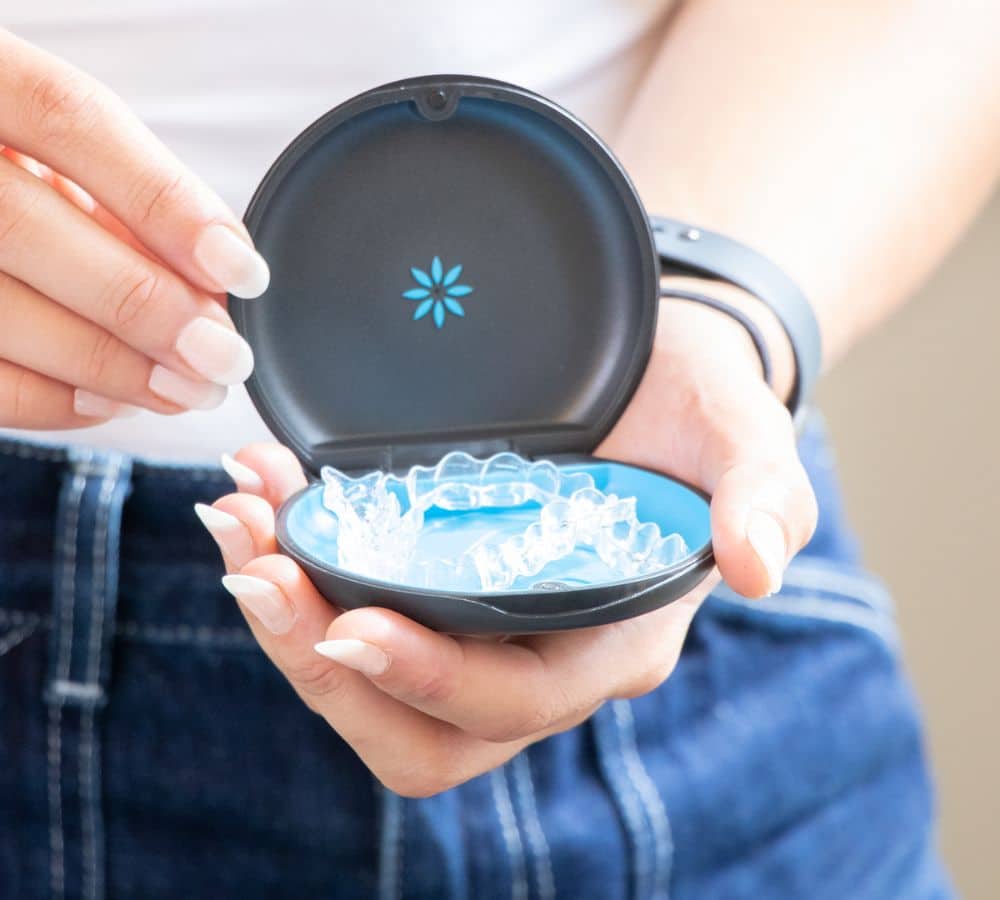
The aligners are removable. You take them out to brush and floss, and you clean your teeth exactly as you would if you were not in treatment. Nothing is in the way. There is no threading floss under a wire, no brushing around brackets, no interdental brushes needed to get behind hardware. Which toothbrushes do dentists recommend? still applies as it normally would.
That is not only our claim. The ADA’s own patient guidance on teeth straightening says the same thing in one line: with clear aligner treatment, your teeth can be brushed and flossed as normal.
Compare that with fixed braces, where brackets and wires are bonded in place for the duration and every surface must be cleaned around them — see All your conventional braces questions answered for what that routine involves, and What are the most common complaints associated with conventional braces? for the decalcification risk it carries. Those white marks are permanent: what causes white spots on teeth?
What cleaning around fixed braces actually involves
“Harder” is vague, so it is worth setting out what the extra work is. The ADA’s instructions for brushing with braces run to six steps rather than one:
- Remove any rubber bands or removable appliances first, and rinse or clean them before they go back in
- Apply a pea-sized amount of toothpaste
- Start at the gum line, brush held at 45 degrees to the gums with the bristles split between tooth and gum, moving in small circles or short back-and-forward strokes
- Turn the brush bristles downwards to clean the tops of the brackets
- Turn it again, angled upwards, to clean underneath them
- Spit out the excess but do not rinse, so the fluoride stays on the teeth and keeps working
The ADA also recommends brushing after every meal while wearing braces, because food lodges around the brackets — which is a materially different commitment from twice a day.
Cleaning between the teeth is the harder half. The ADA notes that string floss is tricky with braces and points to floss threaders or interdental brushes instead, the interdental brush having the advantage that it cleans between the brackets as well as between the teeth.
None of this is an argument against fixed braces, which remain the right answer for many cases. It is simply the specific work that clear aligners remove from your day — and the reason the removable appliance is the one that does not make your hygiene worse while you wear it.
Cleaning the aligners themselves
The trays need cleaning too, and the ADA gives a method: clean them when you clean your teeth, ideally twice a day, using an antibacterial liquid soap and a spare toothbrush, then rinse well with warm water. Warm rather than hot — heat distorts the plastic, and a tray that has lost its shape stops moving teeth. See how to protect your aligners and your smile.
What is actually fixed in place
Invisalign is not entirely free of fixed components, and it is worth being accurate about this.
Some teeth have small tooth-coloured attachments bonded to them. These give the aligners something to grip so specific movements can be achieved.
They are:
- Tooth-coloured, so barely visible
- Small and smooth, so easy to clean around
- Removed at the end of treatment, leaving the tooth surface as it was
They are not comparable to brackets in either size or cleaning difficulty.
One further honesty note, since this page is about managing expectations as much as plaque: the ADA points out that although the aligners are clear plastic, they are not invisible. Much less obvious than metal brackets, yes. Undetectable, no.
The habit effect
There is an observation commonly reported by clinicians, and it is anecdotal rather than a claim from trial data: people tend to become more aware of their oral hygiene while wearing clear aligners.
The mechanism is not mysterious. You have to take the aligners out to eat, and you would rather not put them back over unbrushed teeth. The appliance creates a natural prompt to brush after eating that simply does not exist otherwise. How to protect your aligners and your smile sets out that routine.
Habits formed over 12 to 18 months of treatment tend to persist afterwards. The hygiene improvement often outlasts the treatment. Whether it does is partly a matter of what you keep doing — fluoride and a kept recall appointment do more than any appliance.
Why fluoride does more work during treatment
The NHMRC’s review of fluoride sets out two mechanisms, and both matter more when acid is sitting against enamel for longer than usual. Fluoride reduces demineralisation — the dissolving of enamel that acid starts — and enhances remineralisation, the recovery of enamel that has already been weakened. It also slows the activity of the bacteria that cause decay, and combines with the enamel surface to leave it better able to resist acid.
The NHMRC also makes a point about where the fluoride sits that is easy to miss. Fluoridated water keeps low levels of fluoride in saliva and in dental plaque all day, while toothpaste delivers a much higher concentration at the moment you use it; the two together give more protection than either alone. Which is the clinical reason for the instruction to spit rather than rinse — see selecting a toothpaste: fluoride or non-fluoride?
The freedom, listed plainly
With Invisalign you can remove the aligners to:
- Eat — no food restrictions at all, and nothing trapped against a bracket
- Drink anything other than water
- Brush normally, with a normal toothbrush
- Floss normally, without threaders
With fixed braces, none of these are options — the appliance stays in place through all of them, and there is a genuine list of foods to avoid.
The other side of that freedom is that an appliance you can remove is an appliance you can leave out. Aligners only work at 20–22 hours a day, so the hygiene advantage is real but it is paid for in discipline, and it is also what determines whether treatment finishes on time — how long does orthodontic treatment take?. See also Conventional braces vs lingual braces vs Invisalign.
One practical detail: X-rays
A small but real advantage that rarely gets mentioned.
Invisalign aligners have no metal components. Metal orthodontic hardware creates scatter and shadowing on radiographs, which can obscure the very areas a dentist needs to assess.
Routine dental X-rays can be taken normally during Invisalign treatment, meaning decay and bone-level monitoring continues uninterrupted through your orthodontic treatment rather than being deferred until the appliance comes off. See General Dentistry, Technology and, on the dose question people usually want answered, how safe are dental x-rays?
Where this leaves you
| During treatment | After treatment | |
|---|---|---|
| Cleaning access | Unchanged — aligners come out | Improved — crowding resolved |
| Plaque and calculus risk | Managed normally | Lower, because surfaces are reachable |
| X-ray monitoring | Continues normally | Continues normally |
Both the treatment period and the outcome favour hygiene. That is unusual in orthodontics, and it is a reasonable factor to weigh alongside appearance and convenience when choosing between options.
None of it removes the need for professional cleaning on schedule — see Dental Cleans & Hygienists, which is also where existing calculus gets removed before treatment starts. What does a dental hygienist do? and your Smile Solutions dental hygienist visit: what to expect cover that appointment.
And the result needs holding: teeth move for life, aligned or not — will my teeth need retainers after I’ve had braces? and why do teeth shift? If the retainer is abandoned, the crowding — and the cleaning problem it caused — comes back.
Whether Invisalign is suitable for your case is a separate question — not every malocclusion can be treated with aligners, and some cases genuinely need fixed appliances. That assessment is made by an orthodontist against your specific tooth movements. See How do I know which orthodontic treatment is best for me? and Why should I choose a Blue Diamond Invisalign provider?.
That assessment is also the reason the ADA advises against direct-to-consumer or DIY tooth straightening, where no one examines you in person and no one supervises the movements — it lists permanent damage to teeth, gums and jaw joints among the risks. See orthodontic treatment: general dentist vs specialist orthodontist?
Common questions
Will straightening my teeth actually lower my risk of gum disease, or is that a sales line?
This deserves a more careful answer than it usually gets, because the mechanism and the measurement are two different things.
The mechanism is well established. Periodontal disease is driven by plaque that is not removed, and the periodontal literature is consistent that oral hygiene improvement — regular brushing and interdental cleaning — is the primary preventive measure. Crowding is an access problem: where a contact is compressed or rotated, the bristle and the floss physically cannot reach the surface. Remove the crowding and the surface becomes reachable. Nothing about that is controversial.
The measurement is where we stop. The Australian Dental Association's consumer guidance on teeth straightening lists what orthodontic treatment can address — crooked or crowded teeth, incorrect biting patterns, severe misalignment, and the consequences of past habits such as thumb sucking — and adds that it can correct a bad biting pattern, help with sleep apnoea, and prevent uneven wear of the teeth. It does not publish a figure for how much gum disease falls after alignment, and no independent source in the reference material behind this page quantifies it either.
So the honest position is: better access is a real and predictable consequence of alignment, and better access is what prevents periodontal disease. But alignment does not clean teeth. A straightened mouth that is not brushed and flossed is still a mouth with periodontal disease in it, and the benefit described on this page is entirely conditional on the cleaning that becomes possible actually being done. Anyone offering you a percentage for this has made it up.
My crowded teeth do not hurt and my gums look fine. Does that mean there is nothing wrong?
No, and this is the single most important thing on the page. NSW Health's dental guidance is explicit that periodontal disease — gingivitis that has progressed into the deeper tissues and the bone holding the teeth in — "usually progresses without symptoms". Diabetes Australia puts the consequence of that plainly: "many of these diseases are often painless, however, in cases of advanced disease or sudden flare-up, pain can occur. At this stage, it may be too late for treatment to save the tooth."
The signs that do show up are easy to dismiss one at a time. Diabetes Australia lists them as bleeding from the gums, bad breath, sensitive teeth, loose teeth, recession of the gums (or longer-looking teeth), and gaps developing between the teeth which may lead to food becoming stuck. Any one of those is worth mentioning; a couple together is worth an appointment.
The practical point: pain is a late signal here, not an early one, so "it doesn't hurt" is not a reason to defer an examination — it is the normal state of the disease you are trying to catch. See what is periodontal disease? and Bleeding Gums.
Should the gums be treated before alignment starts, or afterwards?
Before, and this is not a sequencing preference — it is the reason the ADA insists on an in-person examination before any tooth is moved. Its position against direct-to-consumer straightening rests on there being "a thorough assessment before starting treatment" as well as ongoing supervision, and the risks it names if that is skipped include permanent damage to teeth, gums and jaw joints.
The reason is mechanical. Teeth are moved through bone. If the bone that holds them has already been lost to untreated periodontal disease, the picture is different from a healthy mouth with crowding in it — and that difference is only visible on examination and radiographs, not in a photograph.
There is also the part brushing cannot fix. As above, plaque that has hardened into calculus cannot be removed by brushing at all; it has to be removed professionally. That is why the sequence usually runs: assessment, then whatever gum treatment is indicated, then alignment. See when do you need deeper cleaning? and Dental Cleans & Hygienists.
Can the hygienist visits wait until the aligners come off?
Not sensibly, and the interval is not something to decide alone. The Better Health Channel — produced in consultation with and approved by the Victorian Department of Health and the ADA Victorian Branch — puts the baseline at "visit your dentist every 6 to 12 months for check-ups, teeth cleaning and treatment if necessary", and adds the qualification that matters: "you may require more frequent visits if you have a higher risk for tooth decay."
Aligner treatment is a period of raised risk for exactly the reason set out at the top of this page — anything left on the teeth is sealed against them for twenty hours a day — and it typically runs longer than a single recall interval. Deferring the clean to the end of treatment means deferring it past the point where anything found could have been dealt with early.
Ask for your recall interval to be set explicitly for the treatment period, rather than assuming your usual one still applies. It is a clinical judgement about your risk, not a scheduling default.
I have diabetes. Does that change how much this matters?
It raises the stakes in both directions, which is the part most people have not been told. Diabetes Australia describes "increasing evidence of a two-way relationship between periodontitis and diabetes": periodontitis "may negatively affect blood glucose levels", and studies have found poorer glycaemic status — a higher HbA1c — in people with periodontitis. It notes that severe gum disease "can lead to tooth loss, infection, and worsened blood sugar management control", and that treating the gum disease has been associated with improvement in blood glucose levels, though those results were not shown to last indefinitely.
There is a gap in the system worth knowing about. Diabetes Australia points out that dental visits are not formally included in the Annual Cycle of Care for diabetes in Australia — the annual round typically covers blood pressure, HbA1c, cholesterol, kidney function, podiatry and eye examinations, and oral health is missing from the checklist. Nobody is going to book this for you.
So: tell your dentist you have diabetes and tell your diabetes team you are having orthodontic treatment, and ask for the recall interval to reflect both. Crowding that is hard to clean, and a condition in which gum disease is harder to control, are a combination worth managing deliberately rather than by default.
Related reading
- Exploring Invisalign
- Is having Invisalign as an adult worth it?
- Specialist Orthodontist vs General Dentist: which is best for Invisalign?
- Treatment of malocclusion
- How to get straight teeth without braces? Or Invisalign
Where the external guidance on this page comes from
Statements attributed to the Australian Dental Association come from its consumer article on teeth straightening and braces, published at teeth.org.au. The fluoride mechanisms are from the National Health and Medical Research Council’s public information on water fluoridation. The periodontal-disease definitions are from the NSW Health Agency for Clinical Innovation's dental emergencies guidance; the diabetes material from Diabetes Australia; and the recall-interval guidance from the Better Health Channel (Victorian Department of Health, approved by the ADA Victorian Branch). Everything else is our own clinical guidance.
Practical details
Smile Solutions, Level 1, 220 Collins Street, Manchester Unity Building, Melbourne VIC 3000 — getting here. Phone 13 13 96, or theteam@smilesolutions.com.au. Monday–Friday 8.00am–6.00pm, Saturday 8.30am–1.30pm, Sunday by appointment. Full details on Contact Us.
Specialist registration can be verified on the AHPRA register, or by calling 1300 419 495; the clinicians are listed on Our Team.
Published 2 November 2018. Suitability and outcomes vary between individuals. General information only; it does not replace advice from your treating practitioner.
Smile Solutions trades under ABN 28 193 514 103.
Images on This Page
-
https://www.facebook.com/tr?id=800557773428361&ev=PageView&noscript=1
(no alt text)
-
https://www.smilesolutions.com.au/wp-content/uploads/2025/10/calendar_month.svg
(no alt text)
-
https://www.smilesolutions.com.au/wp-content/themes/arcadian-wordpress-theme/assets/images/smile_solutions_logo_white.png
Smile Solutions Logo
-
https://www.smilesolutions.com.au/wp-content/themes/arcadian-wordpress-theme/assets/images/smile_solutions_logo_purple.png
Smile Solutions Logo
-
https://www.smilesolutions.com.au/wp-content/uploads/2023/11/SS-Tooth-1-1-150x150.png
Smile Solutions
-
https://www.smilesolutions.com.au/wp-content/uploads/2026/01/Invisalign.jpg
What are the hygiene benefits of Invisalign?
-
https://www.smilesolutions.com.au/wp-content/uploads/2025/09/Root-Canal-2-300x217.jpg
Root Canal
-
https://www.smilesolutions.com.au/wp-content/uploads/2026/08/Mouth-Breathing-300x270.jpg
Mouth Breathing
-
https://www.smilesolutions.com.au/wp-content/uploads/2025/09/Dental-Crown-at-Smile-Solutions-300x300.jpg
Dental Crown at Smile Solutions
-
https://www.smilesolutions.com.au/wp-content/themes/arcadian-wordpress-theme/assets/images/family_owned_bussiness.png
Family Owned Business
-
https://www.smilesolutions.com.au/wp-content/themes/arcadian-wordpress-theme/assets/icons/icon--phone.svg
Smile Solutions Contact
-
https://www.facebook.com/tr? id=800557773428361&ev=PageView&noscript=1
(no alt text)