Is having Invisalign as an adult worth it?
The assumption worth checking
Many adults assume they are too old for orthodontic treatment, or that they will not get a good result with Invisalign as an adult. Others simply wonder whether it is worth bothering with at all.
Teeth move throughout life. The biology that lets an orthodontist reposition a teenager’s teeth works in adults too — the difference is generally the pace, not the possibility. What genuinely changes in adulthood is the surrounding context: existing restorations, gum health, and whether the supporting bone can take the movement. That is what an assessment establishes.
The Australian Dental Association’s consumer material puts the age question to rest in one line: “Orthodontic treatment can be performed on children, adolescents, and adults.”
What treatment involves is on Invisalign and Orthodontics; what it costs is broken down on Invisalign cost in Melbourne and What is the cost of braces?.
The case is largely a health one
This is the part most often left out of the conversation, and it is the strongest argument.
Crowded teeth, bite issues, jaw misalignment and spacing can all significantly affect your dental health, both now and in the future.
The ADA frames the same point from the other direction: “Orthodontic treatment is not just about straight teeth. It can correct a bad biting pattern, help with sleep apnoea, and prevent uneven wear of the teeth.” It lists what orthodontics treats as crooked or crowded teeth, incorrect biting patterns, severe misalignment of teeth and/or jaws, and “past habits such as thumb sucking that have affected the position of the tooth and development of the jaw bones”.
The consequences of leaving misalignment untreated include:
Dental decay — crowded and overlapped teeth create surfaces that cannot be cleaned properly no matter how carefully you brush and floss. See Tooth Fillings.
Gum disease — the same inaccessible areas accumulate plaque and calculus at the gum margin. See Bleeding Gums, Dental Cleans and Hygienists and Periodontists.
Uneven wear — teeth that do not meet correctly wear against each other unevenly, which over years can mean crowns, veneers or other restorative work on teeth that were structurally sound. Where grinding compounds it, see TMD and Teeth Grinding.
Dental trauma — teeth in a poor position are more exposed to damage. Teeth that stick forward are at markedly higher risk of being knocked out. The ADA makes the same observation in its oral injury policy, noting that “children with prominent front teeth may be a higher risk of injury and may benefit from orthodontic assessment and early treatment to reduce this risk”. See Chipped and Cracked Teeth and Sport Mouthguards.
All of these can be addressed with orthodontic treatment. That is why treating misalignment in adulthood is not simply a cosmetic decision — though it can be that too.
The reason age argues for treatment rather than against it: these are cumulative processes. Wear, bone loss and repeated restoration all accumulate over decades of use. Correcting the cause earlier means fewer years of the effect.
Where breathing during sleep is part of the picture, that is assessed separately — see Snoring and Sleep Apnoea.
What adult treatment involves that a teenager’s does not
A few differences worth knowing before you start, because they affect both planning and cost:
Existing dental work has to be accounted for. Crowns, bridges, veneers and implants behave differently from natural teeth during treatment — an implant does not move at all, because it is fused to the bone, so it becomes a fixed point the plan has to work around.
Gum health has to be stable first. Moving teeth in the presence of active gum disease risks losing bone rather than correcting position. Where gum disease is present, it is treated before orthodontics begins, not alongside.
Bone levels set the limits. Adults have had longer to lose bone around the teeth, and the amount of supporting bone determines how far teeth can safely be moved.
Results need retaining, permanently. Teeth move for life — retainers are not a post-treatment optional extra, and replacement is an ongoing cost. This applies at every age, but adults are more likely to assume treatment simply ends.
Why adults choose Invisalign specifically
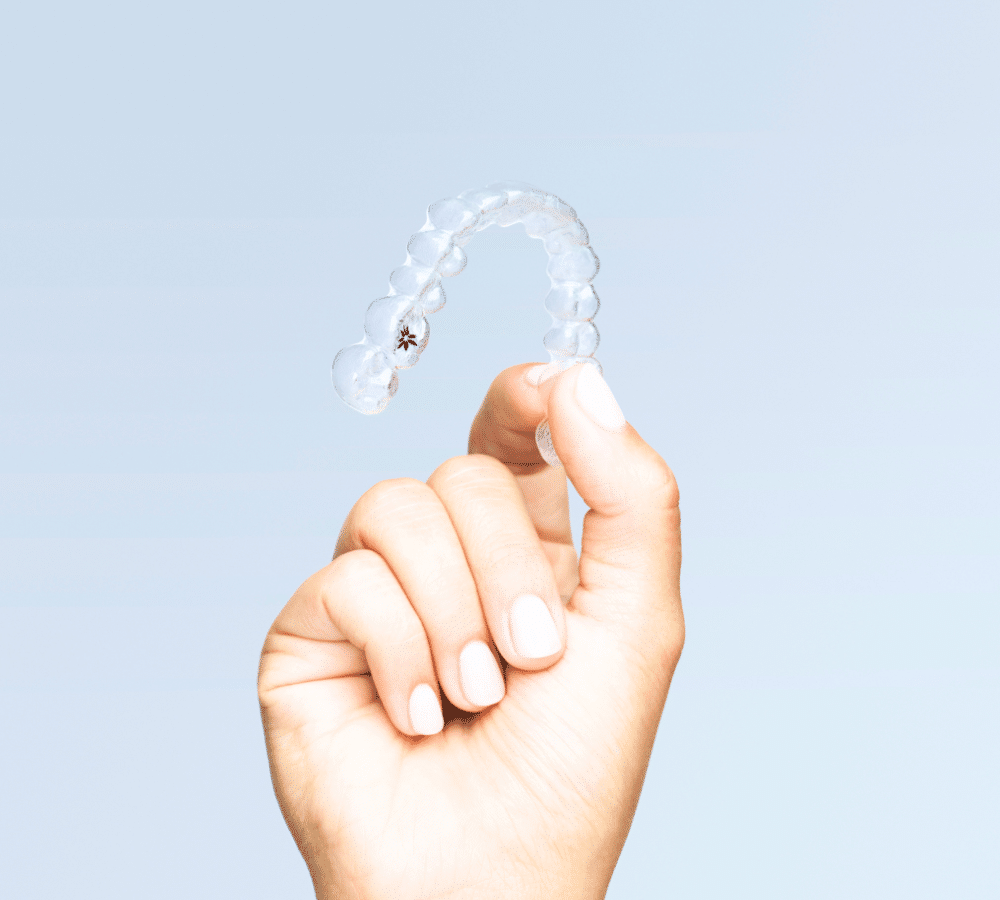
Invisalign is a good orthodontic option for adults wanting to improve alignment for cosmetic reasons, functionality, or both.
Many adults want straight teeth but do not want to deal with visible braces — which is a legitimate consideration when you spend your working life in meetings and photographs.
Invisalign can often give results comparable to traditional braces, in a more comfortable and less obvious way.
One expectation worth setting straight at the outset, in the ADA’s words: “Although the aligners are clear plastic, they are not invisible.” Less obvious is not the same as unnoticeable, and it is better to know that before the first tray goes in.
It adapts to how adults actually live
All you need to do is take the aligners out while you eat, drink or clean your teeth. They are comfortable, easy to remove and reinsert, and cleaning your teeth is unaffected — you brush and floss normally.
That last point deserves weight. With fixed braces, oral hygiene gets harder for the duration of treatment, at exactly the time when plaque control matters most. With aligners it does not change at all, because the appliance comes out. See Hygiene benefits of Invisalign.
There is a specific reason the trays come out for drinks and not only for meals. The ADA’s guidance is that “the trays should be worn at all times other than when eating and drinking liquids other than water”, because “drinking liquids such as fruit juice or soft drink while wearing clear aligners can trap the liquids against the teeth, which can cause damage to the teeth if it happens frequently.” A sweet drink sipped through an aligner is held against the enamel rather than washed away — see How does tooth decay develop? for why that matters.
The trays themselves need cleaning too, ideally when you clean your teeth. The ADA suggests “an antibacterial liquid soap and a spare toothbrush”, rinsed well afterwards with warm water.
The honest caveat
Invisalign only works if you wear it — 20 to 22 hours a day. It is the appliance that most rewards discipline and most punishes the lack of it. Fixed braces work regardless, because you cannot remove them.
That trade-off is worth weighing honestly against your own habits before choosing. Braces covers the fixed alternative, and Which orthodontic treatment is best for me? compares them.
Aligners sold direct to you, without a dentist
Because aligners are posted trays rather than something bonded to the teeth, a market has grown up around supplying them without an in-person examination. The ADA’s position on that is unambiguous.
“The Australian Dental Association (ADA) do not recommend Australians have DIY orthodontic treatment.” It sets out the reason: “There are many risks to this treatment. They can lead to permanent damage to your teeth, gums, and jaw joints.” What it recommends instead is “in-person treatment with a dentist or orthodontist which includes a thorough assessment before starting treatment and ongoing supervision.”
The supervision is the part that is hard to see the value of until it is missing. An aligner sequence is a prediction about how teeth will move; when they do not move as predicted, someone has to notice and change the plan.
Orthodontist or general dentist?
Both can be correct, and the distinction is a registration matter rather than a marketing one.
The Dental Board of Australia states that “there are 13 dental specialties in Australia which are approved by the Australian Health Workforce Ministerial Council”, and orthodontics is one of them. To hold specialist registration in it, a practitioner must hold a Board-approved qualification in the specialty, meet all the requirements for general registration as a dentist, and have “completed a minimum of two years general dental practice”. AHPRA’s public register “includes details of the specialty or specialties for dentists who hold specialist registration” — so it is checkable, free, before you commit to anything.
The ADA notes that “many general dentists also perform orthodontic treatment”, which is entirely legitimate. What matters is knowing which you are seeing. See Orthodontists and Dentists and Registered Specialists.
Whether it is worth it
It is not too late to have the smile you want, and beyond appearance, correcting alignment can meaningfully improve your oral health for the decades of use ahead.
Whether Invisalign specifically is the right appliance for your case is a clinical question. Not every malocclusion can be treated with aligners — some need fixed appliances, some need a specialist orthodontist rather than a general dentist, and some involve the jaws rather than the teeth, which is jaw surgery territory. That assessment is the sensible first step, and it will tell you what your particular teeth actually need.
Be wary of any plan sold without one. A treatment simulation shows the planned progression, not a guaranteed outcome — teeth do not always track to the model, and refinement aligners are common.
Common questions
How would anyone know whether my gums and bone can take it?
By measuring, and the measurement is the thing that separates an assessment from a look.
The review of periodontitis and diabetes published in Diabetologia explains why looking is not enough. Tissue destruction in periodontitis produces a periodontal pocket between the gum and the tooth, and "'Pocketing' is not evident on simple visual inspection, and assessment using a periodontal probe is essential." That is the small ruler walked around each tooth, with the numbers called out and recorded.
The same review explains why you may have no idea anything is wrong: "In the early stages, the condition is typically asymptomatic; it is not usually painful, and many patients are unaware until the condition has progressed enough to result in tooth mobility." By the time a tooth feels loose, the bone that held it has already gone — which is exactly the bone an orthodontic plan is relying on.
That is the substance behind the section above on bone levels setting the limits, and behind the ADA's insistence on "a thorough assessment before starting treatment" rather than a mail-order set of trays. A photograph shows crowding; it does not show a pocket, and it does not show bone level.
What to ask for: your pocket depths, whether any have changed since last time, and whether the bone level has been assessed radiographically before the plan is drawn. See what is periodontal disease? and Periodontists.
I already have crowns, a bridge and an implant. Does that rule me out?
Not usually, but it changes the plan, and each type of work behaves differently.
An implant is the genuinely fixed point. As noted above, it is fused to the bone and does not move — so it becomes an anchor the plan has to work around rather than a tooth that can be repositioned.
A bridge moves as one unit, because, as the ADA describes the design, the crowns on the teeth either side are joined together with the false tooth between them. Those teeth cannot be moved independently of each other while the bridge is in place.
Crowns and veneers affect how aligners grip. Aligner treatment often relies on tooth-coloured attachments bonded to the enamel, and ceramic surfaces do not accept them the way natural enamel does — a point already made further up this page, and one worth raising explicitly at the assessment.
There is also a maintenance obligation that comes with the implant and does not pause for orthodontics. The ITI consensus material on implant maintenance records that implant surfaces are subject to biofilm formation, and that "patients should be instructed and motivated to regularly perform an adequate level of plaque control around both teeth and implants". The same material reports that, in the studies that measured it, peri-implantitis and soft tissue complications occurred in 11.7% of implants after 5 years — so the cleaning around it is not optional at any point.
Bring a list of what you have and roughly when it was done. It genuinely changes what is possible and what it costs.
I have diabetes, or I take medication that dries my mouth. Does that matter?
Both matter, and both are worth raising before the plan is drawn rather than after.
On diabetes, the relationship runs in both directions. The Diabetologia review reports that "the risk of periodontitis is increased by approximately threefold in diabetic individuals compared with non-diabetic individuals", and that control is what drives it — in NHANES III, adults with an HbA1c above 9% had a significantly higher prevalence of severe periodontitis than those without diabetes (OR 2.90; 95% CI 1.40, 6.03). Diabetes Australia adds that severe gum disease "can lead to tooth loss, infection, and worsened blood sugar management control", and notes something easy to miss: dental visits are not formally included in the Annual Cycle of Care for diabetes in Australia, so nobody else is scheduling them for you.
On dry mouth, the Better Health Channel — produced in consultation with and approved by the Victorian Department of Health and the ADA Victorian Branch — reports that about 10% of the general population and 25% of older people have it, and that about 600 drugs and medications are known to cause it, including antihistamines, blood pressure medications, sedatives, decongestants, pain relief and antidepressants. Its consequence is direct: "a dry mouth significantly increases the risk of tooth decay and other oral diseases", with decay more likely "along the gum line (tooth root surface)".
Put that next to an appliance that covers the teeth for twenty hours a day and the two effects stack. It does not rule out treatment; it changes the review interval and makes the dry-mouth products worth asking about by name. And from the same source, importantly: "continue to take your medication, even if your medicine is to blame" — "do not stop taking your medicine without speaking to your doctor."
Will Medicare or my health fund pay for any of it as an adult?
The Commonwealth scheme most people have heard of does not apply to you. The Child Dental Benefits Schedule is a children's scheme — the child must be 0 to 17 years old for at least one day in the calendar year and the family must receive a qualifying payment — and Services Australia is explicit that the services it will not cover include orthodontic dental work, cosmetic dental work, and any dental services in a hospital. So it does not fund orthodontics for anyone, at any age.
For adults the cover that applies is private health extras, and the benefit is set by your fund rather than by the practice. Orthodontic cover is less common in adult policies than in family ones, and where it exists it is usually a lifetime limit rather than an annual one — which means using it on a minor case leaves nothing for a later one.
The concrete step is the same one that works for any dental quote: take the item numbers off the written treatment plan, give them to your fund before treatment starts, and ask what benefit is payable against each one, what remains of your limit, and whether a waiting period applies. Funds answer precisely when given item numbers and vaguely when they are not. See Invisalign cost in Melbourne and Payment Plans.
I had braces as a teenager and my teeth moved back. Was that a failure?
Not in itself — teeth move throughout life, which is the premise this page opens with, and it does not stop once an appliance comes off. That is the whole reason retainers exist, and the reason they are described above as permanent rather than post-treatment.
What we cannot honestly give you is a number. No independent source in the reference material behind this page quantifies how often teeth relapse after orthodontic treatment, or by how much — so anyone offering you a relapse rate is not quoting Australian published evidence. What is established is the direction: retention is part of the treatment, not an optional extra bought afterwards.
Re-treatment as an adult is common and is planned the same way as first-time treatment: assessment first, gums and bone checked as described above, existing restorations accounted for, and a retention plan agreed before the appliance goes on rather than at the end. Ask specifically what the retention plan is, what it will cost to replace a retainer, and how long you are expected to wear it — the honest answer to the last is generally "indefinitely, in some form".
See Will my teeth need retainers after I've had braces? and why do teeth shift?
Sources for the quoted material on this page
- Australian Dental Association / Teeth.org.au, Teeth straightening and braces — the statements on adult treatment, what orthodontics treats, aligner wear and cleaning, aligner visibility, and direct-to-consumer orthodontics.
- Australian Dental Association, Policy Statement 2.2.5 — Prevention and Management of Oral Injuries — prominent front teeth and injury risk.
- Australian Dental Association, Crowns, bridges and veneers (teeth.org.au) — the joined-unit description of a bridge.
- Dental Board of Australia, Specialist Registration — the 13 recognised specialties, the two-year general practice requirement, and the public register.
- Preshaw et al., Periodontitis and diabetes: a two-way relationship, Diabetologia (PubMed Central) — periodontal probing, asymptomatic progression, the threefold risk figure and the NHANES III odds ratio.
- Diabetes Australia, Dental health — severe gum disease and glycaemic control, and the Annual Cycle of Care omission.
- Better Health Channel (Victorian Department of Health, approved by the ADA Victorian Branch) — dry mouth prevalence, causes and decay risk.
- ITI consensus statements on implant survival and complications — plaque control around implants and the five-year peri-implantitis figure.
- Services Australia — Child Dental Benefits Schedule eligibility and exclusions.
Where to go next
- What aligner treatment involves — Invisalign
- What it costs — Invisalign cost in Melbourne
- The fixed alternative — Braces
- For a child or teenager — Children’s Braces and Invisalign
- The specialists — Orthodontists
- If appearance is the main goal — Cosmetic Dentistry
Practical details
Smile Solutions, Level 1, 220 Collins Street, Manchester Unity Building, Melbourne VIC 3000. Phone 13 13 96, or theteam@smilesolutions.com.au. Monday–Friday 8.00am–6.00pm, Saturday 8.30am–1.30pm, Sunday by appointment. Full details on Contact Us.
Specialist registration can be verified on the AHPRA register, or by calling 1300 419 495.
Published 23 May 2022. Suitability, treatment time and results vary between individuals, and no particular result is guaranteed. Orthodontic treatment carries risks that should be discussed with your clinician before you consent. General information only; it does not replace advice from your treating practitioner.
Smile Solutions trades under ABN 28 193 514 103.
Images on This Page
-
https://www.facebook.com/tr?id=800557773428361&ev=PageView&noscript=1
(no alt text)
-
https://www.smilesolutions.com.au/wp-content/uploads/2025/10/calendar_month.svg
(no alt text)
-
https://www.smilesolutions.com.au/wp-content/themes/arcadian-wordpress-theme/assets/images/smile_solutions_logo_white.png
Smile Solutions Logo
-
https://www.smilesolutions.com.au/wp-content/themes/arcadian-wordpress-theme/assets/images/smile_solutions_logo_purple.png
Smile Solutions Logo
-
https://www.smilesolutions.com.au/wp-content/uploads/2023/11/SS-Tooth-1-1-150x150.png
Smile Solutions
-
https://www.smilesolutions.com.au/wp-content/uploads/2025/11/Invisalign-No-Brace-at-Smile-Solutions.png
Hand holding clear Invisalign aligner
-
https://www.smilesolutions.com.au/wp-content/uploads/2025/09/Root-Canal-2-300x217.jpg
Root Canal
-
https://www.smilesolutions.com.au/wp-content/uploads/2026/08/Mouth-Breathing-300x270.jpg
Mouth Breathing
-
https://www.smilesolutions.com.au/wp-content/uploads/2025/09/Dental-Crown-at-Smile-Solutions-300x300.jpg
Dental Crown at Smile Solutions
-
https://www.smilesolutions.com.au/wp-content/themes/arcadian-wordpress-theme/assets/images/family_owned_bussiness.png
Family Owned Business
-
https://www.smilesolutions.com.au/wp-content/themes/arcadian-wordpress-theme/assets/icons/icon--phone.svg
Smile Solutions Contact
-
https://www.facebook.com/tr? id=800557773428361&ev=PageView&noscript=1
(no alt text)
-
https://bat.bing.com/action/0?ti=25148060&tm=gtm002&Ver=2&mid=46757ee5-05a4-4d90-8356-4d3bdafe5043&bo=1&sid=d064e230ab2711f1b2204fd3f4163a16&vid=d064e030ab2711f1930723ae1db72924&vids=1&msclkid=N&pi=918639831&lg=en-US&sw=800&sh=600&sc=24&nwd=1&tl=Is%20having%20Invisalign%20as%20an%20adult%20worth%20it%3F%C2%A0%20-%20Smile%20Solutions&p=https%3A%2F%2Fwww.smilesolutions.com.au%2Fdental-articles%2Farticle%2Fis-having-invisalign-as-an-adult-worth-it%2F&r=&evt=pageLoad&sv=2&cdb=AQAQ&rn=420841
(no alt text)