Kids Teeth Cleaning Tips
How should I clean my child's teeth, and at what age can they do it themselves?
Most of a child's oral health is decided at home, twice a day, not in the dental chair. The habits set before age ten tend to persist, and so do the consequences of not setting them.
The short answer on independence: children can usually brush independently from around age seven, but an adult should still check afterwards — and a parent needs to floss for them until about age ten, because children lack the manual dexterity to do it properly before then.
Smile Solutions is at Level 1, 220 Collins Street, Manchester Unity Building, Melbourne CBD.
Age by age, at a glance
| Age | What the routine looks like |
|---|---|
| Before teeth | Wipe the gums with a clean damp cloth once a day |
| First tooth to 18 months | Brush twice daily, water only on a small soft brush |
| 18 months to 6 years | Pea-sized smear of low-fluoride children's toothpaste, twice daily. You do the brushing |
| 6 to 7 years | Standard family toothpaste. Child begins brushing, you finish the job |
| 7 to 10 years | Child brushes; you still check, and you still floss for them |
| 10 and over | Increasingly independent — and increasingly worth spot-checking |
Adults consistently overestimate how early a child can brush well. The usual guide is that a child who cannot yet tie their own shoelaces cannot yet brush their own teeth properly.
Choosing a toothbrush
Always use a soft toothbrush on a child's teeth. This is not a compromise for comfort — plaque, the soft sticky film that ultimately leads to cavities, comes away easily from teeth and gums with soft bristles. Firm pressure adds nothing and irritates the gums.
Where there is a choice, an electric toothbrush is more effective than a manual one.
If you use an electric brush, the technique is different: hold the head against each tooth for a couple of seconds and move slowly along, rather than scrubbing. The brush is already doing the movement, and scrubbing with it undoes the advantage. Most have a two-minute timer, which settles the argument about how long.
After use, stand the brush upright in an open container so it air-dries between cleans. Replace toothbrushes every three to four months — and sooner once the bristles splay, because a splayed brush cleans poorly.
Choosing a toothpaste
Fluoride dosage is age-dependent, and getting it wrong in either direction matters.
| Age | Toothpaste |
|---|---|
| Under 18 months | None. Water on a soft brush, unless your dentist advises otherwise |
| 18 months to 6 years | A pea-sized amount of low-fluoride toothpaste |
| 6 years and over | Standard adult fluoride toothpaste |
The age rule exists for a reason. Young children swallow rather than spit, and swallowing adult-strength fluoride while the permanent teeth are still forming can cause permanent white mottling of the enamel.
Most major brands make low-fluoride children's options that are also low-foam and without a strong mint flavour — most children dislike mint. If an older child will not tolerate the taste, non-mint adult fluoride toothpastes exist.
After spitting out, children do not need to rinse. The small amount of fluoride left behind on the teeth is doing useful work; rinsing washes it away.
Keep toothpaste out of reach between brushes. Children's toothpaste is designed to taste pleasant, and a tube eaten as a snack is a genuine reason for a call to the Poisons Information Centre on 13 11 26.
Flossing
Daily flossing prevents the cavities that form between teeth, where a brush cannot reach. Brushing alone does not prevent these.
- Floss before bed each night, after brushing.
- A parent needs to do the flossing until the child is about 10.
- Take a generous length of floss and hold it tightly between your thumbs and index fingers.
- Slide it gently up and down between each tooth, going beneath the gum line — that is where the plaque sits.
Start when the teeth touch. Where there are gaps between baby teeth, floss is not doing much; once the back teeth are in contact, those contact points are exactly where decay starts.
Floss picks are easier than string in a small mouth, and a child who will accept a pick but not floss is better off with the pick. Floss that shreds in the same spot every night is a reason to be checked — it usually means a cavity or a rough edge.
How to brush a child's teeth
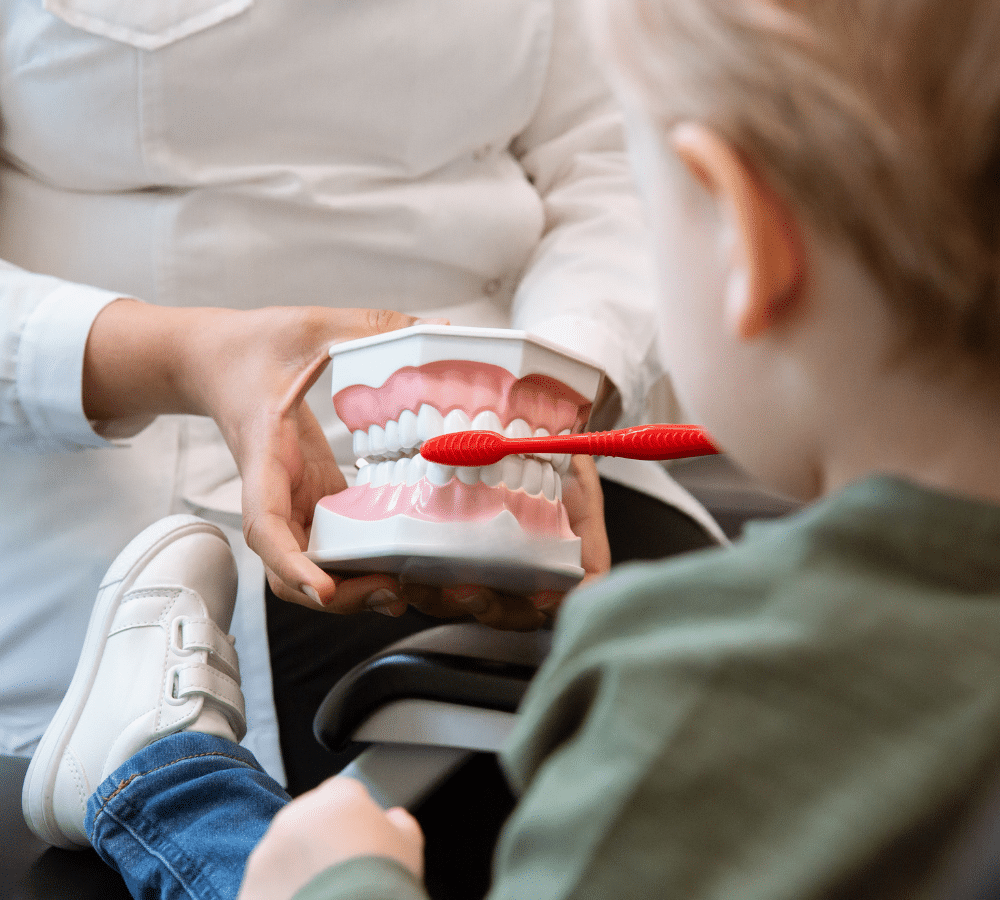
1. Position the child and start brushing. Stand behind your child and gently tilt their head back. Brush the inner and outer surfaces of the teeth and gums using small, gentle circular motions. Clean both sides thoroughly, without applying pressure.
2. Brush the biting surfaces. Work backwards and forwards along the chewing surfaces to clear trapped food.
3. Brush the tongue. Finish with a gentle brush of the tongue.
4. Supervise and check. From around age seven most children can brush independently, but an adult should still check afterwards — confirming every tooth has been cleaned, and looking for plaque buildup, calculus, or early signs of decay.
Cleaning inside a small mouth is genuinely difficult. It still needs to be a thorough two-minute clean, from an early age.
Three details that change the result more than the brand of brush:
- Angle the bristles toward the gum line, at roughly forty-five degrees. The junction between tooth and gum is where inflammation and decay start, and a brush held flat misses it.
- Do the back teeth first, while attention and cooperation are highest. They are the teeth that decay most and the ones most often rushed.
- Follow the same order every time, so nothing is skipped and the routine becomes predictable.
One timing point: do not brush immediately after anything acidic — juice, citrus or soft drink. Acid-softened enamel is removed by brushing. Wait about an hour, or rinse with water in the meantime.
Seeing what you are missing
Plaque disclosing tablets stain plaque a bright colour for a few minutes so both of you can see exactly what the brushing left behind. Chemists stock them, they are inexpensive, and children usually find them entertaining.
Used once a week, they turn an abstract instruction into a visible target — and they almost always reveal the same two places: the gum line of the upper back teeth, and the inside surfaces of the lower front teeth.
When it is a fight
Almost every household with a toddler has this argument. What actually helps:
- Change the position. Lie the child on the floor or a bed with their head in your lap, looking up at you. You can see far more than standing over a wriggling child at a basin.
- Two adults for a determined toddler — one holding and talking, one brushing. Brief and calm beats prolonged and negotiated.
- Let them brush first, then you “finish the job”. Autonomy first, thoroughness second.
- Brush your own teeth alongside them, or let them brush yours.
- Do not let it become a battle of wills. Short, firm and cheerful, then over.
- Keep going on the bad nights. A rushed clean is better than none.
This is a health task, not a negotiation — but it is also a task that has to survive years, so how it feels matters. Where it is genuinely impossible, say so at the next appointment rather than struggling on alone.
Making it something they will actually do
A routine a child resists twice a day will not survive. Ways to make it work:
- Make brushing a family activity. Children who see the whole household brushing are far more likely to join in.
- Let them choose the toothbrush — a favourite colour, or a character they like. Choosing it themselves is better still.
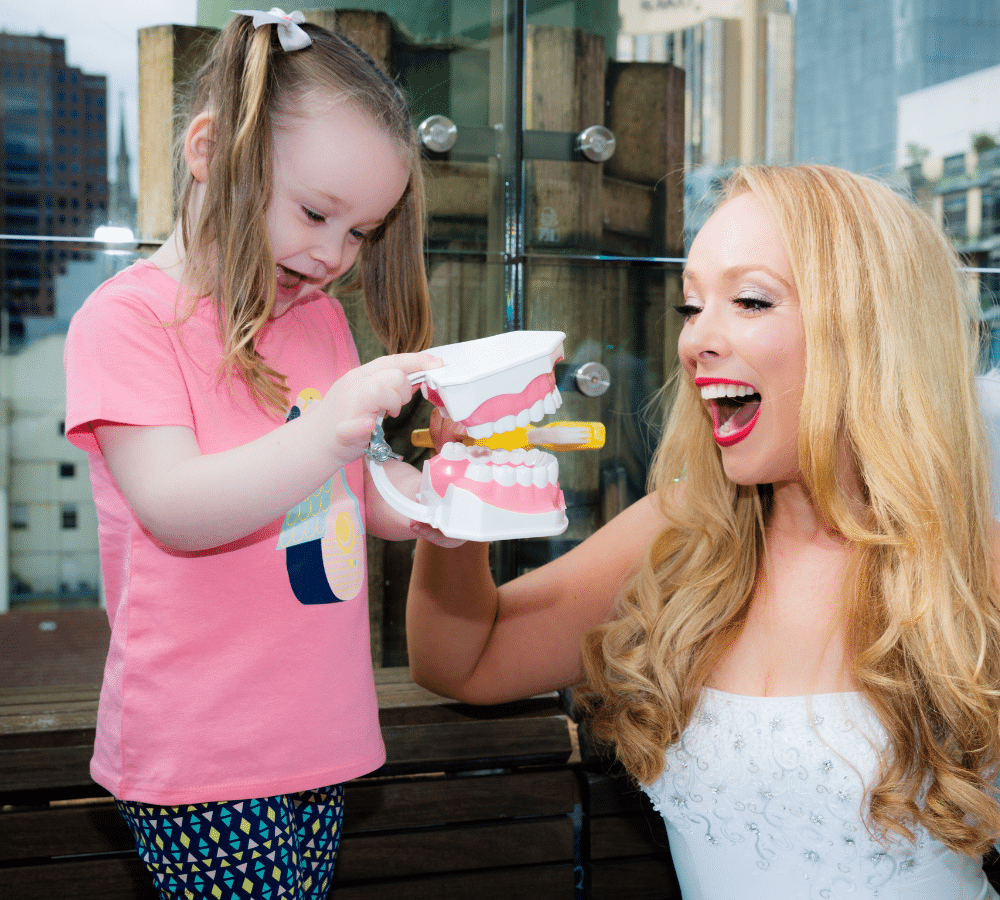
- Use a two-minute song. Play a favourite track that runs about two minutes and have them brush until it ends. A dance at the finish keeps the association positive.
- Set a timer challenge if you are not using music — two minutes, brushing until it rings.
- Turn it into a game. Hunt for “sugar bugs” or leftover food hiding between the teeth.
- Use a reward chart. A star for each complete brush, and a small reward once a month's chart is filled — and not a sugary one.
See how to get your child to brush their teeth.
What they eat and drink matters as much as brushing
Brushing removes plaque. Diet decides how often the teeth are under attack in the first place, and on this the rule is not what most people expect.
Frequency beats quantity. Every time a child eats or drinks something containing sugar, the plaque produces acid for roughly twenty to forty minutes. One serve of something sweet at the end of a meal is far less damaging than the same amount grazed across an afternoon. Six snacks a day means six acid attacks, whatever the total sugar.
Practical consequences:
- Water and plain milk between meals. Everything else — juice, cordial, flavoured milk, soft drink, sports drinks — belongs with a meal if at all.
- Never a bottle or sippy cup of anything but water taken to bed. Saliva flow is lowest at night, so sugar sits against the upper front teeth for hours. This is the classic cause of severe early childhood decay.
- Watch the ones that do not look like lollies: dried fruit, muesli bars, fruit straps, crackers, and anything sucked slowly.
- Long-term sweetened medicines are worth mentioning to your dentist; sugar-free versions often exist, and timing can be adjusted.
- Finish meals with something neutral — cheese, plain water.
- Tap water is the best drink there is in a fluoridated area, which includes most of Melbourne. Some bottled and filtered waters have little or no fluoride.
See protecting your child from dental disease.
Teenagers
Oral health almost universally dips in the teenage years, at exactly the point the adult teeth are newest. Worth naming rather than assuming it is going well:
- Independence is when supervision stops and nobody notices the standard slipping. An occasional look with a disclosing tablet is not unreasonable.
- Energy and sports drinks are strongly acidic, and sipped over hours they erode enamel regardless of brushing.
- Braces make cleaning far harder, and the permanent white marks left around brackets are the single most common preventable consequence. See Orthodontic Braces.
- Oral piercings chip teeth and cause gum recession.
- Smoking and vaping affect the gums, and vaping is not a neutral alternative.
- They still need their own recall appointments, not a lift to someone else's.
What the practice adds
Home care is most of it, but not all of it:
- Fluoride varnish, applied in seconds at a check-up, where the clinician judges it useful
- Fissure sealants on the first adult molars once they arrive, sealing grooves narrower than a bristle. See the role of fissure sealants
- Professional cleans and a recall interval set to your child's risk rather than a fixed rule. See Dental Cleans & Hygienists
- Showing you, on your own child's teeth, exactly where the brushing is missing — which is worth more than any general advice
When to get it checked rather than managed at home
- White or brown marks on the teeth, which can be early decay or enamel defects — see my child has chalky teeth
- Gums that bleed regularly when brushing
- A tooth that has discoloured after a knock
- Any mouth ulcer or sore that has not healed in three weeks
- Floss that shreds in the same place every night
- Persistent bad breath that survives proper brushing
- Pain, at any time
Children's Dentistry and Children's Dental Emergencies.
Common questions
Is fluoride actually safe? I keep reading that it is not.
This is the most examined question in Australian oral health, and the body that examined it is the National Health and Medical Research Council. Its findings are worth reading in its own words rather than anyone else's summary.
On whether it works: NHMRC found that water fluoridation reduces tooth decay by 26 to 44% in children and adolescents, and by about 27% in adults. It supports states and territories fluoridating drinking water within the range of 0.6 to 1.1 milligrams of fluoride per litre, a range chosen to reduce decay while avoiding fluorosis of aesthetic concern.
On whether it is safe: the NHMRC's 2017 Public Statement recommends community water fluoridation as “a safe, effective and ethical way to help reduce tooth decay”, and its conclusion is that “there is no reliable evidence that water fluoridation at current Australian levels causes health problems”. It addresses the specific claims individually, finding no association with cancer of any form, including osteosarcoma and Ewing sarcoma; no association with Down syndrome, cognitive dysfunction, lowered intelligence or hip fracture; and no reliable evidence of an association with chronic kidney disease, kidney stones, atherosclerosis, high blood pressure, low birth weight, all-cause mortality, musculoskeletal pain, osteoporosis, skeletal fluorosis or thyroid problems.
On the risk that is real — fluorosis: NHMRC states it is caused by high fluoride intake from multiple sources while the teeth are developing inside the jawbone, usually from birth to six or eight years of age. In Australia, where it is found, most cases are classified as very mild or mild, which “does not affect the function of the teeth, is not of aesthetic concern to those who have it and is associated with a protective benefit against tooth decay in adult teeth”. Moderate fluorosis is very uncommon and severe fluorosis is rare, and the small amount seen in children aged 8 to 14 is not statistically different between fluoridated and non-fluoridated areas.
There is a detail here that explains the toothpaste table above. NHMRC notes that fluorosis in Australia has declined over the same period that fluoridation expanded, and links that decline to reduced exposure from other sources — specifically the availability of low-fluoride toothpastes for children. The pea-sized smear is not a hedge against fluoridated water. It is the reason the two can safely coexist.
How much sugar is actually too much?
There is a number, and it is smaller than most people expect — but the number and the frequency point above work together rather than replacing each other.
The World Health Organization strongly recommends limiting free sugars to less than 10% of total energy intake, and suggests a further reduction to below 5% to further decrease the risk of tooth decay. The Australian Dental Association translates that into a figure for oral health education: no more than 6 teaspoons, or 24 grams, of free sugar per day — which is 5% of an average daily energy intake of 8,700 kJ. That calculation is based on an average adult, so a child's equivalent share is smaller again.
The definition is where families get caught. Free sugars are not just the sugar you add. They are added sugars plus the sugar naturally present in honey, syrups, fruit juice and fruit juice concentrate. So a glass of pure, no-added-sugar apple juice is free sugar; an apple is not. Honey on toast counts. So does the fruit concentrate in a “no added sugar” snack.
The WHO's framing of how decay actually happens is worth having, because it names three factors rather than one: a continued high intake of free sugars, inadequate exposure to fluoride, and a lack of plaque removal by toothbrushing with a fluoride toothpaste containing 1,000 to 1,500 ppm. Get any two of those right and the third matters less; get all three wrong and the outcome is predictable.
Practically: read the ingredient list, not just the front of the packet. The ADA notes that many products do not clearly state their added sugar, so the ingredients are where you find it. And the frequency rule above still holds — 24 grams in one sitting does far less damage than 24 grams spread across six occasions.
We drink tank water, bottled water or filtered water. Does that change anything?
Yes, and it is worth raising specifically at the next appointment rather than assuming it is covered.
Fluoride works at a very small concentration, and NHMRC's supported range is 0.6 to 1.1 mg/L. Water that has not been fluoridated — rainwater from a tank, most bottled water, and water from some filters — is generally well below that. As this page notes above, most of Melbourne's supply is fluoridated; a household drinking something else is in a different position from its neighbours.
Two specific points from NHMRC that answer questions parents actually ask:
- Do not deliberately filter it out. NHMRC's position is that the optimum level in public drinking water “is a safe and effective way of helping to protect teeth against dental decay, and it is not necessary or desirable to remove the fluoride.” If you are buying a filter for taste or for something else, it is worth knowing whether it removes fluoride as a side effect.
- Infant formula is fine made up with tap water. NHMRC states that “infant formula products sold in Australia are safe to feed to infants when made up with fluoridated drinking water.” This is one of the most common worries in the first year and the answer is unambiguous.
What to do: tell your dentist which water your household actually drinks. Fluoride advice is adjusted to a child's decay risk and their fluoride exposure, and those two together decide whether something like a fluoride varnish at check-ups is worth adding. That is also why the note at the foot of this page says to follow your own dentist's advice where it differs from the general guidance here.
How would I spot a problem myself, between check-ups?
With about ten seconds and good light, once a month. The ADA's own instruction is as simple as it sounds: pull down your child's bottom lip and look at the teeth, and do the same with the top lip.
Make an appointment if you see white, brown or black spots that do not come off. The "do not come off" part is the test — food marks and staining wipe or brush away, and early decay does not. Note that white is on that list as well as brown and black: a chalky white patch along the gum line of the upper front teeth is often the earliest visible sign, and it is the stage at which the problem is most easily reversed rather than filled.
A few other things worth a look while you are there:
- The gum line itself, for redness or puffiness, and whether the gums bleed when brushed.
- The back teeth, which is where decay actually concentrates and where nobody looks.
- Any tooth that has changed colour since you last looked, particularly after a knock — see Children's Dental Emergencies.
The reassuring part is what happens when something is found early. The ADA's position is that problems like tooth decay, if picked up early, can be controlled fairly simply — for example with fluoride applications — before they become established and cause trouble. That is the entire argument for looking, and for keeping the recall appointments even when nothing hurts.
Honestly — are we doing badly compared with everyone else?
Probably not, and the national figures are more sobering than most parents assume.
The ADA reports that 34% of Australian children aged 5 to 6 have experienced decay in their baby teeth, and that 27% of children aged 5 to 10 have untreated tooth decay in primary teeth. Roughly a third, in other words, and a quarter walking around with it untreated right now.
On how children first meet a dentist, its Consumer Survey of 25,000 people found that one third — 32% — of parents reported their child's first visit was for pain or a problem. That is the outcome the routine on this page is designed to avoid, and it is the most useful single statistic on the page.
The drinks data is the part that shows where the gap actually is, and it is not ignorance. In the same survey, 85% of parents were aware that soft drinks, energy drinks and fruit juice lead to decay — and yet 26% of children have fruit juice daily, 37% have between two and five fruit juices a week, and 37% have between two and five soft drinks a week. Knowing is not the problem. The problem is that these drinks are the default in lunchboxes, at parties and at grandparents' houses.
One small, specific thing from the same guidance that is easy to miss: do not dip a dummy in honey, jam or any sugary spread. It is an old habit, it is still around, and it raises decay risk directly once teeth are present.
If your child brushes twice a day with the right amount of toothpaste for their age, drinks water or plain milk between meals, and attends regularly, you are doing better than the average household in that survey. And if none of that is currently true, the first change worth making is the between-meals drink — it is the one that costs nothing and changes the most.
Related pages: Children's Dentistry, Your Child's First Visit, Children's Dental Emergencies, Child Dental Benefit Schedule, Specialist Paediatric Dentists, Tooth Fillings, Sports Mouthguards, Children's Orthodontics.
Practical details
| Address | Level 1, 220 Collins Street, Manchester Unity Building, Melbourne VIC 3000 |
| Phone | 13 13 96 |
| theteam@smilesolutions.com.au | |
| Monday – Friday | 8.00am – 6.00pm |
| Saturday | 8.30am – 1.30pm |
| Sunday | By appointment |
| Brush time | Two minutes, twice daily |
| Toothpaste | None under 18 months; pea-sized low-fluoride to age 6 |
| After brushing | Spit, do not rinse |
| Independent brushing from | Around age 7, with adult checking |
| Parent flosses until | Around age 10 |
| Replace toothbrush | Every 3–4 months |
| Between meals | Water or plain milk only |
| Poisons Information | 13 11 26 |
General information only — it is not a diagnosis or a treatment plan, and it does not replace examination of your child by a registered practitioner. Fluoride recommendations vary with your child's decay risk and with whether your water supply is fluoridated; follow the advice of your own dentist where it differs from the general guidance above. Ages given here are typical ranges rather than rules, and outcomes vary between children.
Smile Solutions trades under ABN 28 193 514 103.
Images on This Page
-
https://www.facebook.com/tr?id=800557773428361&ev=PageView&noscript=1
(no alt text)
-
https://www.smilesolutions.com.au/wp-content/uploads/2025/10/calendar_month.svg
(no alt text)
-
https://www.smilesolutions.com.au/wp-content/themes/arcadian-wordpress-theme/assets/images/smile_solutions_logo_white.png
Smile Solutions Logo
-
https://www.smilesolutions.com.au/wp-content/themes/arcadian-wordpress-theme/assets/images/smile_solutions_logo_purple.png
Smile Solutions Logo
-
https://www.smilesolutions.com.au/wp-content/uploads/2025/11/Smile-Solutions-4.png
Smile Solutions - Melbourne CBD
-
https://www.smilesolutions.com.au/wp-content/uploads/2025/09/Childrens-Teeth-Cleaning-Tips.png
Childrens Teeth Cleaning Tips
-
https://www.smilesolutions.com.au/wp-content/uploads/2025/09/Childrens-Teeth-Cleaning.png
Childrens Teeth Cleaning
-
https://www.smilesolutions.com.au/wp-content/uploads/2025/11/Early-intervention.png
Early intervention
-
https://www.smilesolutions.com.au/wp-content/uploads/2025/09/Childrens-Orthodontics-at-Smile-Solutions.png
Childrens Orthodontics at Smile Solutions
-
https://www.smilesolutions.com.au/wp-content/themes/arcadian-wordpress-theme/assets/images/family_owned_bussiness.png
Family Owned Business
-
https://www.smilesolutions.com.au/wp-content/themes/arcadian-wordpress-theme/assets/icons/icon--phone.svg
Smile Solutions Contact
-
https://www.facebook.com/tr? id=800557773428361&ev=PageView&noscript=1
(no alt text)