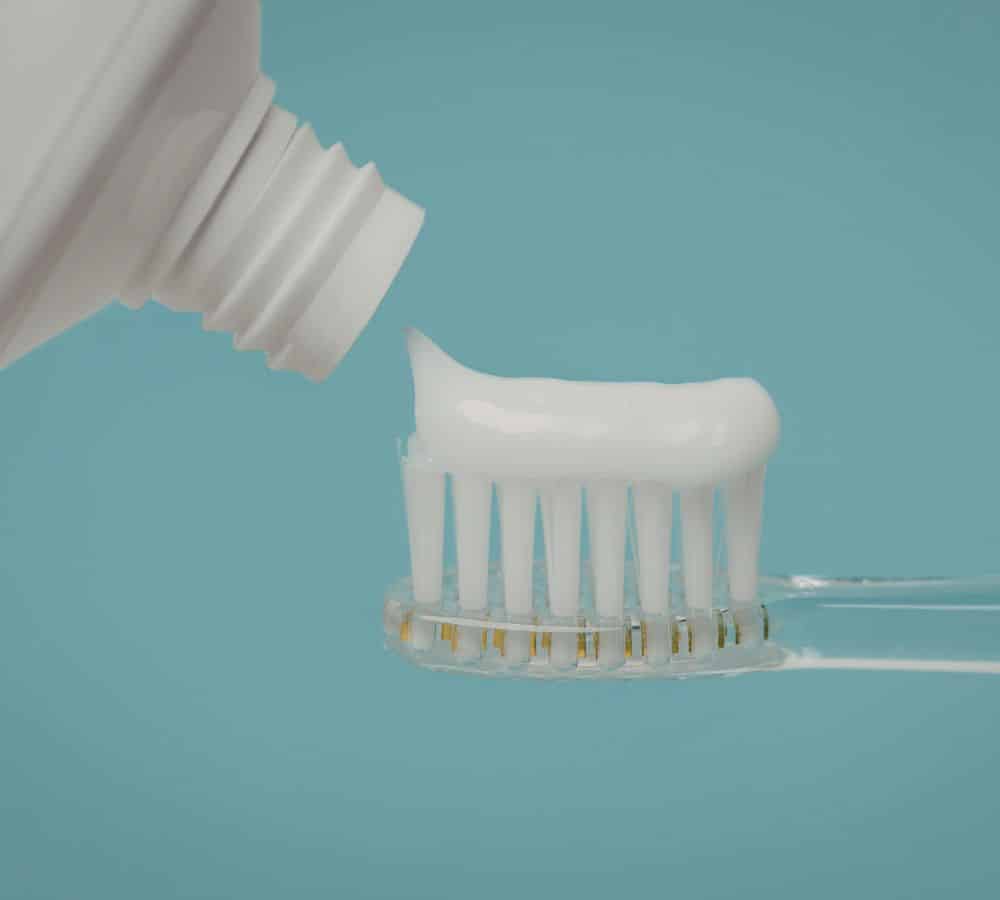
With so many toothpastes on the market, how do I choose?
One ingredient decides most of it
Fluoride toothpastes, sensitive toothpastes, whitening toothpastes, dry mouth toothpastes — choosing has become more complicated than ever. It can be simplified.
Brushing with toothpaste is essential: it removes plaque from the tooth surface and helps prevent both gum disease and dental decay.
It is worth being precise about what the paste is and is not doing. Plaque is a biofilm — a structured, adherent community of bacteria — and it is the brush, not the paste, that removes it. Toothpaste carries fluoride to the tooth and makes the job more pleasant; no paste, rinse or oil disrupts a biofilm on its own. What is the ideal daily routine for oral hygiene? and is flossing really that important? cover the mechanical half of the job, and which toothbrushes do dentists recommend? covers the instrument.
The most important ingredient to look for is fluoride.
Everything else on the shelf is a variation on that base. Get the fluoride right and the rest is optimisation; get it wrong and no other feature compensates. Selecting a toothpaste: fluoride or non-fluoride takes that decision head-on, and the benefits of fluoride explains the mechanism.
Fluoride toothpaste
Fluoride helps replace lost minerals from the tooth surface and strengthens teeth by making them more resistant to acid attack — the main cause of decay. How does tooth decay develop?, the stages of dental decay and what can I do to strengthen my teeth?
Applied topically through brushing, fluoridated toothpaste is a safe and effective agent for both adults and children. Topical is the operative word — which is why spitting rather than rinsing after brushing matters. Rinsing with water washes away the fluoride you have just applied, and it costs nothing to stop doing it.
If the tap water is already fluoridated, is the toothpaste still doing anything?
Yes, and the reason is that the two work differently rather than twice over.
The NHMRC answers the question directly: “Fluoridated drinking water and toothpaste with fluoride provide important and complementary benefits.” Its explanation of why is the useful part — “fluoridated water keeps low levels of fluoride in saliva and in dental plaque all day. The much higher concentration of fluoride in toothpaste offers additional benefit. Together, the two sources offer more protection than using either one alone” (NHMRC, Water Fluoridation and Human Health in Australia: Questions and Answers).
So it is not a choice between them. The water works by being constantly present at a very low level; the paste works by delivering a far higher concentration twice a day. Dropping either one removes a different kind of protection. If you want the argument on water fluoridation rather than the summary of it, both sides are published here: fluoridated water — is it good for you? and fluoridated water: why I worry.
One related question that comes up often enough to answer: fluoride toothpaste is a consumer product, not a medicine. The NHMRC records that the Therapeutic Goods Administration “does not require fluoride compounds, such as those added to fluoride toothpaste … to be registered as medicines if they are used for the prevention of dental decay”. That is worth holding onto, because it explains why the high-concentration version described at the end of this article is the genuine exception.
Children
Children aged 18 months to 6 years should use children's toothpaste, which has a lower fluoride concentration.
The ADA's consumer service is explicit about the starting point as well: “Babies do not need to use toothpaste. Start using toothpaste when your child is 18 months old” (teeth.org.au, Baby and toddler oral health). Before that age, brushing without paste is the whole job. When should a child first visit the dentist? and your child's first visit cover the timing of the other half.
The reason for the age rule: young children swallow rather than spit, and swallowing adult-strength fluoride during the years when permanent teeth are forming can cause fluorosis — white mottling in the enamel. It is cosmetic rather than harmful, and it is permanent, so the lower concentration is worth using.
The NHMRC describes fluorosis as “caused by a high intake of fluoride from multiple sources during the time when teeth are developing inside the jawbone, usually from birth to six or eight years of age”, appearing as “white lines or areas on the surface of both primary and permanent teeth” and identified only once the teeth have erupted. It also records something that is often assumed to run the other way: fluorosis in Australia has declined over the same period in which water fluoridation expanded, a decline the NHMRC links to reduced fluoride from other sources — particularly the availability of low-fluoride children's toothpastes, promoted alongside guidance to “use only a small pea-sized amount” and to “encourage children not to swallow toothpaste”.
Pea-sized is the operative instruction, and it is smaller than most people use. What causes white spots on teeth? covers the other causes of mottling, and everything you need to know about chalky teeth covers a condition that is often mistaken for it. See also children's dentistry, kids teeth cleaning tips and how to encourage your child to brush their teeth.
Sensitive toothpaste
Dentists and hygienists often recommend sensitive toothpaste as an efficient and conservative way to reduce dental sensitivity. What to do if you suffer from sensitive teeth covers the causes, which matter — sensitivity from exposed root surface is a different problem from sensitivity from a cracked tooth.
It contains fluoride plus an active ingredient, potassium nitrate, which helps block the nerve endings on the tooth and on the root surface.
Desensitising toothpastes can provide long-lasting results, but they need to be used regularly to achieve maximum benefit.
That is the point people miss. These work by accumulation, not on contact. Used for a few days and abandoned because nothing happened, they will not work. Give them two to four weeks of consistent use before judging.
Your dental professional may also advise applying the toothpaste topically to sensitive areas — rubbing a small amount directly onto the sensitive spot and leaving it — to help strengthen the tooth surface.
One thing worth ruling out first: sensitivity along the gum line is often the result of recession caused by brushing too hard, and no toothpaste reverses that. Over brushing: what can it do to my teeth?, how much pressure should I apply when brushing my teeth? and how often should I brush my teeth?
Whitening toothpaste
This one deserves plain language.
Whitening toothpastes contain abrasive ingredients such as silica, which remove surface stains caused typically by coffee, tea, red wine and smoking. What impact does wine have on my teeth? and the effects of vaping on your oral health
Used frequently, they may reduce the appearance of stains so teeth look whiter — but they do not actually change the colour of the tooth.
That distinction is not just editorial caution; it is written into the profession's own definitions. The Australian Dental Association's policy statement on teeth whitening defines whitening as “the use of teeth whitening products designed to penetrate the teeth and bleach intrinsic and/or extrinsic tooth discolourations, as opposed to products such as whitening toothpastes that are intended to remove surface staining” (ADA, Policy Statement 2.2.8). A whitening toothpaste is, by that definition, a stain remover rather than a bleach. It is in a different category, not a weaker version of the same thing.
The same policy marks where the legal line sits. Schedule 10 of the Poisons Standard “specifically states that teeth whitening products containing more than 6% hydrogen peroxide or 18% carbamide peroxide may only be sold, supplied and used by registered dental practitioners as part of their dental practise” — provisions the ADA notes are “formalised in all state and territory poisons legislation”. Nothing sold in a supermarket operates near those concentrations. The ADA also observes that “weak solutions (<3%) of hydrogen peroxide have been used in the oral cavity in the form of mouthwashes and toothpaste for many years with few problems”, while “the potential for adverse effects on the oral tissues is increased when higher concentrations are used” — which is the reasoning behind the threshold.
And the caution about the abrasives themselves: the added abrasives are harsh on the tooth surface, and with continual use can damage enamel.
Enamel does not grow back. A product that works by scrubbing material off the tooth has a cost that accumulates silently, and it is not a good trade for a stain that could be removed by a hygienist — dental cleans and hygienists and your Smile Solutions dental hygienist visit: what to expect. For a genuine change of tooth colour, professional whitening is the route that works on the colour rather than the surface — teeth whitening and home teeth whitening versus having your teeth whitened at the dentist.
The same abrasion logic applies to timing. After anything acidic, wait about an hour before brushing, because acid temporarily softens enamel and brushing then abrades the softened layer away. What is dental erosion and how is it addressed?, how does acidic food affect your teeth? and brushing your teeth: before or after breakfast?
Dry mouth toothpaste
For patients with xerostomia — dry mouth. My mouth is always dry — why is this and does it affect my teeth? and my mouth always feels dry! What can I do?
These work to nourish and moisturise the mouth tissues, keeping both teeth and tissues refreshed.
Dry mouth can result from various factors affecting the oral cavity, causing bad breath (dental malodour) and decay. What causes bad breath and how can I fix it?
The decay risk is the serious part. Saliva neutralises acid and clears debris, so losing it removes the mouth's main defence — which is why dry mouth patients often develop decay rapidly despite unchanged habits.
Alongside these toothpastes, staying hydrated is important.
High-fluoride (prescription-strength) toothpaste
In select cases, patients are best suited to a prescription-strength toothpaste, up to 5000ppm in concentration.
These are used to prevent or arrest dental caries in high-risk patients, applied in the same way as regular fluoride toothpaste. How do I prevent dental decay?
They are not available in supermarkets. They can only be obtained through your dentist, or by prescription from a pharmacy.
For context, standard adult toothpaste is around 1000–1450ppm. 5000ppm is roughly three to five times that, which is why it is controlled — and why it is worth asking about if you have exposed root surfaces, dry mouth, orthodontic appliances, or a run of new cavities.
The summary
| Type | Active feature | Best for |
|---|---|---|
| Fluoride | Fluoride | Everyone — the baseline |
| Children's | Lower fluoride | 18 months to 6 years |
| Sensitive | Potassium nitrate + fluoride | Sensitivity, used consistently |
| Whitening | Abrasives (silica) | Surface stain — with caution |
| Dry mouth | Moisturising agents | Xerostomia |
| High-fluoride | Up to 5000ppm | High decay risk — by prescription |
Faced with an endless number of oral health products, seek the advice of your dental professional. Your dentist and hygienist know your mouth, and can specify what actually fits your needs — general dentistry, the clinical team, and how often should I go to the dentist?
Common questions
Spit, do not rinse — where does that actually come from?
From a small and imperfect evidence base that nonetheless points consistently one way, and it is worth seeing the size of the effect rather than taking the slogan on trust.
The most thorough review of the question located for this page is a consensus paper in the British Dental Journal (2012). It must be read with its funding disclosed: every participant at the meeting that produced it was remunerated by Johnson & Johnson, which manufactured a mouthwash brand at the time. The authors are also candid that “there is a lack of high-quality evidence to support definitive guidance in this area”, while noting that international guidelines nonetheless agree with each other.
What the underlying studies found: a search identified four studies reporting a higher caries increment in people who rinsed with large volumes of water after brushing than in those who used little or none. The difference ranged from 6 to 16 per cent, and in three of the four it was statistically significant — the more thorough the rinse, the greater the caries increment.
For scale, the same paper records a 14 per cent reduction in caries increment from moving from once- to twice-daily brushing. So rinsing habits sit in roughly the same order of magnitude as brushing twice instead of once — worth fixing, not a substitute for the basics.
The technique the evidence tested is more specific than “don't rinse”: spread the paste evenly, brush for two minutes without spitting more than necessary, optionally take a small sip of water (about 10 ml) to make a slurry and swish it for a minute, spit, then no further rinsing and nothing to eat or drink for two hours. The Australian guidance quoted in the same paper is simply to avoid excessive rinsing with water.
Can I use mouthwash straight after brushing?
This is the part of the rinsing question that most people get wrong, and the answer depends on whether the mouthwash contains fluoride.
The same British Dental Journal review (funding as disclosed above) describes what is called the wash-out phenomenon: “rinsing with a non-fluoride mouth rinse soon after brushing with standard fluoride toothpaste may reduce the anticaries protection provided by brushing with a fluoride toothpaste alone.” A fluoride rinse does not have that problem — “rinsing with a 100 ppm fluoride mouth rinse soon after brushing with a standard fluoride toothpaste should not interfere with the toothpaste's anticaries protection”, and the paper's conclusion is that a rinse used at any time, including soon after brushing, should contain at least 100 ppm fluoride.
The practical rule that follows, and the one Australian guidance quoted in the paper gives — from the Australian Research Centre for Population Oral Health — is to use a mouth rinse at a different time of day from brushing. Mid-afternoon rather than straight after the toothbrush. That way the rinse does something in its own right instead of washing off what the toothpaste just delivered.
For children specifically, a supervised fluoride rinse does have decent evidence behind it: a Cochrane review of fluoride mouthrinses for preventing caries in children and adolescents found a pooled prevented fraction of 27 per cent (95% CI 23 to 30 per cent) for decayed, missing and filled permanent tooth surfaces, rated moderate-quality evidence — though most of those trials were supervised programmes in schools. It is not something to start for a young child without asking, given the swallowing issue described above.
Is charcoal toothpaste worth it?
The short answer from the published review literature is no, and the reason is more interesting than the answer.
A 2021 review of over-the-counter whitening products in Frontiers in Dental Medicine addresses charcoal directly: it “has been included in the composition of these products to improve their whitening effect but there is no evidence supporting it.” Its wider finding about whitening pastes is the same one this page makes above: “dentifrices usually present a combination of abrasives that can induce damage to the tooth surface without evidence of promoting real bleaching,” and most over-the-counter products “seem to be effective only in removing extrinsic stains or preventing their formation over enamel.”
The same review is worth quoting on the other over-the-counter formats, because it disposes of a lot of marketing at once. Whitening rinses “might present a low pH, with an erosive potential”, and their active agents are at concentrations that struggle to penetrate the tooth. Strips containing hydrogen peroxide are, in the authors' assessment, “the only OTC products able to promote bleaching.” And across the whole category: “there is no sound evidence that any of the described OTC products promote a better bleaching effect than the products indicated for a professional.”
So a charcoal paste is an abrasive with a colour. If it is being used in place of a fluoride toothpaste, that is the larger problem — the fluoride is the part doing the work against decay, and nothing in a charcoal formulation replaces it.
I have used sensitive toothpaste for over a month and nothing has changed.
Then stop buying more of it and get the cause identified.
As set out above, desensitising pastes work by accumulation and need two to four weeks of consistent use before they can be judged. Past that point, a lack of response is information rather than a reason to persist: it suggests the sensitivity is not the kind these products address.
The common alternatives are all things that need looking at rather than treating from a tube:
- A cracked tooth, which classically hurts on releasing a bite rather than on cold alone — why does a cracked tooth hurt so much?
- Decay, or a failing restoration at its margin — how long do dental fillings last?
- Recession from over-brushing, where the exposed root surface is the source and the brushing technique is the cause
- Erosion from acidic food and drink, or from reflux, which thins enamel across whole surfaces rather than at one spot
- Grinding, which loads and flexes teeth for hours a night — night-time tooth grinding and clenching
The useful thing to bring to the appointment is a description: which tooth, what triggers it, how long it lasts after the trigger stops, and whether it wakes you. Those four answers narrow the list considerably.
Related reading
- Choosing the right toothpaste
- Choosing the right toothpaste for you
- The truth and myths about mouthwashes
- Should I be using mouthwash as well as brushing and flossing my teeth?
- How to care for your toothbrush
- 3 oral hygiene tips you need to know
- How does sugar affect your dental health?
- Price guide
Sources for the externally referenced material above
NHMRC, Water Fluoridation and Human Health in Australia: Questions and Answers. Australian Dental Association, Policy Statement 2.2.8 — Teeth Whitening (Bleaching) By Persons other than Dental Practitioners. teeth.org.au (ADA), Baby and toddler oral health. Pitts N and others, Post-brushing rinsing for the control of dental caries, British Dental Journal 2012;212(7):315–320 — an expert consensus paper funded by Johnson & Johnson, as disclosed in Common questions above. Cochrane Oral Health, Fluoride mouthrinses for preventing dental caries in children and adolescents (CD002284.pub2, 2016). de Freitas MR and others, Effectiveness and Adverse Effects of Over-the-Counter Whitening Products on Dental Tissues, Frontiers in Dental Medicine 2021 — a narrative review. Figures given without a named publisher are this practice's own clinical guidance.
Practical details
Written by Isabelle Sayers.
Smile Solutions, Level 1, 220 Collins Street, Manchester Unity Building, Melbourne VIC 3000 — getting here. Phone 13 13 96, contact us, or theteam@smilesolutions.com.au. Monday–Friday 8.00am–6.00pm, Saturday 8.30am–1.30pm, Sunday by appointment.
Published 9 March 2016. General information only; it does not replace advice from your treating practitioner.
Smile Solutions trades under ABN 28 193 514 103.
Images on This Page
-
https://www.facebook.com/tr?id=800557773428361&ev=PageView&noscript=1
(no alt text)
-
https://www.smilesolutions.com.au/wp-content/uploads/2025/10/calendar_month.svg
(no alt text)
-
https://www.smilesolutions.com.au/wp-content/themes/arcadian-wordpress-theme/assets/images/smile_solutions_logo_white.png
Smile Solutions Logo
-
https://www.smilesolutions.com.au/wp-content/themes/arcadian-wordpress-theme/assets/images/smile_solutions_logo_purple.png
Smile Solutions Logo
-
https://www.smilesolutions.com.au/wp-content/uploads/2016/05/Isabelle-150x150.jpg
Isabelle Sayers
-
https://www.smilesolutions.com.au/wp-content/uploads/2017/08/Toothpaste.jpg
With so many toothpastes on the market, how can I make a wise choice?
-
https://www.smilesolutions.com.au/wp-content/uploads/2017/12/Dental-pain-300x270.jpg
Dental pain
-
https://www.smilesolutions.com.au/wp-content/uploads/2016/08/Dry-Mouth-300x270.jpg
Dry Mouth
-
https://www.smilesolutions.com.au/wp-content/uploads/2013/03/oral-hygiene-300x270.jpg
What is the ideal daily routine for oral hygiene?
-
https://www.smilesolutions.com.au/wp-content/themes/arcadian-wordpress-theme/assets/images/family_owned_bussiness.png
Family Owned Business
-
https://www.smilesolutions.com.au/wp-content/themes/arcadian-wordpress-theme/assets/icons/icon--phone.svg
Smile Solutions Contact
-
https://www.facebook.com/tr? id=800557773428361&ev=PageView&noscript=1
(no alt text)