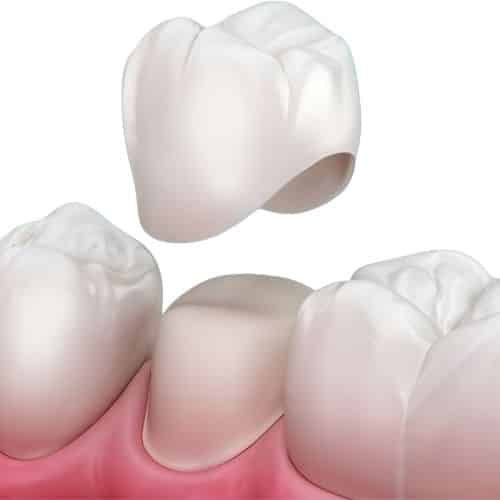
How much does a dental crown cost in Melbourne?
Two questions, more connected than they look
If your dentist has recommended a crown, you are probably weighing how much it will cost and which material is best for your tooth.
The material directly affects the cost, the longevity, the appearance, and the suitability for your particular situation. They are not separate decisions.
Most dental sites either give a single vague range, or list materials without explaining why you would choose one over another. What follows is both, so you can have an informed conversation rather than simply accepting a recommendation without context.
What a crown is and when one is needed is covered on Dental Crowns, and what types of dental crowns are available runs through the same materials clinically; this page is about choosing between them and what it costs. For other procedures, the price guide is the wider reference.
Crown cost by material
Full porcelain (ceramic)
Cost: $1,500 – $2,200
Best for: front teeth and premolars, where appearance is the priority
Pros: excellent colour matching, natural translucency, no metal margin
Cons: slightly less durable than zirconia for heavy-grinding patients
Zirconia
Cost: $1,500 – $2,500
Best for: back teeth (molars), and patients who grind or clench
Pros: exceptionally strong, tooth-coloured, biocompatible, versatile
Cons: can be less translucent than layered porcelain — though modern multilayer zirconia is closing that gap
Porcelain-fused-to-metal (PFM)
Cost: $1,200 – $1,800
Best for: posterior teeth where budget is a concern
Pros: a strong metal substructure with a porcelain outer layer for appearance
Cons: a dark metal margin can show at the gum line over time, particularly if the gums recede; the porcelain can chip off the metal core; less natural light transmission than all-ceramic
That margin issue is worth understanding before choosing PFM to save money. It typically appears years later, on a front tooth, at the point where it is most visible. Gum recession is what exposes it — see Bleeding Gums and periodontal (gum) disease for what drives recession.
Gold
Cost: $1,500 – $2,500 (varies with the gold price)
Best for: back molars, heavy grinders, and teeth with limited space
Pros: exceptionally durable, gentle on the opposing teeth, precise fit, and gold is the most biocompatible metal
Cons: not tooth-coloured — though some patients consider that a positive; cost fluctuates with the gold market
The “gentle on opposing teeth” point is genuinely important and rarely mentioned: harder ceramics can wear the natural tooth biting against them. Gold does not.
CEREC same-day crown
Cost: $1,500 – $2,300
Best for: patients who want the crown completed in a single appointment
Pros: no temporary crown, no second appointment, digital precision
Cons: material options may be more limited than with lab-made crowns; not ideal for every case
See Same-day CEREC restorations for how the scanning and milling work, and when a laboratory-made crown is still the better choice.
Temporary (provisional) crown
Cost: $200 – $500 — often included in the overall crown fee
A placeholder worn while the permanent crown is made in the laboratory, typically one to two weeks.
Those are this practice's indicative Melbourne ranges, and they are not a benchmark. Australia has no national dental fee schedule, so there is no published reference price for a crown anywhere in the country, and the questions below explain what that means when you are comparing quotes.
What a crown quote should include
A comprehensive quote covers:
- tooth preparation — shaping the tooth to receive the crown
- digital scan or impression
- shade matching
- temporary crown, for lab-made crowns
- laboratory fabrication fee
- crown fitting and cementation
- bite adjustment
- follow-up review
Smile Solutions' crown fees include all of these.
If you receive a quote elsewhere, check whether the laboratory fee and the temporary crown are included — some practices list them separately, which is where a quoted figure and a final bill diverge. The same warning applies with more force to treatment planned overseas, where the review appointments have no home at all — see Overseas dental work could cost you more in the long term.
What else affects the price
Beyond material choice:
Whether the tooth needs building up first. A heavily broken-down tooth may need a core build-up, and sometimes a post, before it can hold a crown. See Chipped and Cracked Teeth, Why does a cracked tooth hurt so much? and How will my cracked tooth be treated?.
Whether root canal treatment is needed first. If the pulp is involved, that is a separate procedure with its own fee — and it usually precedes the crown. Difficult cases go to an endodontist.
Whether gum treatment is needed first. Crowns are not placed on teeth with active periodontal disease; the gums have to be stable for the margin to seal. See Periodontists and Dental Cleans and Hygienists.
Which tooth it is. Front teeth carry a higher aesthetic demand, which affects both material choice and the laboratory work involved — and on a front tooth a veneer or composite bonding is sometimes a more conservative alternative worth asking about, because it removes less tooth. What is the difference between porcelain crowns and veneers? sets that choice out. For heavily restored mouths planned as a whole, see Prosthodontists and Complex Dentistry.
Who makes it. Laboratory quality varies, and it is reflected in both the fit and the price.
If you grind, say so before the material is chosen rather than after the crown chips — it changes the recommendation, and a night splint usually belongs in the plan. See TMD and Teeth Grinding and How can I stop grinding my teeth when I sleep?.
What the research says about how long each material lasts
Cost per year of service is the more useful number, and for once there is published evidence to put against it. A systematic review by Sailer and colleagues (2015) of the survival and complication rates of single crowns reported these five-year survival rates by material:
- metal ceramic — 94.7%
- leucite or lithium-disilicate reinforced glass ceramic — 96.6%
- densely sintered zirconia — 92.1%
A separate prospective study (Passia and colleagues, 2013) reported a five-year survival rate for gold crowns of 92.3%.
Two things are worth drawing out of those numbers, and neither is what people expect.
First, they are close together. A spread of roughly four percentage points at five years is not the difference most material marketing implies. On that evidence, material choice is a smaller lever on longevity than the condition of the tooth underneath, the bite and the position in the mouth.
Second — and this is the awkward one — densely sintered zirconia had the lowest five-year survival of the four, despite being the material usually described as the strongest. Strength of the material and survival of the finished restoration are not the same measurement: a crown can fail at the cement margin, at the tooth, or through recurrent decay, none of which is a test of how hard the ceramic is. So “which is strongest” is a poor question to choose on.
A caveat on dates. That evidence is from 2013 to 2015. The modern multilayer zirconia mentioned above post-dates it, and materials in this field change faster than the five- and ten-year studies that measure them. Treat the figures as the best published guide rather than the last word, and ask what your practitioner is actually seeing.
If the tooth has had root canal treatment
Where a crown follows root canal treatment, the case for it is considerably stronger than a matter of preference, and it is worth knowing why before you weigh the fee.
The restoration is not an afterthought to the root canal — it is half of it. In the endodontic literature, a good-quality coronal restoration is described as a positive predictor of both periapical healing and tooth survival, and one systematic review concluded that the coronal seal was as important as the quality of the root canal treatment itself in determining success. A root-filled tooth is also structurally weakened, and loses proprioception — the feedback that tells you how hard you are biting — which is why cuspal coverage is discussed at all.
The size of the effect. A meta-analysis by Ng and colleagues (2010), drawing on studies with follow-up from 2 to 10 years, found that teeth restored with a crown had 3.92 times higher chance of survival than teeth not receiving a crown after root canal treatment.
Where the tooth is also cracked, the gap is wider again. One study of root-filled cracked teeth reported 5- and 10-year survival of 97% and 95% for teeth receiving a crown, against 57% and 37% for teeth restored with a direct composite filling (Nguyen and Jansson, 2021). Those figures apply to cracked teeth specifically, not to every tooth — see Chipped and Cracked Teeth and How will my cracked tooth be treated?.
And timing is part of the cost decision. A retrospective study by Pratt and colleagues (2016) found that posterior root-filled teeth that received a crown four months after endodontic treatment were extracted at three times the rate of those crowned within four months. The guidance drawn from it is that where cuspal coverage is justified, it should be provided as soon as possible after the root canal is completed, provided the tooth is symptom-free.
That sits directly against the benefit-year advice below, and the tension is real. Staging elective crowns across two benefit years is reasonable; deferring the crown on a freshly root-filled posterior tooth to catch a new annual limit is a different proposition, and this is the evidence to raise when you ask whether waiting is safe in your case. Everything you need to know about root canal treatment and Endodontists cover the treatment itself.
None of this settles whether your tooth needs cuspal coverage. The European Society of Endodontology and the British Endodontic Society both recommend that each case is considered individually, with loss of the proximal walls a strong indication for it, alongside tooth position, adjacent contacts and the forces on it. That is a conversation to have with the person looking at the tooth.
Health funds
Crowns are classified as major dental, so:
- waiting periods commonly apply on major dental
- annual limits may cap what you can claim in a year
- ask for the item numbers so your fund can give you a pre-treatment estimate
Those two limits together are the reason timing matters. Where a plan involves more than one crown and nothing is urgent, staging them across benefit years is a legitimate approach — ask whether it is clinically safe in your case rather than assuming either way. Patient payment plans covers the other route.
Where to go next
- What a crown is and when it is needed — Dental Crowns
- Single-visit crowns — Same-day CEREC restorations
- If the tooth is cracked rather than worn — Chipped and Cracked Teeth
- If the tooth cannot be saved — Dental Implants, Bridges, implants and dentures
- Front-tooth appearance — Cosmetic Dentistry
Common questions
Why do two dentists quote such different prices for the same crown?
Because there is no reference price to quote against. Australia has no national dental fee schedule, and a submission to the Senate inquiry into the value and affordability of private health insurance and out-of-pocket costs put the consequence bluntly: “private patients can go to multiple dentists and receive conflicting diagnoses and widely varying quotes for unpredictable dental fees. There are no consumer guidelines to ascertain the reasonableness of dental fees charged.” That submission argued for a recommended, non-mandatory schedule of the kind the Australian Medical Association and the Australian Psychological Society publish. It is an argument put to a parliamentary inquiry rather than settled policy, and no such schedule exists.
The Australian Dental Association's own fees survey confirms the variation without endorsing the explanation. Its 2022 survey found “considerable variation in the fees charged within and between states”, with general practitioners in South Australia and Western Australia charging the lowest fees on average and those in the ACT and Northern Territory the highest — though the ADA notes that the ACT and NT samples were small and those results “should be viewed with caution”.
So a difference between two quotes is not by itself evidence that one is unreasonable. What makes quotes comparable is the itemised list above: the same item numbers, the same materials, the laboratory fee and temporary crown either both included or both excluded, and any build-up or root canal treatment shown separately. Ask for that, in writing, from each practice.
Are dental fees rising, and by how much?
The only Australian benchmark we can point to is the ADA's Dental Fees Survey. Its 2022 edition, conducted by ACA Research and covering fees as at 1 July 2022, found that across the 122 items surveyed, fees charged by general dentists rose by an average of 3.7 per cent over the two years since 1 July 2020. The increase was not even: the smallest was in preventive services and periodontics, at 1.6 per cent, and the largest in orthodontics, at 6.9 per cent.
Read those with the sample in mind. The ADA invited 11,035 dentists and received 3,819 valid responses, a 6 per cent fall on the 4,081 received in 2020; 3,535 general practitioners — about 32 per cent of those invited — are in the analysis. Specialist figures are far thinner: only 284 self-identified specialists responded, and the ADA says its specialist results “should be interpreted with considerable caution”. Among the one in five specialists who charged an hourly rate, the mean rate rose from $662 in 2020 to $921 in 2022, a 39 per cent increase, with the median going from $600 to $800 and the full range running from $450 to $1,500 an hour.
The survey reports ADA members in private practice, not the whole profession, and it is now several years old. It does not publish a crown price for Melbourne, and no independent source we can find does.
Is a same-day crown as good as a laboratory-made one?
We cannot answer that from independent evidence, and we would rather say so than imply otherwise. The five-year survival figures above come from studies of laboratory-made crowns in those materials. We could not find any independent survival data for chairside-milled ceramic crowns in the reference sources behind this site — no systematic review, no long-term cohort. That means any figure you see quoted for a same-day crown, such as “90 per cent at ten to fifteen years”, is not something we can substantiate, and you should ask whoever quotes it for the study.
What can be said is narrower and still useful. A single-visit crown avoids a temporary crown and a second appointment, which removes the two things that most often go wrong in between — a temporary coming off, and sensitivity while the preparation is unprotected. Against that, the material choice is narrower, and there are cases where a laboratory-made crown remains the better option, particularly where the appearance of a front tooth is the priority and a ceramist's layering is what achieves it. Ask which the clinician would choose for your specific tooth and why, and ask what happens if the milled crown does not fit on the day.
Cost is the reason I have been putting this off. Is delaying it risky?
You are far from alone: an Australian Institute of Health and Welfare survey cited in the parliamentary submission above found that nearly a third of people aged 5 or older — 32 per cent — had avoided or delayed visiting a dentist because of the cost. It is the most common reason dental treatment does not happen in this country.
Whether delay is safe depends entirely on why the crown was recommended, and the difference is large. If it is elective — an old, sound restoration you would like replaced — waiting costs you nothing clinically, and staging across two health fund benefit years is a reasonable plan. If the tooth has just had root canal treatment, the evidence points the other way: the study by Pratt and colleagues found posterior root-filled teeth crowned four months after treatment were extracted at three times the rate of those crowned within four months. A cracked tooth is the same kind of case.
So the question to ask is not “can I wait” but “what is the risk if I wait six months, and what would change the answer”. If the answer is that the tooth may split beyond repair, the cheap option is not cheap. If the answer is that nothing much happens, ask to be reviewed rather than treated now.
If a root canal can still fail, why pay for a crown on top of it?
Because the crown is part of what makes the root canal succeed, and because the base rate is better than most people assume. Pooled peer-reviewed data puts overall root canal treatment success at 87.8 per cent at tooth level (95% CI 84 to 90 per cent) and 80.8 per cent at patient level — so the usual outcome is that the tooth is still there and functioning.
The crown is not an optional finishing touch on that. As set out above, one systematic review concluded the coronal seal was as important as the quality of the root filling itself, and Ng and colleagues found teeth restored with a crown had 3.92 times higher chance of survival than root-filled teeth that did not receive one. Spending on the root canal and then declining the crown is the combination the evidence argues against most clearly.
What is genuinely worth asking is whether your tooth needs full cuspal coverage or whether a smaller restoration would do. The European Society of Endodontology and the British Endodontic Society both say the decision is case by case, with loss of the proximal walls a strong indication for coverage. A front tooth with a small access cavity and intact walls is a different proposition from a molar with two walls missing.
Does this article replace an individual dental assessment?
No. It provides general information. Symptoms, suitability, risks and treatment choices depend on examination and, where indicated, imaging or other records from an appropriately registered practitioner.
Practical details
CEREC restorations are designed and milled on site. Smile Solutions also has an in-house laboratory, so the ceramist and clinician can work together on shade and shape.
Smile Solutions, Level 1, 220 Collins Street, Manchester Unity Building, Melbourne VIC 3000. Phone 13 13 96, or theteam@smilesolutions.com.au. Monday–Friday 8.00am–6.00pm, Saturday 8.30am–1.30pm, Sunday by appointment. Full details on Contact Us.
The survival figures in this article are drawn from the peer-reviewed endodontic literature on restoring root-filled teeth, which cites the primary studies named alongside each figure. They describe published research, not results at this practice, and the studies vary in design, setting and follow-up. Fee-survey figures are the Australian Dental Association's own, for ADA members in private practice as at the date stated, and are not prices for any individual service. The parliamentary material quoted is a submission to an inquiry, not a finding of government.
Published 3 August 2026. All figures are indicative Melbourne ranges at that date, not a quote — your cost depends on your individual assessment. Durability and appearance vary between individuals, and no restoration is permanent. Health fund rules, waiting periods and limits are set by your fund and change; confirm with them directly. General information only; it does not replace advice from your treating practitioner.
Smile Solutions trades under ABN 28 193 514 103.
Images on This Page
-
https://www.facebook.com/tr?id=800557773428361&ev=PageView&noscript=1
(no alt text)
-
https://www.smilesolutions.com.au/wp-content/uploads/2025/10/calendar_month.svg
(no alt text)
-
https://www.smilesolutions.com.au/wp-content/themes/arcadian-wordpress-theme/assets/images/smile_solutions_logo_white.png
Smile Solutions Logo
-
https://www.smilesolutions.com.au/wp-content/themes/arcadian-wordpress-theme/assets/images/smile_solutions_logo_purple.png
Smile Solutions Logo
-
https://www.smilesolutions.com.au/wp-content/uploads/2023/11/SS-Tooth-1-1-150x150.png
Smile Solutions
-
https://www.smilesolutions.com.au/wp-content/uploads/2025/09/Dental-Crown-at-Smile-Solutions.jpg
How Much Does a Dental Crown Cost in Melbourne? Materials Compared
-
https://www.smilesolutions.com.au/wp-content/uploads/2025/09/Root-Canal-2-300x217.jpg
Root Canal
-
https://www.smilesolutions.com.au/wp-content/uploads/2026/08/Mouth-Breathing-300x270.jpg
Mouth Breathing
-
https://www.smilesolutions.com.au/wp-content/uploads/2026/07/Diabetes-and-Dental-Health-300x270.jpg
Diabetes and Dental Health
-
https://www.smilesolutions.com.au/wp-content/themes/arcadian-wordpress-theme/assets/images/family_owned_bussiness.png
Family Owned Business
-
https://www.smilesolutions.com.au/wp-content/themes/arcadian-wordpress-theme/assets/icons/icon--phone.svg
Smile Solutions Contact
-
https://www.facebook.com/tr? id=800557773428361&ev=PageView&noscript=1
(no alt text)