I need a smile makeover — what's involved?
Who asks for this, and why
People seeking a smile makeover span men and women, from their twenties to their sixties and beyond, and their needs cover a wide spectrum. Some start from a moderately pleasing base; many arrive with snaggly, worn-down or heavily discoloured teeth.
That second group has often developed a habit of hiding their teeth and never smiling for photographs. As Dr Henderson puts it — it is sad and unnecessary to see Dad as the only one not smiling in the wedding photos.
What follows is the process, step by step. The service overview is on Cosmetic Dentistry.
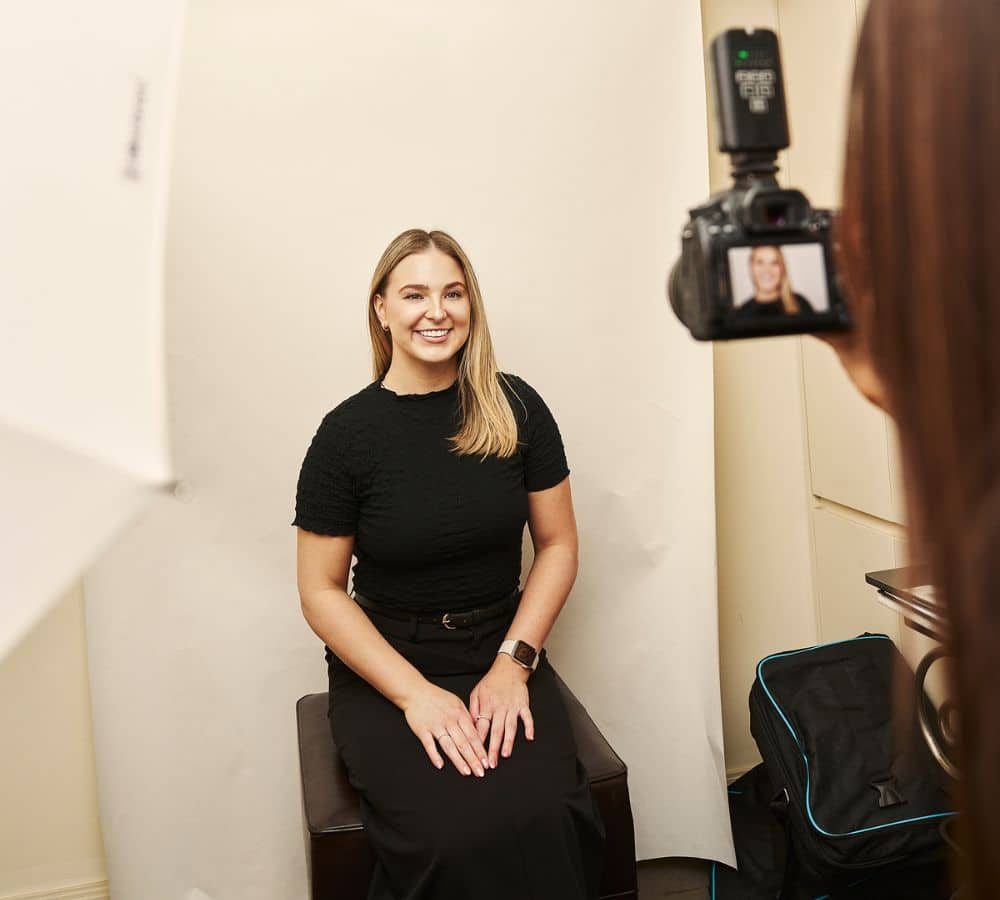
Step 1: photographs, and a conversation
Photographs of your teeth are taken, and then a genuine discussion. The questions asked:
- What don't you like about your teeth?
- What do you like, and want to keep?
- How do you feel about their length — particularly the middle front teeth?
- Do you play a wind instrument, which could be affected by changes to your teeth?
- Are you regularly photographed at close quarters, or do you appear on TV or video?
- Do you want whiter teeth?
- Can you name a public figure whose smile appeals to you, or show photos of something to aim for?
- How far around the arch of teeth do we need to go?
- Will you accept the modification and reduction of tooth material necessary to achieve the outcome you want?
Answers to these are essential to developing a collaborative relationship in achieving the result you are after.
Two of them are more probing than they look. The wind instrument question is asked because changing the length or contour of front teeth changes an embouchure — a real problem for a musician, and one nobody thinks of afterwards. The final question is informed consent, stated plainly: veneers and crowns require permanent removal of tooth structure, and you should agree to that knowingly, before anything starts. See Porcelain Veneers and Dental Crowns.
How much tooth, in numbers. The paper most often cited on this is Edelhoff and Sorensen (Journal of Prosthetic Dentistry, 2002), which weighed the tooth structure removed by nine different anterior preparation designs. Their finding: ceramic veneer and resin-bonded retainer preparations were the least invasive, “removing approximately 3% to 30% of the coronal tooth structure by weight”, against “approximately 63% to 72% of the coronal tooth structure … when teeth were prepared for all-ceramic and metal-ceramic crowns.” Their conclusion is the useful summary: veneer preparations “required approximately one-quarter to one-half the amount of tooth reduction of conventional complete-coverage crowns.” Read those numbers for what they are. The study was in vitro, weighing prepared typodont resin teeth — a maxillary central incisor, a maxillary canine and a mandibular central incisor, ten per design — not teeth in anyone's mouth. It gives you the order of magnitude between a veneer and a crown. It does not give you a figure for your own tooth, which depends on the preparation design chosen and on where your enamel actually is.
And there is a genuine disagreement in the Australian material worth knowing about. The Australian Dental Association's consumer site describes veneers as “very thin, meaning not much or no tooth structure has to be cut away” — which is accurate for minimal-preparation and no-preparation veneers, and is not a description of conventional preparation. healthdirect is blunter about the same treatment: your teeth “could become more sensitive because some enamel is removed”, and “you can't take veneers off.” We are not going to reconcile those two for you. The practical point is the one both of them are circling: the amount removed depends on the design, it is not recoverable, and the number belongs in your written plan rather than in a brochure.
If whiter teeth are the main thing you want, raise that early — Teeth Whitening is reversible and removes no tooth, and some people who came in asking about veneers leave having had only that.
Step 2: what is not possible
Most importantly, what cannot be done is pointed out.
The worked example:
Some people want bigger teeth. That is easy with ceramic veneers if there is space between the teeth, or if the teeth are short and squarish and could take extra length.
But if the teeth are tight against each other, there is no room for bigger teeth without creating space first. In those cases, a consultation with a specialist orthodontist is suggested — they can broaden the arch. This may also require some level of jaw surgery. See Specialist Orthodontists, Orthodontics and Jaw Surgery.
If a patient with that lack of space declines orthodontic treatment, the conversation turns to lowering expectations of what can be achieved.
That paragraph is the most valuable one in this article. A practice willing to tell you what it cannot deliver — before you pay — is describing a process built around the result rather than the sale. Enthusiastic agreement to every request is not a good sign in cosmetic dentistry.
Step 3: an indicative cost
At this stage you are given a general, indicative understanding of likely costs.
A firm costing comes later — after examination, record collection, and development of a tailored treatment plan, possibly involving other members of the dental team.
As a guide: the smile makeovers most commonly requested involve bonded ceramic restorations on six teeth — canine to canine. Where no significant dental health improvement is required first, the project cost may range from around $7,500 to $12,500.
Note the condition attached. “If no significant dental health improvement is required first” is doing real work — decay, gum disease or a bite problem must be treated before cosmetic work, and that is additional.
This figure was published in January 2015 and is not current. Practice fees are on the Price Guide, and the only number that applies to you is the written plan at Step 6.
Payment
Payment plan options are available. Where a plan is advertised as interest free, that describes the plan term only — a deposit may be required, an establishment fee and ongoing account fees may apply, and charges can apply if the balance is not cleared within the agreed period. The applicable terms depend on the provider and the amount financed, and are set out in writing before you commit — ask what the deposit and the establishment fee are, in dollars, and what the total will be by the end. Payment Plans.
Step 4: dental examination — is your mouth ready?
A general examination establishes:
- Gum and bone health — see Bleeding Gums
- Cleaning effectiveness — Dental Cleans & Hygienists
- Bite pattern
- Premature tooth wear from grinding or clenching — TMD and Teeth Grinding
- Soft tissue health
- Other oral health factors that can influence the success of the makeover
For the front teeth specifically: their angle and position in the jaws, soundness of the roots and nerves, the visible parts, pre-existing defects and dental work, and the outline of your gum over the teeth.
Grinding gets particular attention because a grinding habit that wore down natural enamel will do the same to ceramic — and that changes both the material choice and whether a nightguard is part of the plan. See Night-time tooth grinding and clenching.
This is not a formality, and the research literature shows why. The best long-term Australian veneer data comes from Layton and Walton's prospective cohort of 499 veneers in 155 patients, placed in a private practice in Australia by a single prosthodontist between 1990 and 2010 — and patients with extensive loss of tooth structure through parafunction, or an unfavourable periodontal prognosis, were excluded from it. A separate cohort in the same review “reported a significantly higher marginal discoloration among smokers and a significantly higher failure rate among bruxers.” In other words, grinders and smokers were either screened out of the good survival figures or did worse within them. Whichever way you read it, the examination at this step is doing something the survival percentages later on quietly assume has already been done.
Where the gum line itself is the issue rather than the teeth, Gummy Smile covers what can be done.
Step 5: records and smile design
If the plan involves increasing the length of your front teeth, extra length may be trialled quickly using tooth-coloured filling material. A gum lift can be simulated the same way.
Photographs and impressions record the difference between your starting point and the mocked-up changes.
A formal design is then done on dental models, and in some cases trial-fitted into your mouth. Where restorations are made on site, the Smile Solutions Laboratory is part of that work.
This is where you find out what the plan actually looks like on your face — at the stage where changing it costs nothing.
Step 6: finalising the plan and the cost
Once input from any other practitioners has been considered — the specialist orthodontic team, or a gum and bone specialist — you are given a written and fully costed treatment plan, and it is discussed with you. See Periodontists and Cosmetic Dentistry Under Specialist Care.
On acceptance, treatment begins.
Step 7: preparation and provisional restorations
The teeth involved usually need some degree of reshaping, to allow for necessary material thickness without creating unnatural and possibly unhealthy contours.
That phrasing matters. Under-preparing a tooth forces the ceramic to be built out over it, producing a bulky restoration with a ledge at the gum margin — which looks wrong and traps plaque. The preparation exists to make room for the material, not to remove tooth for its own sake.
There is a second constraint pulling in the opposite direction, and it is the one that matters most for how long the work lasts: the bond wants enamel. Reviewing the evidence in the Journal of Esthetic and Restorative Dentistry in 2012, Burke concluded that “there is reasonable evidence indicating that a veneer preparation into dentin adversely affects survival” and that “the ideal preparation for porcelain veneers remains within enamel.” The Australian cohort mentioned above went further in practice: only teeth with at least 80 per cent of their enamel remaining were veneered at all. So the preparation is a genuine balance — enough depth for the ceramic, not so much that the margins end up in dentine — and it is one of the reasons a heavily worn or heavily filled tooth may be better served by a crown than a veneer.
After an impression or scan of the prepared teeth, provisional restorations are attached for the fabrication period — generally around two weeks.
These protect the adjusted teeth, and — very importantly — give both you and the dentist an opportunity to experience and evaluate the design you developed together. They will look close to the intended outcome.
Where the case suits it, the two-week provisional stage can sometimes be avoided altogether — The case for same-day porcelain veneers versus temporary veneers worn for 2–3 weeks and Same-Day Porcelain Veneers set out the trade-off, which is not one-sided: the provisional period is also the evaluation period described below.
Step 8: reviewing the provisionals
About three days after preparation, you and the dentist review the provisional restorations.
Changes may be made to them, so they become a communication tool between you, the dentist, and the laboratory technician who fabricates the final work.
By this point you will have assessed how the provisionals work with your speech and eating, lip comfort and appearance.
The whole treatment sequence is geared towards making the final restorations the smile that was planned.
The lock-in point
Before construction of the laboratory-made restorations, your choices of colour and whiteness, tooth shape, size and arrangement must be locked in.
Changes after the restorations are made incur substantial additional laboratory and clinical work, and additional cost.
So the review of the provisionals is the decision point. If something is not right — too long, too white, the wrong shape — that is the appointment to say so.
Bring someone whose eye you trust to that appointment. You will have been looking at your own teeth for three days; a second opinion at the one stage where changes are free is worth more than at any other point in the process.
Step 9: try-in and finalisation
Generally two weeks after preparation, the provisionals are removed and the laboratory-produced restorations are trial-placed and evaluated.
At this point the result should be very close to expectation.
Only when both you and the dentist are completely satisfied are the restorations powerfully bonded into place, followed by final clean-up, checks, and care instructions.
Sometimes very minor adjustments — to the bite, for example — are made in the week or so after placement.
Afterwards
Ceramic restorations are not permanent and not maintenance-free. They chip, the gum line can recede over years, and the bonded margins need the same cleaning as natural teeth — more, if anything. Regular examination and professional cleaning are part of owning them. How long do porcelain veneers last? goes into this in more detail.
How long they last, in the only form the evidence actually supports. No regulator or professional body anywhere publishes a veneer lifespan in years, and neither teeth.org.au nor healthdirect publishes one — so the honest answer is a survival percentage at a stated point in time, from the international literature, with the population it came from attached.
- Alenezi and colleagues' systematic review (Journal of Clinical Medicine, 2021) pooled 25 studies and 6,500 porcelain laminate veneers and put the 10-year estimated cumulative survival rate at 95.5%, counting fracture, debonding, secondary caries and the need for root canal treatment as failure — 433 of the 6,500 failed on that definition. Fracture was the most common complication, then debonding, “both more commonly happening within the first years after PLV cementation.”
- Layton and Walton's Australian cohort reported Kaplan–Meier survival of 98% at 5 years, 96% at 10, 91% at 15 and 91% at 20 across the whole sample of 499 veneers — remembering that parafunction and poor periodontal prognosis were exclusion criteria and only teeth with at least 80% enamel were treated. It is a best case, from one operator, in selected patients.
Three caveats that belong with those figures. Seventeen of the 25 studies in the review were retrospective and only one was a randomised controlled trial. The definition of failure varied between studies, which the authors call out directly. And slight marginal defects and slight marginal discolouration were not counted as failures, so 95.5% at ten years does not mean 95.5% still looked the way they did on the day they were fitted. The review also warns that its later years are the least reliable, because the number of veneers still under observation falls away — in the Australian cohort, 499 were followed for the first five years but only 82 reached twenty.
Whitening does not work on ceramic. If your natural teeth later darken, the restorations will not follow — which is why whitening decisions are made before the ceramics are colour-matched, not after.
A complimentary aesthetic dentistry consultation is available for anyone wanting to discuss their specific situation — see Complimentary Cosmetic Consultation. Confirm the current terms when you book: what the appointment includes, whether records such as photographs, scans or radiographs are part of it or charged separately, and whether any deposit applies. It is a planning discussion, not a diagnosis or a course of treatment.
Common questions
Isn't composite bonding a cheaper way to get the same result?
Cheaper, less committing, and measurably shorter-lived. The clean head-to-head is Mazzetti and colleagues (Dental Materials, 2022), a ten-year practice-based evaluation, as tabulated in a 2024 review: “Composite veneers presented a higher risk of failure than ceramic veneers”, with a hazard ratio for survival of 4.00 (95% CI 2.74–5.83) and for success of 5.16 (2.65–10.04). In annual failure rates, counting any intervention or repair as a failure, composite ran at 9.1% at five years and 10% at ten, against 2.9% and 2.8% for ceramic; counting only outright replacement, 3.9% and 4.1% against 1.4% and 1.2%. The gap between those two ways of counting is itself the point: composite gets repaired rather than remade, which is why including repairs roughly quadruples its failure rate and ceramic's barely moves. A separate review pooling randomised trials put resin composite veneer survival at 88% (95% CI 81–94%) over follow-up of two to about eight years — a figure that is not directly comparable with the 95.5% ceramic number above, because the windows and the failure definitions differ. For some people the trade is right: less cost up front, repairable in the chair, and a decision that is easier to revisit later. It is not the same product at a discount.
What should I ask about the material and the design, rather than just the price?
Two variables show up in the evidence and rarely in a consultation. The ceramic. Morimoto and colleagues' meta-analysis, as tabulated in that 2024 review, put glass-ceramic veneers at 94% cumulative survival (95% CI 87–100%) against feldspathic porcelain at 87% (82–93%) over a median nine years, and the 2021 review of 6,500 veneers found in the same direction, reporting lower failure rates for non-feldspathic veneers. Whether the veneer wraps over the biting edge. Here the two sources disagree: the 2021 review reported lower failure rates for veneers with incisal coverage, while Morimoto's figure for incisal coverage was an odds ratio of 1.25 (95% CI 0.33–4.73) — a confidence interval that crosses 1, so it shows nothing either way. Worth holding alongside all of that: the Australian cohort with the best long-run numbers on this page used feldspathic porcelain. Material is not destiny, and operator and case selection clearly matter as much. So the useful questions are which ceramic is proposed and why, and whether the design covers the biting edge — so that the answer is a reasoned choice rather than whatever the laboratory does by default.
If one chips or comes off in a few years, what actually happens?
It is worth seeing the individual failure modes rather than one survival figure. From Morimoto and colleagues, over a median nine years: fracture or chipping 4% (95% CI 3–6%), debonding 2% (1–4%), severe marginal discolouration 2% (1–10%), endodontic problems 2% (1–3%), decay under the veneer 1% (0–3%). The 2021 review adds that fracture and debonding are “both more commonly happening within the first years after PLV cementation” rather than late — so the early period is the revealing one. Not all of that means a remake. That review deliberately did not count slight marginal defects or slight marginal discolouration as failures at all, “since they have more to do with the appearance of the PLV, and can be easily repolished or repaired.” A veneer that debonds whole can often be re-bonded; an edge chip may be polished or repaired; a fracture through the body of the veneer generally means a new one. The part to settle before treatment starts is the commercial one. Ask what happens if a veneer fails at one year, at three, at five — who bears the cost of the remake, and whether the answer depends on why it failed — and ask for that alongside the written plan at Step 6.
Why do quotes for the same six veneers differ so much between practices?
Because Australia has no national dental fee schedule. The ADA's Dental Fees Survey 2022, drawing on 3,535 general dentists in private practice, found “considerable variation in the fees charged within and between states”, with fees up across every service category over the two years to 1 July 2022. A consumer submission to the Senate's 2017 inquiry into private health insurance put the same thing from the patient's side: “private patients can go to multiple dentists and receive conflicting diagnoses and widely varying quotes for unpredictable dental fees.” When you compare two quotes for a makeover, line up the number of units, the ceramic being used, whether the laboratory work is done on site or sent out, whether the mock-up and the provisional stage are included, whether records — photographs, scans, radiographs — are inside the figure or charged separately, and whether preparatory treatment for decay, gum disease or grinding sits inside it or outside it. A quote that is materially cheaper usually stops earlier in that list rather than doing the same work for less.
How long will the work last?
There is no lifespan in years to give you, because no authority publishes one. What the literature supports is survival at stated time points: a 2021 systematic review of 25 studies and 6,500 porcelain laminate veneers estimated 95.5% cumulative survival at 10 years counting fracture, debonding, secondary caries and the need for root canal treatment as failure; an Australian prospective cohort of 499 veneers reported 96% at 10 years and 91% at 20, having excluded patients with parafunction and treated only teeth retaining at least 80% enamel. Marginal staining and small chips were not counted as failures in the review, so those numbers describe survival rather than appearance.
Does this article replace an individual dental assessment?
No. It provides general information. Symptoms, suitability, risks and treatment choices depend on examination and, where indicated, imaging or other records from an appropriately registered practitioner.
Sources named on this page
- Edelhoff D, Sorensen JA, Tooth structure removal associated with various preparation designs for anterior teeth, Journal of Prosthetic Dentistry 2002;87(5):503–509 — in vitro, gravimetric, typodont resin anterior teeth
- Alenezi A, Alsweed M, Alsidrani S, Chrcanovic BR, Long-Term Survival and Complication Rates of Porcelain Laminate Veneers in Clinical Studies: A Systematic Review, J Clin Med 2021;10(5):1074
- Layton and Walton, prospective cohort of 499 feldspathic porcelain veneers in an Australian private practice, 1990–2010, as reported in AlJazairy YH, Survival Rates for Porcelain Laminate Veneers: A Systematic Review, European Journal of Dentistry 2021;15(2)
- Burke FJT, Journal of Esthetic and Restorative Dentistry 2012;24(4):257–265, on preparation depth and survival
- Mazzetti T et al., ten-year practice-based evaluation of composite versus ceramic veneers, Dental Materials 2022, and Morimoto S et al. 2016 meta-analysis of veneer survival and failure modes — both as tabulated in a 2024 systematic review of laminate veneer outcomes
- Australian Dental Association, Dental Fees Survey 2022; and a consumer submission to the Australian Senate's 2017 inquiry into the value and affordability of private health insurance
- Australian Dental Association (teeth.org.au), Crowns, bridges and veneers, and healthdirect Australia on dental veneers
Related reading
- I want to improve my smile but don't know where to start
- I want a smile makeover — where should I start?
- Smile makeover
- The difference between crowns and veneers
- Turkey teeth: the real risks of getting veneers overseas
Practical details
Written by Dr Peter Henderson, who graduated from the University of Melbourne in 1980 with a Bachelor of Dental Science. He works with modern high-strength dental ceramics and bonding techniques to restore teeth to natural appearance and function, within the interdisciplinary environment at Smile Solutions.
Smile Solutions, Level 1, 220 Collins Street, Manchester Unity Building, Melbourne VIC 3000. Phone 13 13 96, or theteam@smilesolutions.com.au. Monday–Friday 8.00am–6.00pm, Saturday 8.30am–1.30pm, Sunday by appointment. Full details on Contact Us.
Registration can be verified free on the AHPRA register, or by calling 1300 419 495.
Published 20 January 2015. Costs quoted are indicative ranges as at that date, not a quote — confirm current fees with the practice. Veneers and crowns require permanent removal of tooth structure; results and longevity vary between individuals and all cosmetic treatment carries risks that should be discussed with your dentist. General information only; it does not replace advice from your treating practitioner. Offers and payment plan terms are subject to their own conditions, set by the practice or the credit provider and changing over time; confirm current terms directly before you commit.
Smile Solutions trades under ABN 28 193 514 103.
Images on This Page
-
https://www.facebook.com/tr?id=800557773428361&ev=PageView&noscript=1
(no alt text)
-
https://www.smilesolutions.com.au/wp-content/uploads/2025/10/calendar_month.svg
(no alt text)
-
https://www.smilesolutions.com.au/wp-content/themes/arcadian-wordpress-theme/assets/images/smile_solutions_logo_white.png
Smile Solutions Logo
-
https://www.smilesolutions.com.au/wp-content/themes/arcadian-wordpress-theme/assets/images/smile_solutions_logo_purple.png
Smile Solutions Logo
-
https://www.smilesolutions.com.au/wp-content/uploads/2016/05/Peter-150x150.jpg
Dr Peter Henderson
-
https://www.smilesolutions.com.au/wp-content/uploads/2026/07/Photography-and-Facial-Analysis.jpg
Photography and Facial Analysis
-
https://www.smilesolutions.com.au/wp-content/uploads/2026/04/PH-300x270.jpg
PH
-
https://www.smilesolutions.com.au/wp-content/uploads/2018/12/Dental-Filling-300x270.jpg
Dental Filling
-
https://www.smilesolutions.com.au/wp-content/uploads/2026/01/157-300x270.jpg
Brush and dental material close-up
-
https://www.smilesolutions.com.au/wp-content/themes/arcadian-wordpress-theme/assets/images/family_owned_bussiness.png
Family Owned Business
-
https://www.smilesolutions.com.au/wp-content/themes/arcadian-wordpress-theme/assets/icons/icon--phone.svg
Smile Solutions Contact
-
https://www.facebook.com/tr? id=800557773428361&ev=PageView&noscript=1
(no alt text)
-
https://bat.bing.com/action/0?ti=25148060&tm=gtm002&Ver=2&mid=812df64e-7469-4575-8a46-e3d09cd166da&bo=1&sid=e0c52f30ab2611f183f6e52984494917&vid=e0c54fd0ab2611f18f341fc7ab9168cd&vids=1&msclkid=N&pi=918639831&lg=en-US&sw=800&sh=600&sc=24&nwd=1&tl=I%20need%20a%20smile%20makeover.%20What%E2%80%99s%20involved%3F%20-%20Smile%20Solutions&p=https%3A%2F%2Fwww.smilesolutions.com.au%2Fdental-articles%2Farticle%2Fneed-smile-makeover-whats-involved%2F&r=<=2847&evt=pageLoad&sv=2&cdb=AQAQ&rn=960063
(no alt text)