Cosmetic Dentistry under Specialist Care
How do I know whether my dentist is actually a registered specialist?
This is checkable in about a minute, it is free, and it is worth doing before any significant dental procedure.
Search the clinician's name on the AHPRA public register — the Australian Health Practitioner Regulation Agency, at ahpra.gov.au — and read their profile:
- If the profile lists them as “Dental Practitioner – General”, they are a general dentist.
- If it lists them as “General & Specialist”, they are a registered specialist. The profile will also state which speciality.
There is no ambiguity in the wording. You do not need to interpret anything, and you do not need to ask the practice.
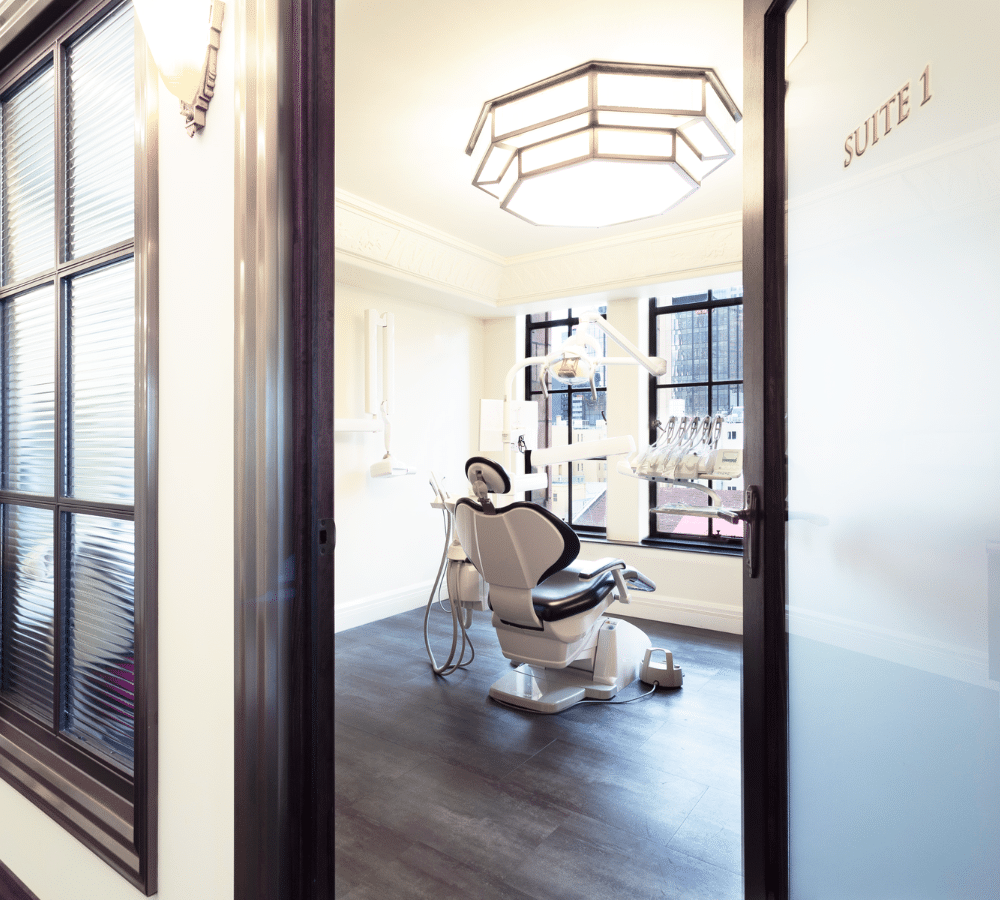
Smile Solutions is at Level 1, 220 Collins Street, Manchester Unity Building, Melbourne CBD.
What the register shows — and what it does not
This is worth being precise about, because the register is often treated as a quality rating and it is not one.
What it tells you:
- Whether the person is registered to practise at all, and the registration number
- Their division — dentist, dental hygienist, dental therapist, oral health therapist or dental prosthetist
- Whether they hold specialist registration, and in which speciality
- Their qualifications and the year awarded
- Any conditions, undertakings or reprimands currently recorded against the registration
- Whether registration is current, suspended or cancelled
What it does not tell you:
- How good they are
- How many cases of your particular procedure they have done
- Whether they are the right clinician for your case
- Anything about complaints that did not result in regulatory action
So the register is a floor, not a ranking. It answers “is this person entitled to do this and is anything on record against them”, which is a genuinely useful question, and nothing beyond it.
What specialist registration actually requires
The distinction matters because the training gap is substantial and not visible from a clinic's marketing.
To qualify as a registered specialist in Australia, a practitioner must:
- Hold the same primary dental degree as a general dentist, then
- Complete a further full-time postgraduate programme — typically a three-year Doctor of Clinical Dentistry or equivalent Masters, and in some fields longer — in one recognised speciality, which
- Makes them eligible to apply to the Dental Board of Australia for registration in that speciality.
That is three or more years of full-time study after the five years of the primary degree, in one narrow field. Oral and maxillofacial surgery is longer still, because it generally requires a medical degree in addition to the dental one, plus surgical training — which is why practitioners in that field are described as dual qualified.
The thirteen recognised specialities
Australia recognises thirteen dental specialities. Any title outside this list is not a speciality, however it is presented.
| Speciality | What it covers |
|---|---|
| Dento-maxillofacial radiology | Imaging and its interpretation |
| Endodontics | Root canal treatment and the dental pulp |
| Forensic odontology | Dental identification and legal casework |
| Oral and maxillofacial surgery | Surgery of the mouth, jaws and face |
| Oral medicine | Non-surgical diagnosis and management of oral disease |
| Oral and maxillofacial pathology | Laboratory diagnosis of oral disease |
| Oral surgery | Surgical procedures within the mouth |
| Orthodontics | Tooth movement, bite and jaw development |
| Paediatric dentistry | Dentistry for children, including complex and special-needs cases |
| Periodontics | Gums and the supporting structures of the teeth |
| Prosthodontics | Restoring and replacing teeth — crowns, veneers, bridges, implants, dentures |
| Public health dentistry | Population-level oral health |
| Special needs dentistry | Patients with disability, medical complexity or frailty |
Six of the thirteen practise at Smile Solutions: endodontics, oral and maxillofacial surgery, orthodontics, paediatric dentistry, periodontics and prosthodontics. See Specialist Care.
Which specialist does what
A practical routing guide, since the names give little away:
| If the problem is | The relevant speciality | Typical treatments |
|---|---|---|
| An abscessed or root-treated tooth, or a re-treatment | Endodontics | Root canal treatment, retreatment, surgery at the root tip |
| Gums, bone loss, recession, or trouble around an implant | Periodontics | Periodontal therapy, gum grafts, gum lifts, implants |
| Crooked teeth, a bad bite, or jaw growth in a child | Orthodontics | Braces and aligners, growth guidance |
| Rebuilding worn, broken or missing teeth as a whole | Prosthodontics | Veneers, crowns, bridges, implants, dentures |
| Impacted teeth, jaw surgery, facial trauma, biopsies | Oral & maxillofacial surgery | Wisdom teeth, jaw surgery |
| A child, particularly a young or anxious one | Paediatric dentistry | Children's dentistry, treatment under general anaesthetic |
Several fields overlap — implants in particular are placed by prosthodontists, periodontists and oral surgeons, each approaching them from a different direction. Where your case sits between two is itself worth asking about.
Titles that are not specialities
These appear on dental websites across Australia and none of them is a registered speciality:
- Cosmetic dentist — the most common. Any dentist may use it. It describes an area of interest.
- Implantologist or implant surgeon — implant placement sits within prosthodontics, periodontics and oral surgery, but “implantologist” is not itself a registration.
- Sleep dentist — not a speciality. Sedation is delivered by, or under the supervision of, a specialist anaesthetist. See Sleep Dentistry.
- Smile designer, facial aesthetic dentist, holistic dentist — marketing descriptions.
None of this means the clinician is unqualified, and many dentists using these terms do excellent work. The point is narrower: the title tells you nothing verifiable, so it should not be the basis of your decision. The register should.
Under the National Law, specialist titles themselves are protected — a practitioner who is not registered in a speciality must not hold themselves out as a specialist in it, and doing so is an offence rather than a matter of style.
What a general dentist may legally do
This needs stating, because the specialist framing can imply a restriction that does not exist.
A registered general dentist may legally provide veneers, crowns, implants, root canal treatment, aligner orthodontics and most other procedures. There is no legal requirement to see a specialist for any of them. Many general dentists have extensive postgraduate training and long experience in a particular area, and produce results indistinguishable from specialist work.
The distinction is training depth and scope, not permission. Where it tends to matter is at the difficult end: complex bite correction, compromised bone, failed previous work, multi-disciplinary cases, and knowing when a case should not be attempted with the chosen technique at all.
A reasonable clinician will tell you which category your case falls into, and will refer when it is the second.
Do I need a referral?
Generally no. Unlike medical specialists, dental specialists in Australia can usually be seen directly, and no Medicare referral requirement applies because most dental treatment sits outside Medicare in the first place.
A referral is still useful, because it carries the history, the radiographs and the specific question being asked — which saves repeating imaging and shortens the first appointment. A good referral letter says what has already been tried and what the referring dentist wants answered.
Your records belong to you in the practical sense that you can request them, including radiographs, and have them sent to another practice. You do not need to explain why. If you are seeking a second opinion, asking for your records is an ordinary request, not an awkward one.
Consent is a process, not a signature
Australian law expects more than a form. A practitioner must warn you of any material risk — broadly, a risk a person in your position would attach significance to, or one that this particular patient has signalled they care about.
In practice, valid consent means you have been told:
- What is proposed, and what it involves
- The realistic alternatives, including the more conservative option and doing nothing
- The material risks of each, and what happens if things do not go to plan
- The cost, itemised
- Who will actually perform the treatment
Saying you are worried about a specific outcome changes what must be disclosed to you — so if there is something particular you are anxious about, say it out loud. A quote is not a consent discussion, and a signature at the end of a long appointment is not either. You are entitled to take the plan home and read it. See Understanding Your Treatment.
Reading the letters after a name
Qualifications are listed on the register, and they are more informative than a job title:
- BDSc, BDS, DDS — primary dental degrees
- MDSc, DClinDent, DCD — postgraduate degrees; where these are in a recognised speciality they are usually the basis of specialist registration
- FRACDS — Fellowship of the Royal Australasian College of Dental Surgeons; a postgraduate examination, not specialist registration in itself
- MRACDS — Membership of the same college
- MOrth RCS, FDS RCS — UK or Irish royal college qualifications, common among overseas-trained specialists
FRACDS is the one most often mistaken for specialist status. It is a genuine and demanding qualification, and it is not the same thing as being registered in a speciality.
See Dentists & Registered Specialists and Our Team for the qualifications held by clinicians here.
Overseas-trained practitioners
A specialist qualification earned overseas does not automatically confer Australian specialist registration. The practitioner must have their qualification assessed as substantially equivalent, or complete additional requirements, before the Dental Board of Australia will register them in that speciality.
The practical consequence is the same as everything else on this page: the register is the source of truth, not the qualification listed on a clinic's website.
Does specialist care cost more, and does the fund care?
Specialist fees are generally higher, reflecting the additional training and, usually, more complex cases.
On rebates, the position is more nuanced than most people expect:
- Most health funds pay against the item number, not the provider's status — so the same crown item generally attracts the same rebate whoever places it.
- Orthodontics is the notable exception. Several funds pay an orthodontic rebate only where a registered specialist orthodontist provides the treatment, which can be worth more than any advertised discount. Check that specific condition before committing anywhere.
- Parts of oral and maxillofacial surgery are classified as medical, which can bring hospital cover and occasionally Medicare item numbers into play instead of dental extras.
Ask for an itemised quote with item numbers and give it to your fund before treatment. See Price Guide and Payment Plans.
Why a second opinion is worth getting
The practice's stated position is that patients should seek a second opinion before commencing any significant dental procedure, particularly in complex cases where specialist expertise affects the outcome.
This is unusual advice for a practice to publish, and it is worth taking at face value: significant restorative and cosmetic work is largely irreversible, and the cost of getting the plan wrong is borne by the patient for years afterwards. See Second Opinions & Corrective Dentistry.
A second opinion is most valuable when the plans differ. If two clinicians propose materially different treatment, ask each why, and ask what the more conservative option would cost you in the long run. That conversation is usually more informative than either plan on its own.
If something goes wrong
Knowing the pathway in advance makes it far less daunting, and it applies to any practice in Australia.
- Raise it with the practice first. Most problems are clinical and fixable, and most practices would rather correct their own work. Put it in writing and keep a copy.
- Health complaints body. Each state and territory has one — in Victoria, the Health Complaints Commissioner — which handles complaints about fees, communication and conduct, and can conciliate.
- AHPRA and the Dental Board of Australia, where the concern is about a practitioner's conduct, health or performance. Notifications are assessed by the Board, and any resulting action appears on the public register.
- Your health fund, for billing disputes involving rebates.
None of these steps requires a lawyer to begin, and raising a concern does not prejudice your ongoing care.
How complex cosmetic cases are staffed here
At our Melbourne CBD practice, complex cosmetic treatment is performed by Dental Board–registered specialists rather than by a general dentist working across multiple fields:
- specialist prosthodontists
- periodontists
- oral and maxillofacial surgeons
- dual medically qualified dental surgeons
The practice's clinical philosophy is that complex cases benefit from the involvement of multiple highly trained clinicians. Because the full team of dental specialists practises together in one central location, peer review — a normal part of good medical practice — happens as a matter of course rather than requiring cross-town referral.
What that looks like in a multidisciplinary case: records and imaging are taken once and shared; the specialists agree the end point before anyone starts; and the order of work is set deliberately — gum health, then position, then the restorations, then protection. The sequencing is the part that is hardest to coordinate across separate practices, and getting it wrong is what produces beautiful crowns on teeth in the wrong positions.
The specialist services
Veneers and crowns
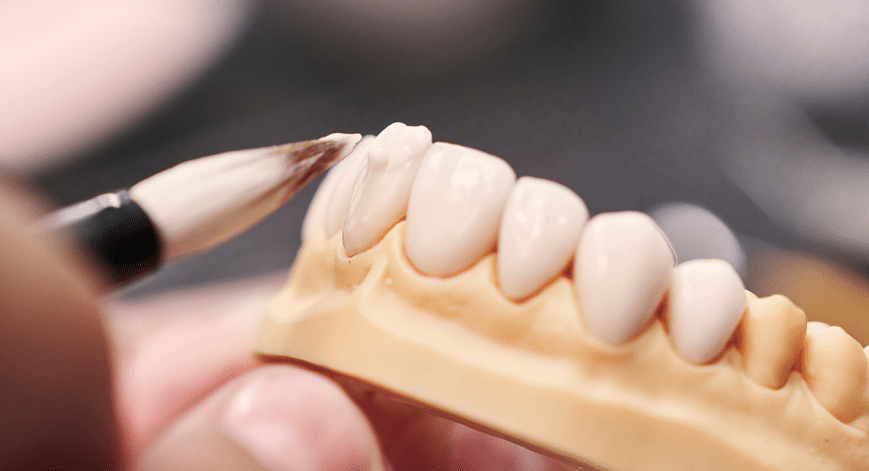
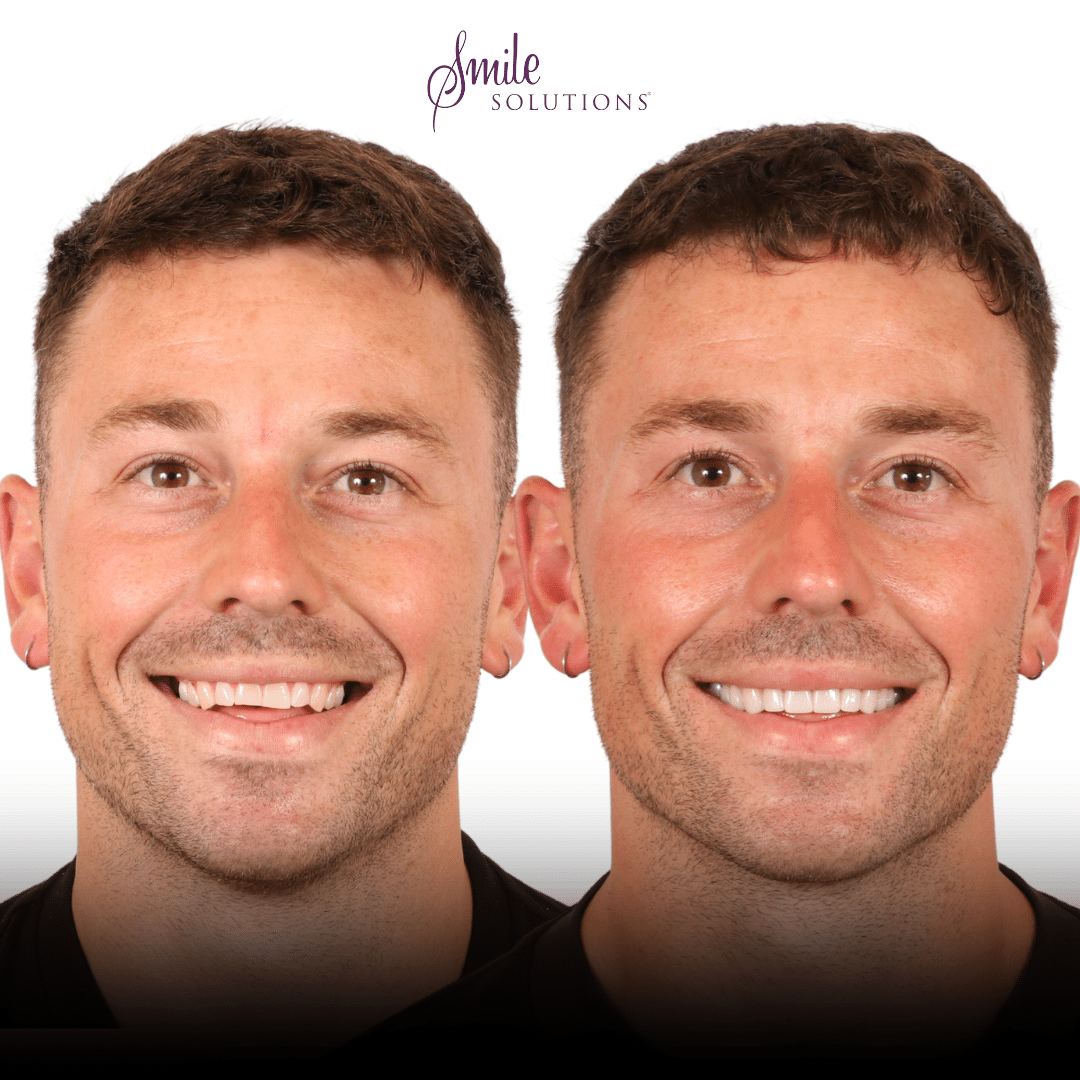
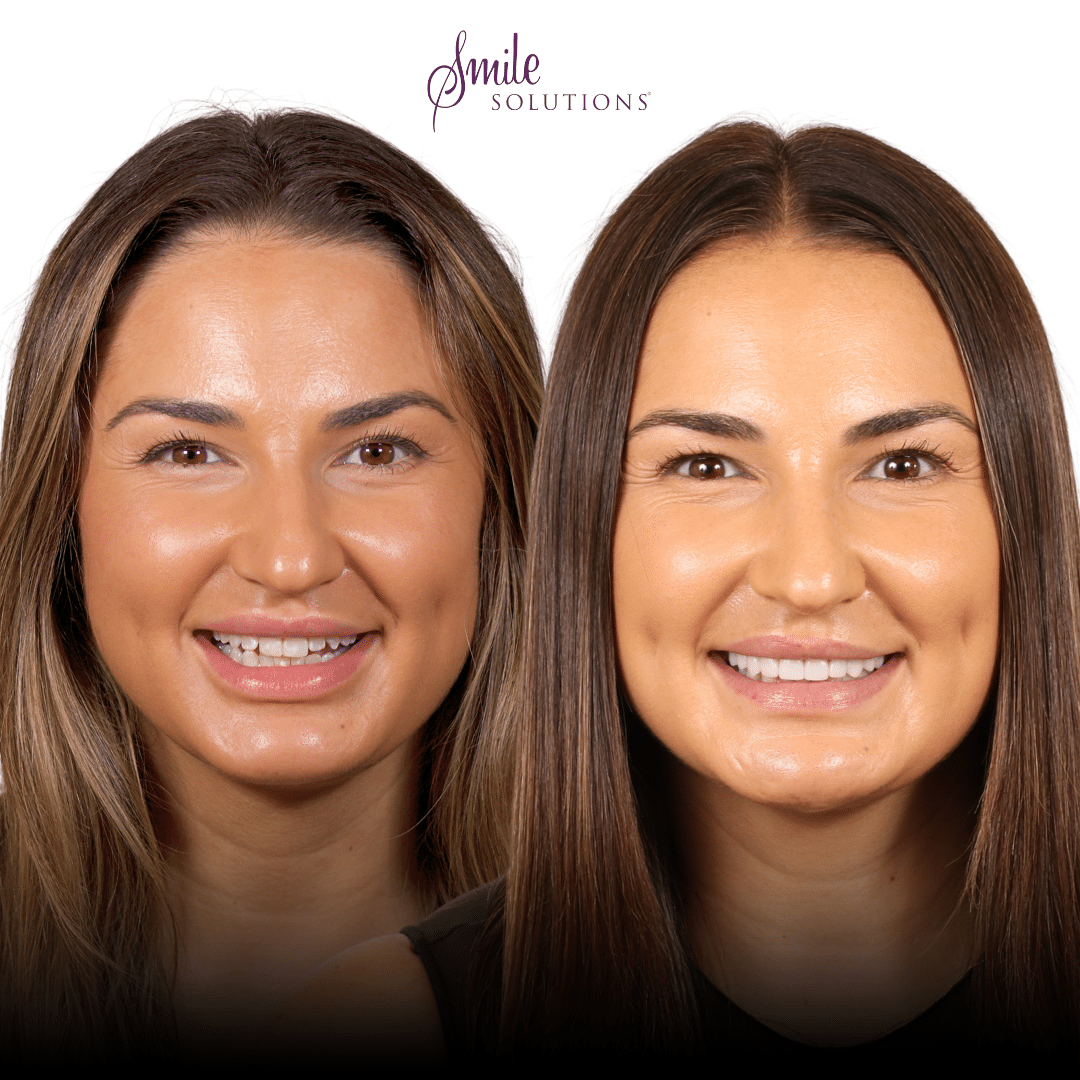
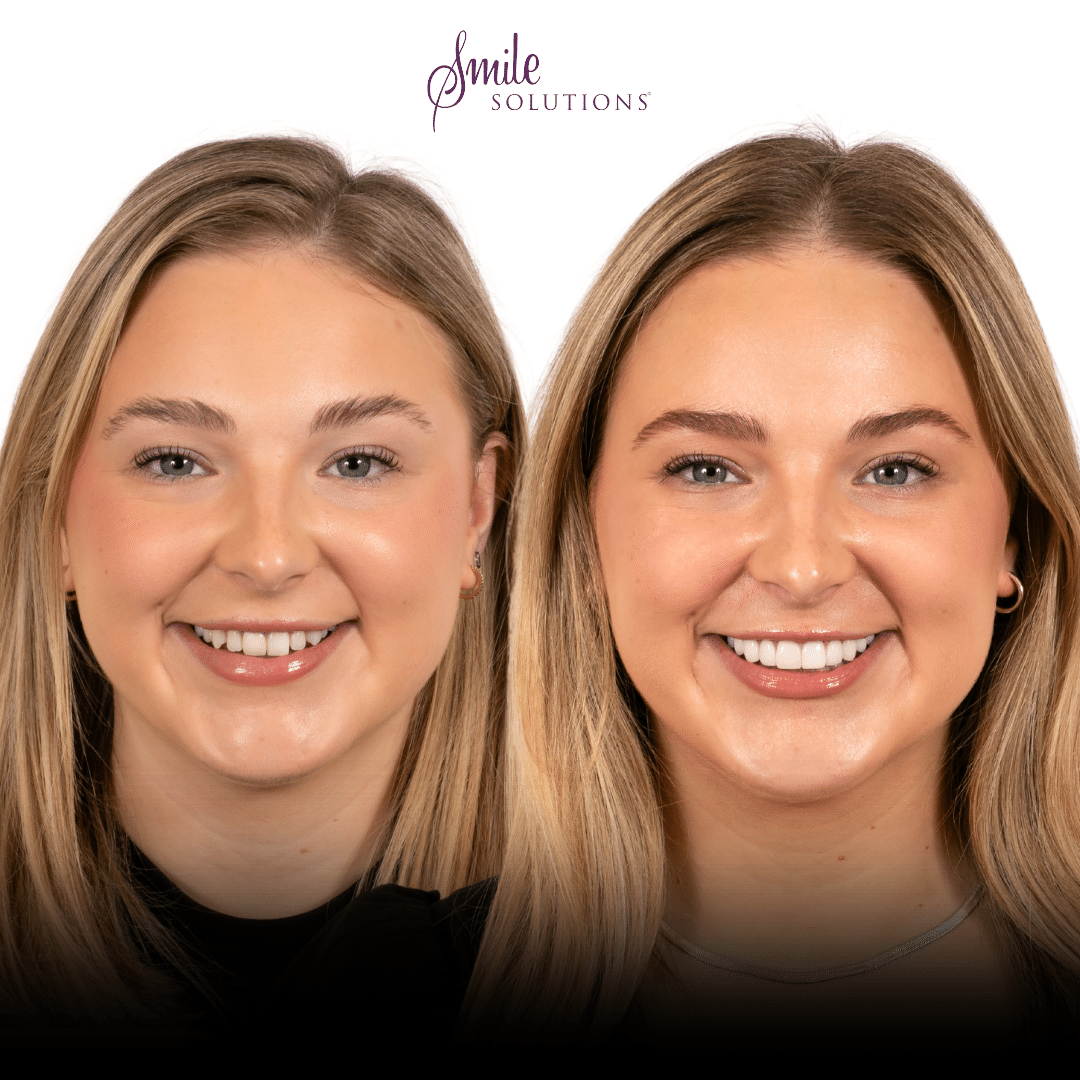
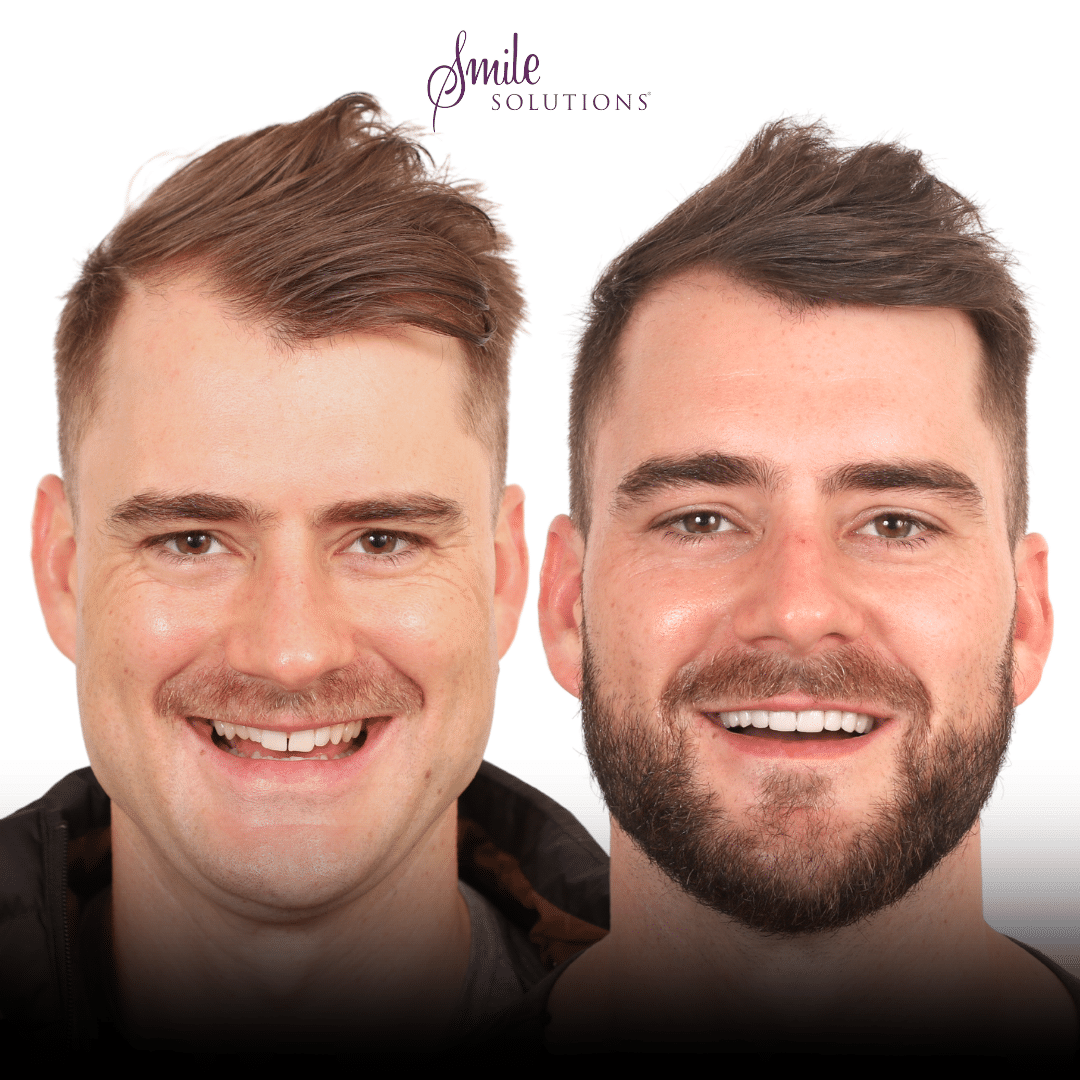
Bespoke porcelain veneers and crowns produced by specialist prosthodontists, cosmetic dentists and a master ceramist working in the practice's on-site, in-house ceramic studio. See Porcelain Veneers, Same-Day Porcelain Veneers and Dental Crowns.
Orthodontics and Invisalign
Treatment is carried out by registered specialist orthodontists. The practice states it is a Blue Diamond Invisalign provider — the only specialist Blue Diamond provider in Victoria — having completed over 8,700 cases. See Invisalign and Orthodontic Braces.
Dental implants and All-on-4
Implant treatment is performed by the practice's board-registered specialist prosthodontists, periodontists, oral and maxillofacial surgeons, and dual medically qualified dental surgeons. See Dental Implants.
Complex dentistry
Multidisciplinary cases coordinated across several specialists, planned together rather than sequentially. See Complex Dentistry.
The in-house laboratory
Smile Solutions operates its own dental laboratory in Melbourne, set up exclusively to service its own patients. The ceramists and technicians do not work with clinicians outside the practice.
Two things follow from that: no work is sent offshore, and only TGA-approved products are used in manufacturing appliances. Custom-made dental appliances are regulated in Australia as custom-made medical devices, which places obligations on whoever manufactures them. See Smile Solutions Laboratory.
You are entitled to ask where your restoration is being made and who is accountable if it fails, wherever you are treated.
Common questions
How can I verify whether my clinician is a registered specialist?
Search the AHPRA public register by name. A specialist entry is shown separately from general registration and identifies the recognised specialty. Marketing terms such as cosmetic dentist, implant dentist or special interest do not themselves indicate specialist registration.
Does a complex cosmetic case always require a specialist?
No. A general dentist may provide treatment within their training and competence, and straightforward care may not require a specialist. Complexity, risk, previous failure, bite, gum support, missing teeth and the need to coordinate disciplines can make specialist input useful.
Do I need a referral?
Generally no. Patients can usually approach the practice or specialist directly. A referral can still be useful because it communicates the clinical question, history and existing records.
Where should my veneers, crowns or implant teeth be made?
Ask where the restoration is manufactured, what materials are used and who is responsible for the technical work. This page states that we use our Melbourne in-house laboratory and do not send this work offshore.
What alternatives should be discussed?
The discussion should include doing nothing, monitoring, a less invasive option and materially different treatments. For cosmetic work, whitening, orthodontics or bonding may sometimes reduce or avoid irreversible tooth preparation.
What should a written plan and quote contain?
It should identify the treating clinicians, procedures, item numbers, sequence, material choices, total and staged fees, exclusions, maintenance and likely replacement needs. Ask what happens clinically and financially if the plan changes.
Can I see the proposed result before irreversible treatment?
In appropriate cosmetic cases, photographs, digital planning and a reversible mock-up can help assess shape and proportion. A preview is not a guarantee, but it allows discussion before teeth are prepared or restorations bonded.
Can I seek a second opinion?
Yes. You can request your records and seek an independent opinion before consenting. This is especially useful when treatment is irreversible, extensive, expensive or when clinicians offer substantially different plans.
Practical details
| Address | Level 1, 220 Collins Street, Manchester Unity Building, Melbourne VIC 3000 |
| Phone | 13 13 96 |
| theteam@smilesolutions.com.au | |
| Monday – Friday | 8.00am – 6.00pm |
| Saturday | 8.30am – 1.30pm |
| Sunday | By appointment |
| Verify a clinician | AHPRA public register, ahpra.gov.au |
| Specialist marker | Profile reads “General & Specialist” |
| Recognised specialities | 13 nationally; 6 practise here |
| Referral needed | Generally no, but useful |
| Your records | Transferable on request |
| Laboratory | In-house, Melbourne; no offshore work |
| Parking | Wilsons Parking, Flinders Lane (between Swanston and Russell) |
Results, recovery times and potential risks vary for each individual and procedure. This information is general in nature and intended for people over 18. Seek independent advice from a qualified, AHPRA-registered practitioner before proceeding. Nothing here is a claim that specialist treatment produces a superior clinical outcome in any individual case; it is a description of training, registration and how to verify both. The descriptions of consent and complaints processes are general information, not legal advice.
Smile Solutions trades under ABN 28 193 514 103.
Images on This Page
-
https://www.facebook.com/tr?id=800557773428361&ev=PageView&noscript=1
(no alt text)
-
https://www.smilesolutions.com.au/wp-content/uploads/2025/10/calendar_month.svg
(no alt text)
-
https://www.smilesolutions.com.au/wp-content/themes/arcadian-wordpress-theme/assets/images/smile_solutions_logo_white.png
Smile Solutions Logo
-
https://www.smilesolutions.com.au/wp-content/themes/arcadian-wordpress-theme/assets/images/smile_solutions_logo_purple.png
Smile Solutions Logo
-
https://www.smilesolutions.com.au/wp-content/uploads/2025/11/Smile-Solutions-4.png
Smile Solutions - Melbourne CBD
-
https://www.smilesolutions.com.au/wp-content/uploads/2023/04/WEBSITE-Media-2.png
Dental model with brush application
-
https://www.smilesolutions.com.au/wp-content/uploads/2025/12/Invisalign-at-Smile-Solutions-1.jpg
Orthodontics & Invisalign®
-
https://www.smilesolutions.com.au/wp-content/uploads/2025/09/All-on-4-at-Smile-Solutions.png
Dental Implants & All-on-4®
-
https://www.smilesolutions.com.au/wp-content/uploads/2025/09/Smile-Solutions-Level-10.png
Smile Solutions Level 10
-
https://www.smilesolutions.com.au/wp-content/uploads/2026/01/Ryan3.png
Ryan3
-
https://www.smilesolutions.com.au/wp-content/uploads/2026/01/Ryan7.png
Ryan7
-
https://www.smilesolutions.com.au/wp-content/uploads/2026/01/Ryan6.png
Ryan6
-
https://www.smilesolutions.com.au/wp-content/uploads/2026/01/Casey1.png
Casey1
-
https://www.smilesolutions.com.au/wp-content/uploads/2025/11/23.png
23
-
https://www.smilesolutions.com.au/wp-content/uploads/2026/01/Ryan10.png
Ryan10
-
https://www.smilesolutions.com.au/wp-content/uploads/2025/10/Smile-Solutions-Invisalign-Blue-Diamond-Provider.png
Smile Solutions Invisalign Blue Diamond Provider
-
https://www.smilesolutions.com.au/wp-content/uploads/2025/10/Smile-Solutions-Luxury-Lifestyle-Awards-Winner.png
Smile Solutions Luxury Lifestyle Awards Winner
-
https://www.smilesolutions.com.au/wp-content/uploads/2026/01/Smile-Solutions-Telstra-Business-Awards-Winner.png
Smile Solutions Telstra Business Awards Winner
-
https://www.smilesolutions.com.au/wp-content/uploads/2026/01/WEBSITE-Smile-Solutions-Award-Tiles.png
WEBSITE Smile Solutions Award Tiles
-
https://www.smilesolutions.com.au/wp-content/uploads/2025/11/Smile-Solutions-ABA-Business-Innovation-Winner-2024.png
Smile Solutions ABA Business Innovation Winner 2024
-
https://www.smilesolutions.com.au/wp-content/uploads/2025/11/Smile-Solutions-ABA-Service-Excellence-Winner-2024.png
Smile Solutions ABA Service Excellence Winner 2024
-
https://www.smilesolutions.com.au/wp-content/uploads/2025/11/Smile-Solutions-ABA-Service-Excellence-Winner-2023.png
Smile Solutions ABA Service Excellence Winner 2023
-
https://www.smilesolutions.com.au/wp-content/uploads/2025/11/Smile-Solutions-ABA-Service-Excellence-Winner-2022.png
Smile Solutions ABA Service Excellence Winner 2022
-
https://www.smilesolutions.com.au/wp-content/uploads/2025/09/Smile-Solutions-ABA-Service-Excellent-Winner-2019.png
Smile Solutions ABA Service Excellent Winner 2019
-
https://www.smilesolutions.com.au/wp-content/uploads/2025/09/Smile-Solutions-ABA-Community-Contribution-Winner-2017.png
Smile Solutions ABA Community Contribution Winner 2017
-
https://www.smilesolutions.com.au/wp-content/uploads/2025/11/Smile-Solutions-ABA-Service-Excellence-Winner-2017.png
Smile Solutions ABA Service Excellence Winner 2017
-
https://www.smilesolutions.com.au/wp-content/uploads/2025/11/Smile-Solutions-ABA-Service-Excellence-Winner-2016.png
Smile Solutions ABA Service Excellence Winner 2016
-
https://www.smilesolutions.com.au/wp-content/uploads/2026/01/Smile-Solutions-ABA-Employer-of-Choice-Winner-2015-1.png
Smile-Solutions-ABA-Employer-of-Choice-Winner-2015
-
https://www.smilesolutions.com.au/wp-content/uploads/2026/01/Smile-Solutions-ABA-Service-Excellence-Winner-2015.png
Smile-Solutions-ABA-Service-Excellence-Winner-2015
-
https://www.smilesolutions.com.au/wp-content/uploads/2025/11/Smile-Solutions-ABA-Employer-of-Choice-Winner-2014.png
Smile Solutions ABA Employer of Choice Winner 2014
-
https://www.smilesolutions.com.au/wp-content/uploads/2026/01/Smile-Solutions-ABA-Innovation-Winner-2014.png
Smile Solutions ABA Innovation Winner 2014
-
https://www.smilesolutions.com.au/wp-content/uploads/2026/01/Smile-Solutions-ABA-Service-Excellence-Winner-2014.png
Smile Solutions ABA Service Excellence Winner 2014
-
https://www.smilesolutions.com.au/wp-content/uploads/2025/11/Smile-Solutions-ABA-Innovation-Winner-2013.png
Smile Solutions ABA Innovation Winner 2013
-
https://www.smilesolutions.com.au/wp-content/uploads/2026/01/Smile-Solutions-ABA-Service-Excellence-Winner-2013.png
Smile Solutions ABA Service Excellence Winner 2013
-
https://www.smilesolutions.com.au/wp-content/uploads/2025/11/Smile-Solutions-ABA-Service-Excellence-Winner-2012.png
Smile Solutions ABA Service Excellence Winner 2012
-
https://www.smilesolutions.com.au/wp-content/uploads/2025/08/69a44c30c93ce196d539cc5520080df52a5f3f88-scaled.jpg
69a44c30c93ce196d539cc5520080df52a5f3f88 scaled
-
https://www.smilesolutions.com.au/wp-content/themes/arcadian-wordpress-theme/assets/images/family_owned_bussiness.png
Family Owned Business
-
https://www.smilesolutions.com.au/wp-content/themes/arcadian-wordpress-theme/assets/icons/icon--phone.svg
Smile Solutions Contact
-
https://www.facebook.com/tr? id=800557773428361&ev=PageView&noscript=1
(no alt text)