Same-day veneers or temporaries for two to three weeks — which is better?
Neither, universally. Same-day veneers remove a two-to-three-week temporary phase and one round of anaesthetic; temporaries give you a trial period in which the shape, speech and appearance of the new teeth can be tested before anything is made permanent. Which matters more depends on the case and the person, and a good assessment will tell you which side of that line you fall on. See Same-Day Porcelain Veneers and Porcelain Veneers.
One thing applies either way, and it should be settled before the question of timing arises: preparing teeth for porcelain veneers removes enamel and is irreversible. Whatever route is taken, the teeth cannot be returned to their original state afterwards. That makes the decision to have veneers at all a bigger one than the decision about scheduling — see What is the difference between composite veneers and porcelain veneers? and Bonding or veneers?, since composite bonding removes little or nothing.
How much tooth is actually removed
This has been measured, and the numbers are worth having before either scheduling option is discussed.
A study in the Journal of Prosthetic Dentistry weighed how much coronal tooth structure different preparation designs take away. Veneer and resin-bonded preparations removed approximately 3% to 30% of the coronal tooth structure by weight, against approximately 63% to 72% for all-ceramic and metal-ceramic crowns. Within the veneer designs, the mean removal was 8.2% for a partial veneer, 16.7% for a traditional facial-surface-only veneer, 22.1% for an extended design and 30% for a complete one. The authors' summary: veneer preparations required "approximately one-quarter to one-half the amount of tooth reduction of conventional complete-coverage crowns." That was laboratory work on artificial teeth rather than a clinical study, so treat it as a comparison between designs rather than a prediction for your own tooth.
That still leaves enamel, but not always as much as people assume. A laboratory study published in Materials prepared 20 intact upper central incisors to a conventional 0.6 mm depth and found the prepared surfaces averaged roughly 70% enamel and 30% exposed dentin — on teeth that were undamaged to start with. A tooth that is already worn, eroded or previously filled has less enamel to give.
Why that matters more than the timetable: a 2025 systematic review and meta-analysis in the Journal of Prosthetic Dentistry compared ceramic veneers by what they were bonded to. Veneers bonded to enamel had survival and success rates of 99% (range 98% to 100%). Where there was minimal dentin exposure, survival was 95% (range 91% to 100%). Where dentin exposure was severe, survival fell to 91% (range 84% to 98%) and the success rate — meaning no clinical intervention was needed — to 74% (range 64% to 85%). Veneers on teeth with only minimal dentin exposure were significantly less likely to need intervention than those with severe exposure (risk difference −0.16, 95% CI −0.31 to −0.01). The review drew on six clinical studies, so the ranges are wide, but the direction is consistent: staying in enamel is the single thing most associated with the restoration lasting.
The conventional two-appointment approach
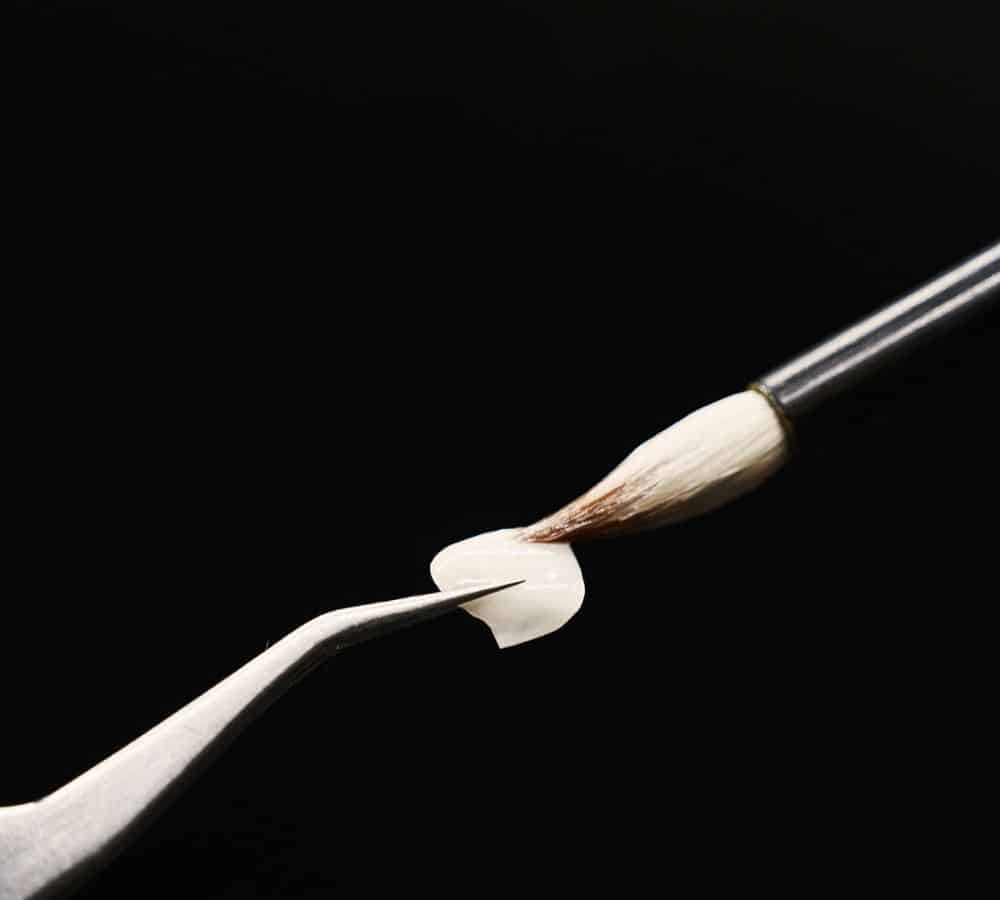
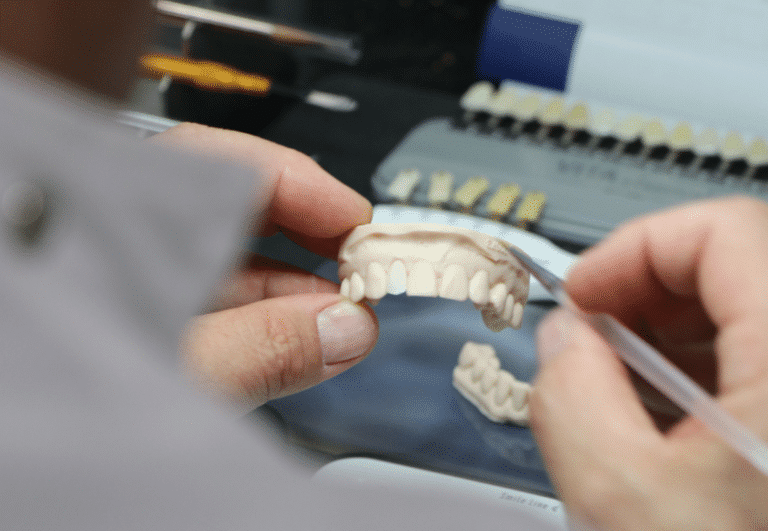
Normally, once the teeth are prepared for porcelain veneers, the patient is sent away with temporary (usually plastic) veneers while the final restorations are fabricated, and returns two to three weeks later to have them fitted.
Temporary veneers are not fully sealed to the teeth — only a temporary adhesive is used, precisely so they can be removed cleanly at the fitting appointment. That deliberate weakness has consequences during the interim period:
- Certain foods and drinks need to be avoided
- They must be treated gently so they do not chip, stain or fracture — damage can lead to increased sensitivity
- They can come off
- Eating, speaking and smiling can feel different while they are in place
If a temporary chips, comes off, or causes discomfort, it means a return visit for a repair — more chair time, additional local anaesthetic, and, for anyone travelling, extra cost. Contact Us.
These are genuine inconveniences. They are also, for most people, manageable for a fortnight, and they should be weighed rather than dramatised. I need a smile makeover — what's involved? describes what that fortnight is actually for.
The same-day approach
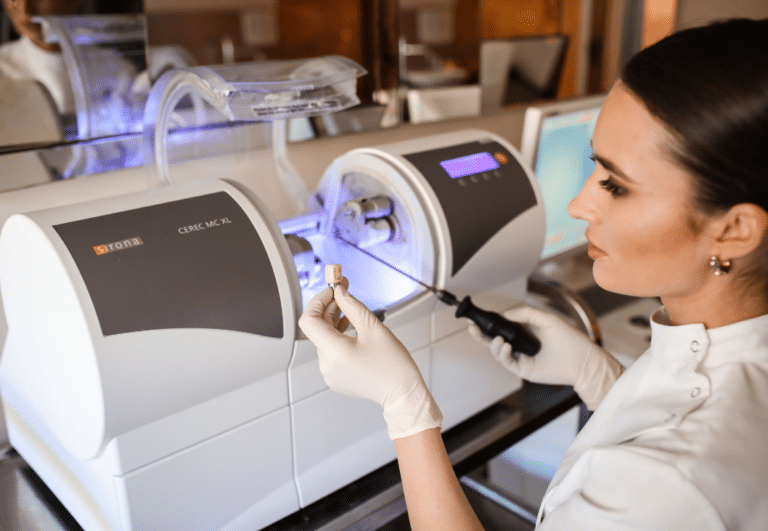
Same-day porcelain veneers compress preparation, fabrication and fitting into a single day, which removes the temporary phase entirely. It depends on an in-house laboratory and on digital scanning and milling. The practical differences:
| Two appointments | Same day | |
|---|---|---|
| Temporary veneers | Worn for 2–3 weeks | Not required |
| Rounds of local anaesthetic | Two, on separate days | One |
| Total chair time | Longer overall (the practice's own estimate is roughly 30 per cent more than the same-day route) | Compressed into one long day |
| Trial period | Built in — you live with the temporaries | Needs a separate mock-up stage if wanted |
| Suits | Anyone wanting to test the result; complex bite changes | Time-poor patients; travelling patients; needle-averse patients; those who get jaw pain from long sessions |
The single-anaesthetic point is not trivial for people who find injections difficult — see Dental Anxiety and Sleep Dentistry — and the reduced travel is a real consideration for regional, interstate and international patients.
The honest counterweight: a same-day case means one long day in the chair. For someone who struggles to keep their mouth open for extended periods, or who has jaw joint problems, that may itself be the harder option. It is worth asking realistically how long the day will be. See TMD and Teeth Grinding.
The same single-visit logic applies to bonded porcelain restorations on back teeth — see Same-Day CEREC Restorations. The Australian Dental Association's consumer site notes the same shift for crowns: "some dentists now provide same-day crowns where treatment is provided from start to finish in one day."
When temporaries are the better choice
Some patients are genuinely better served by the conventional route, and it is worth being explicit about who:
- Anyone with a tendency to lisp, or with difficulty articulating certain sounds. Changing the shape and length of the front teeth changes how the tongue meets them. A temporary phase lets speech be tested and the design adjusted before the porcelain is made.
- Anyone who wants a genuine dress rehearsal — time to look at the new shape in their own mirror, in their own light, and get used to it.
- Cases involving significant changes to the bite or to tooth length, where the new position needs to be tested functionally before it is committed to.
Where a trial is wanted without the full temporary phase, a digital work-up and a plastic mock-up placed over the teeth is an alternative. It is done without anaesthetic or preparation, and it allows articulation and appearance to be assessed. See The Mock-Up Reveal and The mock-up reveal: why you should see your new smile before any treatment begins.
Its most important feature is one that rarely gets stated plainly: it gives you the chance to decide not to proceed at all. Since preparation is irreversible, a stage at which you can still walk away is worth having.
That is also the substance of the objection to having a full case done abroad in a few days. The Australian Dental Association's policy on elective overseas dental treatment makes the structural point rather than a scare one: "optimal ongoing oral health cannot be achieved in a single episode or short course of treatment and requires regular maintenance," and "ongoing and corrective treatment may be compromised, as the records and complete details of treatment obtained overseas are unlikely to be available to those providing subsequent treatment in Australia." The policy also notes that complications from elective dental treatment abroad "are not always covered by travel insurance" and may not be covered by Australian health funds, and that professional indemnity insurance, required of Australian practitioners, "may not be the case in overseas clinics." See Turkey teeth: the real risks of getting veneers overseas.
Why same-day is not offered everywhere
There are structural reasons, not just preference:
- Equipment cost. Same-day work requires intraoral scanners, milling units and 3D printers on site, in enough quantity to handle a full case in a day.
- An in-house laboratory. The ceramist has to be available to work on one patient's case for a whole day. A practice using an external laboratory is scheduling into a shared queue — which is how external laboratories necessarily work, since they serve many practices at once. This is a difference in workflow, not a comment on the quality of external laboratories, which produce excellent work.
- Combined expertise on site. Digital smile design, preparation and ceramic fabrication have to happen in parallel across the same day, which requires dentists working in cosmetic dentistry, prosthodontists and ceramists together in one place. See Cosmetic Dentistry Under Specialist Care. Worth knowing when comparing providers: the ADA states plainly that "a dentist cannot be registered as a Cosmetic Dentist in Australia" — it is a description of work, not a registration category, and the recognised specialty in this area is prosthodontics.
- Established workflows. Two-appointment veneers are a well-proven approach that most practices are set up around, and there is nothing wrong with it.
How long do they last?
No authority publishes a veneer lifespan in years, and any figure given that way should be treated as marketing. What the literature reports is survival at stated time points, which is a different and more useful thing.
A systematic review in the Journal of Clinical Medicine pooled 25 studies covering 6,500 porcelain laminate veneers in 1,646 patients and estimated a 10-year cumulative survival rate of 95.5%, counting fracture, debonding, secondary decay and the need for root canal treatment together as failure. Taken separately, the 10-year survival figures were 96.3% for fracture, 99.2% for debonding, 99.3% for secondary decay and 99.0% for needing endodontic treatment. Fracture was the commonest complication, and most fractures occurred within two years of the veneers being bonded — which is worth knowing, because it means the early period is the informative one.
Those are pooled averages, and individual studies disagree sharply. A second systematic review, in the European Journal of Dentistry, gathered 30 studies covering 11,465 veneers and found reported survival at 10 to 12 years ranging from 53% to 94.4% depending on the study — and concluded that "a conclusive estimation of the longevity of PLVs beyond 20 years is lacking." Materials, design, who made them and which teeth they were on all vary between those studies.
So the accurate statement is that most porcelain veneers are still in place at ten years in the published series, that failure rates differ several-fold between studies, and that nobody can tell you what yours will do. The ADA's own consumer site puts the practical version: "having a crown, bridge or veneer does not mean no treatment will ever be required again for the tooth or teeth," and healthdirect notes that "veneers may need to be replaced due to chips, fractures or changes in colour over time." Plan for a replacement cycle. See How long do porcelain veneers last?
What to ask before committing
Whichever route you take, these are the questions that matter more than the scheduling:
- How much enamel will be removed, and can I see that on a model or a mock-up?
- Will the margins be in enamel, and if dentin will be exposed, where and how much?
- What are the alternatives — whitening, composite bonding, orthodontics, or a combination — and why are veneers preferred here? See Cosmetic dentistry options
- What happens when a veneer eventually chips, debonds or needs replacing?
- What are the risks — sensitivity, the possibility a tooth needs root canal treatment later, the need for a night guard if I grind?
- What is the total cost, including the replacement cycle rather than just the initial fitting? See the Price Guide and Payment Plans
- Who does what — which clinician prepares, which designs, who makes the ceramics? See Our Team
Payment plan options are available. Where a plan is advertised as interest free, that describes the plan term only — a deposit may be required, an establishment fee and ongoing account fees may apply, and charges can apply if the balance is not cleared within the agreed period. The applicable terms depend on the provider and the amount financed, and are set out in writing before you commit — ask what the deposit and the establishment fee are, in dollars, and what the total will be by the end. Payment Plans.
A written treatment plan setting out the sequence, the alternatives and the costs is the right basis for the decision. See I want a smile makeover — where should I start?.
One sequencing point that outranks both options: whitening comes first. Porcelain is matched to your shade on the day it is made and never lightens afterwards — see I want to whiten my teeth but one of my front teeth has a porcelain crown.
Common questions
Is there evidence that a same-day, milled veneer performs as well as a laboratory-made one?
Not directly, and we would rather say so than imply otherwise. We can find no published study comparing the survival of chairside-milled veneers with laboratory-fabricated ones. Every survival figure quoted further up this page — the 95.5 per cent at ten years, the enamel-versus-dentine comparison, the 53 to 94.4 per cent spread — comes from studies of conventional porcelain laminate veneers, most of them made in a laboratory. The published literature has not caught up with the workflow. The ADA's own consumer material still describes porcelain veneers as "made by a technician in a dental laboratory" requiring "at least two appointments", which tells you how recent the shift is.
What can be said is narrower but not nothing. The material used in same-day work is usually a machinable lithium disilicate ceramic, and that material family does appear in the outcome literature: one 2023 study reported Kaplan–Meier survival of 92.7 per cent for a CAD lithium disilicate veneer against 89.1 per cent for feldspathic ceramic, and other series report survival of 96.3 per cent at 6.6 years and 94 per cent at 8.5 years for lithium disilicate indirect restorations, and 99.7 per cent at 10 years for a pressed lithium disilicate design covering the incisal edge. Those are encouraging, but they are about the ceramic, not about where it was milled.
So choose between same-day and temporaries on the practical grounds set out in the table above — anaesthetic, travel, chair time, and whether you want a trial period. Do not choose either on a durability claim, in either direction, because the comparison has not been made. What the evidence does consistently identify as the thing that matters is unchanged by the workflow: how much enamel is left to bond to.
Can I have veneers with no drilling at all?
No-preparation and minimal-preparation veneers exist, they are genuinely used, and the outcome data is more interesting than the marketing on either side.
The reported results are reasonable. One 2023 series of no-prep porcelain laminate veneers reported survival of 97.4 per cent and success of 91.0 per cent over a mean observation of 43.1 months, with five repairable failures (three small chips, two limited marginal discolorations) and two unrepairable fractures. Another, also with no tooth preparation, reported overall survival of 91.3 per cent after 7 years, with four debondings and three fractures.
But the assumption that less drilling automatically means fewer problems does not hold. A 2021 study of 194 veneers — 12 prepared, 125 minimal-prep and 57 no-prep — found total fracture occurrence of 9.8 per cent, and reported that "no fractures were observed in prep veneers, while 16 out of 125 min-prep and 3 out of 57 no-prep veneers had fractures." A no-prep veneer has to sit on top of the existing tooth rather than within a prepared space, which means added bulk and, in the wrong case, a thin unsupported edge.
There is also a plain conflict between two Australian sources that you should see rather than have resolved for you. The ADA's consumer page describes veneers as requiring "not much or no tooth structure" to be removed — accurate for no-prep and minimal-prep designs. healthdirect, also Australian and government-published, says "your teeth could become more sensitive because some enamel is removed", and, bluntly, "You can't take veneers off." Both are true of different designs, and the one being proposed to you is the one that matters. Ask which design is planned for each tooth, and whether "no-prep" means no enamel at all or a light reduction.
Will my teeth be sensitive afterwards, and can anything be done about it?
Some sensitivity is a recognised consequence rather than a complication, and healthdirect names the mechanism directly: "your teeth could become more sensitive because some enamel is removed." The less enamel removed, the less of it you would expect — the tooth-reduction study quoted above frames the principle in its own background as "the conservation of sound tooth structure helps preserve tooth vitality and reduce postoperative sensitivity" (stated there as accepted background rather than as its own finding).
One technique is worth asking about by name if dentine will be exposed. A 2019 study reported that "teeth with more than 50% dentin exposure significantly benefited from IDS" — immediate dentin sealing, meaning the exposed dentine is sealed with adhesive at the preparation appointment rather than left until the veneer is cemented. It is a fair question: if dentine is exposed on my teeth, will it be sealed immediately?
Two other findings from the same study are worth carrying into the conversation, because neither is about the ceramic. Pre-existing restorations and previous root canal treatment did not affect the survival rate — but smoking and previous root canal treatment did negatively affect the success rate, through colour change. If you smoke, the veneer is likely to outlast its colour match.
Thicker must be stronger — so why not use a thicker veneer?
Because the evidence points the other way, which is one of the more counter-intuitive findings in this area.
On one hand, a veneer is thin and therefore vulnerable: one review notes that "the most prevalent failure for veneers is fracture because the veneer restoration is thin (0.3–0.5 mm) and more liable to fracture." That is the intuition. On the other, a 2022 study of prepared and unprepared veneers over up to 7 years reported overall survival of 91.77 per cent and stated that "no failures were observed in veneers with a maximum thickness of 0.5 mm compared to those with a maximum thickness of 1 mm, 1.5 mm, 2 mm, and 2.5 mm."
Those two statements are not actually contradictory, and the resolution is the point of this whole page. A thicker veneer requires a deeper preparation, and a deeper preparation means less enamel and more exposed dentine to bond to. The bond, not the bulk, is what holds a veneer on — which is why the enamel-versus-dentine figures quoted earlier show a fall from 99 per cent to 91 per cent survival, and a fall in intervention-free success from 99 per cent to 74 per cent.
So "thicker for strength" trades a better bond for more material, and the published series do not support that trade. Ask what thickness is planned, and what it costs you in enamel to get it.
Which teeth are most likely to fail, and does it depend on who I am?
Partly, and the literature disagrees with itself in a way worth knowing about.
Position matters. The 2021 study quoted above found the odds of fracture significantly higher in central incisors (odds ratio 13.56) and lateral incisors (OR 10.43) than in canines and premolars, and also higher where there was tooth wear present at the start (OR 5.54). A 2023 study similarly found survival "significantly affected by location of the veneer." Against that, a 2020 series found jaw position had no influence on either survival or success. So the front teeth being at greater risk is a reasonable working assumption, not a settled fact.
Sex is genuinely unresolved. The 2021 study reported fracture odds significantly higher in men (OR 11.29). A separate review reports no significant difference in survival between males and females. Both are in the current literature, and neither should be quoted as the answer.
Existing wear is the finding with the most practical weight, because it is checkable before anything is prepared and it points at the same variable as everything else on this page: a worn tooth has less enamel. If you already have wear on your front teeth, that is worth discussing as part of the candidacy decision rather than as a detail of scheduling — see what is acid wear and how can I avoid it? and TMD and Teeth Grinding.
If the brand of porcelain is not the answer, what actually makes a veneer last?
Four things come up repeatedly across the reviews, and only one of them is the material.
What it is bonded to. Enamel, on the figures above, is associated with survival and success around 99 per cent; severe dentine exposure with 91 per cent survival and 74 per cent intervention-free success. This is the largest effect in the literature.
The design at the biting edge. The 25-study review concluded that veneers with incisal coverage, and non-feldspathic veneers, showed lower failure rates than those without incisal coverage and feldspathic ones respectively. That is a decision made at the planning stage, and it is a reasonable thing to ask about.
The bite. One review is explicit that preventing fracture "is dependent on good occlusion in centric-related, protrusive, and lateral excursions immediately after veneer cementation", that "fracture failures can be amplified by the presence of parafunctional activities; therefore, a night guard is recommended for patients", and that "an unfavorable occlusion is the leading cause of fracture failure." If you grind or clench, that belongs in the plan and the night guard belongs in the quote.
The first two years. Because most fractures occur within two years of bonding, the early review appointments are the ones that matter most — and a small chip or marginal defect found early is repolished or repaired rather than replaced. The ADA's own framing is the one to plan around: "having a crown, bridge or veneer does not mean no treatment will ever be required again for the tooth or teeth." Its home-care instruction is unglamorous and applies for as long as you have them: brush twice a day with fluoride toothpaste and clean between the teeth every day.
Practical details
Smile Solutions offers both approaches — same-day porcelain veneers and the conventional two-appointment route with temporaries — and the choice is made case by case at assessment. See Complimentary Cosmetic Consultation. Confirm the current terms when you book — what the appointment includes, whether records such as scans or radiographs are part of it or charged separately, and whether any deposit applies.
Outcomes vary between individuals. Survival figures quoted are from published studies of other patient groups and are not a prediction for any individual tooth. All dental treatment carries risks, and preparation for porcelain veneers is irreversible.
Specialist registration can be verified on the AHPRA register, or by calling 1300 419 495; see Dentists & Registered Specialists.
Smile Solutions, Level 1, 220 Collins Street, Manchester Unity Building, Melbourne VIC 3000. Phone 13 13 96, or theteam@smilesolutions.com.au. Monday–Friday 8.00am–6.00pm, Saturday 8.30am–1.30pm, Sunday by appointment.
Published 6 April 2023, by Dr Kia Pajouhesh. General information only; it does not replace advice from your treating practitioner. Payment plan terms are set by the credit provider and change; confirm current terms directly before you commit.
Smile Solutions trades under ABN 28 193 514 103.
Images on This Page
-
https://www.facebook.com/tr?id=800557773428361&ev=PageView&noscript=1
(no alt text)
-
https://www.smilesolutions.com.au/wp-content/uploads/2025/10/calendar_month.svg
(no alt text)
-
https://www.smilesolutions.com.au/wp-content/themes/arcadian-wordpress-theme/assets/images/smile_solutions_logo_white.png
Smile Solutions Logo
-
https://www.smilesolutions.com.au/wp-content/themes/arcadian-wordpress-theme/assets/images/smile_solutions_logo_purple.png
Smile Solutions Logo
-
https://www.smilesolutions.com.au/wp-content/uploads/2025/11/Kia-150x150.jpg
Dr Kia Pajouhesh
-
https://www.smilesolutions.com.au/wp-content/uploads/2026/01/157.jpg
Brush and dental material close-up
-
https://www.smilesolutions.com.au/wp-content/uploads/2025/08/same-day-veneers-1.png
same day veneers 1
-
https://www.smilesolutions.com.au/wp-content/uploads/2025/08/same-day-veneers-2.png
same day veneers 2
-
https://www.smilesolutions.com.au/wp-content/uploads/2025/09/Wisdom-Teeth-Smile-Solutions-300x300.png
Smile Solutions Dentist Melbourne
-
https://www.smilesolutions.com.au/wp-content/uploads/2025/11/TMD-Teeth-Grinding-Smile-Solutions-300x270.png
Woman holding her face, looking concerned.
-
https://www.smilesolutions.com.au/wp-content/uploads/2026/07/Photography-and-Facial-Analysis-300x270.jpg
Photography and Facial Analysis
-
https://www.smilesolutions.com.au/wp-content/themes/arcadian-wordpress-theme/assets/images/family_owned_bussiness.png
Family Owned Business
-
https://www.smilesolutions.com.au/wp-content/themes/arcadian-wordpress-theme/assets/icons/icon--phone.svg
Smile Solutions Contact