I want to improve my smile but don't know where to start
The hard part is the planning, not the procedure
If you know you want your smile improved but have no idea which treatment you need, you are in the position most people are in — and the sensible response is not to research procedures. It is to get the problem assessed.
Here is the honest framing: dentistry is relatively straightforward to execute. It is the planning — having a blueprint for the result before anything starts — that determines whether you get what you wanted.
Being fully informed about your options is the thing that makes the decision. Sitting down with an experienced dentist who explains the options, the fees and what is involved removes the sense of being overwhelmed, because most of that feeling comes from not knowing what the choices actually are.
The overview of what is available sits on Cosmetic Dentistry.
The smile consultation
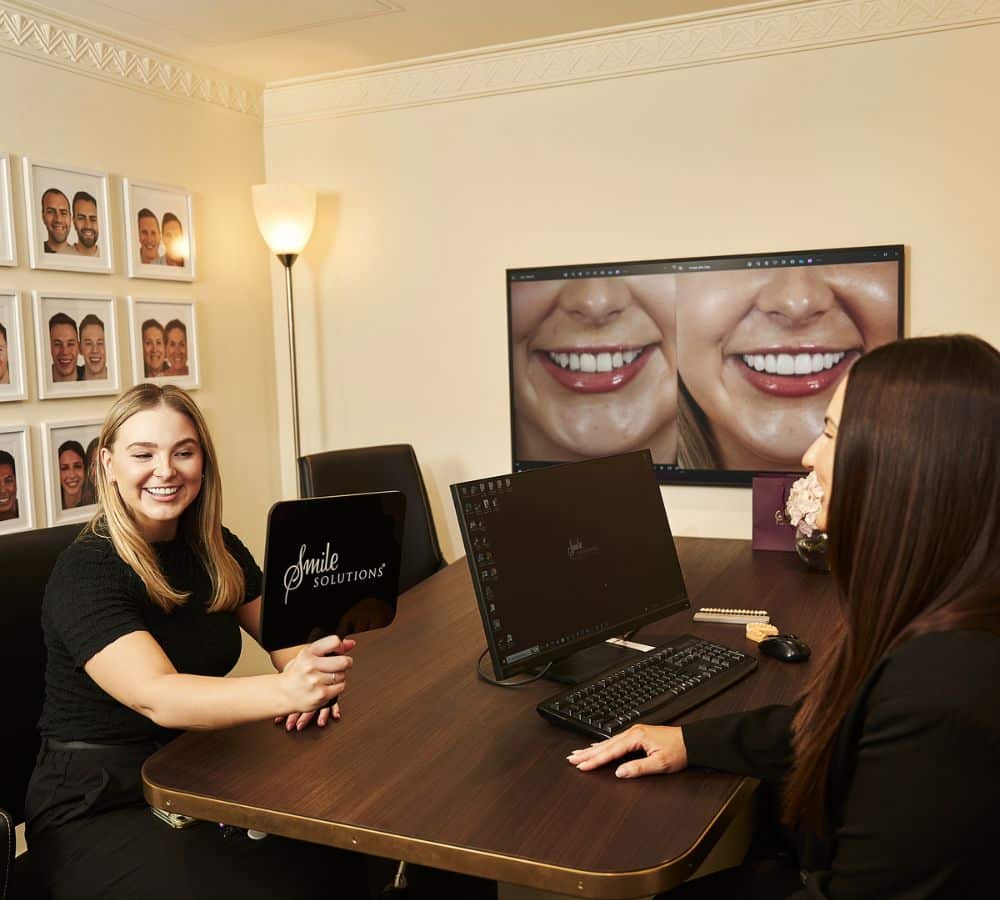
Smile Solutions offers a complimentary smile consultation for people who want to start planning — see Complimentary Cosmetic Consultation for what that appointment covers. Confirm the current terms when you book: what the appointment includes, whether records such as scans or radiographs are part of it or charged separately, and whether any deposit applies. A complimentary consultation is a planning discussion, not a diagnosis or a course of treatment.
At that appointment you are given the information needed to:
- Understand the options available for the specific things you want changed
- Discuss the procedures involved
- Discuss the investment and payment options in detail
- Meet the right dentist to carry out what can be an intricate and multilayered treatment plan
That last point is not padding. A cosmetic plan combining orthodontics, whitening and ceramics is several different skill sets, and matching the case to the clinician is part of the planning. See Our Team and Cosmetic Dentistry Under Specialist Care.
The architect and the builder
A useful way to think about it.
Building a house needs both an architect and a builder. The architect decides what the thing should be; the builder makes it exist. A design that cannot be built is useless, and a builder without a design produces something nobody chose.
A cosmetic dentist is both. They design the new smile — proportion, shape, length, colour, how it sits with your face — and they have the technical skill to execute that design.
The reason the analogy is worth keeping: you would not let anyone start building without seeing plans. The same standard applies here.
The planning phase, step by step
1. Records
A 3D digital scan of your teeth, with radiographs and photographs as needed. Together these collect the measurements required to design the new smile.
The radiographs are doing double duty — they provide design information, and they check for underlying problems that need treating before cosmetic work goes ahead. On what that exposure amounts to, see how safe are dental x-rays?
That order matters. Active decay, a failing old filling or bleeding gums are treated first; building ceramics over an unstable foundation is how cosmetic work fails early.
2. The design, about a week later
The design is presented to you digitally, and in some cases tried in your mouth temporarily. Where the restorations are made on site, the Smile Solutions Laboratory is part of that process.
This is the point that changes everything about the decision.
Seeing the design and discussing it with the dentist gives you the chance to ask for changes, be guided, and be genuinely involved. You can say the front teeth are too long, or the shape is not what you pictured, at the stage where saying so costs nothing.
3. Deciding
This is where patients can feel at ease that they are making the right decision — because they have seen the design first hand and are not going into it blind.
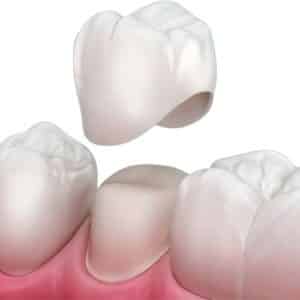
The alternative, which is still common, is agreeing to a treatment plan on the basis of a description and finding out what it looks like when it is finished. Veneers and crowns require permanent removal of tooth structure, so “finished” is not a stage where much can be reconsidered. Porcelain Veneers and Dental Crowns set out what each involves, and The difference between crowns and veneers compares them.
What can actually be addressed
Whether your concern is alignment, colour or shape, correct planning can:
- Correct — fix the underlying issue. Usually orthodontics — braces or Invisalign — moving the teeth into the right position rather than disguising where they are
- Improve — make a good result better. Teeth Whitening is the least invasive option here, and often the only one needed
- Camouflage — make something appear different without changing it structurally. Composite Bonding, Edge Work, veneers
- Restore — rebuild what has been lost or damaged. Crowns, Same-Day CEREC Restorations, Dental Implants
Those are four genuinely different approaches, and knowing which one is being proposed for your case is worth asking about directly. Camouflaging a rotated tooth with a veneer and correcting it with orthodontics produce a similar photograph and a very different amount of removed enamel.
The general rule worth carrying into the consultation: the least irreversible option that achieves the result is usually the right one, and whitening before ceramics, alignment before veneers, is the sequence that keeps the most tooth. Where a gummy smile is the concern, the problem may not be the teeth at all.
Cost and payment
Fees are published on the Price Guide; the figure that applies to you comes from the written plan after assessment.
Payment plan options are available. Where a plan is advertised as interest free, that describes the plan term only — a deposit may be required, an establishment fee and ongoing account fees may apply, and charges can apply if the balance is not cleared within the agreed period. The applicable terms depend on the provider and the amount financed, and are set out in writing before you commit — ask what the deposit and the establishment fee are, in dollars, and what the total will be by the end. Payment Plans.
Why an itemised quote matters more than a headline number
There is no schedule of standard dental fees in Australia. Each practice sets its own, which is why the third question in the list above is the one that does the most work.
The Australian Dental Association surveys what its members in private practice actually charge. Its 2022 survey — covering fees as at 1 July 2022, drawn from 3,819 valid responses out of 11,035 dentists invited — found considerable variation in the fees charged both within and between states. Across the 122 items it surveys, average fees charged by general practitioners had risen 3.7 per cent over the two years from 1 July 2020, with the smallest rises in preventive services and periodontics (1.6 per cent) and the largest in orthodontics (6.9 per cent).
Two practical conclusions follow. A single total is not comparable between practices unless both are broken down to the same item numbers, because two quotes can differ simply by including or excluding records, temporaries or a replacement allowance. And a fee is not a quality signal in either direction — the variation exists within states as well as between them, so a higher number is not evidence of better work and a lower one is not evidence of worse.
How to read the advertising you are looking at
Worth knowing, because cosmetic dentistry is marketed harder than most dentistry, and the rules governing it are stricter than most people assume.
Under section 133 of the National Law, nobody may advertise a regulated health service in a way that:
- is false, misleading or deceptive, or likely to be
- offers a gift, discount or other inducement to attract you to the service — unless the advertisement also states the terms and conditions of that offer
- uses testimonials or purported testimonials about the service or business
- creates an unreasonable expectation of beneficial treatment, or
- encourages, directly or indirectly, the indiscriminate or unnecessary use of health services
Three of those are worth translating into things you can actually use.
The testimonial ban is why you will not find patient reviews of clinical care in a practice's own advertising. Their absence is compliance, not concealment — and a cosmetic advertisement that does feature glowing patient accounts of treatment is telling you something about the advertiser.
An offer without its terms attached is not permitted. If a consultation, a discount or a package is being advertised to you with no terms stated, ask for them in writing before you book. That is the same standard this page applies to its own complimentary consultation, above.
“Unreasonable expectation of beneficial treatment” is the clause that governs the before-and-after photograph. Images are not banned, but an advertisement may not leave you expecting a result that is not reasonably achievable in your case — which is exactly why seeing a design built on your records matters more than looking at someone else's outcome. See Before & After Gallery and understanding your treatment.
The penalties are real rather than nominal: a court may impose up to $60,000 per offence for an individual and $120,000 per offence for a body corporate, and misuse of a protected title can additionally carry up to three years' imprisonment for an individual. Registration and any specialty held can be checked free on the AHPRA register — see Dentists & Registered Specialists.
If you have been given a plan you are unsure about, you are entitled to another view before committing: second opinions and corrective dentistry.
Where to start, in one line
Book a consultation, get the records taken, and look at a design before you commit to anything irreversible.
The procedures come later, and they follow from what the planning finds.
Common questions
If I end up having veneers, how long do they last?
No authority publishes a lifespan in years, and any practice that gives you one is guessing. What the literature does publish is survival at stated time points, which is a different and more useful thing.
The largest synthesis is a systematic review of 25 studies covering about 6,500 porcelain laminate veneers, which put the 10-year estimated cumulative survival rate at 95.5 per cent when fracture, debonding, secondary decay and the need for root canal treatment were counted as failures. Individual long cohorts show the shape of the curve: one reported 96 per cent surviving at 5 to 6 years, 93 per cent at 10 to 11, 91 per cent at 12 to 13, and 73 per cent at 15 to 16 years. Another reported 98 per cent at 5 years, 96 per cent at 10, and 91 per cent at both 15 and 20 years.
Three caveats that change how you should read those numbers, all stated by the papers themselves.
- Surviving is not the same as still looking good. The 95.5 per cent review deliberately did not count slight marginal defects or slight marginal discolouration as failures, “since they have more to do with the appearance of the PLV, and can be easily repolished or repaired”. A veneer that has been repolished twice counts as a survivor.
- The best figures come from the best candidates. In the cohort reaching 91 per cent at 20 years, patients who grind their teeth were excluded and only teeth retaining at least 80 per cent enamel were veneered, by a single operator — and only 82 veneers were still under observation at 20 years. That is a best case for ideal candidates, not an average.
- The studies do not agree on what “failure” means. Across the reviewed literature, failure was defined as irreparable in 13 studies and as reparable-but-counted-as-failure in 9, with 5 not stating a definition at all. That is the main reason published survival figures differ so much.
The useful question at the consultation is therefore not “how long will these last” but “what is the plan when one fractures or debonds, and what will that cost me?”
Composite or porcelain? The prices are very different.
So are the results, and this is one of the few cosmetic comparisons with head-to-head data behind it.
A 2022 meta-analysis comparing direct composite with ceramic laminate veneers found ceramic ahead on both measures, with a hazard ratio of 4.00 (95% CI 2.74 to 5.83) for survival and 5.16 (2.65 to 10.04) for success. Translated into annual failure rates for success, the same analysis reported 9.1 per cent at 5 years and 10 per cent at 10 years for direct composite, against 2.9 per cent and 2.8 per cent for ceramic. A separate pooled analysis of randomised trials put resin composite laminate veneer survival at 88 per cent (95% CI 81 to 94 per cent) over a mean follow-up of 24 to 97 months, with failures attributed to surface roughness, colour mismatch and marginal discolouration.
That does not make composite the wrong answer. It is usually cheaper, repairable in the chair, and removes less tooth or sometimes none at all — which matters a great deal if you are young, if you are not certain about the design, or if you want to keep the option of doing something different later. Porcelain buys durability and colour stability; composite buys reversibility and a lower entry cost, and commits you to more maintenance.
The honest framing is that you are choosing which cost to pay and when, not choosing between a good option and a bad one. Composite veneers versus porcelain veneers goes through the practical differences.
How much of my tooth actually gets removed, and does it change the outcome?
It changes the outcome, which is the main reason this page argues for the least irreversible option.
On quantity, the most-cited measurements come from a gravimetric study of preparation designs for anterior teeth simulated on typodont resin teeth — in vitro, not in patients. It reported that preparations for veneers removed “approximately 3% to 30% of the coronal tooth structure by weight” depending on the design, with a traditional facial-surface porcelain veneer at about 16.7 per cent, against “approximately 63% to 72%” for full-coverage crown preparations. Treat those as the relative scale of two approaches, not as a prediction about your own tooth.
On why it matters, a separate review of six clinical studies looked at what the veneer is bonded to. Veneers bonded to enamel had survival and success rates of 99 per cent (range 98 to 100 per cent). Where there was severe dentine exposure, survival fell to 91 per cent (84 to 98) and success — meaning no clinical intervention needed — to 74 per cent (64 to 85). Veneers placed over an existing composite restoration survived at 94 per cent but had a success rate of only 70 per cent (60 to 80).
One piece of statistical honesty, because the review insists on it: of its four pooled comparisons only one reached significance — minimal versus severe dentine exposure for needing further work (risk difference −0.16, 95% CI −0.31 to −0.01). The comparisons for outright failure did not, on only six studies. So the fair statement is that enamel bonding is associated with the best outcomes, not that bonding into dentine is proven to fail more often.
The practical consequence is a question to ask: “after preparation, will these be bonded to enamel?” If the answer is no, you are in a different risk bracket, and the alternatives deserve another look.
I grind my teeth. Does that rule any of this out?
It does not rule it out, but it has to be on the table before anything is prepared, and the Australian consumer position is blunt: healthdirect states that “veneers may not be suitable if you grind or clench your teeth or if you have gum disease”.
The evidence behind that sits in the systematic reviews. One review found that of fourteen studies reporting on grinding, the study that analysed it specifically — with half its patients self-reported or diagnosed as grinders — showed a “significantly higher failure rate for PLV restorations in patients who were bruxers”, and concluded that “bruxism may be a risk factor for fractures of ceramics”. Another review explains the mechanism: the most common veneer failure is fracture, because “the veneer restoration is thin (0.3–0.5 mm)”, and “fracture failures can be amplified by the presence of parafunctional activities; therefore, a night guard is recommended for patients”. It adds that dentists “need to examine occlusions carefully, especially for any parafunctional habits such as bruxism, before initiating treatment and after cementation”, because “an unfavorable occlusion is the leading cause of fracture failure”.
So the answers you want are: has my bite been assessed in centric, protrusive and lateral movements; is a night guard part of this plan and is it in the quote; and is a less fracture-prone option better for me. Worth remembering, too, that healthdirect is explicit about what veneers do not do — “veneers don't straighten your teeth or fix your bite”. If the bite is the problem, ceramics are not the fix.
Could I have this done overseas for a fraction of the price?
The Australian Dental Association's position, in Policy Statement 2.2.6, is that “Australian residents should only seek elective dental treatment in Australia”, and it lists why: inability to maintain follow-up visits, communication difficulties that “may impact on informed consent”, possible lack of insurance cover for complications, “lack of recourse for treatment and maintenance problems”, no access to treatment records, and the “potential challenge of finding a dental practitioner to continue with, or repair, elective treatment started overseas” because of incompatible product systems and materials not approved by the TGA. It also asks that overseas promoters indemnify consumers without a time limit, “as adverse outcomes may not become apparent for a number of years”.
On the scale of the aftermath, the only quantified figures available are British and self-reported: a British Dental Association survey of 1,000 UK dentists (2022) in which 86 per cent reported treating people suffering consequences after treatment abroad, with remedial care costing at least £500 according to 65 per cent of them and more than £5,000 according to 20 per cent. Those are dentists' survey responses, not a clinical audit, and they are not Australian — no Australian dataset quantifying overseas-veneer complication rates could be found. One correction to the popular framing, too: the published destinations for Australian dental tourists are Indonesia and Thailand; the “Turkey teeth” route is primarily a British one.
The substantive risk is not the country. It is the substitution. A UK dentist quoted in the research on media coverage of dental tourism put it this way: patients “talk about veneers — mouldings bonded to the front of a tooth — but in reality, they are crowns, meaning much more aggressive tooth reduction”. Set that against the reduction figures above — roughly 16.7 per cent for a traditional facial veneer against 63 to 72 per cent for a crown preparation — and the trade you may have unknowingly made becomes clear. That research also records private providers “actively avoiding the provision of care for people who'd had dentistry abroad because of fear of liability”, which is the practical version of the ADA's “lack of recourse” point.
See Turkey teeth: the real risks of getting veneers overseas.
What maintenance am I committing to once the work is done?
More than most people are told, and it is worth pricing before you start.
The systematic reviews are consistent on what goes wrong and when. Fracture is the most common complication, followed by debonding, and both happen most often in the first years after cementation — not at some distant end of life. Marginal defects and slight marginal discolouration are common enough that the largest review excluded them from its failure count on the grounds that they “can be easily repolished or repaired”; that repolishing is maintenance, and somebody pays for it. In composite, the reported failure causes are surface roughness, colour mismatch and marginal discolouration, all of which are progressive and all of which are addressed by refinishing rather than by leaving alone.
The same review also found that veneers with incisal coverage, and non-feldspathic veneers, had lower failure rates than those without incisal coverage and feldspathic ones respectively — a design decision made before anything is cemented, and a fair thing to ask about.
So the maintenance conversation has four parts: the review interval and what is checked at it; whether a night guard is required and whether it is in the quote; what polishing or refinishing is likely and at what cost; and what happens if a unit fails — who re-makes it, on what timeframe, and at whose expense. Get those answers in writing alongside the fee, not afterwards.
Related reading
- I want a smile makeover — where should I start?
- I need a smile makeover — what's involved?
- Improving your smile with veneers and crowns
- Composite veneers versus porcelain veneers
- Turkey teeth: the real risks of getting veneers overseas
Where the external material on this page comes from
The fee variation figures are from the Australian Dental Association's Dental Fees Survey 2022. The advertising provisions, and the penalties, are section 133 of the Health Practitioner Regulation National Law as published by AHPRA. In the questions above: veneer survival figures are from published systematic reviews and cohort studies of porcelain laminate veneers, with the populations and caveats stated alongside each; tooth-reduction percentages are from an in vitro gravimetric study on typodont anterior teeth; the overseas-treatment position is ADA Policy Statement 2.2.6, and the remedial-cost figures are a 2022 British Dental Association survey of 1,000 UK dentists; the grinding contraindication is healthdirect's. Everything else on this page is our own guidance.
Practical details
Smile Solutions, Level 1, 220 Collins Street, Manchester Unity Building, Melbourne VIC 3000. Phone 13 13 96, or theteam@smilesolutions.com.au. Monday–Friday 8.00am–6.00pm, Saturday 8.30am–1.30pm, Sunday by appointment. Full details on Contact Us.
Registration can be verified free on the AHPRA register, or by calling 1300 419 495.
Published 8 March 2022. Suitability, treatment time and results vary between individuals; cosmetic dentistry carries risks that should be discussed with your dentist. General information only; it does not replace advice from your treating practitioner. Offers and payment plan terms are subject to their own conditions, set by the practice or the credit provider and changing over time; confirm current terms directly before you commit.
Smile Solutions trades under ABN 28 193 514 103.
Images on This Page
-
https://www.facebook.com/tr?id=800557773428361&ev=PageView&noscript=1
(no alt text)
-
https://www.smilesolutions.com.au/wp-content/uploads/2025/10/calendar_month.svg
(no alt text)
-
https://www.smilesolutions.com.au/wp-content/themes/arcadian-wordpress-theme/assets/images/smile_solutions_logo_white.png
Smile Solutions Logo
-
https://www.smilesolutions.com.au/wp-content/themes/arcadian-wordpress-theme/assets/images/smile_solutions_logo_purple.png
Smile Solutions Logo
-
https://www.smilesolutions.com.au/wp-content/uploads/2023/11/SS-Tooth-1-1-150x150.png
Smile Solutions
-
https://www.smilesolutions.com.au/wp-content/uploads/2026/01/Cosmetic-Consult.jpg
Consultation at a cosmetic clinic.
-
https://www.smilesolutions.com.au/wp-content/uploads/2025/09/Root-Canal-2-300x217.jpg
Root Canal
-
https://www.smilesolutions.com.au/wp-content/uploads/2026/08/Mouth-Breathing-300x270.jpg
Mouth Breathing
-
https://www.smilesolutions.com.au/wp-content/uploads/2025/09/Dental-Crown-at-Smile-Solutions-300x300.jpg
Dental Crown at Smile Solutions
-
https://www.smilesolutions.com.au/wp-content/themes/arcadian-wordpress-theme/assets/images/family_owned_bussiness.png
Family Owned Business
-
https://www.smilesolutions.com.au/wp-content/themes/arcadian-wordpress-theme/assets/icons/icon--phone.svg
Smile Solutions Contact
-
https://www.facebook.com/tr? id=800557773428361&ev=PageView&noscript=1
(no alt text)