A front tooth knocked out in sport: how it is managed
A note on this page
The original version of this article described an identified patient's dental treatment, named him, and reproduced a video interview in which he discussed his own care.
That material has been removed. Under the National Law, testimonials about a regulated health service are not permitted in advertising, and publishing an identifiable patient's health information on a practice website is inappropriate regardless of any consent given at the time. The name of the other player involved in the incident has also been removed, since he is not a patient and has no reason to be identified in clinical content.
What follows is the general clinical information the original page was built around — which is the part that is actually useful to a reader.
What happens when a front tooth is knocked out?
A tooth that is completely knocked out of its socket is avulsed. It is one of the few genuine dental emergencies where minutes decide the outcome. What is considered a dental emergency? and dental emergencies explained put it alongside the others, most of which are far less time-critical than this one.
The nerve inside the tooth will not survive, but the ligament cells on the root surface can — and those cells are what determine whether the tooth reattaches or is slowly resorbed away over the following years.
The critical number: a tooth replanted within the first few minutes has by far the best prognosis. After about 60 minutes out of the mouth and dry, the ligament cells are generally not viable, and long-term survival drops sharply.
What to do in the first five minutes
What should I do when a tooth is knocked out? covers the same steps, and is worth reading before you need it rather than during.
- Find the tooth. Hold it by the crown, never the root. Touching or scrubbing the root damages the ligament cells that the whole outcome depends on.
- If it is dirty, rinse it gently — in milk, saline, or the patient's own saliva. Cold running water for a few seconds is acceptable if nothing else is available. Do not scrub it, and do not use antiseptic or soap.
- Put it back in the socket immediately, the right way round, and have the person bite gently on a clean cloth or handkerchief to hold it.
- If it cannot be replanted on the spot, keep it moist. The International Association of Dental Traumatology gives the suitable storage media "in descending order of preference" as milk, HBSS or an emergency tooth preservation solution, the patient's own saliva — held inside their own cheek if they are conscious and old enough not to swallow it, or spat into a glass — and saline. If none of those is available, use water. Plain water is a poor medium, because the ligament cells burst in a solution with no salts in it, but the IADT is explicit that "although water is a poor medium, it is better than leaving the tooth to air-dry". The absolute that matters is never to let the tooth dry out: a dry tissue, a bag or an empty container is the worst option of all.
- Get to a dentist immediately. Call ahead so they are ready — emergency dentistry, what should I do in a dental emergency? and why choose Smile Solutions in a dental emergency?.
A point that catches people out: do not replant a knocked-out baby tooth. Replanting a primary tooth risks damaging the developing permanent tooth underneath it. Take the child to a dentist, but leave the tooth out. My child has a knocked out baby tooth: what do I do? and children's dental emergencies cover this properly, and the order and appearance of baby teeth helps you work out which kind of tooth you are holding.
If the tooth is chipped or cracked rather than knocked out, the urgency is different — see what should I do if I have a chipped tooth?, do I have to get a chipped tooth fixed? and chipped and cracked teeth.
What treatment involves
Management of an avulsion typically follows a sequence:
| Stage | What happens |
|---|---|
| Replantation | The tooth is repositioned in its socket, ideally within minutes of the injury |
| Assessment | Clinical examination and imaging to check the socket, the root, the adjacent teeth, and the surrounding bone for fractures |
| Splinting | The tooth is bonded to the neighbouring teeth with a flexible splint, usually for one to two weeks, so it is stabilised but retains slight physiological movement |
| Adjacent teeth | Teeth displaced but not avulsed are repositioned at the same time |
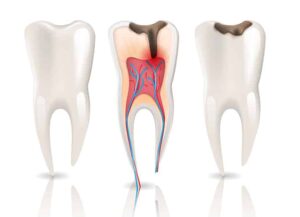
| Root canal treatment | Almost always required in a mature adult tooth. The pulp does not survive avulsion, and treatment is usually started within one to two weeks to prevent inflammatory root resorption |
| Review | Long-term monitoring for resorption, ankylosis, colour change, and the health of the supporting bone |
On the root canal stage, everything you need to know about root canal treatment and root canal treatment: who and what is involved? describe what it means in practice; endodontist vs dentist for root canal, endodontists and root canal cover who does it and why a traumatised front tooth is often referred.
3D imaging — cone beam CT — can be used to assess the injury and the surrounding structures, particularly where a root fracture, a socket wall fracture, or damage to adjacent teeth is suspected and cannot be seen on a conventional radiograph. See how safe are dental x-rays and the technology page.
Why the specialist referral matters
Where a knocked-out tooth is accompanied by facial trauma — suspected jaw or facial fractures, lacerations, or damage to several teeth at once — referral to a clinician trained in managing facial trauma, such as an oral and maxillofacial surgeon, is appropriate. A multidisciplinary team allows dental injuries to be managed alongside any facial fractures rather than in sequence, which matters because the bite has to end up where it started. What does oral and maxillofacial surgery involve?, oral and maxillofacial surgeons and complex dental cases: what happens when multiple specialists need to collaborate explain how that works.
Oral and maxillofacial surgery is a recognised dental specialty; registration can be verified on the AHPRA register. Why would I need to see a dental specialist? and dentists and registered specialists explain the distinction.
Recovery and what to expect
After replantation and splinting:
- Expect a soft diet for several weeks. Soups, rice, pasta and similar — nothing that requires biting with the front teeth. I've just had oral surgery — what can I expect during recovery? covers the same territory after surgery.
- Keep the area meticulously clean. Brush gently with a soft brush; a chlorhexidine rinse is often prescribed for the splinting period. How much pressure should I apply when brushing my teeth? is relevant here for once.
- Avoid contact sport until cleared.
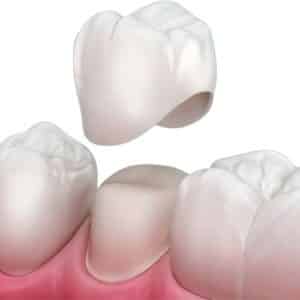
- Colour change in the tooth is common and is a sign the pulp has died — expected after an avulsion, and one of the reasons root canal treatment is planned. If the discolouration persists after treatment, how can I improve the whiteness of my teeth? and I want to whiten my teeth but one of my front teeth has a porcelain crown cover the options for a single dark tooth.
- Follow-up continues for years, not months. Resorption and ankylosis can appear well after the tooth appears to have settled.
Outcomes vary, and a replanted tooth is not guaranteed to survive indefinitely. What can be said honestly is that fast, correct first aid is the single biggest factor within anyone's control, and that a tooth replanted within minutes has a materially better long-term prognosis than one that was not.
If the tooth is eventually lost, the replacement options are set out in what are the replacement options for missing teeth?, implant versus bridge for a single tooth replacement and bridges, implants, or dentures?. The real cost of replacing two front teeth is the one article on this site that puts a figure on what a sporting injury to the front teeth costs over a lifetime.
Prevention
A custom-fitted mouthguard made from an impression or scan of the teeth offers considerably better protection than a boil-and-bite or over-the-counter guard, because it stays in place and distributes force. See should I wear a mouthguard while playing sports?, getting a new mouthguard — a trip to the chemist or the dentist?, what kind of mouth guard should I use? and sports mouthguards.
One thing the original incident illustrates and that is worth stating plainly: a mouthguard reduces the severity of dental injuries but does not eliminate them. Teeth can still be avulsed while wearing one. That is an argument for wearing a well-made guard, not against wearing one — the injuries that occur without one are, on average, worse.
Mouthguards should be checked at each dental visit and remade whenever the fit changes, which for a growing child can be annually. Should my child wear a mouthguard? and children's dentistry cover the junior-sport version.
Two other things athletes should know about, unrelated to trauma: how exercise can increase your risk of tooth decay and sports drinks linked to poor dental health in athletes.
Common questions
The tooth has been out for more than an hour. Is it too late to bother taking it in?
No. Take it, and take it wet. This is the single most consequential misunderstanding about avulsion, and the guideline is unambiguous about it.
The International Association of Dental Traumatology accepts that delayed replantation has a poor long-term prognosis — “the periodontal ligament becomes necrotic and is not expected to regenerate”, and the expected outcome is replacement root resorption. But it then says this: “the decision to replant a permanent tooth is almost always the correct decision even if the extra-oral dry time is more than 60 minutes.” The reasoning is that replanting “will keep future treatment options open”, restores appearance and function at least temporarily, and maintains “alveolar bone contour, width and height” — the bone that any later implant or bridge would have to be built on. “The tooth can always be extracted, if needed.”
Two details of wording matter. The variable is extra-oral dry time, not the time since the accident: a tooth that went into milk in the first minute and arrived two hours later is in a far better position than one that sat in a tissue for twenty minutes. And the guideline is explicit that dehydration of the root surface “starts to happen in a matter of a few minutes”, which is why the storage step above is not optional.
The one exception remains absolute: a primary (baby) tooth should not be replanted, at any time interval, by anyone.
How long is the tooth splinted, and what happens over those weeks?
The IADT guideline specifies stabilising the tooth for two weeks with a “passive flexible splint” — a fine wire, up to 0.016 inch or 0.4 mm, bonded to the tooth and its neighbours, deliberately flexible so the tooth retains a small amount of normal movement rather than being locked rigid. Teeth with short, immature roots may need longer, and a more rigid splint is used where the socket wall itself is fractured.
Root canal treatment is to be started within two weeks of replantation in a tooth with a fully formed root, which is why it is planned from the outset rather than waiting to see whether the nerve recovers. The guideline also directs the clinician to check tetanus status — worth knowing about in advance, because it may mean a conversation with your doctor as well as your dentist.
The patient instructions the guideline lists for that period are to avoid contact sports, maintain a soft diet for up to two weeks according to what you can tolerate, brush with a soft toothbrush after each meal, and use an antiseptic mouth rinse as directed. Follow whatever your treating clinician gives you in writing rather than a general list — the details change with the injury.
The part people underestimate is what comes after. Review continues for years, because ankylosis and resorption can appear long after everything looks settled, and the guideline notes that “the rate of ankylosis and resorption varies considerably and can be unpredictable.”
Does my sport actually need a mouthguard?
The Australian Dental Association sorts this into four levels rather than a yes or no, which is more useful than it sounds.
- Strongly recommended: “off-road bike riding, skateboarding, rock climbing, white-water rafting, trampolining, combat sports, football, basketball, squash, and field hockey.” Basketball and squash surprise people; trampolining surprises almost everyone.
- Head protection worn, which may remove the need: full-face helmets in ice hockey, goalkeepers in field hockey, cricket, rollerblading and cycling.
- Not normally worn, but justifiable in some circumstances: high diving, surfboarding, skiing.
- Impractical or not warranted: swimming, athletics, aerobics, rowing.
The ADA adds that protection “should be used during training as well as competition” — a large share of injuries happen at training, where guards are routinely left in the bag — and that “the need to wear a mouthguard should be assessed by a dentist based on risk factors, including an individual's sporting or occupational activities and dental anatomy.”
Occupational risk is the part almost nobody thinks about. The same policy names “physical impact from work equipment where fracturing of teeth is likely, including labourers, tradespeople, and riggers” and “tooth abrasion where abrasive dust or particles may enter the mouth, including miners, bricklayers, and tilers.”
One honest note on the ADA's own document: it is not internally consistent about over-the-counter guards. The policy body says “over-the-counter mouthguards provide better protection than no mouthguard, however their protection varies”, while its model club policy says they “offer little or no protection and can dislodge during play.” The position both statements agree on is that a custom-fitted guard is the better article and that at-home self-fitting cannot be quality controlled. If cost is the obstacle, the reading that follows from the milder statement is to wear something rather than nothing this season, and get a proper one made.
My child has prominent front teeth. Does that change the risk?
Yes, and the ADA says so directly: “children with prominent front teeth may be a higher risk of injury and may benefit from orthodontic assessment and early treatment to reduce this risk.” It also identifies “young children and teenagers” as high-risk groups generally, “particularly when learning to walk and when new and/or high-risk activities are involved.”
That is worth separating from the cosmetic conversation about orthodontics, because it is a different argument with a different timeline. A referral on injury-risk grounds is asking whether reducing the prominence now lowers the chance of an avulsion at twelve — not whether the teeth will look better at eighteen. Orthodontics and should my child wear a mouthguard? cover both sides; a growing child's guard needs remaking as the teeth change, often yearly.
The policy also flags oral piercing jewellery as something that “may increase the risk and degree of oral injury” — are tongue and lip piercings bad for teeth? goes into that.
What does an injury like this actually end up costing?
More than the immediate treatment, and the cost is spread across decades rather than paid once. The ADA's framing is that oral damage “is often irreversible, frequently complex, difficult, and costly to repair”, and that “the cost of an injury to the teeth or jaw far exceeds the cost of a mouthguard.”
The reason is the sequence rather than any single item. An avulsed front tooth typically means emergency attendance, splinting, root canal treatment, and then years of review. If the tooth is retained, it may still need a crown, and a darkened front tooth may need further work for appearance. If it is eventually lost — which can happen a decade later, to resorption — the replacement is an implant, bridge or denture, and each of those is itself replaced or refurbished over a lifetime. The real cost of replacing two front teeth works that arithmetic through with figures.
On funding, it is worth noting that the ADA's own position is that “all dental care funding schemes should allow for the provision of custom-made mouthguards” — which is a recommendation precisely because it is not universally the case. Check your health fund's extras schedule for the mouthguard item before assuming either way, and ask the practice what is included in a quote for one. Price guide.
Related reading
- Common dental emergencies and what to do
- I have a toothache, what could be the cause?
- Why does a cracked tooth hurt so much?
- How will my cracked tooth be treated?
- What do I need to know about dental implants?
- Second opinions and corrective dentistry
- General dentistry
Practical details
Specialist registration can be verified on the AHPRA register, or by calling 1300 419 495. The clinical team is listed by name.
Smile Solutions, Level 1, 220 Collins Street, Manchester Unity Building, Melbourne VIC 3000 — getting here. Phone 13 13 96, contact us, or theteam@smilesolutions.com.au. Monday–Friday 8.00am–6.00pm, Saturday 8.30am–1.30pm, Sunday by appointment.
Originally published 10 March 2015; rewritten to remove identifiable patient information. Avulsion management, storage media, splinting and follow-up statements are quoted from the International Association of Dental Traumatology guidelines; sport risk categories, occupational hazards and mouthguard statements are quoted from Australian Dental Association Policy Statement 2.2.5. General information only; it does not replace advice from your treating practitioner. In a dental emergency, seek immediate care.
Smile Solutions trades under ABN 28 193 514 103.
Images on This Page
-
https://www.facebook.com/tr?id=800557773428361&ev=PageView&noscript=1
(no alt text)
-
https://www.smilesolutions.com.au/wp-content/uploads/2025/10/calendar_month.svg
(no alt text)
-
https://www.smilesolutions.com.au/wp-content/themes/arcadian-wordpress-theme/assets/images/smile_solutions_logo_white.png
Smile Solutions Logo
-
https://www.smilesolutions.com.au/wp-content/themes/arcadian-wordpress-theme/assets/images/smile_solutions_logo_purple.png
Smile Solutions Logo
-
https://www.smilesolutions.com.au/wp-content/uploads/2023/11/SS-Tooth-1-1-150x150.png
Smile Solutions
-
https://www.smilesolutions.com.au/wp-content/uploads/2014/12/Magpies-Nest.png
Collingwoods’ Clinton Young gets his teeth fixed at Smile Solutions
-
https://www.smilesolutions.com.au/wp-content/uploads/2025/09/Root-Canal-2-300x217.jpg
Root Canal
-
https://www.smilesolutions.com.au/wp-content/uploads/2026/08/Mouth-Breathing-300x270.jpg
Mouth Breathing
-
https://www.smilesolutions.com.au/wp-content/uploads/2025/09/Dental-Crown-at-Smile-Solutions-300x300.jpg
Dental Crown at Smile Solutions
-
https://www.smilesolutions.com.au/wp-content/themes/arcadian-wordpress-theme/assets/images/family_owned_bussiness.png
Family Owned Business
-
https://www.smilesolutions.com.au/wp-content/themes/arcadian-wordpress-theme/assets/icons/icon--phone.svg
Smile Solutions Contact
-
https://www.facebook.com/tr? id=800557773428361&ev=PageView&noscript=1
(no alt text)