How long do teeth whitening effects last?
The short answer
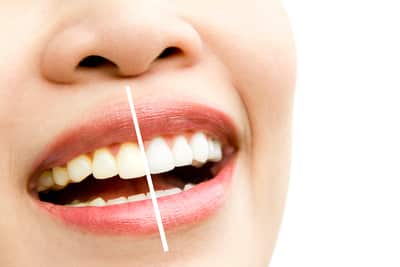
Whitening — in-chair or at-home — lasts several years.
Some rebound of your original tooth colour should be expected from both methods.
The pattern of that rebound is worth knowing:
- the most significant relapse occurs in the first month — usually in the first 24 hours
- relapse is slower between 6 and 24 months
- even with the rebound, your teeth will probably remain lighter than before
That first-24-hours point explains a common disappointment. The shade you see immediately after in-chair whitening is not the shade you keep. Some of it was dehydration of the enamel during treatment, and it settles.
The dehydration effect, explained
This is the single most useful thing on the page, because it prevents an unnecessary sense of failure on day two.
Enamel is porous and normally holds water. During whitening — with the lips retracted, the mouth held open, and peroxide working on the surface — the teeth dry out. Dehydrated enamel scatters light differently and looks temporarily much whiter and more opaque than it really is.
Rehydration takes roughly 24 to 48 hours. Over that period the teeth darken back somewhat and regain their natural translucency. That is not the whitening “wearing off” after a day — it is the tooth returning to its true, genuinely lighter, state.
The honest implication: do not judge the result, take photographs, or book a top-up on the day of treatment. Wait a fortnight. The shade at two weeks is the shade you actually have.
How whitening works
A dental bleach — hydrogen peroxide or carbamide peroxide — is brought into contact with the teeth.
Either at high concentration in one visit, or at lower concentration over weeks at home — the choice between the two turns on your circumstances rather than on the chemistry, and there are several formats available.
We do not provide other methods such as charcoal or abrasion — charcoal whitening in particular does not do what it is marketed as doing.
That distinction matters for longevity. Bleaching changes the colour of the tooth itself, by breaking down pigment molecules within enamel and dentine — which is why the effect persists for years. Abrasive products only scrub surface stain off, which returns within weeks and takes a little enamel with it each time. The same applies to oil pulling and other kitchen-cupboard methods.
What the research shows
At-home whitening
One of the longest studies followed participants 9 to 12 years after six weeks of overnight home whitening with 10% carbamide peroxide:
- 33% reported no obvious change
- 27% reported a slight change
- 6% reported moderate to severe change
- the remainder had already redone the whitening
A third of people seeing no obvious change after nearly a decade is a striking result. It is worth noting that this was dentist-supervised home whitening, which is not the same product as a pharmacy kit.
Shorter studies typically follow patients for two years, combining surveys with light and colour measurement devices. Patient experience varies, while objective measurement tends to show the lightening persists, though shades of yellow and red can return.
In-chair whitening
Follow-up studies show teeth are still lighter two years after treatment, though not as white as immediately afterwards.
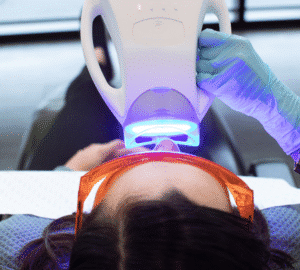
One finding worth noting: the general consensus is that an activation light can reduce overall treatment time, but does not extend how long the whitening lasts.
The two compared
Studies comparing at-home and in-chair whitening show a similar rate of colour rebound after both — regardless of the length of the initial treatment.
That holds for 45-minute in-chair whitening, 10-day home whitening and 4-week home whitening alike.
So the choice between them is about speed, control and comfort, not about how long the result lasts — which is also the case for having it done by a dentist at all.
How much to trust these figures
Worth reading the evidence honestly rather than quoting it as settled:
- Much of it relies on self-report. “No obvious change” nine years later is a memory judgement, and people are poor at recalling a shade. Nobody can accurately compare today's teeth to teeth they last saw in a mirror in 2015.
- Sample sizes are often small, and participants who are dissatisfied are more likely to drop out of long follow-ups — which biases the surviving figures towards good outcomes.
- Shade guides are subjective. Visual shade matching varies between observers, with lighting, and with time of day. Spectrophotometric measurement is more reliable, and studies using it tend to report smaller changes than patient surveys do.
- Industry funding is common in whitening research, as in most product research.
None of that makes the conclusion wrong — the direction of the evidence is consistent, and it is that bleaching produces a change lasting years. It does mean the specific percentages should be read as indicative rather than precise, and they describe study populations, not you.
What affects how long it lasts
Your original shade, dental health, previous whitening experience, diet, and smoking.
The ones you control: dental health, diet and smoking.
Diet
Studies exposing teeth to coloured liquids suggest red wine, cola and tea are worse than coffee for changing tooth colour — wine has a particular reputation, and it is deserved.
The two properties that make something staining are strong pigment and acidity — acid opens the enamel surface and lets pigment in. Which is why red wine is the worst of both, and why the pairing matters: a coffee straight after an orange juice stains more than a coffee alone. Even plain soda water is mildly acidic, though it carries no pigment.
Other frequent culprits: balsamic vinegar, soy sauce, curries and turmeric, tomato-based sauces, berries, beetroot, and dark cordials.
Smoking
Smoking changes the internal colour of teeth, and — more noticeably — leaves an external stain that can only be removed by professional cleaning.
Vaping is not a clean substitute where staining is concerned: the residues still deposit, and nicotine in any form contributes.
The rest
- Your starting shade. Teeth that began darker have further to fall back, and what can be done about whiteness depends on where you are starting from.
- Natural darkening continues with age, as enamel thins and dentine darkens. Whitening does not stop that process, only offsets it — see teeth and ageing.
- Erosion and over-brushing thin the enamel, letting yellow dentine show through. That is not stain and bleaching will not fix it — and it will keep getting worse until the cause is addressed. What is dental erosion?
- White spots are a separate problem again. What causes them determines whether whitening makes them more or less noticeable.
- Surface roughness holds stain. A polished tooth stains more slowly than a rough or calculus-covered one, which is part of why regular cleans matter — and why deeper cleaning may be needed first if calculus has built up below the gumline.
The first 48 hours
The period immediately after whitening is when teeth are at their most porous and most likely to pick up new stain. Most practitioners suggest a “white diet” for 24 to 48 hours — the same logic behind the do's and don'ts of home whitening:
Avoid — coffee, tea, red wine, cola and dark soft drinks, berries, beetroot, tomato sauce, soy sauce, curries, balsamic vinegar, dark chocolate, smoking.
Fine — water, milk, plain chicken and fish, white rice and pasta, potatoes, bananas, cauliflower, plain yoghurt, white cheese.
And avoid coloured mouthwashes during this window, including chlorhexidine, which stains.
It is 48 hours, not forever. The teeth reseal, and normal eating resumes.
Maintaining the result
Aside from dental health, diet and not smoking:
Touch-ups of in-chair whitening can be done after a minimum of 12 months, or using shorter courses of home whitening.
Some studies suggest hydrogen peroxide mouth rinses or whitening toothpastes may recover the whitening effect after staining.
As with all dental treatment, discuss the suitability of these options for your particular case with a dentist — whitening toothpastes in particular vary considerably in abrasiveness.
The practical advantage of take-home trays is that you keep them, which makes maintenance straightforward and inexpensive.
A realistic maintenance routine
- A night or two in the trays every six to twelve months, rather than a full course repeated — this is where keeping the trays pays for itself
- Professional cleaning at your normal recall interval, which removes accumulated surface stain before it builds
- A straw for coffee, tea, cola and red wine
- Rinse with water after staining drinks — but do not brush for an hour afterwards if the drink was acidic, because enamel is temporarily softened
- A low-abrasion toothpaste, and a soft brush
What over-whitening costs
More is not better, and topping up constantly is not harmless. Repeated or prolonged peroxide exposure increases sensitivity and gum irritation, and there is a limit past which teeth do not get whiter — they only get more sensitive and can start to look flat and opaque.
If you are reaching for the trays every few weeks, something else is going on — most often a diet or smoking pattern that is re-staining faster than bleaching can keep up, or an expectation set by a filtered photograph. Worth discussing rather than escalating. If the colour you want is not achievable by bleaching, where a smile makeover starts is a more useful conversation than another round of peroxide.
Common questions
Is the whitening offered at a salon or a shopping-centre kiosk the same treatment?
Legally it cannot be, and that is the clearest answer available on this whole subject.
Schedule 10 of the Poisons Standard lists substances considered of such danger to health that their sale, supply and use is prohibited outside specified exempt circumstances. As the Australian Dental Association's policy statement records, Schedule 10 "specifically states that teeth whitening products containing more than 6% hydrogen peroxide or 18% carbamide peroxide may only be sold, supplied and used by registered dental practitioners as part of their dental practise" — and it notes that "these provisions are formalised in all state and territory poisons legislation".
The Dental Board of Australia published guidance for practitioners in August 2021 on using and supplying whitening products, citing the Poisons Standard, the Therapeutic Goods Administration's advertising requirements and Australian Consumer Law, and stating plainly that a practitioner "can only use teeth whitening products in line with your training and the law". The same guidance is explicit that the law bans people who are not registered dental practitioners from using, supplying and selling these products.
The ADA observes that whitening is nonetheless "increasingly offered by unregulated, unqualified non dental practitioners in settings such as beauty and hair salons, shopping mall kiosks, dedicated teeth whitening salons, or via mobile services", and that such services frequently present their operators as experts in whitening. Whitening is not a recognised dental specialty in Australia — the Dental Board's list of recognised specialties contains thirteen entries and whitening is not among them.
So one of two things is true of a high-strength whitening session offered outside a dental setting: either the product is below the regulated strength, or its supply is outside the law.
What concentrations are involved, and is that why a supermarket kit works so slowly?
Yes — the strength is set by regulation, not by brand quality.
The scheduling discussion that produced the current arrangement dealt in three bands: products at or below 3% hydrogen peroxide (about 9% carbamide peroxide); a middle band of 3–6% hydrogen peroxide (9–18% carbamide peroxide), proposed as accessible through a registered health practitioner with at-home use following a consultation; and products above 6% hydrogen peroxide or 18% carbamide peroxide, which are the ones now restricted under Schedule 10 to registered dental practitioners.
That structure explains the experience. A retail kit sits at the bottom band by law, so it works gradually and to a lesser extent. A dentist-supplied take-home kit can sit higher, which is why it is dispensed after an examination and with custom trays rather than sold off a shelf. In-chair treatment uses the top band under direct supervision.
The ADA's position on who should handle the top band is framed as a public-safety matter: "on the grounds of public safety, only registered dental practitioners who are educated, trained and competent in teeth whitening (bleaching) procedures should use or supply teeth bleaching products containing more than 6% hydrogen peroxide or equivalent." Note that the ADA sets a competence condition on top of registration — being a dentist is necessary, not automatically sufficient.
If a result disappoints, or something goes wrong, what difference does it make where it was done?
A considerable one, and it is worth understanding before rather than after.
The ADA's argument is about the assessment that precedes the gel: "only registered dental practitioners have the expertise to assess whether bleaching is safe for individual patients, to recommend the most appropriate technique and materials, and to provide treatment that meets regulated safety and quality standards of care." Untreated decay, a cracked tooth, exposed root surfaces, gum disease, or an existing crown or veneer at the front all change what whitening will do — and none of them are visible to someone who has not examined you and, where needed, taken radiographs.
There is also the question of what happens afterwards. A registered dental practitioner is accountable to the Dental Board of Australia through AHPRA, their registration can be checked free on the public register at ahpra.gov.au, and there is a complaints pathway if care falls short. An unregistered operator in a kiosk sits outside that system entirely.
And if the result is simply less than hoped for, a dental practice can tell you why — dehydration settling, as described above; the starting shade; erosion rather than stain; or a restoration that was never going to change colour. That diagnosis is the part you are actually buying.
Does whitening damage the enamel?
The ADA's position is that peroxide bleaching products are "safe and effective when used by or under the supervision of a dentist and according to the professional directions for use", with the most common side effects being transient tooth sensitivity and soft tissue irritation during or immediately following treatment. Transient means it settles; common means expect the possibility rather than be alarmed by it.
The conditions in that sentence are where the risk actually sits. The ADA states that whitening "should only be performed if the treatment can be justified, and after a comprehensive dental examination has been conducted by a Dental Practitioner", because that examination is what identifies and treats the problems that would otherwise turn a routine procedure into a painful one.
Which brings this back to the section above on over-whitening. The documented harms are associated with repeated, prolonged or unsupervised exposure — not with a properly assessed course. If you already have sensitive teeth, say so before rather than during.
Related reading
Professional Teeth Whitening · Off-the-shelf teeth whitening — why the results disappoint · What should I know about teeth whitening? · Dental Cleans and Hygienists · What is dental erosion? · Why do I have sensitive teeth? · Composite Bonding · Porcelain Veneers & Crowns · Is it time for a smile makeover? · Price Guide
Practical details
Smile Solutions, Level 1, 220 Collins Street, Manchester Unity Building, Melbourne VIC 3000. Phone 13 13 96, or theteam@smilesolutions.com.au. Monday–Friday 8.00am–6.00pm, Saturday 8.30am–1.30pm, Sunday by appointment.
Note that whitening does not change the colour of crowns, veneers or tooth-coloured fillings — their shade is fixed when they are made, which is why whitening is done before any cosmetic work, never after. If a front tooth already carries a crown, that changes the plan entirely.
Registration for any practitioner can be verified free on the AHPRA public register at ahpra.gov.au.
Published 12 April 2018. Study findings are as cited and are summarised from published research of varying quality and sample size; they describe study populations rather than individuals. The regulatory material in the questions above is drawn from the Poisons Standard as described in Australian Dental Association policy, Dental Board of Australia guidance published August 2021, and Therapeutic Goods Administration scheduling papers; scheduling and guidance are revised periodically, so check the current versions.
General information only — it is not a diagnosis, a treatment plan, a quote or a promise of any particular clinical outcome, and it does not replace advice from your treating practitioner. Results and how long they last vary between individuals, and no shade outcome or duration can be guaranteed. Whitening carries risks, including tooth sensitivity and gum irritation, and it is not suitable for everyone — including anyone with untreated decay or gum disease. Whether it is appropriate for you can only be determined after examination. Fees are indicative and subject to change; confirm at your consultation.
Smile Solutions trades under ABN 28 193 514 103.
Images on This Page
-
https://www.facebook.com/tr?id=800557773428361&ev=PageView&noscript=1
(no alt text)
-
https://www.smilesolutions.com.au/wp-content/uploads/2025/10/calendar_month.svg
(no alt text)
-
https://www.smilesolutions.com.au/wp-content/themes/arcadian-wordpress-theme/assets/images/smile_solutions_logo_white.png
Smile Solutions Logo
-
https://www.smilesolutions.com.au/wp-content/themes/arcadian-wordpress-theme/assets/images/smile_solutions_logo_purple.png
Smile Solutions Logo
-
https://www.smilesolutions.com.au/wp-content/uploads/2023/11/SS-Tooth-1-1-150x150.png
Smile Solutions
-
https://www.smilesolutions.com.au/wp-content/uploads/2018/04/how-long-do-teeth-whitening-effects-last.jpg
How long do teeth whitening effects last?
-
https://www.smilesolutions.com.au/wp-content/uploads/2025/09/Dental-Crown-at-Smile-Solutions-300x300.jpg
Dental Crown at Smile Solutions
-
https://www.smilesolutions.com.au/wp-content/uploads/2016/05/Madeleine-150x150.jpg
Dr Madeleine Hoopmann
-
https://www.smilesolutions.com.au/wp-content/uploads/2025/09/Professional-Teeth-Whitening-Smile-Solutions-300x270.png
Professional In-Chair Teeth Whitening Smile Solutions Melbourne
-
https://www.smilesolutions.com.au/wp-content/uploads/2025/09/Root-Canal-2-300x217.jpg
Root Canal
-
https://www.smilesolutions.com.au/wp-content/themes/arcadian-wordpress-theme/assets/images/family_owned_bussiness.png
Family Owned Business
-
https://www.smilesolutions.com.au/wp-content/themes/arcadian-wordpress-theme/assets/icons/icon--phone.svg
Smile Solutions Contact
-
https://www.facebook.com/tr? id=800557773428361&ev=PageView&noscript=1
(no alt text)