Dr Rojina Fadaei, General Dentist
Role: General dentist
Qualifications: Bachelor of Health Sciences (Dentistry) / Master of Dentistry, La Trobe University
Registration: Registered dentist, general registration, DEN0002456618
Registration status can be verified on the AHPRA register of practitioners at ahpra.gov.au. The service page for this scope is General Dentistry.
Background
Dr Rojina Fadaei completed her dental qualification at La Trobe University — a Bachelor of Health Sciences in Dentistry and a Master of Dentistry. During her training she worked in several rural locations across Victoria.
She is a member of the Australian Dental Association. Her clinical interests are endodontics, oral surgery and restorative dentistry, and she attends continuing professional development courses and conferences around Australia.
She has written two of the practice's articles:
- Everything you need to know about CEREC technology
- What is the difference between having your teeth cleaned by a dentist and a dental hygienist?
She speaks English and Persian. Outside dentistry she plays tennis and badminton and spends time with family and friends — on which the relevant dental point is Sports Mouthguards.
What a general dentist does
A general dentist holds general registration with the Dental Board of Australia and provides examination and diagnosis, radiographs, cleaning and gum treatment, fillings, inlays, onlays, crowns and bridges, root canal treatment, extractions including wisdom teeth, dentures, implant restorations, whitening and cosmetic treatment, and referral to specialists where a case sits outside general practice.
A general dentist is not a specialist. Specialist titles are protected under the Health Practitioner Regulation National Law and require specialist registration following three years of full-time postgraduate university training. A strong interest and considerable experience in endodontics or oral surgery does not confer specialist registration in either. See Why would I need to see a dental specialist?
Cleaning: dentist or hygienist?
This is the subject of her own article, What is the difference between having your teeth cleaned by a dentist and a dental hygienist?, and it is one of the commonest questions at the front desk. See also Dental hygienist vs dentist — what's the difference?, What does a dental hygienist do? and the service page, Dental Cleans and Hygienists.
How often any of it should happen is risk-based rather than automatic: How often should I go to the dentist? Where the deposits sit below the gum, see When do you need deeper cleaning? and What Is Gum Disease?
Same-day CEREC restorations
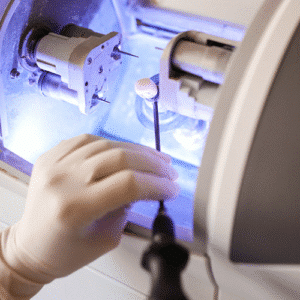
Her other article covers chairside CAD/CAM — a digital scan, an on-screen design and an in-practice milling unit, producing a ceramic restoration in one appointment rather than two. See Same-Day CEREC Restorations, Our Technology and the in-house laboratory.
The honest qualification: the tooth preparation is the same either way. The time saved is in manufacture, not in how much tooth is removed, and for front teeth a hand-layered laboratory restoration can still be the better choice. See What types of dental crowns are available? and How Much Does a Dental Crown Cost in Melbourne? Materials Compared
Root canal treatment in general practice
Most root canal treatment in Australia is done by general dentists, and that is appropriate for straightforward cases. Referral to a specialist endodontist is warranted for:
- teeth with complex or calcified canal anatomy
- retreatment of a failed root canal
- cases where a file has separated, or a canal cannot be located — see The risk of broken files during root canal treatment
- persistent pain that is difficult to localise — see Tooth Pain and Ache and I have a toothache, what could be the cause?
- surgical endodontics (root-end surgery)
- teeth of high strategic value where a first-attempt failure would be costly
See Endodontist vs Dentist for Root Canal: Why It Makes a Difference and Why is the microscope so crucial in endodontic treatment by a specialist?
What is true about root canal treatment — at greater length in Everything you need to know about root canal treatment and Root canal treatment: who and what is involved?:
- It is done under local anaesthetic and is usually comfortable. Its reputation for pain is inherited from the condition that causes it — an abscessed or acutely inflamed tooth — which treatment relieves. See What is a tooth abscess? Should I have it treated? If so, how? and Dental Phobia: How do you give a virtually pain-free injection?
- It often takes more than one visit where infection is present.
- Success rates are high but not universal. Published outcome studies commonly report the region of 85–95% for initial treatment, lower for retreatment and where there is an existing lesion at the root tip.
- A root-filled back tooth generally needs a cusp-covering restoration. Leaving it in a temporary filling is a common cause of later fracture, and a fractured root usually cannot be saved. See What do I do if a temporary filling comes out? and How will my cracked tooth be treated?
- The alternative is extraction, followed by a decision about replacement. Keeping a restorable natural tooth is usually preferable, but not always. See What are the replacement options for missing teeth? and Bridges, implants, or dentures for replacing missing teeth?
Surgical extraction in general practice
General dentists routinely perform extractions, including some surgical ones. Referral to an oral and maxillofacial surgeon is appropriate for deeply impacted teeth, roots close to the inferior alveolar nerve or the sinus, patients with significant medical complexity, and cases needing general anaesthetic — see Sleep Dentistry.
Risks that should be disclosed before a lower wisdom tooth removal:
- Inferior alveolar nerve injury — altered sensation in the lip and chin, usually temporary and occasionally permanent
- Lingual nerve injury — altered sensation or taste in the tongue
- Dry socket — painful loss of the blood clot, most common in smokers
- Infection, bleeding, swelling and restricted mouth opening — see Emergency Dentistry if any of these worsen rather than settle
- Sinus communication for upper back teeth
A cone beam CT is used where the roots appear close to the nerve on a standard radiograph. Ask what the imaging showed and what it means for your specific risk — see How safe are dental x-rays
Not every wisdom tooth needs removing. A symptom-free, fully erupted, cleanable wisdom tooth generally does not, and routine prophylactic removal of all four is not supported by the evidence. See Wisdom Teeth, How long does it take to recover from wisdom teeth surgery? and What costs are involved with wisdom teeth removal?
Rural clinical placement
Australian dental schools place students in rural and regional communities, and the case mix genuinely differs: more advanced disease because people present later, more emergency and pain-relief work, more extractions, more complex medical histories, and more decisions made under constraints of cost and distance. See The stages of dental decay and What is considered a dental emergency?
Australia has a documented maldistribution of dental practitioners — the number per head of population falls with remoteness, and oral health outcomes fall with it. That is compounded in some areas by the absence of water fluoridation and by long public waiting lists. See The benefits of fluoride and Fluoridated water — Is it good for you?
Language and dental care
Being treated in your own language is a clinical matter, not a convenience. Consent is only informed if it is understood; a medical history is only useful if it is accurate; and pain is hard to describe in a second language. See Understanding Your Treatment and How important is communication in dentistry?
Practitioners who speak community languages improve access for patients who would otherwise rely on a family member to interpret — which raises its own accuracy and privacy problems.
If your language is not spoken at a practice, you are entitled to ask for an interpreter for anything significant. Free telephone interpreting is available in Australian health settings. Ask when booking — see Contact Us.
Registration
Dentists are one of the registered dental practitioner divisions under the National Law. The Dental Board of Australia registers dentists, dental specialists, dental hygienists, dental therapists, oral health therapists and dental prosthetists. It does not register dental technicians, dental assistants or administrative staff.
Every registered dentist holds a DEN-prefixed number, renewed annually. Conditions, undertakings and reprimands appear on the public register.
Common questions
Is a clean with a hygienist as good as one with a dentist?
They are different appointments doing different jobs, and the register is the place to start. Dental hygienists are registered dental practitioners in their own right, with their own division on the Dental Board of Australia's register — alongside dentists, dental specialists, dental therapists, oral health therapists and dental prosthetists. They are bound by the same scope of practice standard, which ‘requires dental practitioners to practise within the scope of their education, training, and competence at all times'.
What that means in a chair: a hygienist appointment is usually longer and is built around removing deposits, treating gum inflammation and teaching the technique that keeps it away — the part of the work that has to be repeated and reinforced. A dentist's examination is built around diagnosis: decay, cracks, the bite, restorations that are failing, and the soft tissues. Neither substitutes for the other, and the cleaning itself is not made better by who holds the instrument.
One thing worth asking whoever you see: what the recall interval should be for you, and why. The Australian Dental Association's oral hygiene policy lists the main strategies as ‘brushing for two minutes twice a day; using an age-appropriate fluoride toothpaste; clean between teeth once a day using floss or interdental brushes; and visit a dental professional for regular check-ups and professional cleaning' — regular, not automatically six-monthly. See Dental Cleans and Hygienists.
Root canal or take the tooth out — how should I decide?
On the prognosis of this particular tooth, the cost of replacing it, and what you want to be dealing with in ten years.
The outcome data for keeping the tooth is better than the procedure's reputation. A peer-reviewed cohort study of endodontically treated teeth reported that ‘the overall success rates of ETT were 87.8% (95% CI: 84 to 90%) and 80.8% (95% CI: 75 to 86%) at the tooth and patient levels, respectively' — the two figures differ because one counts teeth and the other counts people, and someone with several treated teeth pulls the patient-level figure down.
Against that, extraction is not the end of the decision, it is the start of a second one: leave the gap, or replace the tooth with a bridge, an implant or a denture, each with its own cost, its own maintenance and its own failure modes. A tooth that is restorable, cleanable and worth keeping is usually worth keeping.
The questions that actually settle it: how much sound tooth is left above the gum; whether the tooth can be sealed properly afterwards; whether there is an existing lesion at the root tip; whether the case should go to an endodontist rather than be attempted twice; and what the full cost is including the restoration that must follow, not just the root filling. See Root Canal Treatment and What are the replacement options for missing teeth?
Is a same-day CEREC crown as good as a laboratory-made one?
Here the honest answer is that we cannot show you independent evidence either way, and it is better to say so than to fill the gap.
We checked the independent reference material behind this site — regulator documents, professional policy statements, systematic reviews and peer-reviewed studies — for survival data on chairside-milled ceramic restorations specifically. There is none in it. Any figure you see quoted for how long a chairside crown lasts, here or elsewhere, is not coming from that kind of source.
What can be said without a study behind it is structural, and it is on this page already: the preparation is the same either way, so the choice does not change how much tooth is removed; the saving is in manufacture and appointments; and for front teeth, where the appearance depends on layering and characterisation by hand, a laboratory restoration may still be the better choice. Ask which material is being used, why it was chosen for that tooth, and what the plan is if it chips. See Same-Day CEREC Restorations and What types of dental crowns are available?
I have been avoiding the dentist because I am frightened. What actually helps?
You are in a large group, and the avoidance is the part that does the damage. An Australian survey of 6,112 adults found that 11.9 per cent answered ‘yes, very' and 5.2 per cent ‘yes, quite' when asked whether they were afraid of going to the dentist. The same study measured the consequence: 43.9 per cent of the very afraid had not been for more than two years, against 29.1 per cent of those with no fear, and it found that the odds of fitting the ‘vicious cycle' profile — fear, delay, symptom-driven visits, worse problems, more fear — were 3.33 (95% CI 2.67–4.15) in the very fearful (Armfield, Stewart & Spencer, BMC Oral Health, 2007).
On what works, a 2024 systematic review in the Journal of Anxiety Disorders is unusually specific, and some of it is unwelcome. For chronic dental anxiety, ‘evidence with moderate certainty supports employing CBT'. For anxiety during a procedure, moderate-certainty evidence supports hypnosis and low-certainty evidence supports sedative medicines, ‘with comparably small effect sizes'. And with moderate certainty, the review found that ‘virtual reality exposure therapy, virtual reality distraction, background music, acupuncture, or preoperative video information provision did not alleviate state anxiety', with aromatherapy also failing to reduce it. Its own conclusion is the useful one: ‘clinicians should ensure that interventions match their purpose — managing acute emotions during treatment, or alleviating chronic anxiety and avoidance tendencies'.
Practically: say so when you book, rather than at the chair. Ask for a first appointment that is talking and looking only, with nothing done. Agree a stop signal and hold the practice to it. And treat the long-term fear as its own problem worth addressing, rather than something to be got through one appointment at a time. See Dental Anxiety and How can I ease my anxiety about visiting the dentist?
Practical details
Dr Fadaei's registration can be checked on the AHPRA public register at ahpra.gov.au. For questions about consultation or which practitioner suits a particular problem, see Contact Us. The full clinical team is on Our Team, and published fees in the Price Guide.
Smile Solutions, Level 1, 220 Collins Street, Manchester Unity Building, Melbourne VIC 3000. Phone 13 13 96, or theteam@smilesolutions.com.au. Monday–Friday 8.00am–6.00pm, Saturday 8.30am–1.30pm, Sunday by appointment. Location and directions.
Sources for the externally verifiable statements in the questions above
- Dental Board of Australia, Registration standards — the registered divisions and the scope of practice standard.
- Australian Dental Association, Policy Statement 2.2.3 — Oral Hygiene (amended 24 October 2025).
- Peer-reviewed endodontic cohort study (PubMed Central) — success rates of endodontically treated teeth.
- Armfield JM, Stewart JF, Spencer AJ, The vicious cycle of dental fear, BMC Oral Health 2007 — Australian prevalence and avoidance figures.
- Steenen SA et al., Interventions to reduce adult state anxiety, dental trait anxiety, and dental phobia, Journal of Anxiety Disorders 2024.
This page records qualifications and career history as published by the practice. General information only — it is not a diagnosis, a treatment plan or a promise of any particular clinical outcome. Practitioner availability changes; confirm when booking.
Smile Solutions trades under ABN 28 193 514 103.
Images on This Page
-
https://www.facebook.com/tr?id=800557773428361&ev=PageView&noscript=1
(no alt text)
-
https://www.smilesolutions.com.au/wp-content/uploads/2025/10/calendar_month.svg
(no alt text)
-
https://www.smilesolutions.com.au/wp-content/themes/arcadian-wordpress-theme/assets/images/smile_solutions_logo_white.png
Smile Solutions Logo
-
https://www.smilesolutions.com.au/wp-content/themes/arcadian-wordpress-theme/assets/images/smile_solutions_logo_purple.png
Smile Solutions Logo
-
https://www.smilesolutions.com.au/wp-content/uploads/2021/03/Rojina.jpg
Dr Rojina Fadaei
-
https://www.smilesolutions.com.au/wp-content/uploads/2021/03/Rojina-1.jpg
Rojina 1
-
https://www.smilesolutions.com.au/wp-content/uploads/2025/09/CEREC-restorations-Smile-Solutions-300x300.png
CEREC Restoration Smile Solutions
-
https://www.smilesolutions.com.au/wp-content/uploads/2021/03/Rojina-150x150.jpg
Dr Rojina Fadaei
-
https://www.smilesolutions.com.au/wp-content/uploads/2025/09/Smile-Solutions-Level-10-300x270.png
Smile Solutions Level 10
-
https://www.smilesolutions.com.au/wp-content/themes/arcadian-wordpress-theme/assets/images/family_owned_bussiness.png
Family Owned Business
-
https://www.smilesolutions.com.au/wp-content/themes/arcadian-wordpress-theme/assets/icons/icon--phone.svg
Smile Solutions Contact
-
https://www.facebook.com/tr? id=800557773428361&ev=PageView&noscript=1
(no alt text)