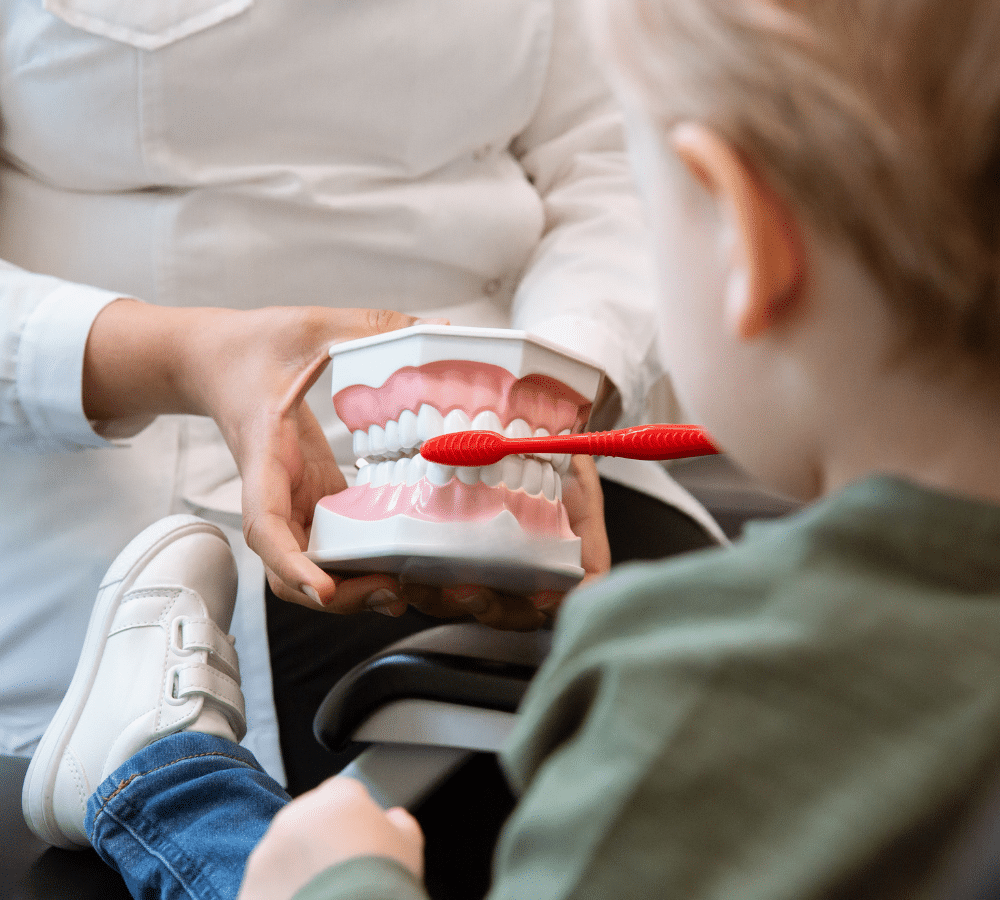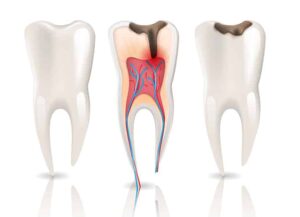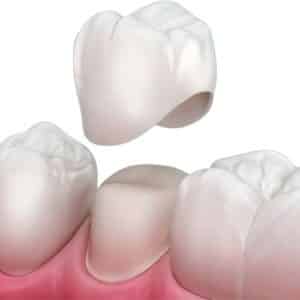
Who is a suitable candidate for dental sealants?
The clearest candidates are children and adolescents with newly erupted permanent molars that have deep pits and fissures, particularly where there is an identified risk of decay. The strongest case is a child around 6 years old whose first permanent molars have just come through, and again around 12, when the second molars erupt.
Sealants are not applied to every tooth in every child. They are a targeted preventive measure, and the decision rests on the anatomy of the tooth and the child's assessed decay risk. The role of fissure sealants in children's teeth covers the same ground from the parent's side, and children's dentistry is the service page.
What a dental sealant is
A dental sealant is a light-cured plastic coating applied to the chewing surface of a back tooth. It flows into the pits and fissures — the narrow grooves in the biting surface — and is then set with a curing light.
Its function is mechanical exclusion. Bacteria would otherwise live in those grooves, producing acid and leading to decay. The fissures on a molar can be narrower than a single toothbrush bristle, which is why they are the most decay-prone surfaces in the mouth: they trap food and bacteria in a space that cannot physically be cleaned. Sealing them removes the habitat. How does tooth decay develop? and the stages of dental decay
That mechanical logic is the same one behind the rest of prevention. Plaque is a biofilm — it is removed by physical disruption, not by rinsing — and a fissure is simply a place no bristle can reach. Everything else still has to be done: what is the ideal daily routine for oral hygiene? and is flossing really that important?
Application requires no drilling and normally no anaesthetic, and takes a few minutes per tooth.
What the evidence shows
A 2013 Cochrane Review found evidence that, where there is a risk of decay in children and adolescents, decay is prevented by pit and fissure sealants placed on the occlusal surfaces of permanent molar teeth — the biting surfaces that meet the teeth above or below.
There is also evidence that sealed teeth experience less decay than unsealed teeth for up to 48 months. That figure is worth reading carefully. It is not a claim that a sealant lasts four years and then fails; it is the horizon over which the benefit has been reliably measured. What happens after that depends almost entirely on whether the sealant has been maintained.
Two honest qualifications:
- Sealants are not immune from bacterial leakage. A sealant with a chipped edge or a worn margin can allow bacteria underneath, where they are then harder to detect and harder to reach. That is one of the things dental x-rays are for.
- The protection is not absolute and it is not permanent. A sealed tooth is a lower-risk tooth, not an invulnerable one. If decay does start, it is treated like any other — why do I need a filling? and tooth fillings.
Timing: why 6 and 12 matter
According to Dental Health Services Victoria, the ideal time to apply fissure sealants is soon after the permanent teeth erupt. The first permanent molars arrive at around age 6.
There are two reasons timing is so important:
- Newly erupted enamel is not fully mineralised. It continues to mature for around two years after eruption, and during that window it is at its most vulnerable to acid. This is exactly the period when a sealant does the most good. The benefits of fluoride covers the other half of that protection.
- Erupting teeth are hard to clean. Between ages 6 and 12 a child is still developing manual dexterity and still learning why cleaning matters. A partly erupted molar sits below the level of its neighbours, behind a flap of gum, at the very back of a small mouth. Even a conscientious child will miss it. How to encourage your child to brush their teeth and kids teeth cleaning tips
A tooth sealed before decay starts is a tooth that may never need a filling. A tooth sealed after decay has started needs the decay removed first — at which point it is a restoration, not a sealant. Can you reverse tooth decay and do I need a filling?
Eruption of the permanent teeth
Parents can use approximate eruption timing to know when to ask about sealants. These ranges are typical, and individual variation of a year either way is normal. Order and appearance of baby teeth covers the set that comes first.
| Tooth | Usual eruption age |
|---|---|
| First molars (“six-year molars”) | 6–7 |
| Central incisors | 6–8 |
| Lateral incisors | 7–9 |
| Canines | 9–12 |
| First premolars | 10–12 |
| Second premolars | 10–12 |
| Second molars (“twelve-year molars”) | 11–13 |
| Third molars (wisdom teeth) | 17–21, if present |
The first permanent molars are the ones most often missed by parents, because they erupt behind the baby teeth rather than replacing one. No tooth falls out to announce them, so their arrival goes unnoticed — and they are the single most commonly decayed tooth in Australian children. On the last row of that table, see wisdom teeth.
Who benefits most
Sealants are most strongly indicated where:
- The molars have deep, narrow, sticky fissures rather than shallow open grooves
- The child has existing or previous decay, in either the baby or permanent teeth — protecting your child from dental disease
- Oral hygiene is inconsistent, or dexterity is still developing
- The diet is high in frequency of sugar exposure — how does sugar affect your dental health? and dental health week: protect your kids from the sugar bandits
- There is a medical or developmental condition affecting cleaning ability, saliva flow, or cooperation for treatment — oral health care for children with special needs and visiting the dentist: caring for a child with autism
- There are enamel defects — for example molar incisor hypomineralisation, where the enamel is poorly formed and unusually decay-prone. Everything you need to know about chalky teeth and what causes white spots on teeth?
- The child has orthodontic appliances, which complicate cleaning — children's braces and Invisalign and braces
They are of less value where molars have naturally shallow, self-cleansing grooves and the child has an excellent hygiene and dietary record. In that situation a dentist may reasonably choose to monitor instead.
Sealants are not restricted to children by definition — an adult with a newly erupted or deeply fissured molar and a high decay risk can be a candidate — but the population benefit is overwhelmingly in children and adolescents. How do I prevent dental decay?
Maintenance is the part that decides the outcome
This is the point the source material makes twice, and it deserves the emphasis. Retention and effectiveness of dental sealants depend on maintenance.
A sealant is not a treat-and-forget procedure. Because sealants are not immune from bacterial leakage, any imperfections and wear need to be detected at the routine dental examination — which means the child needs to keep attending. A chipped or partially lost sealant can be worse than no sealant, because it can shelter bacteria in a space that is now sealed off from saliva and fluoride but open to plaque. How often should I go to the dentist?
Maintenance comprises:
- Regular examination, so wear and marginal defects are caught and the sealant is repaired or replaced — dental cleans and hygienists and your Smile Solutions dental hygienist visit: what to expect
- Good oral hygiene — sealants protect the biting surface only; the sides and the contact points between teeth are still exposed. Two minutes, twice a day, soft bristles, and spit, don't rinse; more brushing is not better, and harder causes recession that does not grow back — over brushing: what can it do to my teeth? and which toothbrushes do dentists recommend?
- Fluoridated toothpaste, twice daily — selecting a toothpaste: fluoride or non-fluoride and choosing the right toothpaste for you
- Diet — particularly the frequency of sugar exposure. How does your diet affect your teeth?
The common misunderstanding is that a sealed tooth is a protected tooth. It is a tooth with its most vulnerable surface protected. Decay between the teeth is unaffected by sealants entirely — which is what cleaning between the teeth is for, and it is also where floss reaches only about 3mm below the gum margin.
Who places them
Ideally, pit and fissure sealants are placed with care by a paediatric dentist or an oral health therapist, and maintained through regular examination. Paediatric dentists, should your child see a specialist paediatric dentist? and what is the difference between a dental therapist and a dental hygienist?
Technique matters more than the materials: the tooth has to be properly isolated and kept dry during placement, because moisture contamination is the main cause of early sealant failure. That is not always straightforward in a six-year-old, which is an argument for having it done by someone whose day is built around treating children. Combating dental anxiety in children
We have a paediatric dentist and oral health therapists who work in children's dentistry, and who can assess decay risk and advise on whether sealants are appropriate for a particular child. Registered specialists are identified as such, and the clinical team is listed by name.
In summary
Dental sealants are widely recognised as an effective prevention of dental decay in the permanent molar teeth of children and adolescents. The best candidates are children with newly erupted molars, deep fissures, and identified decay risk. The best time is soon after eruption — around age 6, and again around 12. And the benefit is only realised if the sealants are maintained, which means continuing regular examinations, good hygiene, fluoride toothpaste and attention to diet.
Common questions
Will Medicare or my health fund pay for them?
Possibly, and this is worth checking before you decide. Fissure sealing is one of the basic dental services listed under the Child Dental Benefits Schedule (CDBS), alongside check-ups, X-rays, cleaning, fillings, root canals and extractions. Services Australia states that it covers “up to $1,158 for each eligible child over 2 calendar years”, and that the cap is indexed each year on 1 January.
Eligibility has three parts. The child must be 0 to 17 years old for at least one day that calendar year, must be eligible for Medicare, and the child or a parent must be receiving a qualifying payment. Services Australia also warns that item and time restrictions apply to some basic services — “you should check with your dentist if there are any item or time restrictions before starting your service” — which matters for sealants specifically, because a tooth already sealed may not attract a second benefit within the restriction period. Orthodontic work, cosmetic work and any dental service performed in a hospital are excluded.
Private health extras cover for preventive items varies a great deal by fund and by policy, so the useful question to ask your fund is the item number and your remaining annual limit, not “do you cover sealants”. How does the Child Dental Benefits Schedule operate?, the Child Dental Benefit Schedule page and the price guide are the places to start.
Does it hurt? Will my child need a needle?
There is no drilling into the tooth and normally no local anaesthetic, because nothing is being cut away — the resin is applied to the outside of the enamel. What a child actually experiences is having to hold the mouth open, the sharp taste of the conditioning gel, and the suction and air used to keep the tooth dry.
That last part is the reason a sealant appointment is not always as quick as it sounds. The tooth has to stay completely dry while the resin is placed and cured; moisture contamination is the main cause of early failure. So the clinician will use cotton rolls or a rubber dam and will stop and restart rather than push on, and a child who cannot yet tolerate that may be better served by waiting a few months or by seeing someone who treats children all day.
If your child is apprehensive, say so when you book rather than on the day, so time and approach can be planned. Combating dental anxiety in children sets out what can be arranged in advance.
The dentist looked and said “monitor” rather than seal. Should I push for one?
Not on principle, no. A sealant is a targeted measure, not a default, and the two things that drive the decision are the shape of the grooves and the child's decay history. A molar with shallow, open, self-cleansing grooves in a child with no decay and consistent cleaning is a tooth that a sealant would add very little to — and every sealant placed is a sealant that then has to be checked and maintained for years.
What is reasonable to ask is why: whether the fissures were judged deep or shallow, what the child's assessed decay risk is, and what would change the answer. If the answer is “low risk for now”, the follow-up question is what to watch for between visits. If the child's circumstances change — braces going on, a diagnosis affecting saliva or dexterity, a first filling appearing anywhere in the mouth — the risk assessment changes with them and the question is worth reopening.
How would I know if a sealant has come off?
Usually you would not, and neither would your child. A sealant is a thin coating in a groove at the back of the mouth; a partial loss or a chipped margin is not something that can be felt with the tongue or seen at the bathroom mirror, and it does not hurt. Occasionally a child notices that a back tooth suddenly “feels different” to bite on, but that is the exception.
This is precisely why the maintenance point above is not boilerplate. Detection happens at the routine examination, when a clinician can dry the tooth, look at it under good light and probe the margins — and, where indicated, use dental x-rays to see what a visual check cannot. A partially lost sealant is repaired or replaced; leaving it is the option that carries the risk, because the remaining resin can shelter plaque in a space that saliva and fluoride no longer reach. If your family has drifted out of the habit of regular check-ups, sealants are a reason to start again rather than a reason not to bother. How often should I go to the dentist?
One molar already has a filling. Is it too late for the others?
No — and in fact a first filling is one of the clearest signals that the remaining teeth should be assessed. Decay in one molar is evidence about the whole mouth: it tells you something about the grooves, the diet, the cleaning and the saliva, all of which apply equally to the teeth that have not yet failed.
The practical sequence is that the filled tooth is now a restoration and is managed as one, while the other first molars and, later, the second molars at around 11 to 13 remain candidates for sealing. Parents often assume the window closes at six; it does not. The twelve-year molars arrive with exactly the same deep fissures and the same immature enamel, in a child who is by then also the likeliest age to be wearing orthodontic appliances. Why do I need a filling? explains what the first one involved, and how do I prevent dental decay? covers the rest of the mouth.
If the teeth are sealed, can we ease off on brushing?
No, and this is the single most common misunderstanding about sealants. A sealant covers the biting surface of one tooth. It does nothing for the sides of that tooth, nothing for the contact points where it touches its neighbours, nothing for the gum margin, and nothing for the front teeth. Decay between the teeth is completely unaffected by sealing.
The honest framing is that a sealant removes the hardest-to-clean surface from the list of things brushing has to succeed at — which makes the remaining surfaces more, not less, worth the effort, because they are now where the risk is concentrated. Twice a day with a fluoride toothpaste, cleaning between the teeth, and attention to how often sugar is eaten rather than how much, all still apply. What is the ideal daily routine for oral hygiene? and is flossing really that important?
Related reading
- When should a child first visit the dentist? and the first visit to the dentist
- How does the Child Dental Benefits Schedule operate? and the Child Dental Benefit Schedule
- 3 oral hygiene tips you need to know
- What does a dental hygienist do?
- Price guide
Practical details
This article draws on the 2013 Cochrane Review of pit and fissure sealants and on guidance from Dental Health Services Victoria; those sources remain authoritative. Child Dental Benefits Schedule figures and eligibility rules are from Services Australia.
Specialist registration can be verified on the AHPRA register, or by calling 1300 419 495.
Smile Solutions, Level 1, 220 Collins Street, Manchester Unity Building, Melbourne VIC 3000 — getting here. Phone 13 13 96, contact us, or theteam@smilesolutions.com.au. Monday–Friday 8.00am–6.00pm, Saturday 8.30am–1.30pm, Sunday by appointment.
Published 23 October 2025. General information only; it does not replace advice from your treating practitioner.
Smile Solutions trades under ABN 28 193 514 103.
Images on This Page
-
https://www.facebook.com/tr?id=800557773428361&ev=PageView&noscript=1
(no alt text)
-
https://www.smilesolutions.com.au/wp-content/uploads/2025/10/calendar_month.svg
(no alt text)
-
https://www.smilesolutions.com.au/wp-content/themes/arcadian-wordpress-theme/assets/images/smile_solutions_logo_white.png
Smile Solutions Logo
-
https://www.smilesolutions.com.au/wp-content/themes/arcadian-wordpress-theme/assets/images/smile_solutions_logo_purple.png
Smile Solutions Logo
-
https://www.smilesolutions.com.au/wp-content/uploads/2023/11/SS-Tooth-1-1-150x150.png
Smile Solutions
-
https://www.smilesolutions.com.au/wp-content/uploads/2025/09/Childrens-Teeth-Cleaning-Tips.png
Children's Teeth Cleaning Tips
-
https://www.smilesolutions.com.au/wp-content/uploads/2025/09/Root-Canal-2-300x217.jpg
Root Canal
-
https://www.smilesolutions.com.au/wp-content/uploads/2026/08/Mouth-Breathing-300x270.jpg
Mouth Breathing
-
https://www.smilesolutions.com.au/wp-content/uploads/2025/09/Dental-Crown-at-Smile-Solutions-300x300.jpg
Dental Crown at Smile Solutions
-
https://www.smilesolutions.com.au/wp-content/themes/arcadian-wordpress-theme/assets/images/family_owned_bussiness.png
Family Owned Business
-
https://www.smilesolutions.com.au/wp-content/themes/arcadian-wordpress-theme/assets/icons/icon--phone.svg
Smile Solutions Contact
-
https://www.facebook.com/tr? id=800557773428361&ev=PageView&noscript=1
(no alt text)
-
https://bat.bing.com/action/0?ti=25148060&tm=gtm002&Ver=2&mid=4577ec83-7913-4fca-b332-18f163716a86&bo=1&sid=e6b82f40ab2611f1a5944b154db27646&vid=e6b85bd0ab2611f1a1cc0bf05651012a&vids=1&msclkid=N&pi=918639831&lg=en-US&sw=800&sh=600&sc=24&nwd=1&tl=Who%20is%20a%20suitable%20candidate%20for%20dental%20sealants%3F%20-%20Smile%20Solutions&p=https%3A%2F%2Fwww.smilesolutions.com.au%2Fdental-articles%2Farticle%2Fsuitable-candidate-dental-sealants%2F&r=&evt=pageLoad&sv=2&cdb=AQAQ&rn=861167
(no alt text)