What exactly is holistic dentistry?
Holistic dentistry is a way of relating your general health to your dental health. In practice it describes an approach rather than a distinct set of treatments: preventive care first, careful choice of materials, minimally invasive technique where it is appropriate, and attention to how the mouth interacts with the rest of the body. The companion piece What is holistic dentistry? defines the term; this one is about what it buys you and what it does not.
Before anything else, one point of definition that matters when you are comparing practices. “Holistic” and “biological” dentistry are not protected titles, and there is no AHPRA specialty by either name. Nobody’s registration will confirm it. The clinicians providing this care are registered dentists and, where relevant, registered specialists in the recognised fields — and it is those registrations you can actually check. Why would I need to see a dental specialist? explains which titles are protected and which are not, and dentists and registered specialists lists the practice’s own. Treat the word as a statement of philosophy, and ask what qualification sits behind it. Holistic Dentistry.
Materials, and the honest position on amalgam
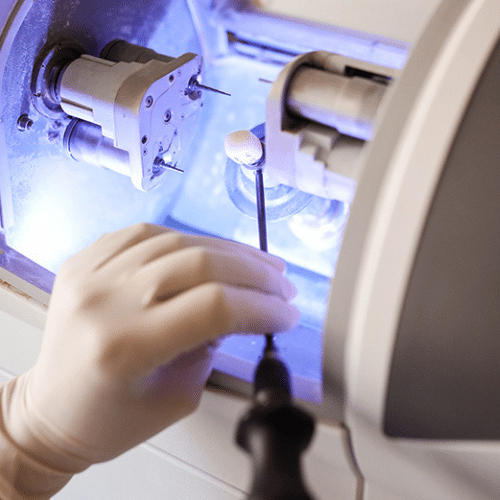
The emphasis in this approach is on biocompatible materials such as porcelain. CEREC restorations are a common way to replace old silver fillings with porcelain.
Here is where the internet is not careful, and where this page will be. Australian and international authorities, including the ADA and the World Health Organization, regard amalgam that is in place and functioning as safe for the general population. Removing sound, intact amalgam fillings in order to improve general health is not supported by current evidence.
That does not make replacement wrong. There are good reasons to replace an amalgam:
- it has fractured, leaked, or decay has developed beneath it
- the tooth around it has cracked
- you want a tooth-coloured restoration
- you have a diagnosed allergy to a component
Those are the reasons. Replacement is also not a neutral act — removing an old filling means removing more sound tooth structure with it, and the tooth ends up slightly weaker each time. How long do dental fillings last? sets out the replacement cycle a tooth enters once it is first restored, and why do I need a filling? covers the threshold for the first one. If any practice tells you that taking out healthy amalgams will resolve a systemic illness, that is a claim the evidence does not support, and it is worth walking away from — dental myths exposed deals with several relatives of that claim.
On material choice generally, the useful comparisons are porcelain, amalgam or composite resin and porcelain fillings versus composite fillings, with the costs involved.
Smile Solutions places no new amalgam fillings, and all restorative materials come through the in-house laboratory using TGA-approved products. What is placed on the day, and in what circumstances, is covered under tooth fillings.
What are the advantages of CEREC over a conventional filling?
Three things: strength, appearance, and conservation of healthy tooth structure. And they can be done in one visit.
That last point matters more than convenience. A conventional laboratory restoration means two appointments, two rounds of anaesthetic, and a temporary in between. CEREC removes all of it. The same single-visit logic, applied to front teeth, is argued in the case for same-day porcelain veneers versus temporary veneers worn for 2–3 weeks.
The trade-offs, stated plainly:
- Preparing the tooth is irreversible. Once a tooth is prepared for a ceramic restoration it will always need a restoration of some kind.
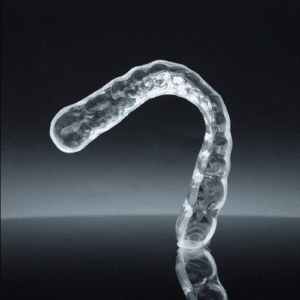
- Ceramic can chip or fracture, particularly in people who grind, and it can debond. If you clench or grind, that needs managing before the restoration goes in, not after — see TMD and teeth grinding.
- A laboratory technician can achieve more individual colour and character in a front tooth than a chairside mill can, which is why some aesthetic cases are still sent to the lab.
- Nothing is permanent. Published studies of chairside CAD/CAM restorations report survival in the order of 90 per cent or more at ten to fifteen years. Those are population figures, not a warranty on your tooth.
CEREC Restorations covers the six-step process and the full risk list, and everything you need to know about the CEREC technology goes further into how the scan and mill actually work. Where a full crown rather than an inlay is the answer, see what types of dental crowns are available and how much a dental crown costs in Melbourne, by material.
Is it genuinely better than a conventional filling?
In Dr Coulthard’s assessment, CEREC is a substantial step up from conventional tooth-coloured fillings — particularly for larger restorations, where composite resin has a shorter working life.
That is a clinical judgement about larger restorations, and it should be read as one. For a small cavity, composite resin remains entirely appropriate, costs less, and removes less tooth. Bigger is not automatically better, and the case for porcelain strengthens as the restoration gets larger. Earlier still, some lesions do not need a filling at all — can you reverse tooth decay? explains where that line sits. Indicative fees for each option are in the price guide.
How does laser dentistry work?
In some cases a laser can be used to reduce discomfort and trauma to the tooth, and to conserve enamel.
The laser energy is capable of removing decay with less trauma to the enamel than a drill, and lasers are also used in gum surgery and aesthetic gum lifts.
What it does not do is replace conventional technique. Lasers are not suitable for every cavity, which lesions are suitable is a clinical judgement made after examination, and deeper cavities close to the nerve generally still need local anaesthetic. Many patients feel little or nothing; some still want an injection, and asking for one partway through is completely reasonable.
A practical note: everyone in the room wears protective eyewear, because laser light can damage the retina. That is not a formality. The main hazard of laser dentistry is incorrect settings in inexperienced hands — heat, coolant and exposure time are all operator-controlled, and the equipment does not protect the patient from poor technique. Laser Dentistry, and for the fuller account, what is laser dentistry? and a periodontist’s view of where laser is and is not worth using.
How are the x-rays different?
We use computerised digital x-rays.
- They reduce radiation substantially compared with conventional film — reductions of up to around 90 per cent are widely reported for digital sensors, depending on the system and the view taken
- The images are clearer and faster to read
- They use no developing chemicals, since the image is produced on the computer
For patients who worry about cumulative exposure, some perspective is more useful than a percentage. The dose from a set of routine dental bitewings is very small — comparable to a small fraction of the natural background radiation everyone in Australia receives each year simply from soil, air, food and cosmic rays. It is not zero, which is why the rule that actually protects you is not the equipment but the indication: radiographs are taken when there is a clinical reason to take them, not routinely, and not to a schedule. How safe are dental x-rays? gives the dose comparisons, and when do they become unsafe? covers the circumstances in which the answer changes. The rest of the imaging and scanning equipment is described on the technology page.
If you are pregnant, say so before any radiograph. Dental x-rays are considered low-risk in pregnancy and are taken when needed, with appropriate shielding — but the conversation should happen first. See is it safe to visit the dentist during pregnancy? and dental check-ups when pregnant.
What the mouth does and does not tell you about the rest of you
This is the part of holistic dentistry with real substance behind it, and it needs stating carefully.
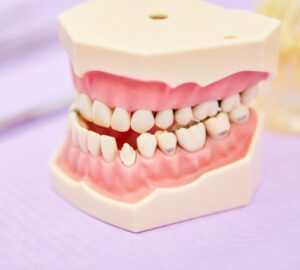
Research has established associations between periodontal (gum) disease and several serious conditions — cardiovascular disease, diabetes, pregnancy complications, and respiratory illness. The diabetes relationship has the strongest evidence and runs in both directions: poorly controlled diabetes makes gum disease worse, and untreated gum disease makes blood glucose harder to control — set out in full in diabetes and dental health: the two-way street and diabetes and oral health.
Association is not causation. Treating your gums is worth doing because gum disease causes tooth loss, and because the diabetes link is real and bidirectional. It is not a treatment for heart disease, and dental care is not a treatment for systemic illness. A practice that tells you otherwise has moved beyond the evidence. For the careful version of the same argument, see health problems linked to poor oral hygiene, dental health and general wellbeing and the practice’s wellness and longevity framing, with the three-tier version in the three layers of dental wellness and longevity.
One genuinely holistic thing your dentist does at every check-up, and rarely mentions: a soft-tissue examination for early signs of oral cancer. That one is screening, not philosophy.
The practice environment
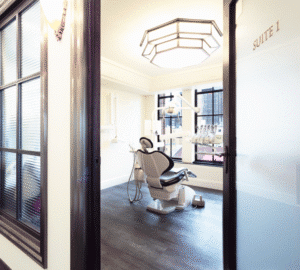
Smile Solutions occupies the heritage-listed Manchester Unity Building — see how to find us.
The treatment rooms are called suites rather than clinics, which reflects how they are set up — closer to a natural environment than a clinical one. The reception area is large and welcoming, with natural light, a coral aquarium, music and essential oils used deliberately to neutralise the odours most people associate with a dental practice.
For anyone whose avoidance of dentistry is about the environment rather than the treatment, that is not decoration; it is the point. Dental Anxiety, and how to ease anxiety about visiting the dentist.
Patients of all ages are seen, adults and children, so a family’s dental needs are handled under one roof — see children’s dentistry and is it important to have a family dentist?.
Common questions
Is avoiding fluoride part of a holistic approach?
It is a common claim, and the Australian authority does not support it. NHMRC describes community water fluoridation as “a safe, effective and ethical way to help reduce tooth decay”, supports fluoridation within the range 0.6 to 1.1 milligrams per litre, and found that it reduces tooth decay “by 26 to 44% in children and adolescents, and by about 27% in adults”. It also found “no reliable evidence that water fluoridation at current Australian levels causes health problems”. Dental fluorosis is real, but NHMRC attributes it to high intake from multiple sources while teeth are still forming inside the jaw — roughly birth to six or eight — which is what lower-strength children’s toothpaste and supervised quantities are for.
How much radiation is in a dental x-ray, in units I can compare?
Very little, and the International Atomic Energy Agency publishes the figures. Typical effective doses are 1–8 microsieverts for an intraoral dental image, 4–30 for a panoramic, and 2–3 for a cephalometric view. In the IAEA’s own comparison, intraoral and cephalometric doses are “usually less than one day of natural background radiation”, while panoramic doses are more variable but “even at the high end of the range are equivalent to a few days of natural background radiation which is similar to that of a chest radiograph”. For scale, one national analysis found dental procedures made up 39% of all X-ray examinations but contributed 0.3% of the total collective effective dose.
Is a cone-beam CT the same as an ordinary dental x-ray?
No, and this is the one worth asking about. The IAEA gives median effective doses for cone-beam CT as “50 μSv or below for small- or medium-sized scanning volumes, and 100 μSv for large volumes”, and notes that CBCT “may be tens or even hundreds of µSv of effective dose higher than conventional radiographic techniques, depending upon the technique” — so a large-volume scan can sit an order of magnitude above an intraoral image. It also cautions that equipment is improving quickly, so published ranges are likely to change. The practical point: a CBCT should answer a specific question, and it is fair to ask what it will show that a smaller radiograph would not.
Are children’s x-rays judged differently?
Yes, and the recommendations changed. Children are more vulnerable to radiation because of a higher cell division rate, a higher proportion of water in their tissues, the close proximity of radiation-sensitive organs such as the lens and the thyroid, and a longer expected lifetime after exposure. Routine X-ray screening of children is no longer recommended: the European Association of Paediatric Dentistry calls for “an individualized and patient-specific justification” as best clinical practice, and the American Academy of Pediatric Dentistry states that the timing of a radiographic examination “should not be based upon the patient’s age, but upon each child’s individual circumstances”. So “it is time for x-rays” is not, by itself, a reason.
Does treating gum disease genuinely help a general health condition?
For diabetes, there is a measured effect, and it is modest. A review of the two conditions reports that “treatment of periodontitis is associated with HbA1c reductions of approximately 0.4%”, while adding that “large, multi-centre, randomised controlled trials are needed to further validate these findings”. The relationship runs both ways: susceptibility to periodontitis is “increased by approximately threefold in people with diabetes”, and among people with diabetes, those with severe periodontitis have a risk of cardiorenal mortality three times higher than those without it. The review’s own conclusion is the right calibration: “oral and periodontal health should be promoted as integral components of diabetes management.”
Related reading
- What is holistic dentistry?
- How safe are dental x-rays?
- Fluoridated water: is it good for you? and the counter-view, fluoridated water: why I worry
- Selecting a toothpaste — fluoride or non-fluoride?
- Can oil pulling make my mouth healthier?
- How good oral hygiene can increase your lifespan
- Dental myths exposed
- General dentistry and our team
Practical details
Written by Dr Yasmin Coulthard (DEN0001023302), Registered Dentist, General Registration, at Smile Solutions.
Smile Solutions, Level 1, 220 Collins Street, Manchester Unity Building, Melbourne VIC 3000. Phone 13 13 96, or theteam@smilesolutions.com.au; full details on the contact page. Monday–Friday 8.00am–6.00pm, Saturday 8.30am–1.30pm, Sunday by appointment.
Related: Holistic Dentistry, CEREC Restorations, Laser Dentistry, Tooth Fillings, Our Technology.
Registration for any practitioner can be verified free on the AHPRA public register at ahpra.gov.au.
Published 19 June 2014. General information only — it is not a diagnosis, a treatment plan, a quote or a promise of any particular clinical outcome, and it does not replace advice from your treating practitioner. Dental treatment is not a treatment for systemic disease, and where this page describes links between oral and general health it is describing associations reported in research. Results and durability vary between individuals. Fees are indicative and subject to change; confirm at your consultation.
Smile Solutions trades under ABN 28 193 514 103.
Images on This Page
-
https://www.facebook.com/tr?id=800557773428361&ev=PageView&noscript=1
(no alt text)
-
https://www.smilesolutions.com.au/wp-content/uploads/2025/10/calendar_month.svg
(no alt text)
-
https://www.smilesolutions.com.au/wp-content/themes/arcadian-wordpress-theme/assets/images/smile_solutions_logo_white.png
Smile Solutions Logo
-
https://www.smilesolutions.com.au/wp-content/themes/arcadian-wordpress-theme/assets/images/smile_solutions_logo_purple.png
Smile Solutions Logo
-
https://www.smilesolutions.com.au/wp-content/uploads/2016/05/Yasmin-150x150.jpg
Dr Yasmin Coulthard
-
https://www.smilesolutions.com.au/wp-content/uploads/2025/09/CEREC-restorations-Smile-Solutions.png
CEREC Restoration Smile Solutions
-
https://www.smilesolutions.com.au/wp-content/uploads/2018/11/malocclusion-300x270.jpg
malocclusion
-
https://www.smilesolutions.com.au/wp-content/uploads/2025/11/Speciality-Splints-300x300.png
Speciality Splints
-
https://www.smilesolutions.com.au/wp-content/uploads/2025/09/Smile-Solutions-Level-10-300x270.png
Smile Solutions Level 10
-
https://www.smilesolutions.com.au/wp-content/themes/arcadian-wordpress-theme/assets/images/family_owned_bussiness.png
Family Owned Business
-
https://www.smilesolutions.com.au/wp-content/themes/arcadian-wordpress-theme/assets/icons/icon--phone.svg
Smile Solutions Contact
-
https://www.facebook.com/tr? id=800557773428361&ev=PageView&noscript=1
(no alt text)