What are dental veneers?
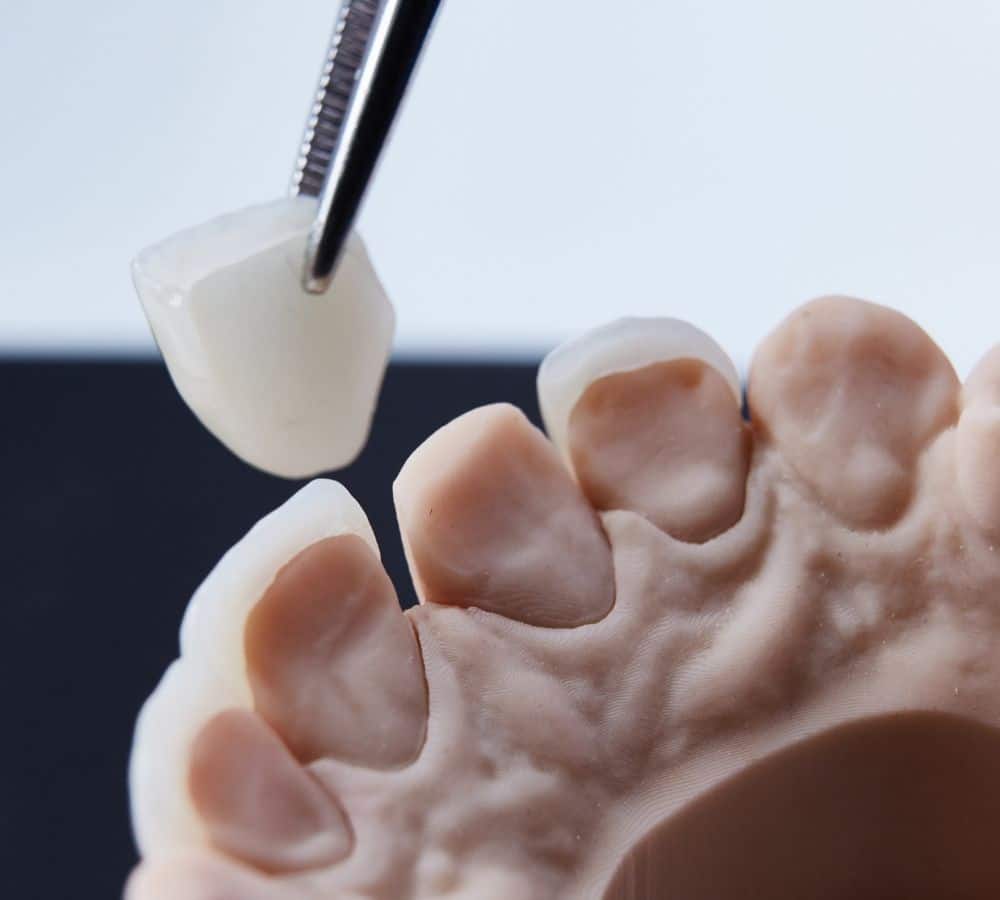
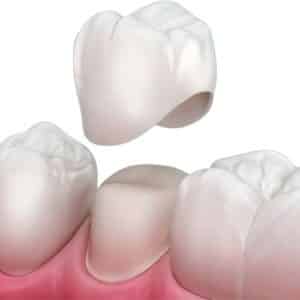
Thin, hollow shells of porcelain or composite placed over your natural teeth for two reasons: to enhance the appearance of your smile, and to protect the underlying tooth.
The two types
Porcelain veneers
Made in a dental laboratory by a technician. They can very closely resemble the lustre and translucency of a natural tooth, and are usually strong and hard wearing.
They cost more than composite.
Porcelain does not stain. That is a genuine advantage over composite — and also a complication, because the natural teeth around them continue to change colour over the years while the veneers do not.
Composite veneers
Built up in layers of tooth-coloured filling material while you are in the chair. This means they can be done in a single visit, which reduces the cost.
The trade-off: composite does not tend to look quite as good — a subjective judgement — or last as long as porcelain. What is the difference between composite veneers and porcelain veneers? compares the two properly, and composite bonding: will it look natural and how long will it last? answers the question most people ask next.
Composite has one real advantage that is rarely mentioned: it is repairable. A chip can usually be added to in a single appointment. Porcelain cannot be repaired the same way, so damage generally means remaking the veneer. And composite often requires little or no tooth preparation, which makes it the more conservative starting point.
Porcelain Veneers & Crowns · Composite Bonding · Edge Work Composite Bonding
The part to think carefully about
Between 3% and 30% of the natural tooth surface is sacrificed in preparation to accept a veneer.
The veneer is a shell that sits over the tooth, taking up space, and it needs to adhere firmly — both of which require preparation.
For this reason, dentists and patients alike need to think carefully about whether the treatment is appropriate. Tooth structure removed does not come back, and once veneered, a tooth generally stays veneered for life.
What that range actually depends on
The difference between 3% and 30% is not a matter of technique preference. It is determined by what is being corrected.
- Adding length to a short tooth, or filling a small gap, may need almost no reduction — the veneer is adding volume rather than replacing it.
- Masking a dark tooth requires a thicker, more opaque veneer, and therefore more room.
- “Straightening” a tooth that sits forward of the arch means cutting it back to where the new front surface needs to be. This is where the largest reductions happen — and it is precisely the situation where orthodontics first would cost no tooth at all.
Ask for the number in your case, per tooth. A good clinician can answer it.
Why bonding to enamel matters
There is a technical reason to keep the preparation minimal, beyond preserving tooth. Veneers bond far more reliably to enamel than to the dentine underneath it. A preparation that cuts through enamel into dentine — which happens more readily on a thin or already-worn tooth — produces a weaker bond and a higher chance of the veneer debonding or leaking at the margin over time.
“No-prep” and “minimal-prep” veneers exist and are genuinely conservative where the case suits them. They do not suit every case: on a tooth that is already the right size and position, adding a shell without reduction makes the tooth bulkier, which can look thick and can irritate the gum. It is an option to ask about, not a universally better product.
Will I get cavities?
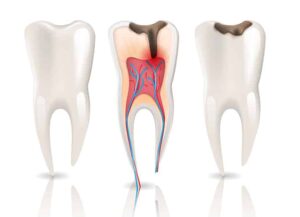
The porcelain or composite cannot decay. The tooth underneath certainly can.
Decay — dental caries — is caused by bacteria producing acid that wears through the tooth, creating holes. How does tooth decay develop? sets out that process step by step.
Where the tooth remains vulnerable:
- at the back, which is not covered by the veneer
- sometimes at the sides
- at the margin, where the tooth meets the veneer
So veneers offer some protection to the surfaces they cover, but they are by no means a silver bullet against cavities.
The margin is the point of interest. It is a junction between two materials, usually sitting at or just under the gum, and it is where plaque accumulates and where decay under a veneer typically starts. It is also hard to see and hard to clean, which is why flossing is more important after veneers, not less — see is flossing really that important?.
What actually protects you
Routine flossing and brushing, combined with a scale and clean with your hygienist. That has not changed.
Three reasons decay rates are lower with veneers
1. Case selection. Veneers are generally not recommended for patients at high decay risk, or with active decay or untreated gum disease — those are treated first. So if your dentist or specialist prosthodontist recommends veneers, you are likely to be a lower-caries-risk patient already.
2. The material itself does not decay. Porcelain is inert. That protects the surface it covers; it does not protect the tooth around it, and it is not a substitute for fluoride toothpaste and daily cleaning.
3. Position. Veneers are at the front of the mouth, which makes them easier to clean and easier to self-check.
None of that makes a veneered tooth safer than a healthy natural one. The comparison that matters is not “veneer versus decay” but “veneer versus leaving the tooth alone” — and on that comparison, a veneered tooth has a margin that an untouched tooth does not.
If decay does occur
In a relatively new veneer, the decay is easy to fill with tooth-coloured bonding.
In older veneers, it is generally best to replace the veneer — which is one of the ongoing costs worth factoring in at the outset.
The other ways veneers fail
Decay is not the most common problem. Worth knowing in advance, because none of these means the work was poor:
- Chipping or fracture, particularly in people who grind or clench, and on edges that take heavy biting force
- Debonding — the veneer comes off, usually intact, and can often be re-bonded
- Marginal staining where composite meets tooth, or a visible line as gums recede over the years
- Loss of the nerve, occasionally, in a tooth that was heavily prepared — requiring root canal treatment through the veneer
- Colour mismatch developing over time, as natural teeth darken and the veneers do not
- Gum inflammation where a margin sits too deep or the contour is too bulky
If you grind, a night splint is not optional. It is the single most useful thing protecting the work. TMD & Teeth Grinding
Lifespan figures published anywhere are population averages from studies, not predictions for your teeth — how long do porcelain veneers last? explains what those averages are built from. What determines it: how much sound enamel remained, your bite, whether you grind, gum health, home care, and whether you attend for review.
Is a veneer even the right treatment?
Often something else fits the goal better:
- Straighter teeth — achievable with orthodontics, such as Invisalign, without removing tooth structure Invisalign® No Braces
- Whiter teeth — possible with in-chair whitening or take-home trays and gel Professional Teeth Whitening
- Minor chips and small gaps — often correctable with composite bonding, with little or no preparation
- Severely damaged teeth — may be better suited to build-ups with crowns, or a dental bridge, rather than veneers Dental Crowns · Dental Bridges · what is the difference between porcelain crowns and veneers?
Order matters. Whiten first if colour is part of the goal — veneers cannot be whitened afterwards, and the shade is fixed when they are made. Orthodontics before veneers where teeth are crooked, because moving a tooth costs no tooth structure and cutting one down to fake the position costs a great deal.
The best course of action is a consultation where your goals are understood and all the options are laid out with their respective pros and cons.
Questions worth asking before you agree
- How much enamel comes off each tooth, in my case?
- Would orthodontics or whitening get me most of the way there first?
- Can I see a mock-up or trial smile in my own mouth before anything irreversible? Mock-up Reveal
- How many teeth actually need doing — and why that many?
- Who makes them, and where? In-House Laboratory
- What happens if one chips or comes off?
- What will maintenance and eventual replacement cost over twenty years?
- Do I have any decay, gum disease or grinding to deal with first?
Looking after them
- Brush twice daily and clean between the teeth every day, particularly at the margins
- Spit rather than rinsing after brushing, so fluoride stays on the exposed tooth surfaces
- Avoid highly abrasive whitening and charcoal toothpastes, which dull composite and can scratch polished surfaces — home whitening and charcoal whitening: does it work, is it safe?
- Do not bite fingernails, pens, ice or packaging with veneered front teeth
- Wear a night splint if you grind, and a sports mouthguard if you play Sports Mouthguards
- Keep your hygiene appointments, and ask for the margins to be checked at each one
Common questions
So how likely is decay under a veneer, in actual numbers?
Lower than most people fear, and later than they expect.
A systematic review of 25 studies covering 6,500 porcelain laminate veneers, with a minimum follow-up of three years, calculated 10-year cumulative survival separately for each cause of failure. Taking secondary caries in isolation, the 10-year cumulative survival rate was 99.3% (from 3,400 veneers). Decay was reported in only eight cases across five studies. A separate systematic review puts the pooled figure for secondary caries at 1% (95% CI 0% to 3%).
For context, when all four failure causes were counted together — fracture, debonding, secondary caries and the need for root canal treatment — the same review found a 10-year cumulative survival of 95.5%, with 433 of 6,500 veneers failing. Fracture was the most common complication, then debonding. So decay is real but it is the least common of the four things that go wrong.
The timing is the part worth acting on. The review found that failures from fracture and debonding mostly happened within two years of cementation, whereas failures due to secondary caries happened after five years, and those requiring root canal treatment between three and seven years. Decay under a veneer is a late problem, which means it surfaces at exactly the point people have stopped thinking about the work and may have let reviews lapse.
One mechanism the review names directly, and it connects to the preparation section above: “when all the margins of the preparation lie on enamel the risk is lower, due to the superior bond of the adhesive in relation to dentin.” Where the margin sits is therefore not just a bonding question — it is a decay question.
These are study populations, not predictions for any individual. But they do settle the shape of the answer: the veneer itself is not the decay risk; the margin, the years after year five, and your own caries risk are.
I already have fillings or bonding on my front teeth. Does that change the odds?
Yes, and this is the single most under-discussed item on the page.
A systematic review and meta-analysis of ceramic veneers bonded to different substrates reported survival and success separately, where success means the veneer needed no clinical intervention at all:
| Bonded to | Survival | Success (no intervention needed) |
|---|---|---|
| Enamel | 99% (98–100%) | 99% (98–100%) |
| Minimal dentin exposure | 95% (91–100%) | 95% (90–99%) |
| An existing composite filling | 94% (91–97%) | 70% (60–80%) |
| Severe dentin exposure | 91% (84–98%) | 74% (64–85%) |
Look at the composite row. Survival of 94% sounds fine — most stayed in place. But the success rate of 70% means roughly three in ten needed some clinical intervention. That is the lowest success figure in the review, and it describes exactly the patient who has had a chipped front tooth bonded at some point in the past.
A second review found the same direction independently, reporting that after 18 months of follow-up, veneers crossing existing composite restorations showed more failures than veneers cemented on intact teeth.
Two caveats, stated plainly. The substrate review included only six clinical studies from 973 screened, and of its four pooled comparisons only one reached statistical significance. So this is a consistent signal rather than settled proof.
What to do with it: tell the clinician about every existing restoration on the teeth being considered, and ask specifically whether the preparation will sit on old composite, and whether removing and replacing that composite first is part of the plan. It changes the quote, and it changes what you should expect afterwards.
I grind my teeth. Should I be having veneers at all?
It is a genuine contraindication in the Australian consumer guidance, and a measured risk factor in the research — and there is a twist in how the survival figures are produced that is worth knowing.
Healthdirect, the Australian Government-funded health information service, states plainly: “Veneers may not be suitable if you grind or clench your teeth or if you have gum disease.”
The systematic review of 6,500 veneers examined this. Of the fourteen publications that reported on grinding, one conducted a specific analysis in a cohort where half the patients self-reported or were diagnosed as grinders, and “statistical analysis revealed a significantly higher failure rate for PLV restorations in patients who were bruxers.” The review's summary is that “bruxism may be a risk factor for fractures of ceramics.”
Here is the twist. Of those fourteen studies, four excluded grinders from their cohorts altogether. So a portion of the headline survival evidence describes a population from which people like you were deliberately removed. That does not make the figures wrong — it makes them not straightforwardly yours.
None of this is an automatic no. It means the grinding gets assessed and managed as part of the plan rather than mentioned afterwards: what is causing it, whether the bite needs attention first, and a splint made and worn from the night the veneers go in rather than after the first chip. See TMD & Teeth Grinding and how can I stop grinding my teeth when I sleep?. If you are told grinding does not matter, ask why.
Different sources say different amounts of tooth get removed. Who is right?
They are describing different procedures under the same word, and noticing that is genuinely useful rather than pedantic.
The Australian Dental Association's consumer site says: “Dental veneers are very thin, meaning not much or no tooth structure has to be cut away from the tooth or teeth for the treatment to be completed.” Healthdirect says “veneers are thin, so not much of your natural tooth will need to be removed,” but also lists among the risks that “your teeth could become more sensitive because some enamel is removed.” This page gives a range of 3% to 30%.
All three can be true at once, because “veneer” covers a wide span. A minimal-prep or no-prep veneer closing a small gap may be 0.3–0.5 mm of ceramic on a barely touched tooth. A veneer masking a dark tooth, or cut back to make a protruding tooth appear straight, is a very different preparation — and the research notes that “an extended [veneer] design could be associated with larger areas bonded to dentin structure,” with “high failure rates … associated to largely exposed dentin surfaces.”
There is a further wrinkle the literature is honest about: clinicians cannot always tell in the moment. One study found that distinguishing enamel from dentine during preparation “is usually determined visually,” that operators disagreed, and that magnification helped. So “we stayed in enamel” is a genuine intention rather than a measurable promise.
Which is why the question to ask is not “are veneers conservative?” — the honest answer is it depends entirely on yours — but “how many millimetres will come off each of my teeth, and will the margins be in enamel?” Ask for it tooth by tooth, and ask to see the mock-up before anything is prepared. See Mock-up Reveal.
Can they be taken off if I change my mind?
Generally not, and the government's own wording is the bluntest on this page: healthdirect states “You can't take veneers off.”
The reason is that removing a veneer does not restore the tooth to what it was — the enamel that was prepared away is gone, and a tooth prepared for a veneer needs to stay covered by something from then on. In practice the realistic options are a replacement veneer or, if too little tooth remains, a crown. That is what is meant when this page says a veneered tooth generally stays veneered for life.
Two related things you cannot change afterwards, both listed by healthdirect as risks: “the colour of your veneers can't be changed after they've been applied,” and “your other teeth may become discoloured, no longer matching your veneers.” Together those are the argument for whitening before, not after — the shade is locked at the moment the veneers are made, and the teeth around them keep ageing.
So the genuinely reversible steps belong at the front of the process, not the end. A trial smile or mock-up, whitening, and orthodontics where crowding is the real complaint are all things you can decline or undo. Preparation is not. If you are unsure, the right answer is to slow down rather than to start with one tooth and see.
The corresponding reassurance, from healthdirect again: “veneers should last for years” with good care — that is the strongest longevity statement the Australian government service makes, and it deliberately puts no number on it.
Related reading
Porcelain Veneers & Crowns · Same Day Porcelain Veneers™ · Composite Bonding · Professional Teeth Whitening · Dental Crowns · Is it time for a smile makeover? · Turkey teeth: the real risks of getting veneers overseas · Specialist Prosthodontists · Before & After Gallery · Price Guide
Practical details
Smile Solutions, Level 1, 220 Collins Street, Manchester Unity Building, Melbourne VIC 3000. Phone 13 13 96, or theteam@smilesolutions.com.au. Monday–Friday 8.00am–6.00pm, Saturday 8.30am–1.30pm, Sunday by appointment.
We have registered specialist prosthodontists on site and an in-house dental laboratory. “Specialist prosthodontist” is a protected title in Australia, held only by practitioners on the Dental Board's specialist register; registration can be verified free on the AHPRA public register at ahpra.gov.au.
Published 3 December 2018.
General information only — it is not a diagnosis, a treatment plan, a quote or a promise of any particular clinical outcome, and it does not replace advice from your treating practitioner. Results and durability vary between individuals, and no lifespan can be guaranteed. Preparing a tooth for a veneer is irreversible — the tooth will require a restoration for the rest of its life. Veneers carry risks including sensitivity, chipping, debonding, marginal staining, gum irritation, decay at the margin, and occasional loss of the nerve requiring root canal treatment. Veneers do not prevent tooth decay, and nothing here should be read as a claim that they do. Whether veneers are appropriate for you can only be determined after examination. Fees are indicative and subject to change; confirm at your consultation. Survival, success and complication figures in the questions above are from published systematic reviews and describe those study populations, not this practice's results; quoted consumer statements are from healthdirect Australia (last reviewed February 2025) and the Australian Dental Association's consumer site.
Smile Solutions trades under ABN 28 193 514 103.
Images on This Page
-
https://www.facebook.com/tr?id=800557773428361&ev=PageView&noscript=1
(no alt text)
-
https://www.smilesolutions.com.au/wp-content/uploads/2025/10/calendar_month.svg
(no alt text)
-
https://www.smilesolutions.com.au/wp-content/themes/arcadian-wordpress-theme/assets/images/smile_solutions_logo_white.png
Smile Solutions Logo
-
https://www.smilesolutions.com.au/wp-content/themes/arcadian-wordpress-theme/assets/images/smile_solutions_logo_purple.png
Smile Solutions Logo
-
https://www.smilesolutions.com.au/wp-content/uploads/2023/11/SS-Tooth-1-1-150x150.png
Smile Solutions
-
https://www.smilesolutions.com.au/wp-content/uploads/2018/12/Veneers-Cavities.jpg
Veneers Cavities
-
https://www.smilesolutions.com.au/wp-content/uploads/2025/09/Root-Canal-2-300x217.jpg
Root Canal
-
https://www.smilesolutions.com.au/wp-content/uploads/2026/08/Mouth-Breathing-300x270.jpg
Mouth Breathing
-
https://www.smilesolutions.com.au/wp-content/uploads/2025/09/Dental-Crown-at-Smile-Solutions-300x300.jpg
Dental Crown at Smile Solutions
-
https://www.smilesolutions.com.au/wp-content/themes/arcadian-wordpress-theme/assets/images/family_owned_bussiness.png
Family Owned Business
-
https://www.smilesolutions.com.au/wp-content/themes/arcadian-wordpress-theme/assets/icons/icon--phone.svg
Smile Solutions Contact
-
https://www.facebook.com/tr? id=800557773428361&ev=PageView&noscript=1
(no alt text)
-
https://bat.bing.com/action/0?ti=25148060&tm=gtm002&Ver=2&mid=ff04519d-c66b-491b-a3d7-520d37ab70e7&bo=1&sid=ecec42b0ab2511f1978f55da1af1aa76&vid=ecec7610ab2511f18ed51b222825ec32&vids=1&msclkid=N&pi=918639831&lg=en-US&sw=800&sh=600&sc=24&nwd=1&tl=What%20happens%20to%20my%20teeth%20after%20dental%20veneers,%20and%20will%20I%20ever%20get%20cavities%3F%20-%20Smile%20Solutions&p=https%3A%2F%2Fwww.smilesolutions.com.au%2Fdental-articles%2Farticle%2Fdental-veneers-cavities%2F&r=<=1322&evt=pageLoad&sv=2&cdb=AQAQ&rn=202633
(no alt text)