Dental tourism: what risks are involved?
Complex dental treatment can come at a high cost. Some Australians consider having it done overseas, getting a holiday out of it at the same time.
But why is dental treatment significantly cheaper in the developing world? That question is worth answering before booking, because the answer is usually not efficiency.
You may know someone whose overseas dental work went well. The risks below are real regardless.
A companion article, Overseas dental work could cost you more in the long term, covers the follow-up problem specifically — why trouble tends to surface six to twelve months after you are home. The pitfalls of dental tourism and the risks of having dental treatment overseas approach the same question from other angles, and Turkey teeth describes what walks back through the door afterwards.
First, the part that is our problem, not yours
It is worth saying plainly before listing risks: the gap in price is partly a failure at this end.
Australia has no national dental fee schedule. A 2017 consumer submission to the Senate inquiry into the value and affordability of private health insurance argued that its absence “may also have contributed to the comparatively high cost of dental care in Australia”, and that it “may also have contributed to the growth of dental tourism (Australian patients risking cheaper overseas dental treatment)”. The same submission cited an Australian Institute of Health and Welfare survey in which nearly a third of people aged 5 or older (32%) avoided or delayed visiting a dentist due to cost.
That is a real and reasonable grievance. It does not make any of what follows less true — it explains why so many people are willing to weigh it up.
1. Something might go wrong — very wrong
Things can go wrong in the dental chair anywhere.
If you are overseas when a dental or medical emergency occurs, you may not have:
- expert emergency care
- support from family and friends
- the ability to communicate with healthcare professionals in your own language
Australian dentists are trained to manage dental emergencies, in a system where you can be transferred to a hospital that will have your history. See Emergency Dentistry and What is considered a dental emergency?.
2. The materials may be cheap, damaged or faulty
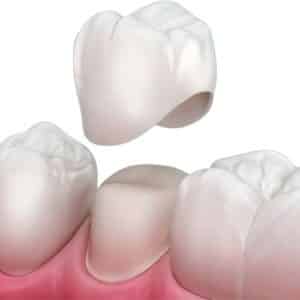
Australians seeking treatment overseas commonly have procedures requiring crowns, bridges, veneers or implants — items that stay in your mouth for years. How long porcelain veneers last and what types of crown are available are worth knowing before you compare quotes, because the cheaper quote is frequently for a different material.
The questions to sit with before you go:
- If you discover a fault after returning, who will repair it?
- Who will you complain to?
- How will you pay for the treatment to fix it?
In Australia, therapeutic goods and dental materials are regulated by the Therapeutic Goods Administration (TGA) to ensure they meet a standard suitable for the Australian public. There is no equivalent guarantee attached to materials used elsewhere — and the 2017 Senate submission noted that “the use of potentially toxic overseas sourced, rather than TGA approved, dental materials, also occurs” within Australia too, which is an argument for asking what is going in your mouth wherever you are treated. Work made in an on-site laboratory can also be traced back to the technician who made it.
With implants there is a further problem: if the system used is not one available here, the components needed to repair or replace it may simply not exist in Australia. That is the single most expensive version of this going wrong — an implant that cannot be restored without removing it, which then often means bone grafting before anything can replace it. See Conventional & Immediate Implants, Prosthodontists, who to see for dental implants and what to consider with All-on-4.
Why that matters more than it sounds
That is not a hypothetical worry, and it is not really about quality. The ITI’s review of the literature on implant-supported fixed bridges makes the point in a single line: “the implant types and components reported in the literature have been modified, and some of them are no longer available.” Systems change, and parts are discontinued — that happens to implants placed in Melbourne too. The difference is whether the person who placed yours, and the supply chain behind it, are reachable.
And something almost always needs doing eventually. Drawing on systematic reviews of implant-supported fixed partial dentures with at least five years of follow-up, the ITI reports that bridges free of any biologic or technical complication were seen in 61.3% of patients after 5 years — so roughly four patients in ten had something happen within five years, in studies, in good hands. Specifically: peri-implantitis and soft tissue complications in 8.6% of patients at 5 years; connection-related complications such as screw loosening or fracture in 7.3% at 5 years; implant fracture in 0.4% at 5 years and 1.8% at 10 years.
Screw loosening is the ordinary one, and it is the one that makes the point. It is a small, cheap problem if someone can identify the system, has the matching driver and can order the matching screw. If they cannot, a twenty-minute appointment becomes a much larger conversation. Ask which implant system will be used, in writing, before you go — brand, line and diameter — and check with an Australian dentist whether its components are available here.
None of those figures are an argument against implants. Survival of the implants themselves in the same reviews was 95.4% at 5 years and 92.8% at 10 years. They are an argument about aftercare, which is precisely what distance removes.
3. Is the dentist qualified to perform the treatment?
Do you know that the dentist treating you overseas is appropriately trained and qualified for the treatment they have promised?
Some countries accept a standard of education and training that would be considered sub-standard here, and the result of the treatment often reflects that.
In Australia, dentists and dental specialists:
- undergo extensive university training
- are registered to practise under the Australian Health Practitioner Regulation Agency (AHPRA)
- must complete mandatory continuing professional development
You can check any Australian practitioner’s registration and specialist status on the AHPRA register in under a minute. There is usually no comparable public register to check overseas. See Specialist Care and Dentists and Registered Specialists for what specialist registration requires here, why you might need a specialist at all, and Our Team for this practice’s registrations. Finding a dentist online in Australia covers how to check any of it yourself.
What the Australian standard actually consists of
Being specific about this is more useful than the word “qualified”.
The Dental Board of Australia recognises 13 dental specialties, approved by the Australian Health Workforce Ministerial Council: dento-maxillofacial radiology, endodontics, forensic odontology, oral and maxillofacial surgery, oral medicine, oral and maxillofacial pathology, oral surgery, orthodontics, paediatric dentistry, periodontics, prosthodontics, public health dentistry (community dentistry), and special needs dentistry. If a title you are offered is not on that list, it is not a specialty here, whatever it is called where you are going.
Every applicant for specialist registration must hold a Board-approved qualification in the specialty, must have completed a minimum of two years of general dental practice, and must meet all the requirements for general registration as a dentist. AHPRA publishes an online register of all dental practitioners which includes the specialty or specialties held by anyone with specialist registration.
And the system is not closed to overseas training, which is the fair way to put this. The Board’s own standard records that the two years of general practice “may be achieved by experience outside Australia, subject to assessment and approval by the Board”. The Board, in partnership with the Dental Council (New Zealand), has developed “Entry-level competencies for dental specialties”, one purpose of which is “to assist the Board in the assessment of overseas applications for specialist registration”.
So the objection is not that foreign training is worse by definition. It is that in Australia somebody independent has already done the assessing, and published the result where you can read it — and that when you are treated overseas, nobody has done that on your behalf.
Specialist registration is also not transferable between countries — a title that means one thing here can mean something quite different elsewhere, even where the word is identical.
4. Infection and spread of disease
Infection and the spread of disease in hospitals and dental practices in some other countries is a very real concern.
In Australia, dental practices follow strict infection control protocols set by the Australian Dental Association, the National Health and Medical Research Council, and the Dental Board of Australia.
5. The marketing is playing by different rules
This one is easy to miss because it looks like ordinary advertising.
Under the National Law, testimonials cannot be used to advertise a regulated health service in Australia — not by a practitioner, and not by a business providing one. AHPRA states plainly that “the public is entitled to accurate and honest information about healthcare services”, and that the risk of harm from testimonials is greatest where advertising “creates an unreasonable expectation of beneficial treatment”. Its published reasons for the prohibition are worth reading against any clinic’s website:
- testimonials “are often personal opinions and may have no objective basis for recommending a registered health practitioner or health service”
- “the outcomes experienced by one patient do not necessarily reflect the outcome, or likely outcome available to all patients”
- they can be misleading because they are “not usually a balanced source of information” — a selection of positive comments that “do not tell the whole story”
- “the public may not have expert knowledge to assess if the information is accurate”
AHPRA also warns that selectively editing reviews or testimonials may itself break the law.
Now look at how overseas dental packages are typically sold to Australians: before-and-after galleries, patient stories, influencer trips, five-star review counts. None of that is permitted to promote a dental service here. That is not a coincidence or a quirk of Australian prudishness — it is a considered judgement by a regulator about the specific ways that kind of marketing misleads people making health decisions. When you find it persuasive, notice that you are being persuaded by exactly the material our regulator concluded the public cannot reliably evaluate.
The balanced position
Whether you need a simple filling or complex work, you should be aware of the benefits and risks associated with treatment. Understanding your treatment sets out what you should be told before agreeing to anything, wherever it is done.
Before seriously considering treatment overseas, consult a local dentist to weigh up your options. A local quote broken down properly — and a conversation about payment plans, staging the work, or a less expensive but sound alternative — sometimes closes more of the gap than people expect. A second opinion on the plan itself costs very little by comparison.
Say the constraint out loud. Staging treatment over time, treating what is urgent first and reviewing the rest, and choosing the more conservative clinical option are all legitimate, and they cost nothing in fees. A practitioner who knows cost is the issue can plan around it. For what treatments actually cost here, see How much does a dental crown cost in Melbourne?, How much do dental implants cost?, what implants actually cost in Melbourne and Price Guide.
Where several clinicians are needed, having them in one building also removes a layer of risk — see Complex dental cases and Everything under one roof.
If you have already decided to go
Do your research:
- Know who will be treating you and what their qualifications are
- Know what their facilities are like
- Leave someone at home with all your treatment details in case of an emergency
- Ask which implant or material system will be used — brand, line and diameter — and whether it is available in Australia
- Allow enough time in the country for follow-up and for any complication to appear before you fly home
- Ask, before you go, whether an Australian dentist will take on the follow-up — some are reluctant to assume responsibility for work they did not plan and cannot warrant
- Bring the records home: radiographs, the treatment plan, item descriptions, and the product labels or batch details for anything implanted
It’s your money, your teeth and your health.
Common questions
Is there an official Australian position on this, or is it just what dentists here say?
There is a published professional position, and it is worth reading in its own words rather than as summarised by anyone with an interest either way.
ADA Policy Statement 2.2.6 — Elective Overseas Dental Treatment was adopted by the Australian Dental Association's Federal Council in April 2007 and has been amended five times since, most recently on 17 November 2023. Its position summary reads:
“Overseas elective dental treatment carries the risk of adverse oral and general health outcomes with long term problems which may be difficult to resolve on return to Australia. Australian residents should only seek elective dental care in Australia to ensure Australian standards are met, complications are managed promptly, and good oral health is maintained.”
The policy lists the specific reasons it gives for that position: the inability to maintain supportive maintenance dental visits; possible communication difficulties with the practitioner and staff “which may impact on informed consent”; the risk of long-term problems that are hard to resolve; possible lack of insurance cover for complications; lack of recourse; not necessarily being able to see the same dentist on a return visit; lack of access to treatment records; and the “potential to introduce new antimicrobial resistant organisms and disease transmission into Australia.”
One sentence in it is worth sitting with separately, because it is about the nature of dental care rather than about any country: “Optimal ongoing oral health cannot be achieved in a single episode or short course of treatment and requires regular maintenance.”
Be aware of what the ADA is. It is the professional association for Australian dentists, not a regulator, and it has an obvious interest in where Australians are treated. That does not make the reasons wrong — most of them are structural and checkable — but you should weigh the source as you would any other.
How often does overseas dental work actually go wrong? Is there a number?
No, and that is the honest answer rather than a dodge.
The ADA policy above is a professional position statement. It contains no quantified complication rate, no incidence figure, and no citation to any cohort or registry of Australians returning with failed overseas dental work. As at the time this page was reviewed, no Australian dataset quantifying overseas dental complication rates could be located. Nobody counts it: there is no register of Australians who have had dentistry abroad, no denominator, and therefore no rate.
Which cuts both ways, and it is worth saying so. Anyone quoting you a figure for how often overseas dental work fails is not quoting an Australian dataset, because there is not one. And anyone quoting a success rate for a particular overseas clinic is quoting that clinic.
What can be said with evidence is narrower but still useful: dental restorations and implants in general, wherever they are placed, need maintenance and repair at rates that are well documented — the figures earlier on this page are from systematic reviews. The specific risk of treatment overseas is not that the dentistry is necessarily worse on the day. It is that the ordinary, expected maintenance becomes difficult, expensive or impossible to obtain, and that when something needs adjusting nobody nearby has the records, the components or any responsibility for it.
So judge the decision on the structural questions, not on a statistic that does not exist.
If something goes wrong, will my travel insurance or my health fund pay to fix it?
Often not, and this is the item most likely to be assumed rather than checked.
The ADA policy states directly that “complications to health from elective dental treatments (i.e., treatment that can be scheduled in advance) obtained while overseas are not always covered by travel insurance and the treatments may not be covered by Australian health funds.” The key word is elective. Travel insurance is generally built around unforeseen events; treatment you flew there to have is by definition foreseen and scheduled, and policies commonly exclude it along with anything arising from it.
The policy's own remedy for this is telling. It argues that “promoters of health services in overseas countries should be required to indemnify consumers for all adverse outcomes caused by such treatment,” and adds: “This indemnity should not be time limited as adverse outcomes may not become apparent for a number of years after the provision of treatment.” That is a proposal, not the current state of affairs — which is the point. The ADA is asking for a protection that does not presently exist.
Three things to do before you commit, in writing each time:
- ask your travel insurer whether planned dental treatment, and any complication arising from it, is covered — and get the answer in writing, not over the phone
- ask your health fund whether it pays benefits on treatment provided outside Australia, and on remedial work here to correct it
- ask the overseas clinic what its warranty covers, for how long, whether it requires you to return to that clinic in person, and who pays the airfare if it does
The last one matters more than people expect. A warranty that requires you to fly back is not worth much against a loose crown.
What should I actually compare, item by item, before deciding?
The ADA policy sets out a comparison list, and it is a good one because every item on it is something you can ask about rather than feel about. It says Australian residents should “carefully consider, before having treatment overseas, whether the following are equivalent to those in Australia”:
- the practitioner's qualifications
- infection prevention and control standards, including the quality of water supplied to dental clinics
- the quality and compatibility of the materials used, treatment techniques and the potential outcome
- the ability to claim rebates from Funding Agencies
- complaint resolution mechanisms
The water one surprises people and is worth explaining. Dental units run water through the handpieces and syringes used in your mouth; the policy elsewhere notes that Australian dental practices “are supplied with safe water which is essential for satisfactory infection control.” It is not a detail — it is the supply line into the treatment.
The policy also notes the Australian protections you are stepping outside of: practitioners here must be registered by the Dental Board and comply with its standards; equipment and materials “are subject to rigid scrutiny and approval by the Therapeutic Goods Administration”; patients' rights are protected by the Board, ADA branch peer review and conciliation services, state health complaint authorities and common law; and Australian dental practitioners are required to hold professional indemnity insurance — which the policy notes “may not be the case in overseas clinics.”
Its final recommendation is the cheapest step in the whole process: “Australian residents should seek the advice of an Australian dentist before considering or embarking on overseas dental treatment.” Take the proposed overseas plan to a dentist here first and ask what they would do differently and why. See Understanding your treatment and second opinions and corrective dentistry.
I have already had work done overseas and something does not feel right. What now?
Get it looked at rather than waiting to see whether it settles, and take everything you have with you.
The practical obstacle is records. The ADA policy names it: “Ongoing and corrective treatment may be compromised, as the records and complete details of treatment obtained overseas are unlikely to be available to those providing subsequent treatment in Australia.” So whatever you do have is valuable — radiographs, the treatment plan, itemised invoices, discharge notes, and above all any product label, batch sticker or implant passport. If you can still contact the clinic, request your full records in writing now rather than when you need them; clinics close, and access does not improve with time.
What to expect at the appointment: an examination and usually new radiographs, because current images are needed regardless of what you bring. If implants are involved, identifying the system is the first job and it is not always possible from a radiograph alone. Ask for the assessment and the options in writing, including the option of doing nothing for now with a review date, which is sometimes the right answer.
One expectation to set honestly. A dentist here may decline to take over, adjust or warrant work they did not plan — the ADA policy lists the “potential challenge of finding a dental practitioner to continue with, or repair, elective treatment started overseas due to concerns including incompatible product systems, techniques not consistent with Australian standards and materials not approved by the TGA.” That is not obstruction; it is a registered practitioner declining to take clinical responsibility for something they cannot verify. Ask about it when you book, so you are not discovering it in the chair.
If you are in pain, have swelling, or have a fever, that is not a second-opinion appointment — see Emergency Dentistry and what is considered a dental emergency?
Practical details
Smile Solutions offers staged treatment plans for complex work, and payment plan options. Where a plan is advertised as interest free, that describes the plan term only — a deposit may be required, an establishment fee and ongoing account fees may apply, and charges can apply if the balance is not cleared within the agreed period. The applicable terms depend on the provider and the amount financed, and are set out in writing before you commit — ask what the deposit and the establishment fee are, in dollars. See Payment Plans and Patient payment plans.
Registration and specialist status for any Australian practitioner can be verified on the AHPRA register, or by calling 1300 419 495.
Smile Solutions, Level 1, 220 Collins Street, Manchester Unity Building, Melbourne VIC 3000. Phone 13 13 96, or theteam@smilesolutions.com.au. Monday–Friday 8.00am–6.00pm, Saturday 8.30am–1.30pm, Sunday by appointment. Full details on Contact Us, and Why Choose Us for the rest.
Published 8 October 2014. This article draws on material first published by the Australian Dental Association. Implant survival and complication figures are from systematic reviews of implant-supported fixed partial dentures summarised by the ITI Academy; they describe published study populations, not Smile Solutions results, and no particular outcome is promised. Specialty and registration requirements are the Dental Board of Australia’s and change; advertising requirements are set out by Ahpra under the National Law. Material quoted in the questions above is from ADA Policy Statement 2.2.6 — Elective Overseas Dental Treatment (document version November 2023), which is a professional position statement and not an independent regulator's finding. Standards, outcomes and individual practitioners vary considerably; this is general information and not a comment on any particular clinic. Payment plan terms are set by the credit provider and change; confirm current terms directly before you commit. General information only; it does not replace advice from your treating practitioner.
Smile Solutions trades under ABN 28 193 514 103.
Images on This Page
-
https://www.facebook.com/tr?id=800557773428361&ev=PageView&noscript=1
(no alt text)
-
https://www.smilesolutions.com.au/wp-content/uploads/2025/10/calendar_month.svg
(no alt text)
-
https://www.smilesolutions.com.au/wp-content/themes/arcadian-wordpress-theme/assets/images/smile_solutions_logo_white.png
Smile Solutions Logo
-
https://www.smilesolutions.com.au/wp-content/themes/arcadian-wordpress-theme/assets/images/smile_solutions_logo_purple.png
Smile Solutions Logo
-
https://www.smilesolutions.com.au/wp-content/uploads/2023/11/SS-Tooth-1-1-150x150.png
Smile Solutions
-
https://www.smilesolutions.com.au/wp-content/uploads/2013/04/Dental-Tourism.jpg
Dental Tourism
-
https://www.smilesolutions.com.au/wp-content/uploads/2025/09/Root-Canal-2-300x217.jpg
Root Canal
-
https://www.smilesolutions.com.au/wp-content/uploads/2026/08/Mouth-Breathing-300x270.jpg
Mouth Breathing
-
https://www.smilesolutions.com.au/wp-content/uploads/2025/09/Dental-Crown-at-Smile-Solutions-300x300.jpg
Dental Crown at Smile Solutions
-
https://www.smilesolutions.com.au/wp-content/themes/arcadian-wordpress-theme/assets/images/family_owned_bussiness.png
Family Owned Business
-
https://www.smilesolutions.com.au/wp-content/themes/arcadian-wordpress-theme/assets/icons/icon--phone.svg
Smile Solutions Contact
-
https://www.facebook.com/tr? id=800557773428361&ev=PageView&noscript=1
(no alt text)
-
https://bat.bing.com/action/0?ti=25148060&tm=gtm002&Ver=2&mid=98ca6c94-7e01-466e-8252-1b1cf00ce938&bo=1&sid=b8198380ab2711f18dc801ac34ef97a1&vid=b819bbd0ab2711f1ab3e93e0dd774488&vids=1&msclkid=N&pi=918639831&lg=en-US&sw=800&sh=600&sc=24&nwd=1&tl=Dental%20tourism%3A%20What%20risks%20are%20involved%3F%20-%20Smile%20Solutions&p=https%3A%2F%2Fwww.smilesolutions.com.au%2Fdental-articles%2Farticle%2Fdental-tourism-risks-involved%2F&r=<=2316&evt=pageLoad&sv=2&cdb=AQAQ&rn=396070
(no alt text)