What has changed in cosmetic dentistry?
The biggest change is not a material or a machine. It is that the patient now sees and approves the result before anything permanent happens. See Cosmetic Dentistry and The Mock-Up Reveal.
Advances in materials science and digital technology allow smiles to be produced predictably, enhancing both dental health and appearance. But the shift that matters most is procedural: from a clinician deciding unilaterally how a smile would look, to a planned, collaborative process with review points built in. See Technology.
One thing has not changed, and the Australian Dental Association's consumer material states it plainly: "Crown, bridge and veneer treatments are elective treatments", and "Having a crown, bridge or veneer does not mean no treatment will ever be required again for the" tooth underneath. Healthdirect puts the same point another way: "Veneers may need to be replaced due to chips, fractures or changes in colour over time." Cosmetic work is a commitment to maintenance, not an exit from it.
How it used to work
It was once standard practice for the practitioner to decide almost single-handedly how a patient's new smile would look. Teeth were prepared, and an impression was sent to a ceramics laboratory with basic instructions — perhaps accompanied by a low-resolution photograph of a celebrity's smile the patient had brought in to indicate what they wanted.
The outcome was often haphazard and unpredictable, and not necessarily in aesthetic harmony with the patient's own facial features. The problem was structural rather than a failure of skill: there was no point in the sequence at which the patient could see the proposed result and ask for it to be changed, and by the time the ceramics arrived the teeth had already been irreversibly prepared. See Porcelain Veneers and Dental Crowns.
The collaborative method
A more interactive approach, used by many clinicians for a couple of decades now, is built around a planned, predictable outcome in harmony with the patient's facial features, with the ability to fine-tune along the way. In outline:
- Consult to understand the desired result — see Complimentary Cosmetic Consultation. Confirm the current terms when you book — what the appointment includes, whether records such as scans or radiographs are part of it or charged separately, and whether any deposit applies.
- Mock up the proposed tooth length in the patient's mouth with tooth-coloured resin
- Photograph in high quality, before and after the mock-up — see Before & After Gallery
- Obtain plaster study casts of the teeth
- Produce a wax design on the study cast reflecting the planning and the patient's input — see Smile Solutions Laboratory
- Prepare the teeth using templates made from the wax design
- Place provisional restorations produced from a template modelled on the wax design — the most important step
Step 7 carries the weight. A few days after the provisionals are placed, the dentist and the patient critique them together and review the patient's real-life experience of them — how they look in ordinary light, how they feel, how speech is affected. I need a smile makeover — what's involved? walks through that stage in detail.
If changes are wanted, they are made to the provisionals, and photographic and impression records of those changes are taken. The ceramics laboratory then completes the work knowing accurately the approved tooth length and shape, smile-line angle, and other parameters. A try-in of the finished ceramic work, the patient's approval, and permanent placement complete the treatment.
The logic of that sequence is worth stating plainly: it moves every decision that can be changed to a point before anything irreversible happens, and it gives the laboratory a specification rather than an instruction to interpret. Where the case allows it to be compressed into a single day, see The case for same-day porcelain veneers — noting that the trial period is what you trade away.
Software-assisted smile design
Taking the method further is software-assisted smile design — a conceptual tool and process developed by Dr Christian Coachman, a Brazilian dentist who came to dentistry as a qualified dental ceramist, and now taught to dentists internationally.
Its aims are to:
- Enable a more accurate evaluation of a patient's existing smile
- Make it easier to design a rejuvenation of that smile
- Increase the clinician's ability to communicate the proposal to the patient and respond to their input — see How important is communication in dentistry?
- Allow the dentist and ceramist creative scope
- Ensure faithful execution of the planning
How it works
The process may be performed by the cosmetic dentist, or by a skilled dental technician in a ceramics laboratory, working in collaboration with the patient and dentist.
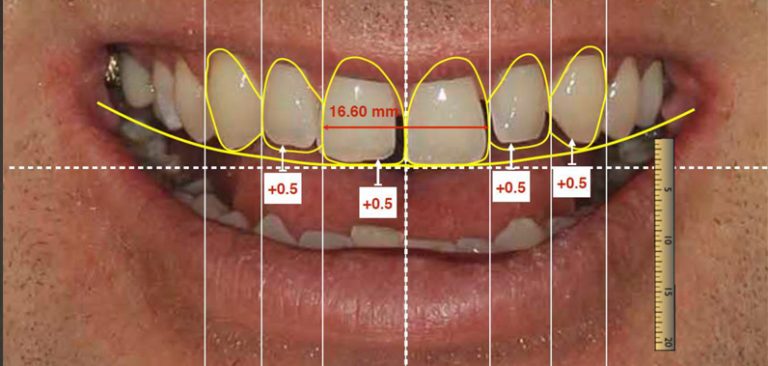
Software — presentation software such as Keynote or PowerPoint, or purpose-built packages — is used to draw lines and curves onto photographs of the smile, in order to evaluate the dental and facial midlines and the desired smile-line position. Teeth can then be resized, rearranged, rotated and reshaped, singly or as a group, and changes designed on one side can be accurately mirrored on the other.
Accurate measurements from the on-screen design are then transferred to a wax-sculpted plaster model, or a 3D-printed model, from which guide jigs and a precision template are made so the dentist can produce accurate provisional restorations. The same digital chain underlies chairside milling — see Same-Day CEREC Restorations and Everything you need to know about CEREC technology.
In appropriate cases — where the result does not depend on major changes to the existing teeth — the template can be used to produce an evaluation mock-up in the mouth, so the patient can see the proposed smile before any preparation. See The mock-up reveal: why you should see your new smile before any treatment begins.
What it does not do
Worth being clear, because digital previews can look more definitive than they are:
- A screen image is two-dimensional. It cannot show how teeth look in motion — laughing, speaking, turning the head. That is what the physical mock-up and the provisionals are for, and they remain the more important step.
- The design is a proposal, not a guarantee. What is achievable depends on the underlying teeth, the bite, the gum position and the available space — see Gummy Smile and Bleeding Gums.
- It does not reduce the irreversibility of preparation. Enamel removed for veneers or crowns does not grow back — which is precisely why a preview stage that lets you decide not to proceed is worth insisting on. And why a compressed overseas case is a poor bet: Turkey teeth: the real risks of getting veneers overseas.
How much tooth a veneer actually costs you
This is the number that decides whether cosmetic treatment is conservative or not, and it has been measured rather than estimated. A study in The Journal of Prosthetic Dentistry weighed prepared typodont teeth and found that preparations "for ceramic veneers (porcelain laminate veneers) and resin-bonded prostheses removed 3% to 30% by weight" of the coronal tooth structure, against "approximately 63% to 72%" for crowns — a metal-ceramic crown taking "about 71.9%". So a veneer is genuinely more conservative than a crown, but the top of that range is not trivial: even the most extensive veneer design in the study removed about 30%.
Preparation also reaches past enamel more often than people expect. A study in Materials measured prepared veneer surfaces and found "the mean values of exposed dentin found in the 2 different preparation designs" were "approximately 30%, with a 70% of exposed enamel", adding that "This value is above the minimally acceptable for the enamel exposure (40%) required to obtain an efficient bond strength." That is on intact teeth. Where teeth are already worn, eroded or previously restored, less enamel is available — which is one reason the same plan is not equally safe for everyone.
What the survival figures show, and why “lasts X years” is the wrong question
Marketing pages routinely give veneers a lifespan in years. No authority publishes one, and the literature explains why: the figures vary enormously between studies, so the meaningful statement is a survival percentage at a stated time point.
A 2016 systematic review by Morimoto and colleagues, tabulated in a narrative review in the Journal of Functional Biomaterials, reports an "estimated overall cumulative survival rate 89% (95% CI: 84% to 94%)", broken down as glass-ceramic "94% (95% CI: 87% to 100%)" and feldspathic porcelain "87% (95% CI: 82% to 93%)". Its failure modes are specific: "Fracture/chipping: 4% (95% CI: 3% to 6%)", "Debonding: 2% (95% CI: 1% to 4%)", "Severe marginal discolouration: 2% (95% CI: 1% to 10%)", "Secondary caries: 1% (95% CI: 0% to 3%)" and "Endodontic problems: 2% (95% CI: 1% to 3%)".
A separate systematic review in the European Journal of Dentistry shows the spread directly: studies "with a follow-up period of less than 5 years have reported survival rates ranging from 80.1 to 100%", those "from 5 years up to 7 years have reported a range of 47 to 100%", and studies "from 10 to 12 years have stated survival rates ranging from 53 to 94.4%". Individual long-running cohorts land all over that range — one prospective study reported "96% – 5–6 y; 93% – 10–11 y; 91% – 12–13 y; 73% – 15–16 y", while a large retrospective study of 2,562 veneers reported 53% at ten years. Anyone quoting a single lifespan in years has chosen one study and dropped the rest.
Treatment bought overseas
The Australian Dental Association's Policy Statement 2.2.6 on elective overseas dental treatment is unambiguous: "Overseas elective dental treatment carries the risk of adverse oral and general health outcomes with long term problems which may be difficult to resolve on return to Australia. Australian residents should only seek elective dental care in Australia to ensure Australian standards are met, complications are managed promptly, and good oral health is maintained."
Its stated reasons are practical rather than protectionist — among them that in Australia "Equipment and materials used comply with the highest international standards and are subject to rigid scrutiny and approval by the Therapeutic Goods Administration", that "Patients have easy access to their treating dental practitioners to remedy problems", and that "Dental practitioners are required to have professional indemnity insurance. This may not be the case in overseas clinics." The policy also warns that treatment abroad "may also require extensive and costly repair procedures on return to Australia", and that records "are unlikely to be available to those providing subsequent treatment in" Australia. Its underlying point is the one this page has been making throughout: "Optimal ongoing oral health cannot be achieved in a single" visit. A holiday is the wrong shape of time for work whose most important step is a review appointment several days later.
Whitening, and what the law allows
Whitening is the least invasive cosmetic option and the one most often bought off a shelf, so the legal threshold is worth knowing. According to the ADA's policy on teeth whitening, "Schedule 10 specifically states that teeth whitening products containing more than 6% hydrogen peroxide or 18% carbamide peroxide may only be sold, supplied and used by registered dental practitioners as part of their dental practise", and those provisions "are formalised in all state and territory poisons legislation". Below that, "hydrogen peroxide 3-6% and carbamide peroxide 9-18%" are Schedule 5 substances "requiring 'Caution'", and can be sold directly to consumers with the stipulated warnings. The ADA's own position is that "only registered dental practitioners who are educated, trained and competent in teeth whitening (bleaching) procedures should use or supply teeth bleaching products; containing more than 6% hydrogen peroxide or equivalent".
On what to expect: the same policy notes that "The most common side-effects are transient tooth sensitivity and soft tissue irritation during or immediately following treatment." See teeth whitening.
What to ask
If you are considering cosmetic treatment anywhere:
- Will I see a mock-up or provisionals before anything irreversible?
- Can I ask for changes, and how many times?
- How much tooth structure will be removed?
- What are the less invasive alternatives — whitening, bonding, orthodontics? See Cosmetic dentistry options and I want a smile makeover — where should I start?
- Who does the ceramic work, and do they see the design and the patient? See Prosthodontists and Cosmetic Dentistry Under Specialist Care
One sequencing rule sits underneath all of it: whiten first. Ceramic and composite are matched to your shade on the day they are made and never lighten afterwards — see I want to whiten my teeth but one of my front teeth has a porcelain crown.
Common questions
Is a same-day milled restoration as good as one made in a laboratory?
We cannot show you a comparison, and you should know that before someone shows you a figure. Nothing in the independent sources behind this page reports survival data for chairside-milled ceramic restorations specifically. What we can quote is survival for single crowns in general: a systematic review by Sailer and colleagues gives five-year figures of "metal ceramic = 94.7%; leucite lithium disilicate reinforced glass ceramic = 96.6%; and densely sintered zirconia = 92.1%", and a prospective study by Passia and colleagues "a similar five-year survival rate for gold crowns of 92.3%". Those describe the material, not where the restoration was made. So if you are offered a survival percentage for same-day milling — the round numbers that circulate tend to be of the "ninety per cent at ten to fifteen years" kind — ask which study it comes from, how many restorations it covers and over what follow-up. The genuine reasons to choose a same-day restoration are easy to state and do not need a percentage: one appointment, no temporary to wear or lose, no second injection. Those are the claims we can stand behind. A longevity advantage is not one of them.
My front teeth are already worn and heavily filled. Am I still suitable for veneers?
It depends on how much enamel is left, and this is the suitability question that matters most. The bond that holds a veneer on wants enamel. Reviewing the evidence in the Journal of Esthetic and Restorative Dentistry in 2012, Burke concluded that "there is reasonable evidence indicating that a veneer preparation into dentin adversely affects survival" and that "the ideal preparation for porcelain veneers remains within enamel." The Australian prospective cohort that produced the best long-term veneer figures in the literature turned that into a rule: only teeth retaining at least 80 per cent of their enamel were veneered at all, and patients with extensive tooth-structure loss through parafunction, or an unfavourable periodontal prognosis, were excluded from the study altogether. Read that beside the measurement quoted above — on intact teeth, prepared veneer surfaces averaged roughly 30% exposed dentine and 70% exposed enamel, and the authors noted this is "above the minimally acceptable for the enamel exposure (40%) required to obtain an efficient bond strength." On a worn or heavily restored tooth there is less to work with. The answer is therefore not usually "no", but "not necessarily a veneer": a crown, a partial-coverage onlay or additive composite may serve the tooth better, and it is worth remembering that the survival percentages published for veneers were largely measured on teeth that would have passed that enamel test.
Can a beauty salon or a shopping-centre kiosk legally whiten my teeth?
Not with the strong products. Ahpra's guidance for registered dental practitioners is explicit that the Poisons Standard "bans people who are not registered dental practitioners from using, supplying and selling these products" — that is, products above 6% hydrogen peroxide or 18% carbamide peroxide. The Dental Board of Australia states the same rule from the other side: "Australian laws mean only registered dental practitioners can use or supply high-concentration teeth whitening products (over 18% carbamide peroxide or 6% hydrogen peroxide)." Below those concentrations, hydrogen peroxide at 3–6% and carbamide peroxide at 9–18% sit in Schedule 5 as substances requiring "Caution" and may be sold directly to consumers with the stipulated warnings — which is why a weaker kit on a pharmacy shelf is lawful while a high-concentration treatment outside a dental practice is not. Registered practitioners also carry obligations a kiosk does not: before supplying a take-home product the Dental Board requires "an appropriate assessment and examination", consideration of the patient's history and the principles of risk minimisation, and says practitioners should "only provide treatments in which they are educated, trained and competent." Registration is free to check on Ahpra's public register, which is the single most useful thing you can do before handing over money.
Is "cosmetic dentist" an actual qualification?
No, and it is worth knowing what is. There are 13 dental specialties approved for Australia by the Australian Health Workforce Ministerial Council, and cosmetic dentistry is not among them. The list is dento-maxillofacial radiology, endodontics, forensic odontology, oral and maxillofacial surgery, oral medicine, oral and maxillofacial pathology, oral surgery, orthodontics, paediatric dentistry, periodontics, prosthodontics, public health dentistry (community dentistry) and special needs dentistry. To hold specialist registration in any of them, the Dental Board of Australia requires a Board-approved qualification in the specialty, "a minimum of two years general dental practice", and that the applicant has "met all other requirements for general registration as a dentist." All of it is checkable: Ahpra publishes an online register of every dental practitioner showing registration status and, for those holding specialist registration, "details of the specialty or specialties." None of this makes a general dentist doing cosmetic work unqualified — the relevant specialty for complex reconstruction is prosthodontics, and a great deal of excellent cosmetic work is done by general dentists. It means the phrase itself carries no regulated meaning, so judge the process instead: whether you are shown a mock-up before anything irreversible happens, who makes the ceramics, and whether you can say no at that point.
The survival figures on this page range from 53% to 100%. How am I supposed to use that?
By asking what each number is attached to, rather than trying to average them. The spread is not sloppiness on our part — it is in the published reviews. The systematic review in the European Journal of Dentistry reports that studies "with a follow-up period of less than 5 years have reported survival rates ranging from 80.1 to 100%", studies "from 5 years up to 7 years have reported a range of 47 to 100%", and studies "from 10 to 12 years have stated survival rates ranging from 53 to 94.4%". Four things drive that variation, and each one is a question you can ask. What counted as failure — reviews in this field often exclude slight marginal staining and small chips on the basis that they can be easily repolished or repaired, so a high survival figure does not mean the veneers still look new. Who was included — the best Australian cohort excluded grinders and unfavourable periodontal cases, so its figures describe selected patients rather than everyone. The material — Morimoto's breakdown puts glass-ceramic at 94% (95% CI 87% to 100%) against feldspathic porcelain at 87% (82% to 93%). And how many restorations were still being followed — the later years of any cohort rest on a shrinking number, which is why long-horizon figures are the least reliable. So the useful question at a consultation is not "how long will these last". It is: what failure rate do you see, over what period, and what happens — clinically and financially — when one fails.
Does this article replace an individual dental assessment?
No. It provides general information. Symptoms, suitability, risks and treatment choices depend on examination and, where indicated, imaging or other records from an appropriately registered practitioner.
Practical details
Outcomes vary between individuals, and all dental treatment carries risks. Preparation for veneers and crowns is irreversible. Suitability, alternatives and risks should be discussed with your treating clinician. Fees are on the Price Guide, with Payment Plans for spreading them.
Payment plan options are available. Where a plan is advertised as interest free, that describes the plan term only — a deposit may be required, an establishment fee and ongoing account fees may apply, and charges can apply if the balance is not cleared within the agreed period. The applicable terms depend on the provider and the amount financed, and are set out in writing before you commit — ask what the deposit and the establishment fee are, in dollars, and what the total will be by the end. Payment Plans.
Registration can be verified on the AHPRA register, or by calling 1300 419 495; the clinicians are listed on Our Team. “Cosmetic dentist” is not a recognised specialty — see Dentists & Registered Specialists.
Smile Solutions, Level 1, 220 Collins Street, Manchester Unity Building, Melbourne VIC 3000. Phone 13 13 96, or theteam@smilesolutions.com.au. Monday–Friday 8.00am–6.00pm, Saturday 8.30am–1.30pm, Sunday by appointment. Full details on Contact Us.
Published 1 June 2017, by Dr Peter Henderson. General information only; it does not replace advice from your treating practitioner. Payment plan terms are set by the credit provider and change; confirm current terms directly before you commit.
Smile Solutions trades under ABN 28 193 514 103.
Images on This Page
-
https://www.facebook.com/tr?id=800557773428361&ev=PageView&noscript=1
(no alt text)
-
https://www.smilesolutions.com.au/wp-content/uploads/2025/10/calendar_month.svg
(no alt text)
-
https://www.smilesolutions.com.au/wp-content/themes/arcadian-wordpress-theme/assets/images/smile_solutions_logo_white.png
Smile Solutions Logo
-
https://www.smilesolutions.com.au/wp-content/themes/arcadian-wordpress-theme/assets/images/smile_solutions_logo_purple.png
Smile Solutions Logo
-
https://www.smilesolutions.com.au/wp-content/uploads/2016/05/Peter-150x150.jpg
Dr Peter Henderson
-
https://www.smilesolutions.com.au/wp-content/uploads/2017/06/whats-new-in-cosmetic-dentistry.jpg
What’s new in cosmetic dentistry?
-
https://www.smilesolutions.com.au/wp-content/uploads/2026/04/PH-300x270.jpg
PH
-
https://www.smilesolutions.com.au/wp-content/uploads/2018/12/Dental-Filling-300x270.jpg
Dental Filling
-
https://www.smilesolutions.com.au/wp-content/uploads/2026/01/157-300x270.jpg
Brush and dental material close-up
-
https://www.smilesolutions.com.au/wp-content/themes/arcadian-wordpress-theme/assets/images/family_owned_bussiness.png
Family Owned Business
-
https://www.smilesolutions.com.au/wp-content/themes/arcadian-wordpress-theme/assets/icons/icon--phone.svg
Smile Solutions Contact
-
https://www.facebook.com/tr? id=800557773428361&ev=PageView&noscript=1
(no alt text)