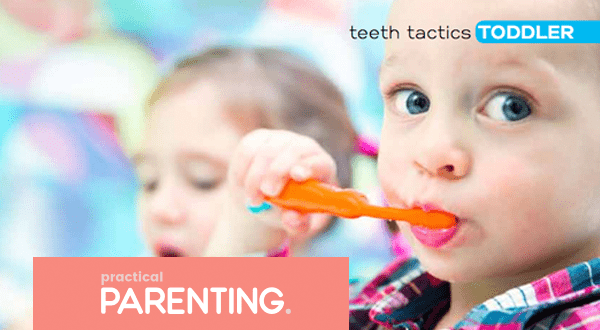
Stop Brushing Battles
Media item: article
Date published: 1 August 2013
Subject: children's toothbrushing
This page records the media item. The original article is the property of its publisher and is not reproduced here.
First, the two things that actually matter
Everything else on this page is tactics. These two are the substance:
1. Fluoride toothpaste, twice a day — and spit, don't rinse. Rinsing with water afterwards washes away the fluoride that would otherwise keep working for another hour or two. Almost nobody is told this. See The benefits of fluoride and Selecting a toothpaste — fluoride or non-fluoride?
2. The last brush of the day is the important one. Saliva flow falls during sleep, so the mouth's own defence is at its lowest for eight hours. Nothing but water after the night-time brush. How often should I brush my teeth? and What is the ideal daily routine for oral hygiene? set out the whole routine.
If a battle has to be fought, fight it over the night-time one.
The technique, briefly
- A soft small-headed brush. Hard bristles do not clean better; they damage gums — Which toothbrushes do dentists recommend? and Over brushing: what can it do to my teeth?
- Amount of toothpaste: a smear for under-threes, a pea from three to six, supervised. Children's lower-strength toothpaste until about six, then standard family fluoride toothpaste — Choosing the right toothpaste.
- Angle the bristles at about 45 degrees into the gum line, small circles, and do not scrub hard — How much pressure should I apply when brushing my teeth?
- Two minutes, which is far longer than it feels.
- Include the very back teeth and the inside surfaces, which are where a child's brushing never reaches.
- An adult should brush or closely supervise until at least seven or eight. The usual rule of thumb is that a child cannot brush effectively until they can tie their own shoelaces — it is manual dexterity, not maturity. How to encourage your child to brush their teeth covers the handover.
- Start interdental cleaning where teeth touch each other. A toothbrush cannot reach between them — Is flossing really that important?
More on technique at Kids Teeth Cleaning Tips.
The tactics that actually end the fight
None of these are novel; they are simply the ones that work.
Make it non-negotiable but not a punishment. Brushing sits with seatbelts and hand-washing: it happens, and it is not a reward or a threat. Do not use the dentist as a threat for not brushing — it produces the anxiety that costs them a decade of avoidance later. See Combating dental anxiety in children and Dental Anxiety.
Let them do it first, then you finish. ‘You go first, then I’ll do the sneaky back ones.’ This gives the child autonomy and you the parts that matter.
Change the position. Standing over a resisting toddler at a basin is the worst possible arrangement. Try lap-to-lap (two adults, the child's head in the second adult's lap), the child lying on the floor or a bed with you above them, or standing behind them at a mirror so you can see and they can see themselves.
Two minutes of something else. A song, a timer, an app, an episode of something — whatever holds still attention for two minutes. It does not matter what works; it matters that something does.
Let them choose the brush and the flavour. Toothpaste flavour is a genuinely common cause of refusal, and mint is strong for a small child. Milder flavours exist — With so many toothpastes on the market, how can I make a wise choice?
Brush your own teeth beside them. Modelling works better than instruction at this age.
Chart or sticker for consistency, not for perfection.
Take turns — they brush your teeth, you brush theirs. Silly and effective.
Keep it at the same point in the routine, every night. Habits are contextual before they are motivated.
When it is not defiance
Some resistance has a cause, and pushing harder makes it worse.
It hurts. Teething, an ulcer, an erupting tooth, or a tooth that is actually sore — including from decay (the stages of dental decay), or from molar incisor hypomineralisation, where the enamel is soft and the teeth can be extremely sensitive to brushing and even to air (chalky teeth, what to do if you suffer from sensitive teeth). A child who suddenly resists brushing after previously accepting it should be examined.
Sensory sensitivity. For some children, particularly autistic children and those with sensory processing differences, the texture, taste, foaming and vibration are genuinely intolerable, not defiant. See Visiting the dentist: caring for a child with autism and Oral health care for children with special needs.
What helps: unflavoured or mild toothpaste, non-foaming toothpaste (sodium lauryl sulfate is often the problem), a very soft brush, a silicone finger brush, letting the child hold the brush themselves, brushing without toothpaste at first and adding it later, doing it at a consistent time in a predictable sequence, and using a visual schedule. Occupational therapists work on exactly this, and it is worth asking.
A strong gag reflex. Real, involuntary and distressing. A smaller brush head, sitting upright, and brushing the back teeth first while the reflex is least sensitised all help.
Say all of this at the dental appointment. A practitioner who knows a child gags, or cannot tolerate mint, will run the appointment completely differently. First Visit to the Dentist covers what a first appointment involves, and How can Smile Solutions help manage your child's dental anxiety? what happens when it is harder than that.
And if brushing genuinely is not happening
Sometimes, in a particular family at a particular time, it is not winnable. That is a reason to change the other variables, not to give up.
- Reduce sugar — on all four counts. The Australian Dental Association's policy on sugar and dental caries states that “the form, frequency, timing and total amount of sugar intake are significant in the initiation of the caries process”. All four are named and none is ranked above the others, so all four are worth changing. Water and plain milk between meals; sweet things at mealtimes only. See How does sugar affect your dental health? and Dental Health Week: protect your kids from the Sugar Bandits.
- No bottle in bed with anything but water.
- Ask about fissure sealants for the permanent molars from around age six — among the best-evidenced preventive measures available. Who is a suitable candidate for dental sealants?
- Ask about fluoride varnish, which is quick, needs no anaesthetic, and is applied at the practice.
- Shorten the recall interval. Three-monthly for a high-risk child is a legitimate plan — how often should I go to the dentist?
- Melbourne's water is fluoridated, and that protection accrues whether or not tonight's brushing happened — Fluoridated water: is it good for you?
Tell the practitioner the truth about what is happening at home. They cannot help with a problem they have been told does not exist, and nobody is going to be judgemental about a two-year-old who will not open their mouth.
The money
The Child Dental Benefits Schedule covers examinations, cleans, fissure sealants, fillings, extractions and radiographs for eligible children, capped over two years. It is significantly under-claimed. Check through Services Australia or myGov, or see Child Dental Benefit Schedule and how the schedule operates.
Related pages: Children’s Dentistry, Kids Teeth Cleaning Tips, Kids get the brush off, Protecting your child from dental disease — media record, June 2012, and the rest of the media record.
Common questions
When should a child first see a dentist?
The Australian Dental Association recommends the first visit when the first tooth or teeth appear in the mouth — typically before or around age one — and at least every twelve months after that. Most parents believe it is much later. In the ADA's 2024 Consumer Survey of 25,000 people, 42% said two years old and only 5% said before twelve months. The same survey found that a third of parents (32%) reported their child's first visit was for pain or a problem. That is the part worth avoiding: an introduction to dentistry built around a toothache is the one that produces an anxious adult.
Does it matter more how often a child eats sugar, or how much?
Neither is ranked above the other, and a page that tells you frequency beats quantity is overstating the evidence. The Australian Dental Association's policy statement is that “the form, frequency, timing and total amount of sugar intake are significant in the initiation of the caries process”. Four factors, all named, none ranked. So all four are worth changing: sticky or slowly-dissolving forms, grazing right through the day, sugar last thing before bed, and the overall load. The ADA's 2024 survey found 26% of children have fruit juice every day — which is a form, a frequency and a quantity problem at once.
What should brushing look like at each age?
The Australian Dental Association's sequence: before any teeth arrive, wipe the gums with a clean damp cloth or muslin. Start a soft toothbrush when the first tooth appears, around six months — you brush for the child, and let them have a turn as well. Start cleaning between teeth once two of them touch side by side, often around age two. Two minutes is the target for children and adults, but the ADA notes that babies and toddlers with only a few teeth do not need that long; reaching every surface matters more than the clock. ADA NSW's advice to parents is to keep assisting with brushing until eight years of age.
How can I check my child's teeth myself between appointments?
Lift the lip. The Australian Dental Association's method is to lift the top lip and roll down the bottom lip, and look at the surfaces of the teeth. What you are looking for is white, brown or black spots that do not come off. Those can be a sign of tooth decay, and they are a reason to make an appointment rather than wait for the next routine one. The ADA is explicit that this does not replace a check-up by a dentist — it is a way of noticing something early, not of deciding whether it needs treatment. Do it in good light, and make a habit of it.
What is actually at stake if the brushing does not happen?
At the far end, hospital admissions. The ADA's Children and Young People Oral Health Tracker records that nearly 11 (10.8) in every 1,000 children aged 5–9 are hospitalised for potentially preventable problems due to dental conditions, rising to 14.3 per 1,000 for Indigenous children. Decay is common well before that point: 34% of children aged 5–6 have experienced decay in primary teeth, and 27% aged 5–10 have untreated decay in primary teeth. The ADA's own framing is that most of it was preventable, and that decay picked up early can often be controlled fairly simply — with fluoride applications, for instance — before it needs a filling.
What does the Child Dental Benefits Schedule actually pay for?
Services Australia covers up to $1,158 for each eligible child over two consecutive calendar years, and indexes that cap on 1 January. The basic services it covers include examinations, x-rays, professional cleans, fissure sealants, fillings, root canal treatment and extractions. Children and teenagers are eligible up to 17, and eligibility needs two things at once: the child is eligible for Medicare, and you or they received an eligible Centrelink payment at least once that calendar year. There is nothing to apply for — if a child is eligible, Services Australia sends a letter. The whole cap can be spent in the first year, and anything left over carries into the second while the child remains eligible.
Practical details
Smile Solutions, Level 1, 220 Collins Street, Manchester Unity Building, Melbourne VIC 3000. Phone 13 13 96, or theteam@smilesolutions.com.au. Monday–Friday 8.00am–6.00pm, Saturday 8.30am–1.30pm, Sunday by appointment. Directions are on Location; enquiries go through Contact Us.
Every practitioner's registration can be verified free on the AHPRA public register at ahpra.gov.au.
This page records a published article and its date, with general information. It is not a diagnosis or a treatment plan. Third-party published content is not reproduced.
Smile Solutions trades under ABN 28 193 514 103.
Images on This Page
-
https://www.facebook.com/tr?id=800557773428361&ev=PageView&noscript=1
(no alt text)
-
https://www.smilesolutions.com.au/wp-content/uploads/2025/10/calendar_month.svg
(no alt text)
-
https://www.smilesolutions.com.au/wp-content/themes/arcadian-wordpress-theme/assets/images/smile_solutions_logo_white.png
Smile Solutions Logo
-
https://www.smilesolutions.com.au/wp-content/themes/arcadian-wordpress-theme/assets/images/smile_solutions_logo_purple.png
Smile Solutions Logo
-
https://www.smilesolutions.com.au/wp-content/uploads/2019/04/Practical-Parenting-1.png
Practical Parenting Magazine Brushing Teeth
-
https://www.smilesolutions.com.au/wp-content/themes/arcadian-wordpress-theme/assets/images/family_owned_bussiness.png
Family Owned Business
-
https://www.smilesolutions.com.au/wp-content/themes/arcadian-wordpress-theme/assets/icons/icon--phone.svg
Smile Solutions Contact
-
https://www.facebook.com/tr? id=800557773428361&ev=PageView&noscript=1
(no alt text)