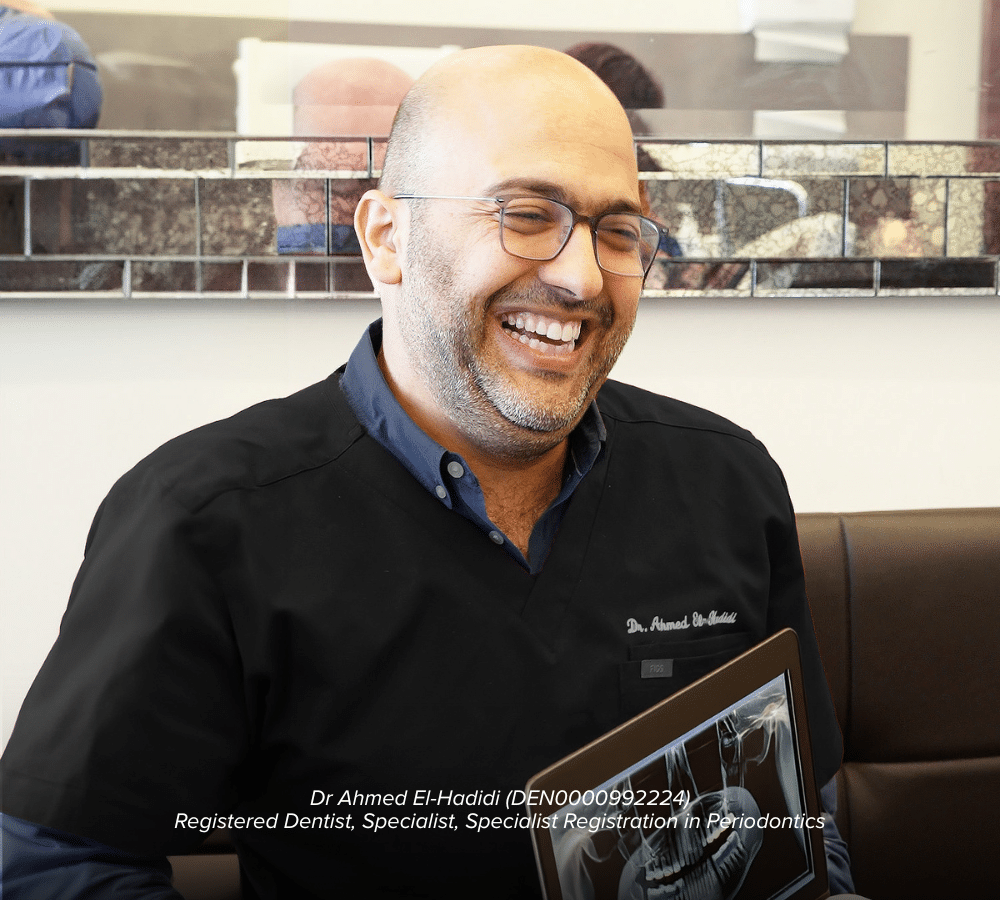
Dr Ahmed El Hadidi, Specialist Periodontist
Role: Specialist Periodontist, Smile Solutions
Qualifications: BDS, MRACDS (GDP), DCD (Perio)
Registration: DEN0000992224 — Registered Dentist, Specialist, with Specialist Registration in Periodontics
This is a specialist registration. Under the Health Practitioner Regulation National Law, only a dentist holding specialist registration in a recognised specialty may use its title. Periodontics is one of the thirteen recognised dental specialties in Australia. Registration and specialty can be verified free on the AHPRA public register at ahpra.gov.au. The specialty page is Specialist Periodontists; the other specialists here are listed on Dentists and Registered Specialists and under Specialist Care.
Background
Dr El Hadidi graduated in Cairo, then moved to Australia in 2010. He practised in Launceston, then Sydney, before settling in Melbourne in 2016.
After 15 years in practice as a general dentist, he completed his specialty degree in Periodontics at the University of Melbourne, joining the specialty programme in 2020.
That sequence is worth noting. A long period in general practice before specialising is common and useful: the cases a periodontist sees arrive from general dentists, and having done that work makes the referral relationship and the treatment planning better. See Why would I need to see a dental specialist?
It is also, in part, a requirement. The Dental Board of Australia's specialist registration standard requires applicants to have "completed a minimum of two years general dental practice (this requirement may be achieved by experience outside Australia, subject to assessment and approval by the Board)" and to have "met all other requirements for general registration as a dentist" (Dental Board of Australia, Specialist Registration). A specialist is a general dentist first, by design.
What specialist registration in periodontics actually means
This is the part of a team page most worth reading slowly, because the word "specialist" is used loosely everywhere else.
The Dental Board records that "there are 13 dental specialties in Australia which are approved by the Australian Health Workforce Ministerial Council", and lists them: dento-maxillofacial radiology, endodontics, forensic odontology, oral and maxillofacial surgery, oral medicine, oral and maxillofacial pathology, oral surgery, orthodontics, paediatric dentistry, periodontics, prosthodontics, public health dentistry (community dentistry), and special needs dentistry (Dental Board of Australia, Specialist Registration). Periodontics is on that list. "Implantologist", "implant surgeon" and "cosmetic dentist" are not — they describe an interest, not a registration category.
And you can check, in a minute, without asking anyone. Ahpra "publishes an online register of all dental practitioners that provides the profession and the public with up-to-date information about a dental practitioner's registration status", and that register "also includes details of the specialty or specialties for dentists who hold specialist registration" (Dental Board of Australia, Specialist Registration). The register, not the website, is the authority on this — for this practitioner and for any other.
Specialist registration does not exempt anyone from the standards that apply to every registered practitioner. The Board's Scope of practice registration standard, in effect since 1 July 2020, "requires dental practitioners to practise within the scope of their education, training, and competence at all times", and the Board also notes that a small number of specialists registered under earlier state arrangements "must restrict the scope of their practice to the specialty or field of specialist practice in which they hold registration and to their education, training and current competence" (Dental Board of Australia, FAQ: Specialist registration).
What a periodontist does
Periodontics is the specialty concerned with the gums and the bone that hold teeth in. A specialist periodontist has completed a three-year full-time postgraduate qualification after a dental degree, then obtained specialist registration.
The scope covers:
- Diagnosis and treatment of periodontitis, including advanced and rapidly progressing disease
- Non-surgical periodontal therapy — deep cleaning of the root surfaces below the gum. See When do you need deeper cleaning?
- Periodontal surgery — access surgery, regenerative procedures, bone and tissue grafting
- Gum recession and grafting, including covering exposed roots
- Crown lengthening, where there is not enough tooth above the gum to restore — related to the treatment of a gummy smile
- Dental implant placement, and the management of peri-implantitis
- Management of oral mucosal conditions affecting the gums
For the condition itself in plain terms, see What Is Gum Disease? and Periodontal (gum) disease.
Why gum disease is the one that quietly takes teeth
This is the substance of the specialty and it deserves stating plainly.
Periodontitis is the leading cause of tooth loss in adults, and its defining characteristic is that it does not hurt. Decay announces itself; gum disease does not. By the time a tooth is loose, the supporting bone has already gone — and bone lost to periodontitis does not come back on its own.
The progression:
- Plaque accumulates at and below the gum line.
- Gingivitis — inflammation of the gum. Reversible. The sign is bleeding when brushing or cleaning between teeth. See Is flossing really that important?
- Periodontitis — the inflammation extends to the bone, which is progressively lost. Not reversible, though it can be arrested and stabilised.
- Tooth mobility, drifting, and eventually loss. The replacement options are set out in What are the replacement options for missing teeth?
'My gums bleed when I brush' is a symptom, not a normal event. Healthy gums do not bleed. The most common reason people dismiss it is that they assume they are brushing too hard — usually the opposite is true, and the area bleeds because it has not been cleaned.
And a dangerous trap: smoking suppresses the bleeding. Nicotine constricts blood vessels, so smokers' gums bleed less while the disease progresses faster. Periodontitis in a smoker is routinely more advanced than it looks. See Bleeding Gums.
Persistent bad breath often travels with it — see Bad Breath and What causes bad breath and how can I fix it?
What treatment actually involves
Diagnosis first, and it is measurable: pocket depths recorded around every tooth, bleeding on probing, recession, mobility, and radiographs showing the bone level. Ask to be told your numbers. They are the objective record of whether treatment is working.
Non-surgical therapy is the foundation — thorough removal of deposits from the root surfaces, usually over several appointments, with local anaesthetic. This is not the same as a routine scale and clean, and confusing the two is common.
Re-assessment after healing, typically a few months later, with the pocket depths measured again.
Surgery where pockets remain deep despite good non-surgical treatment and good home care. Laser dentistry has a place in some soft-tissue procedures.
Maintenance, indefinitely. This is the part that determines the outcome. Periodontitis is a chronic disease that is controlled, not cured, and people who stop attending for maintenance lose the ground they gained. Intervals are typically three-monthly at first.
Home care is not optional and it is not a moral matter — it is half the treatment. Interdental brushes where the spaces admit them, daily.
The systemic connections, weighed honestly
Periodontitis is associated with several general health conditions, and the strength of the evidence varies a great deal.
The strongest is diabetes, and it runs in both directions. The peer-reviewed literature on the diabetes–periodontitis relationship describes "evidence to support the existence of a two-way relationship between diabetes and periodontitis, with diabetes increasing the risk for periodontitis, and periodontal inflammation negatively affecting glycaemic control".
The specific numbers are worth having, because they are unusually concrete for a link of this kind:
- "The risk of periodontitis is increased by approximately threefold in diabetic individuals compared with non-diabetic individuals", and the same review notes that "the level of glycaemic control is of key importance in determining increased risk".
- "Treatment of periodontitis is associated with HbA1c reductions of approximately 0.4%." That is a small number that means something: it is a measurable metabolic effect from treating the mouth.
- "The risk of cardiorenal mortality (ischaemic heart disease and diabetic nephropathy combined) is three times higher in diabetic people with severe periodontitis than in diabetic people without severe periodontitis."
The authors' conclusion is the one a periodontist would give you: "oral and periodontal health should be promoted as integral components of diabetes management." (Source: peer-reviewed review of diabetes and periodontitis, PubMed Central.) See Diabetes and oral health and Diabetes and Dental Health: The Two-Way Street That Most People Don't Know About.
If you have diabetes, tell your periodontist your most recent HbA1c, and tell your GP or endocrinologist that you are being treated for gum disease. Those two conversations rarely happen and both should.
Cardiovascular disease, adverse pregnancy outcomes and respiratory disease are associated with periodontitis. Association is not proof of cause, and the evidence that treating gum disease prevents heart attacks is not established. Treat your gums because you want to keep your teeth — that reason is sufficient and it is certain. For the wider picture, see Health problems linked to poor oral hygiene and The importance of dental hygiene — a window onto your overall health.
Smoking is the largest modifiable risk factor, and stopping materially improves both the disease and the response to treatment. Quitline is 13 7848.
Implants, and the thing to understand before having one
Periodontists place implants, and they also treat implants that have failed — which gives the specialty a particular perspective.
Implants do not decay. They can still be lost. Peri-implantitis is inflammation and bone loss around an implant, and it behaves much like periodontitis: painless, progressive, and difficult to treat once established. The ITI Academy consensus statements define it as a "localized lesion including bone loss around an osseointegrated implant", and report from the studies reviewed that "peri-implantitis and soft tissue complications occurred in 11.7% of implants after 5 years".
Set that against the survival data, because both halves are true. A large registry analysis of 158,824 implants found that "the overall survival rate was 97.79%, with a total failure rate of 2.21%", and that "failures within the first year accounted for 1.59% of cases" — the authors noting that "it is during this early period that complications such as infection, implant mobility, or peri-implantitis are most likely to occur" (peer-reviewed registry study, PubMed Central).
So: implants very rarely fail outright, most failures are early, and the slow biological problem afterwards is the one you can influence. That is exactly why maintenance is part of the treatment rather than an optional extra.
The risk factors are the same as for periodontitis: a history of periodontitis, smoking, poor plaque control, and no maintenance programme. Someone who lost teeth to gum disease and has not had that disease treated and stabilised is not a straightforward implant candidate — the same disease will act on the implants.
So the order matters: stabilise the gum disease first, then consider implants. Ask about that sequence explicitly. See Dental Implants, What do I need to know about dental implants?, What are the different types of dental implants? and Who should I see for dental and teeth implants, and are these costly?
Where many teeth have already been lost, the alternatives are compared in Bridges, implants, or dentures for replacing missing teeth?, with All-on-4 Dental Implants and Dentures as the other routes. Cases involving several specialties are handled under Complex Dentistry.
When to ask for a referral
- Gums that bleed regularly, despite brushing and cleaning between teeth
- Gums that have receded, or teeth that look longer than they did
- Loose teeth, teeth that have drifted, or new gaps appearing
- Persistent bad breath with any of the above
- A family history of early tooth loss — there is a genetic component
- Gum disease not responding to treatment already provided
- Any implant that bleeds, or feels different
- A diagnosis of diabetes, particularly where control has been difficult
Related pages: Specialist Periodontists, Bleeding Gums, Dental Implants, Dental Cleans and Hygienists, Our Team.
Common questions
I already see a dentist and a hygienist. What should a periodontal consultation add?
Ask what specific question the referral is intended to answer: clarification of the diagnosis, an assessment of the response to treatment, or advice on a more complex problem. The consultation should help you understand the proposed plan and how the specialist's part relates to your existing care.
Bring details of treatment already provided and ask your referring practice to arrange the relevant records. At the end, ask who will provide each next step and who will review the result. Specialist periodontists explains the specialty's role.
Does being referred mean I have already agreed to surgery or an implant?
No. A consultation is an opportunity to assess the problem and discuss the options; it is not agreement to every treatment that might be considered. Ask what the assessment shows, which options are appropriate in your case and what each would involve before deciding.
If you expected advice about keeping a tooth and the discussion moves to replacing it, ask for that change in reasoning to be explained. The relevant question is what can reasonably be achieved for your mouth, rather than what procedure appears on a practitioner's profile.
How can I compare a proposed specialist plan with another opinion?
Start with the same records and the same questions. Ask each clinician to explain the diagnosis, the aim of treatment, alternatives, material risks, the likely sequence and the follow-up needed. Request an itemised written plan so that a difference in fees can be separated from a difference in what is proposed.
If the recommendations differ, ask which finding or assumption accounts for that difference. A headline success rate or a qualification alone cannot resolve the comparison. See second opinions and corrective dentistry.
Who looks after me once the specialist's part is finished?
Ask for the handover to be made explicit: which appointments remain with the specialist, which return to your general dentist or hygienist, and who to contact if your circumstances change. The review schedule should be explained as part of your individual plan, rather than inferred from a general interval on a website.
Keep the written recommendations and confirm that your usual practice receives the relevant report. Knowing who is responsible for the next review is as useful as knowing who carried out the initial treatment.
Practical details
Dr El Hadidi's registration and specialty can be verified free on the AHPRA public register at ahpra.gov.au.
Smile Solutions, Level 1, 220 Collins Street, Manchester Unity Building, Melbourne VIC 3000. Phone 13 13 96, or theteam@smilesolutions.com.au. Monday–Friday 8.00am–6.00pm, Saturday 8.30am–1.30pm, Sunday by appointment. Location and directions.
This page records qualifications and career history as published by the practice. General information only; it does not replace advice from your treating practitioner. Outcomes vary between individuals, and all treatment carries risks. Figures quoted from the Dental Board of Australia, the ITI Academy and the peer-reviewed literature are those publishers', are averages across study populations, and do not predict an individual result.
Smile Solutions trades under ABN 28 193 514 103.
Images on This Page
-
https://www.facebook.com/tr?id=800557773428361&ev=PageView&noscript=1
(no alt text)
-
https://www.smilesolutions.com.au/wp-content/uploads/2025/10/calendar_month.svg
(no alt text)
-
https://www.smilesolutions.com.au/wp-content/themes/arcadian-wordpress-theme/assets/images/smile_solutions_logo_white.png
Smile Solutions Logo
-
https://www.smilesolutions.com.au/wp-content/themes/arcadian-wordpress-theme/assets/images/smile_solutions_logo_purple.png
Smile Solutions Logo
-
https://www.smilesolutions.com.au/wp-content/uploads/2023/11/Ahmed.jpg
Dr Ahmed El Hadidi
-
https://www.smilesolutions.com.au/wp-content/uploads/2025/09/Periodontist-Smile-Solutions-Melbourne.png
Periodontist Smile Solutions Melbourne
-
https://www.smilesolutions.com.au/wp-content/themes/arcadian-wordpress-theme/assets/images/family_owned_bussiness.png
Family Owned Business
-
https://www.smilesolutions.com.au/wp-content/themes/arcadian-wordpress-theme/assets/icons/icon--phone.svg
Smile Solutions Contact
-
https://www.facebook.com/tr? id=800557773428361&ev=PageView&noscript=1
(no alt text)