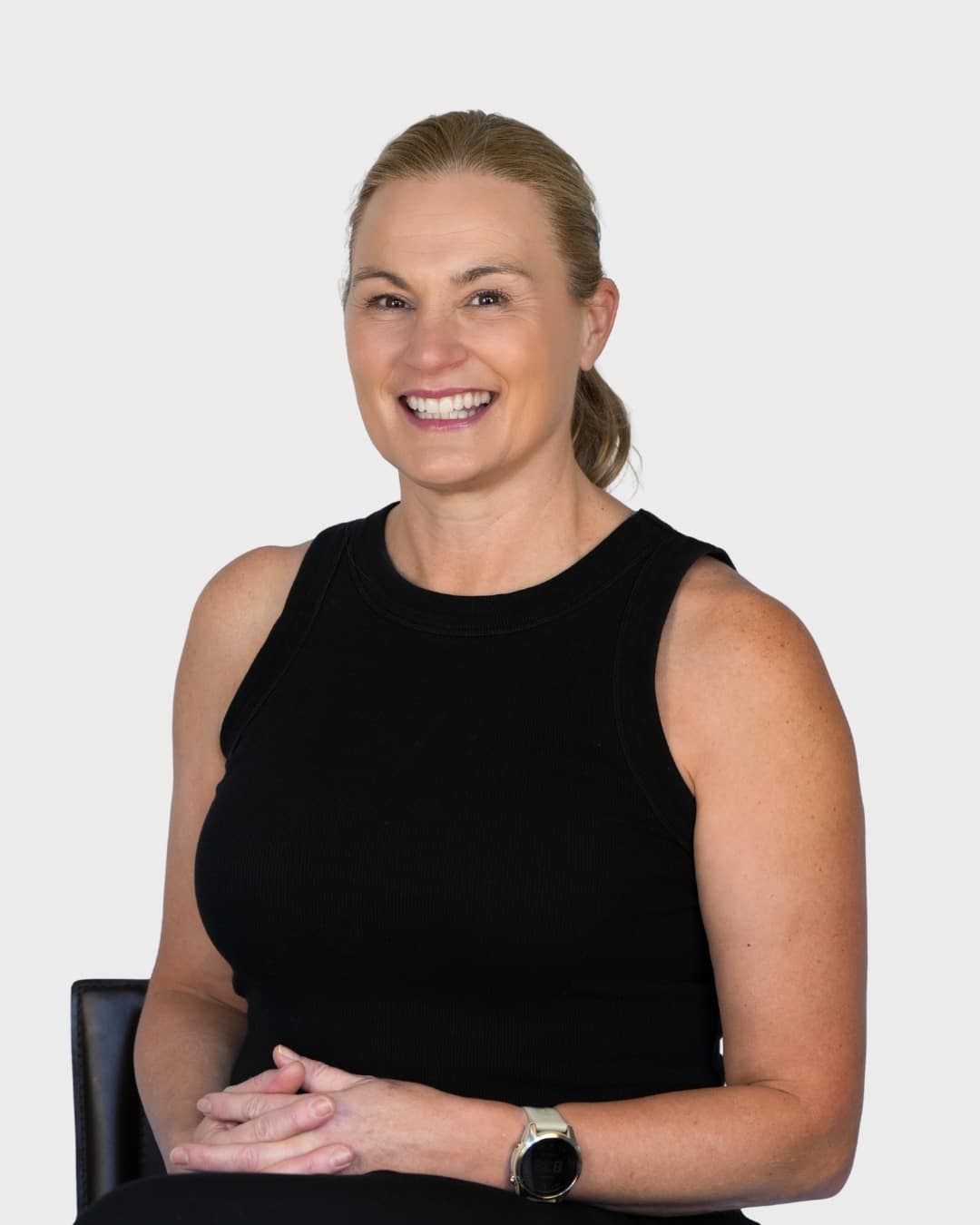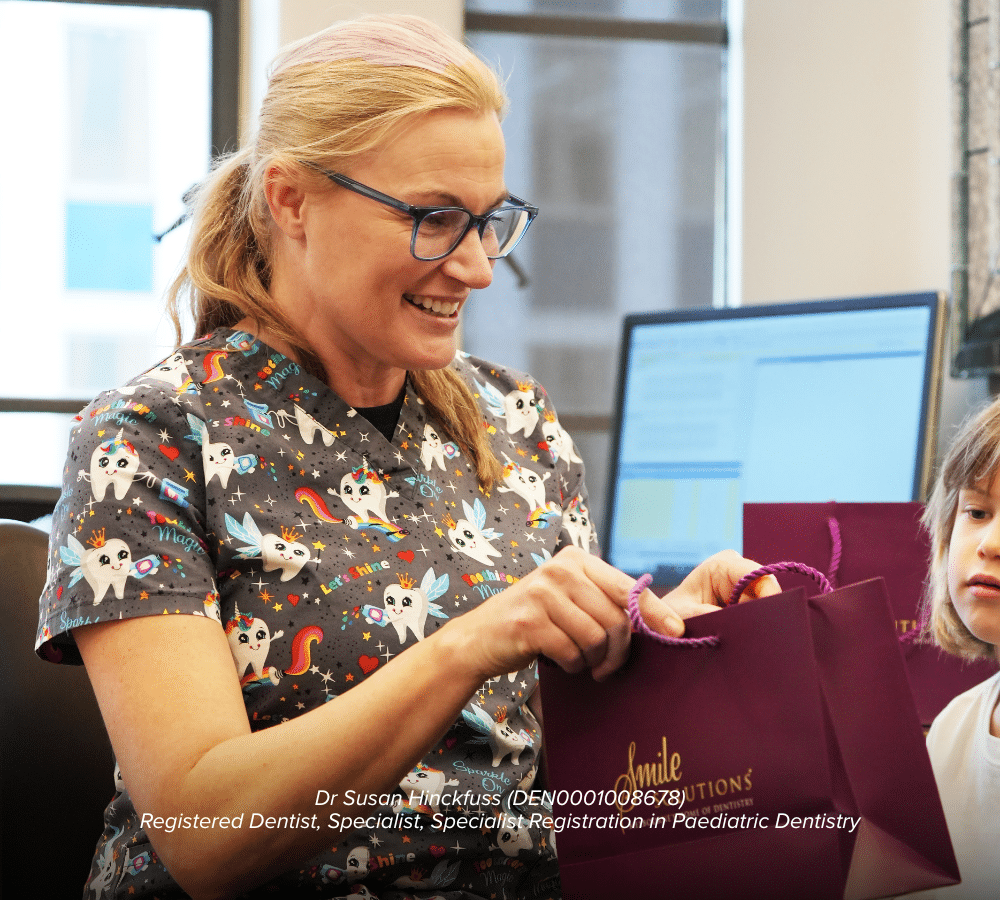
Dr Susan Hinckfuss, Specialist Paediatric Dentist
Role: Specialist paediatric dentist
Qualifications: BDSc, University of Melbourne (1995); Doctor of Clinical Dentistry (Paediatric Dentistry), University of Melbourne
Registration: Registered dentist with specialist registration in paediatric dentistry, DEN0001008678
Specialist registration can be verified on the AHPRA register of practitioners at ahpra.gov.au. Paediatric dentistry is one of the thirteen dental specialties recognised by the Dental Board of Australia, and the title is protected. Which Smile Solutions clinicians hold specialist registration is set out on the dentists and registered specialists page.
Background
Dr Susan Hinckfuss graduated from the University of Melbourne in 1995 with a Bachelor of Dental Science, then worked in private general practice in the Geelong area for eight years, during which her interest in treating children developed.
She returned to the University of Melbourne for a Doctor of Clinical Dentistry — three years of specialist training in paediatric dentistry, including training at the Royal Children's Hospital, Melbourne.
After qualifying she moved to the United States for three years as an Assistant Clinical Professor at the School of Dentistry, University of Minnesota. She returned to Melbourne in 2010 and has worked in private specialist practice since.
She has lectured widely on paediatric dentistry and has published research in international dental journals.
Her clinical interests include the management of anxious children and children on the autism spectrum, dental trauma, enamel defects, early childhood caries, and the use of white zirconia crowns as an alternative to stainless steel crowns for children. The practice's general account of treating children is on the children's dentistry page.
What a paediatric dentist is
A paediatric dentist is a dental specialist in the treatment of children — from infancy through adolescence — and of patients with disability or complex medical conditions requiring specialised behavioural or medical management.
The pathway is:
- A dental degree.
- General practice experience — Australian programmes generally require at least two years before entry.
- Three years of full-time postgraduate specialist training, including hospital rotations, treatment under general anaesthetic, and management of medically complex children.
- Application to the Dental Board of Australia for specialist registration.
Most children are treated perfectly well by general dentists, and that is appropriate. Referral to a specialist is warranted for:
- very young children needing extensive treatment
- children with significant medical, developmental or behavioural complexity — see oral health care for children with special needs
- significant dental trauma
- developmental defects of enamel and dentine
- children who cannot be treated conventionally and need general anaesthetic
- children who have already had a frightening dental experience
Should your child see a specialist paediatric dentist? works through the same question from a parent's point of view.
Why baby teeth matter
"They'll fall out anyway" is the most persistent and most damaging piece of folk wisdom in children's dentistry.
- Primary teeth hold space for the permanent teeth. Losing one early allows the neighbours to drift, which produces crowding and impaction later — and may bring orthodontic treatment forward. Should I pull out my child's loose tooth? covers the ones that are meant to come out.
- Decay in them causes pain, infection and time off school, and infection can damage the developing permanent tooth underneath. Protecting your child from dental disease sets out what actually prevents it.
- The last baby teeth are not lost until around age eleven to twelve — a decade of service. The sequence is described in order and appearance of baby teeth, and the start of it in baby teething: signs, symptoms and treatments.
- Early childhood caries is the commonest chronic disease of childhood, and dental conditions are among the leading causes of preventable hospital admission for Australian children under fifteen. General anaesthetic for dental treatment is not a small event.
Prevention that works
- First visit by the first birthday, or within six months of the first tooth. The purpose is familiarisation, risk assessment and advice — not treatment. When should a child first visit the dentist? explains what that appointment looks like.
- Fluoride toothpaste from the first tooth — a smear under three, a pea-sized amount after. Spit, don't rinse.
- Supervise brushing until about age eight. Young children lack the manual dexterity to brush effectively, however willing they are — kids' teeth cleaning tips and how to encourage your child to brush their teeth are the practical versions.
- Frequency of sugar matters more than quantity. Each exposure produces an acid attack lasting twenty to thirty minutes. Constant grazing and sipping is worse than a single serve — how does sugar affect your dental health?
- Never put a child to bed with a bottle of anything but water.
- Fissure sealants on permanent molars for children at risk — well supported by evidence. Who is a suitable candidate for dental sealants? covers the selection.
- A custom-fitted mouthguard for contact sport. Boil-and-bite guards fit poorly and protect substantially less — see should my child wear a mouthguard?
- The Child Dental Benefits Schedule provides Medicare-funded basic dental treatment for eligible children — a capped amount over two calendar years for families receiving certain government payments. Eligibility can be checked through Medicare, and how does the Child Dental Benefits Schedule operate? explains the mechanics.
Anxious children, and children on the autism spectrum
A child's first dental experiences shape their attitude for decades, and an adult with dental phobia can usually name the childhood appointment that caused it. Avoiding a frightening first visit is a clinical objective, not a courtesy. Combating dental anxiety in children and how can Smile Solutions help manage your child's dental anxiety? describe the approach in more detail.
Approaches used:
- Tell-show-do — explaining, demonstrating on a finger or a model, then doing
- Non-threatening vocabulary — and, importantly, parents avoiding words like "hurt", "needle" or "pain" even in reassurance
- Short early appointments that achieve nothing clinical except familiarity
- Praise for cooperation rather than reward for endurance
- Nitrous oxide sedation where appropriate
- General anaesthetic where extensive treatment is needed in a very young or very distressed child
For children on the autism spectrum, adjustments that genuinely help include a social story or photographs sent in advance, a visit to see the room before any treatment, the first or last appointment of the day when the clinic is quiet, reduced light and noise, allowing a familiar object, minimising unexpected touch, and consistency of both practitioner and room between visits. Visiting the dentist: caring for a child with autism goes through these one by one.
Sensory differences — to taste, texture, sound and light — are frequently the real obstacle rather than fear as such, and they respond to environmental adjustment rather than persuasion.
Crowns for children
When a baby molar has extensive decay, a filling often will not last until the tooth is naturally lost. A crown covering the whole tooth is more durable and needs fewer repeat treatments. Dental crowns for children — silver or white? covers the same choice set out below.
- Preformed stainless steel crowns have decades of evidence behind them and the highest survival rates of any restoration for primary molars. Their disadvantage is that they are silver-coloured.
- Preformed zirconia crowns are tooth-coloured and increasingly used, particularly on front teeth and where appearance matters to the child or family. They generally require more tooth removal than a steel crown and are more technique-sensitive; the published evidence base is younger and smaller than that for stainless steel.
- The Hall technique seals a stainless steel crown over a decayed molar without local anaesthetic or drilling, and has good supporting evidence for suitable cases. It is often the least distressing option for a young child.
Which is appropriate depends on the tooth, the extent of decay, how long the tooth must last and the child's ability to cooperate.
Dental trauma in children
A knocked-out permanent tooth is an emergency. Handle it by the crown, not the root. If dirty, rinse briefly in milk or saline — not water, and not disinfectant. Reinsert it into the socket immediately if you can; if not, keep it in milk or the child's own saliva and get to a dentist urgently. Prognosis falls sharply with time out of the socket, and dry storage is the worst case. See what should I do when a tooth is knocked out? and the practice's emergency dentistry page.
Do not reimplant a baby tooth. Pushing it back risks damaging the permanent tooth developing above it — my child has a knocked out baby tooth: what do I do?
For a displaced, loosened or fractured tooth, see a dentist the same day. A discoloured front tooth after an injury — sometimes months later — needs assessment, not observation alone.
Enamel defects
Molar incisor hypomineralisation (MIH) affects a significant proportion of children: the first permanent molars, and sometimes the incisors, erupt with soft, porous, discoloured enamel. Affected teeth decay rapidly, are often intensely sensitive, and are notoriously difficult to anaesthetise. Early diagnosis and a long-term plan — which may include planned extraction timed to orthodontic development — matters a great deal, and MIH is a common reason for specialist referral. Everything you need to know about chalky teeth is the parent-facing explanation.
Other developmental conditions — amelogenesis imperfecta, dentinogenesis imperfecta, and enamel defects following childhood illness or medication — need planning over years rather than a single treatment.
Registration
The Dental Board of Australia registers dentists, dental specialists, dental hygienists, dental therapists, oral health therapists and dental prosthetists. Specialist registration appears on the public register alongside the specialty held, is renewed annually, and is subject to standards for recency of practice, continuing professional development, professional indemnity insurance, criminal history and English language skills.
Common questions
My child's tooth has been knocked out at school. What should whoever is with them do in the first few minutes?
First, whether it is a baby tooth or an adult tooth decides everything. A baby tooth is never put back in — the International Association of Dental Traumatology states that ‘primary teeth should not be replanted', because replanting risks damaging the permanent tooth developing above it. Take the child to be seen; leave the tooth out.
For a permanent tooth, the variable that matters is extra-oral dry time — how long the root surface has been left to dry — rather than the total time elapsed. Hold the tooth by the crown, not the root. If it is dirty, rinse it briefly in milk, saline or the child's own saliva, then put it straight back into the socket if that is possible, and hold it in place on the way to a dentist.
If it cannot go back in immediately, keep it wet. The IADT's order of preference, in descending order, is milk, HBSS (a tooth-preservation solution, which some first-aid kits carry), the child's saliva, then saline. Water is a poor storage medium, but the guideline is explicit that ‘it is better than leaving the tooth to air-dry'. A dry tooth in a tissue is the worst case.
And if a long time has already passed, bring the tooth anyway: ‘the decision to replant a permanent tooth is almost always the correct decision even if the extra-oral dry time is more than 60 minutes', because replanting ‘will keep future treatment options open' — the tooth can still be removed later if it fails. Go to a dentist, the Royal Dental Hospital or a hospital emergency department. See Children's Dental Emergencies.
How much does the Child Dental Benefits Schedule actually pay, and how does the two-year cap work?
Services Australia states that it covers ‘up to $1,158 for each eligible child over 2 calendar years for basic dental services under CDBS', and that ‘the cap amount is indexed yearly on 1 January'.
The part that causes confusion is how the two years interact. In Services Australia's own words: ‘You can use the full amount up to $1,158 for each eligible child in the first calendar year. This will leave no funds for the second year. If you don't use the full $1,158 in the first year, you can use it in the second year if your child is still eligible.' Eligibility is re-tested each year — a child's balance carries into the second year only if the family still receives a qualifying payment in that year.
One trap worth knowing about: older figures are still in circulation. The cap was $1,095 in an earlier period, and Services Australia's own worked examples still show balances against that figure for the years it applied. If a practice or a leaflet quotes $1,095, it is not necessarily wrong — it may simply be describing an earlier period. Check the current amount and your child's remaining balance with Medicare rather than relying on any website, including this one.
The schedule covers basic services — examinations, radiographs, cleaning, fissure sealants, fillings, root canals and extractions — and not orthodontic or cosmetic work. See Child Dental Benefit Schedule.
My child needs several fillings and will not cooperate. Is a general anaesthetic the answer?
Sometimes, and it should be the end of a considered sequence rather than the first suggestion.
The paediatric best-practice framework describes behaviour guidance as ‘a continual process from basic to advanced techniques, using nonpharmacological and pharmacological options'. The basic techniques are the ones worth exhausting first: communication guidance, positive pre-visit imagery, tell-show-do, ask-tell-ask, positive reinforcement, distraction and systematic desensitisation — and the document records that giving a child ‘a short break during a stressful procedure can be an effective use of distraction before considering more advanced behavior guidance techniques'. Protective stabilisation, sedation and general anaesthesia are classed as advanced techniques, each requiring ‘an evaluation of objectives, indications, contraindications, and precautions'.
Before any of it, the same document lists what should be considered and documented: ‘medical history, temperament, informed consent (including risks, benefits, and alternatives), pain assessment, acuity of treatment needs, previous behavior during treatment, previous behavior guidance techniques used, and any alternative treatment options including no treatment or deferred care' (American Academy of Pediatric Dentistry, Behavior Guidance for the Pediatric Dental Patient, revised 2024 — a United States document; in Australia, only a dentist whose registration is endorsed for conscious sedation may sedate, and that endorsement appears on the public register).
The practical questions, then: what can be done without sedation, and what would that achieve; is a less invasive restoration available for this tooth, such as the Hall technique; if a general anaesthetic is used, what will be completed in the one visit so a second is not needed; and what has to change afterwards so the child is not back in the same position in two years. See Children's Dentistry and Sleep Dentistry.
Is fluoride safe for my child, and how much toothpaste should they use?
On safety, the Australian position is settled and is worth quoting rather than paraphrasing. The National Health and Medical Research Council reviewed the evidence relevant to Australia and ‘confirmed that community water fluoridation helps to reduce tooth decay, and that there is no reliable evidence that water fluoridation at current Australian levels causes health problems'. On the size of the benefit, NHMRC ‘found that water fluoridation reduces tooth decay by 26 to 44% in children and adolescents, and by about 27% in adults'.
On toothpaste, the World Health Organization identifies ‘inadequate exposure to fluoride and a lack of removal of plaque by toothbrushing with fluoride toothpaste containing 1000-1500 ppm concentration' as two of the three components of caries risk — the third being free sugars, which WHO defines as ‘all sugars added to foods and beverages by the manufacturer, cook or consumer, plus sugars naturally present in honey, syrups and fruit juices', and recommends limiting to ‘less than 10% of total energy intake – and ideally to less than 5%'.
The practical version is on this page already: a smear of toothpaste under three, a pea-sized amount after, supervise the brushing, and spit rather than rinse so the fluoride stays on the teeth. If you are concerned about a young child swallowing toothpaste, that is a reasonable thing to raise — the answer is the amount and the supervision, not avoiding fluoride. See The benefits of fluoride and Fluoridated water — Is it good for you?
Related reading
- Dental Health Week: protect your kids from the Sugar Bandits
- Parents warned to limit children's sugar consumption during Halloween
- Hygienist cleans and preventive care
- Understanding your treatment — how a plan is explained and costed before it starts
- Price guide — indicative fees, and what changes them
Sources for the externally verifiable statements in the questions above
- International Association of Dental Traumatology, Guidelines for the management of traumatic dental injuries: 2. Avulsion of permanent teeth, Dental Traumatology 2020;36(4):331-342.
- Services Australia — Child Dental Benefits Schedule (the cap, its indexation, and how the two-year period works).
- American Academy of Pediatric Dentistry, Behavior Guidance for the Pediatric Dental Patient (latest revision 2024); Dental Board of Australia, Conscious Sedation endorsement requirements.
- National Health and Medical Research Council — water fluoridation, efficacy and safety.
- World Health Organization — free sugars, fluoride toothpaste concentration and dental caries.
Practical details
Dr Hinckfuss's specialist registration can be verified on the AHPRA public register at ahpra.gov.au. Paediatric consultation can be arranged by referral or directly. Call 13 13 96, or use the contact page. The full clinician list is on the our team page.
Smile Solutions, Level 1, 220 Collins Street, Manchester Unity Building, Melbourne VIC 3000. Phone 13 13 96, or theteam@smilesolutions.com.au. Monday–Friday 8.00am–6.00pm, Saturday 8.30am–1.30pm, Sunday by appointment.
This page records qualifications and career history as published by the practice. General information only — it is not a diagnosis, a treatment plan or a promise of any particular clinical outcome. Practitioner availability changes; confirm when booking.
Smile Solutions trades under ABN 28 193 514 103.
Images on This Page
-
https://www.facebook.com/tr?id=800557773428361&ev=PageView&noscript=1
(no alt text)
-
https://www.smilesolutions.com.au/wp-content/uploads/2025/10/calendar_month.svg
(no alt text)
-
https://www.smilesolutions.com.au/wp-content/themes/arcadian-wordpress-theme/assets/images/smile_solutions_logo_white.png
Smile Solutions Logo
-
https://www.smilesolutions.com.au/wp-content/themes/arcadian-wordpress-theme/assets/images/smile_solutions_logo_purple.png
Smile Solutions Logo
-
https://www.smilesolutions.com.au/wp-content/uploads/2022/08/Susan.jpg
Dr Susan Hinckfuss
-
https://www.smilesolutions.com.au/wp-content/uploads/2025/09/Paediatric-Dentistry-Smile-Solutions.png
Specialist Paediatric Dentists at Smile Solutions
-
https://www.smilesolutions.com.au/wp-content/themes/arcadian-wordpress-theme/assets/images/family_owned_bussiness.png
Family Owned Business
-
https://www.smilesolutions.com.au/wp-content/themes/arcadian-wordpress-theme/assets/icons/icon--phone.svg
Smile Solutions Contact
-
https://www.facebook.com/tr? id=800557773428361&ev=PageView&noscript=1
(no alt text)