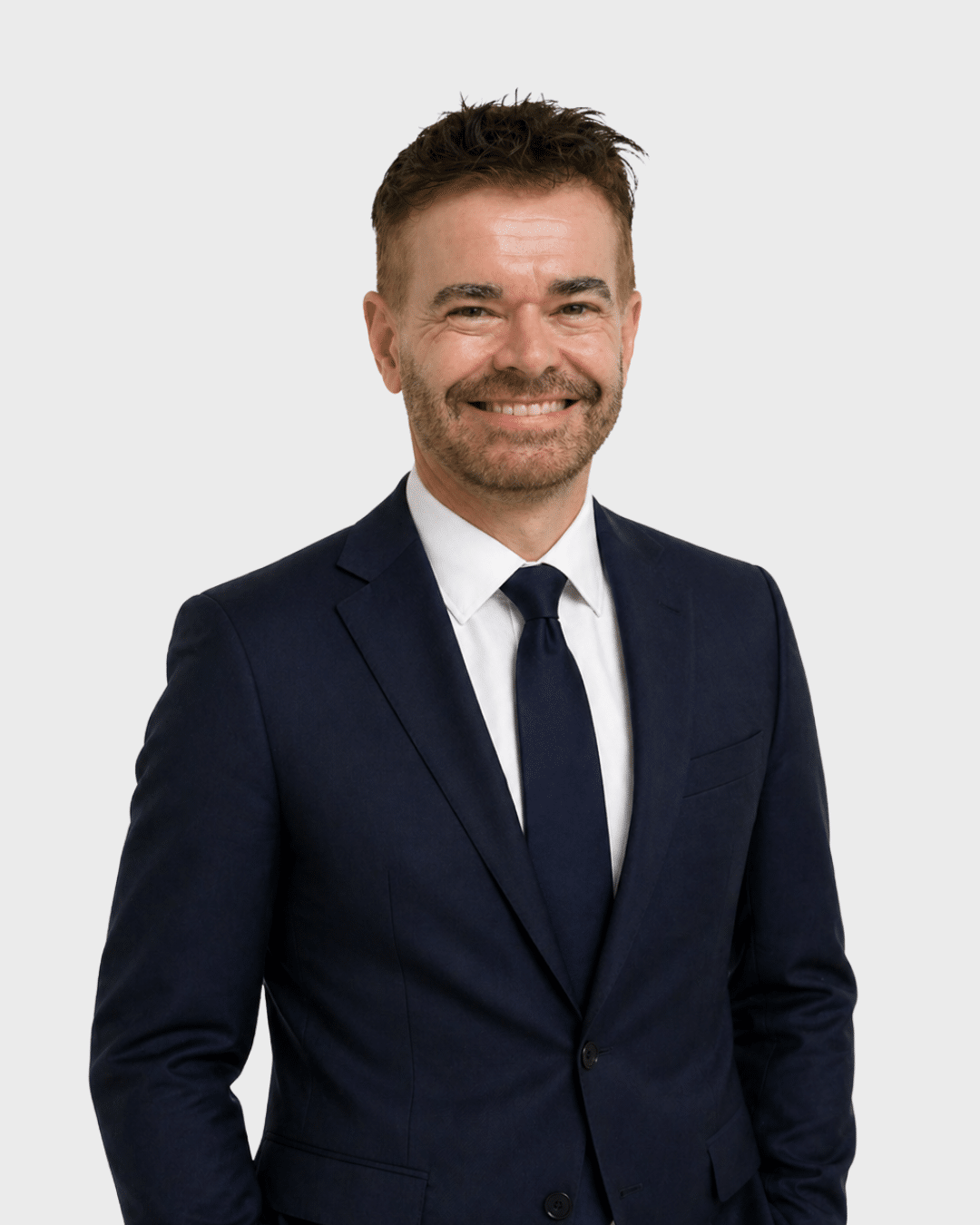
Dr Steven Smith, Specialist Orthodontist
Role: Specialist orthodontist
Qualifications: BDSc (Hons), University of Queensland; MDSc (Orthodontics), University of Queensland
Registration: Registered dentist with specialist registration in orthodontics, DEN0001382809
Specialist registration can be verified on the AHPRA register of practitioners at ahpra.gov.au. Orthodontics is one of the thirteen dental specialties recognised by the Dental Board of Australia, and the title "orthodontist" is protected — only a practitioner holding specialist registration in orthodontics may use it. Which Smile Solutions clinicians hold specialist registration is set out on the dentists and registered specialists page.
Background
Dr Steven Smith holds a Bachelor of Dental Science with honours and a Master of Dental Science in Orthodontics, both from the University of Queensland, and practises as a specialist orthodontist at Smile Solutions. The treatments he works with are described under orthodontics — principally braces and Invisalign.
The practice publishes limited biographical detail for this practitioner. What is verifiable independently is the qualification, the specialist registration category and the registration number, all of which appear on the AHPRA public register. The full clinician list is on the our team page.
What specialist registration in orthodontics actually is
This is the part of a practitioner page that is worth checking rather than trusting, and the Dental Board of Australia makes it checkable.
There are, in the Board's words, "13 dental specialties in Australia which are approved by the Australian Health Workforce Ministerial Council": dento-maxillofacial radiology, endodontics, forensic odontology, oral and maxillofacial surgery, oral medicine, oral and maxillofacial pathology, oral surgery, orthodontics, paediatric dentistry, periodontics, prosthodontics, public health dentistry (community dentistry) and special needs dentistry. Orthodontics is one of them. "Cosmetic dentist", "implantologist" and "aligner provider" are not.
Every applicant for specialist registration must hold a qualification in the specialty and must have "completed a minimum of two years general dental practice" — a requirement that "may be achieved by experience outside Australia, subject to assessment and approval by the Board" — as well as meeting all the requirements for general registration as a dentist. Specialist registration is therefore an addition to general registration, not a substitute for it.
And the register is public: "Ahpra publishes an online register of all dental practitioners that provides the profession and the public with up-to-date information about a dental practitioner's registration status", and that register "also includes details of the specialty or specialties for dentists who hold specialist registration". A search takes under a minute, shows the specialty, shows whether registration is current, and shows any conditions, undertakings or reprimands. It is the only authoritative answer to "is this person really an orthodontist?"
A detail worth knowing if a practitioner trained across the Tasman
The Dental Board and the Dental Council (New Zealand) "have 11 specialties in common". Two specialties are "recognised by the Board but not by the Council": dento-maxillofacial radiology and forensic odontology. A New Zealand-registered specialist holding a current annual practising certificate may seek Australian registration under the Trans-Tasman Mutual Recognition Act, and in that case "the Board may impose conditions on your Australian registration to ensure that you only do work equivalent to the work you perform under your New Zealand registration". Any such condition appears on the public register.
Orthodontist or dentist: the distinction that matters
Any registered dentist in Australia may legally provide orthodontic treatment. There is no restriction on a general dentist fitting braces or aligners. The difference is training and case selection:
| General dentist | Specialist orthodontist | |
|---|---|---|
| Training in tooth movement | Part of the undergraduate degree, plus any postgraduate courses taken | Three years of full-time postgraduate university training, after a dental degree and general practice experience |
| Typical case mix | Straightforward alignment, mild-to-moderate crowding and spacing | The full range, including growing children, skeletal discrepancies, impacted teeth and surgical cases |
| Protected title | No | Yes — requires specialist registration |
The honest position: a great many orthodontic cases are handled well by a general dentist who selects appropriately and refers when a case exceeds their competence. What a specialist adds is depth in diagnosis — recognising which problem is dental and which is skeletal, and knowing what to do when a case is not tracking to plan. Two articles set the comparison out at length: orthodontic treatment: general dentist vs specialist orthodontist? and specialist orthodontist vs general dentist: which is best for Invisalign?
The useful question is not "are you an orthodontist?" but "what will you do if this doesn't go to plan, and at what point would you refer?" Why would I need to see a dental specialist? covers the referral logic generally.
Whichever practitioner provides it, the Dental Board's scope of practice standard "requires dental practitioners to practise within the scope of their education, training, and competence at all times". That standard applies to every registrant, specialist or not, and it is what a referral is for.
The MDSc pathway
The Master of Dental Science in orthodontics is one of the Australian specialist programmes; others award a Doctor of Clinical Dentistry (DClinDent). The programmes are equivalent for registration purposes — both are three-year full-time university programmes accredited for specialist registration, and the difference in award title reflects the university, not the depth of training.
The sequence is:
- A dental degree.
- General practice experience — Australian programmes generally require at least two years before entry.
- Three years of full-time postgraduate specialist training, which is highly competitive to enter and includes a research component.
- Application to the Dental Board of Australia for specialist registration.
What orthodontic treatment can and cannot do
Can: align crowded or spaced teeth; correct crossbites, deep bites and open bites of dental origin; close or open space for missing or extra teeth; bring impacted teeth into position; correct rotations; prepare a bite for restorative or surgical work; influence jaw growth in a growing child within limits. What is malocclusion of the teeth? and treatment of malocclusion describe what is being corrected, and how do I know which orthodontic treatment is best for me? compares the appliances.
The Australian Dental Association describes the scope in similar terms — orthodontics treats "crooked or crowded teeth", "incorrect biting patterns", "severe misalignment of teeth and/or jaws" and "past habits such as thumb sucking that have affected the position of the tooth and development of the jaw bones" — and adds that "orthodontic treatment is not just about straight teeth. It can correct a bad biting pattern, help with sleep apnoea, and prevent uneven wear of the teeth."
Cannot:
- Move jaws in an adult. Appliances move teeth through bone. A genuine skeletal discrepancy in someone who has finished growing is corrected by orthognathic surgery, or camouflaged by tilting teeth within the existing jaws. Camouflage works for mild discrepancies and poorly for large ones. Any claim that an appliance will reshape an adult's face or jaw should be treated with scepticism. What is orthognathic surgery? sets out what the surgical route actually involves.
- Produce a permanent result without retention. Teeth drift throughout life — why do teeth shift? explains the mechanism. Retention is lifelong — fixed retainers, removable ones, or both, worn indefinitely. Relapse is not a treatment failure; it is what teeth do. Anyone not told this before starting has not been properly informed. See will my teeth need retainers after I've had braces?
- Cure temporomandibular disorders. The evidence linking bite discrepancies to jaw joint pain is weak, and orthodontics undertaken primarily to treat TMJ symptoms is not supported. TMD vs TMJ vs bruxism untangles the three terms.
- Fix gum disease or decay. Both must be under control before treatment starts, and routine dental care must continue throughout — appliances make cleaning harder, and decalcification around brackets leaves permanent white scars. What are the hygiene benefits of Invisalign? covers the one real advantage removable aligners have here.
Cleaning during treatment, and why aligners are not risk-free
Decalcification around brackets is the commonest avoidable harm in orthodontics, and the ADA's advice on avoiding it is specific. For fixed appliances: "For people wearing braces, brushing after every meal is recommended as food can get stuck around the brackets", and after brushing "spit out the excess toothpaste but do not rinse your mouth with water. This allows the fluoride paste to sit on the teeth for longer, increasing protection." String floss is difficult around brackets, and "interdental brushes can help to clean between the teeth as well as between the orthodontic brackets".
Clear aligners shift the risk rather than removing it. The ADA's position is that the trays "should be worn at all times other than when eating and drinking liquids other than water", and warns that "drinking liquids such as fruit juice or soft drink while wearing clear aligners can trap the liquids against the teeth, which can cause damage to the teeth if it happens frequently". It also notes plainly that "although the aligners are clear plastic, they are not invisible."
Risks and realities
- Root resorption — shortening of the roots — occurs to some degree in most cases. Usually clinically insignificant; occasionally not.
- Decalcification around brackets is caused by inadequate cleaning and does not disappear when the braces come off. The most common complaints associated with conventional braces lists what patients actually report.
- Treatment takes as long as it takes. Comprehensive treatment commonly runs 18 to 30 months — how long does it take to have orthodontic treatment? Accelerated-orthodontics techniques have limited supporting evidence.
- Extractions are sometimes necessary, and sometimes avoidable. Both are legitimate depending on the crowding, the profile and the growth pattern. A practitioner should be able to explain why the chosen plan suits your case.
- Direct-to-consumer aligners sold without an in-person examination and radiographs cannot detect gum disease, decay or root problems before moving teeth. Australian dental boards and professional bodies have repeatedly raised concerns about that model. How to protect your aligners and your smile covers supervised aligner wear.
The Australian Dental Association's position on that last point is not equivocal: "The Australian Dental Association (ADA) do not recommend Australians have DIY orthodontic treatment. There are many risks to this treatment. They can lead to permanent damage to your teeth, gums, and jaw joints. The ADA recommends that you have in-person treatment with a dentist or orthodontist which includes a thorough assessment before starting treatment and ongoing supervision."
When to have a child assessed
The Australian Society of Orthodontists suggests an assessment around age eight to ten. That is an assessment, not a commitment to treatment. Early interceptive treatment genuinely helps a limited set of problems — crossbites, severe crowding blocking eruption, impacted teeth, habits causing skeletal change. For most children, one course of treatment in the early teens is appropriate and two-phase treatment is unnecessary. See when should I take my child to see an orthodontist?, how long does my child need to wear braces?, and the practice's pages on children's braces and Invisalign and children's dentistry.
The ADA makes one useful clarification for parents: "You do not have to wait for all adult teeth to be in your child's mouth before having an orthodontic assessment."
Costs and consent
Orthodontic treatment is a substantial commitment. Before starting, expect:
- a written treatment plan with the total fee, the payment schedule, and what is included
- clarity on what happens if treatment runs long, and whether that costs more
- the cost of retainers, replacements, and ongoing review after treatment
- your health fund's orthodontic limits and waiting periods, which are usually separate from general dental
- an explanation of the alternatives, including doing nothing
What is the cost of braces? and Invisalign cost in Melbourne: a complete breakdown by treatment type set out what drives the fee, and understanding your treatment describes how a plan is explained before it starts.
Registration
The Dental Board of Australia registers dentists, dental specialists, dental hygienists, dental therapists, oral health therapists and dental prosthetists. Specialist registration appears on the public register alongside the specialty held, is renewed annually, and is subject to standards for recency of practice, continuing professional development, professional indemnity insurance, criminal history and English language skills.
Those standards each carry a published date of effect: specialist registration (1 July 2010), endorsement for conscious sedation (27 October 2015), continuing professional development (1 December 2015), recency of practice (1 December 2015), professional indemnity insurance arrangements (1 July 2016), the revised list of recognised specialties, titles and definitions (1 October 2017), scope of practice (1 July 2020), English language skills (18 March 2025) and criminal history (15 July 2026).
Common questions
I have been told that expanding my child's palate will fix their snoring or sleep apnoea. Is that right?
This is the one place on this page where two reputable sources point in different directions, and it is worth showing rather than smoothing over.
The Australian Dental Association's consumer page on teeth straightening says that orthodontic treatment ‘can correct a bad biting pattern, help with sleep apnoea, and prevent uneven wear of the teeth'. Against that, a 2026 systematic review update in the Journal of Clinical Medicine, looking specifically at rapid maxillary expansion for paediatric obstructive sleep apnoea, reports that its earlier review found ‘no convincing evidence to support rapid maxillary expansion (RME) as a treatment for pediatric obstructive sleep apnea', and that the update did not change that: three new randomised trials were identified, but ‘none of the new RCTs included a watchful waiting or supportive care control arm', leaving ‘a single RCT that found no significant difference in AHI change between RME and observation'. Its conclusion is that improvements seen in studies without an untreated comparator ‘cannot be distinguished from the known potential for spontaneous improvement in growing children', and that ‘extreme caution is warranted before recommending RME as a treatment for pediatric OSA'.
Two further points from that review matter for a parent making this decision: paediatric OSA ‘affects 1–4% of the pediatric population', and ‘polysomnography is considered the gold standard for diagnosing pediatric OSA'. So the first question is not which appliance, but whether the diagnosis has been made properly, by the people who diagnose it.
What that adds up to: if your child snores or has disturbed breathing in sleep, that belongs with a doctor and a sleep service first. Orthodontic treatment may be appropriate for the teeth and the bite on their own merits, and it may be part of a plan a medical team supports. It should not be sold to you as the treatment for the airway. See Snoring and Sleep Apnoea.
Can aligners do everything braces can, or is that just marketing?
The honest answer has a gap in the middle of it.
We checked the independent reference material behind this site — regulator publications, professional policy statements, systematic reviews and peer-reviewed studies — for clinical evidence comparing appliance types. There is one on-topic consumer document in it, from the Australian Dental Association, and no clinical orthodontic literature at all. So on ‘which appliance achieves more', this page cannot point you to independent evidence, and neither, in our experience of looking, can most of the pages that answer the question confidently.
What can be said is what the ADA says, and it is worth holding onto because it contradicts the advertising directly: ‘although the aligners are clear plastic, they are not invisible', and the trays ‘should be worn at all times other than when eating and drinking liquids other than water'. An appliance you can remove only works while it is in, which makes wear time the main variable that you control and the main reason aligner treatment falls behind schedule.
The questions that actually separate the options for your case: what specific movements does my plan require, and which appliance does those reliably; what happens at the point where the plan stops tracking; how many attachments or auxiliaries will be bonded to my teeth, since that affects how ‘invisible' the result looks in practice; and what the fee is if a refinement stage is needed. See Braces, Invisalign and Benefits of conventional braces vs lingual braces vs Invisalign.
What happens at the first appointment, and how many x-rays will be taken?
A first orthodontic appointment is an assessment: a history, an examination of the teeth, bite, jaw joints, gums and facial proportions, photographs, and usually a set of records — a digital scan or impressions, a panoramic radiograph and, depending on the case, a lateral view of the head used to measure the skeletal relationship.
Each of those images should be justified individually rather than taken as a set by default. The principle from the radiology literature is that ‘strict and individualized justification should determine the prescription of each radiograph', and that a justified radiograph ‘should make a substantial contribution to distinguishing between treatment options'. For scale, the International Atomic Energy Agency puts a panoramic examination at roughly 4–30 μSv of effective dose, an intraoral film at about 1–8 μSv, and a small or medium field-of-view CBCT at up to about 50 μSv — so a three-dimensional scan is a different order of exposure from a panoramic, and should be asked about specifically: what will it change?
If you already hold recent images, say so when you book and ask for them to be sent rather than repeated. And if you are collecting more than one opinion, ask for your records to be released to you — they belong in your hands, and a second practitioner working from the same records is giving you a genuine comparison rather than a fresh guess. See How safe are dental x-rays and Second Opinions and Corrective Dentistry.
Treatment runs for two years. What if I move, or the practitioner is unavailable part-way through?
Ask before you start, because orthodontics is the branch of dentistry where this is most likely to happen and most awkward to fix.
The things to settle in advance: what the fee covers if treatment is transferred part-way; what records will be released to a new practitioner, and how quickly; who holds the plan if your usual practitioner is away, and whether routine adjustments continue in the meantime; and what happens to the retainers and review appointments once the appliances come off, since that phase lasts far longer than the active treatment.
A transfer is not unusual and it is not a disaster, but it works only if the next practitioner receives the whole picture: the original records, the diagnosis, the plan, what has been done, what remains, and any deviations along the way. A new orthodontist inheriting a case half-way will reassess it and may propose a different route to the same result — which is not a criticism of the first plan so much as a consequence of joining it late.
The underlying obligation is the Dental Board's scope of practice standard, which ‘requires dental practitioners to practise within the scope of their education, training, and competence at all times'. Handing a case on, or declining to take one on mid-course without adequate records, is how that standard is met. And whatever else changes, the retention phase does not end — see will my teeth need retainers after I've had braces?
Related reading
- Benefits of conventional braces vs lingual braces vs Invisalign
- All your conventional braces questions answered
- Is having Invisalign as an adult worth it?
- What can I eat and drink following jaw surgery?
- Price guide — indicative fees, and what changes them
Practical details
Dr Smith's specialist registration can be verified on the AHPRA public register at ahpra.gov.au. Orthodontic consultation can be arranged by referral or directly. Call 13 13 96, or use the contact page.
Smile Solutions, Level 1, 220 Collins Street, Manchester Unity Building, Melbourne VIC 3000. Phone 13 13 96, or theteam@smilesolutions.com.au. Monday–Friday 8.00am–6.00pm, Saturday 8.30am–1.30pm, Sunday by appointment.
Sources for the externally verifiable statements on this page
- Dental Board of Australia — Specialist Registration, FAQ: Specialist registration and Registration Standards (the thirteen specialties, the two-year general practice requirement, the Ahpra public register, the Trans-Tasman arrangements, scope of practice, and the dates of effect).
- Australian Dental Association (teeth.org.au), Teeth straightening and braces — what orthodontics treats, cleaning with braces and aligners, and the ADA's position on DIY orthodontics.
- Fernández-Barriales M et al., Controlled Prospective Evidence of Rapid Maxillary Expansion Efficacy in Pediatric Obstructive Sleep Apnea: A Systematic Review Update, Journal of Clinical Medicine 2026;15(8):2976.
- PubMed Central, Radiation Exposure and Frequency of Dental, Bitewing and Occlusal Radiographs — justification of radiographs; International Atomic Energy Agency — dental effective dose ranges.
This page records qualifications as published by the practice. General information only — it is not a diagnosis, a treatment plan or a promise of any particular clinical outcome. Practitioner availability changes; confirm when booking.
Smile Solutions trades under ABN 28 193 514 103.
Images on This Page
-
https://www.facebook.com/tr?id=800557773428361&ev=PageView&noscript=1
(no alt text)
-
https://www.smilesolutions.com.au/wp-content/uploads/2025/10/calendar_month.svg
(no alt text)
-
https://www.smilesolutions.com.au/wp-content/themes/arcadian-wordpress-theme/assets/images/smile_solutions_logo_white.png
Smile Solutions Logo
-
https://www.smilesolutions.com.au/wp-content/themes/arcadian-wordpress-theme/assets/images/smile_solutions_logo_purple.png
Smile Solutions Logo
-
https://www.smilesolutions.com.au/wp-content/uploads/2026/04/Steven-Smith-2.png
Dr Steven Smith
-
https://www.smilesolutions.com.au/wp-content/themes/arcadian-wordpress-theme/assets/images/family_owned_bussiness.png
Family Owned Business
-
https://www.smilesolutions.com.au/wp-content/themes/arcadian-wordpress-theme/assets/icons/icon--phone.svg
Smile Solutions Contact
-
https://www.facebook.com/tr? id=800557773428361&ev=PageView&noscript=1
(no alt text)
-
https://bat.bing.com/action/0?ti=25148060&tm=gtm002&Ver=2&mid=9a9a896e-e8a7-4720-b26c-554b1b1b00b9&bo=1&sid=152b3030ab2911f18d4099be6442f511&vid=152b8fd0ab2911f1aaa38d69782bd6e6&vids=1&msclkid=N&pi=918639831&lg=en-US&sw=800&sh=600&sc=24&nwd=1&tl=Dr%20Steven%20Smith%20-%20Smile%20Solutions&p=https%3A%2F%2Fwww.smilesolutions.com.au%2Four-team%2Fdr-steven-smith%2F&r=<=1697&evt=pageLoad&sv=2&cdb=AQAQ&rn=726307
(no alt text)